
Qatar Building Information Modeling Market (2025-2030)

The Qatar Building Information Modeling Market was valued at $14.5 Million in 2025 and projected to reach to $18.6 Million by 2030, representing a compound annual growth rate of 5.1%. Qatar's Building Information Modeling market is positioned for steady growth as the nation continues investing in infrastructure modernization and smart city development.


| Market Size in | USD 26.32 MN |
| Market Forecast in | |
| CAGR | |
| Forecast Period | |
| Units Considered | Value (USD MN) |
Qatar Building Information Modeling Market Trends and Insights
- Other African Countries are experiencing gradual adoption of BIM technologies within the semiconductor and electronics sectors, driven by increasing infrastructure development and digital transformation initiatives.
- The market growth in Other African Countries reflects emerging demand for advanced construction and design methodologies, though adoption rates remain below global averages. Other African Countries face unique challenges in BIM implementation, including limited digital infrastructure and workforce training gaps.
- However, Other African Countries are witnessing growing investment in technology infrastructure and construction modernization.
- The forecast period through 2030 indicates steady expansion as Other African Countries continue to integrate BIM solutions into their industrial and commercial projects, supported by regional development programs and international partnerships..
Key Market Statistics
- CAGR (2025-2030) 5.1% CAGR
- Market Size, 2025 ~USD 14.5 Million
- Forecast, 2030 ~USD 18.6 Million
- Country Qatar
Qatar Building Information Modeling Market Overview
Market Size & Growth :
Qatar's Building Information Modeling market is valued at USD 14.5 million in 2025, with projected growth to USD 18.6 million by 2030, reflecting a steady CAGR of 5.1% driven by infrastructure modernization initiatives.
Infrastructure Development Driver :
Qatar's ambitious infrastructure projects, including World Cup legacy developments and smart city initiatives, are accelerating BIM adoption across the semiconductor and electronics construction sectors.
Technology Adoption Pace :
While Qatar's 5.1% CAGR lags the global 11.3% rate, the nation is gradually increasing BIM implementation in construction and facility management for high-tech manufacturing environments.
Sector Focus :
The semiconductor and electronics industry in Qatar is leveraging BIM technologies for precision facility design, operational efficiency, and compliance with international manufacturing standards.
Qatar Building Information Modeling Market Dynamics
- The semiconductor and electronics sector is increasingly recognizing BIM's value for optimizing facility design, reducing construction timelines, and enhancing operational efficiency.
- Government initiatives supporting digital transformation in construction and manufacturing are expected to drive gradual market expansion through 2030. While Qatar's growth rate remains below global benchmarks, the market presents significant opportunities for BIM solution providers targeting high-tech manufacturing facilities and large-scale infrastructure projects.
- Strategic partnerships with local construction firms and technology integrators will be essential for capturing market share in this emerging segment..
Market Ecosystem
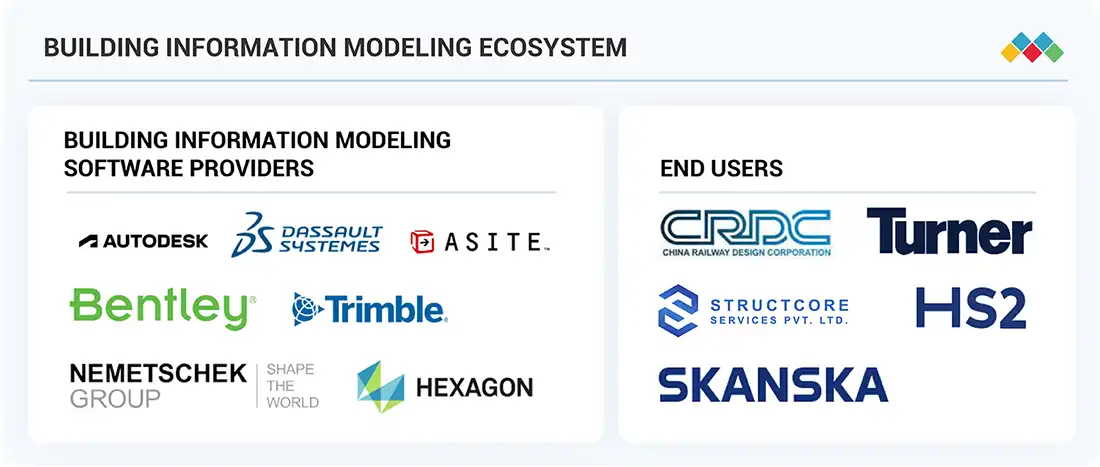
BUILDING INFORMATION MODELING MARKET SIZE, SHARE & GROWTH: COMMERCIAL USE CASES ACROSS INDUSTRIES
| COMPANY | USE CASE DESCRIPTION | BENEFITS |
|---|---|---|
 |
BIM software solutions (Revit, AutoCAD, and BIM 360) for architecture, engineering, and construction, enabling design, visualization, and project collaboration across all project phases | Streamlined design workflows, enhanced collaboration, improved project accuracy, and reduced errors across construction lifecycle |
 |
BIM-enabled construction and geospatial solutions, integrating site planning, surveying, and modular construction workflows | Increased field-to-office coordination, higher construction productivity, reduced rework, and better cost management |
 |
BIM tools (Allplan, Vectorworks) targeting architects, engineers, and planners for design, simulation, and project coordination | Improved design efficiency, better interdisciplinary collaboration, optimized resource allocation, and enhanced visualization capabilities |
 |
3DEXPERIENCE platform combining BIM with virtual twin, simulation, and lifecycle management for complex infrastructure projects | Enhanced project visualization, risk mitigation, lifecycle optimization, and support for sustainable and smart building initiatives |
 |
BIM and digital twin solutions for infrastructure projects, including civil engineering, utilities, and transportation | Better asset management, improved project monitoring, reduced operational costs, and accelerated delivery of large-scale infrastructure projects |
Logos and trademarks shown above are the property of their respective owners. Their use here is for informational and illustrative purposes only.
Related Ecosystem
Electronics System And Components
- Sensors
- Temperature Sensors
- Pressure Sensors
- Actuators
- Image Sensors
- Lenovo
- Samsung
- Texas Instruments Incorporated
- HONEYWELL INTERNATIONAL INC.
- Teledyne Technologies Incorporated
Industrial Automation
- Sensors
- Image Sensors
- Manufacturing Execution System (MES)
- Actuators
- Flow Sensors
- Siemens ag
- ABB India Limited
- Emerson Electric Co.
- HONEYWELL INTERNATIONAL INC.
- SCHNEIDER ELECTRIC SE
Key Takeaways
- Other African Countries' BIM market is valued at USD 14.5 million in 2025 with projected growth to USD 18.6 million by 2030.
- Other African Countries demonstrate a 5.1% CAGR, reflecting moderate but consistent market expansion in the semiconductor and electronics sector.
- Other African Countries face infrastructure and training challenges that currently limit BIM adoption compared to global markets.
- Other African Countries are positioned for accelerated growth through increased investment in digital infrastructure and construction modernization initiatives.
Building Information Modeling Market Report Scope
| Report Metric | Details |
|---|---|
| Base Year | 2025 |
| Fastest Growing Segment | FACILITY & ASSET MANAGEMENT SOFTWARE (Software Type) |
| Forecast Period | 2025–2030 |
| Growth Rate | CAGR of 11.3% from 2025 to 2030 |
| Largest Segment | AEC PROFESSIONALS (End User) |
| Market Size Base Year (Billions) | ~USD 9.03 (2025) |
| Revenue Forecast (Billions) | ~USD 15.42 (2030) |
| Segments Covered | Deployment Type, End User, Project Lifecycle, Offering Type, Vertical, Software Type, Service Type |
Qatar Building Information Modeling Market Report Segmentation
7 segment dimensions are covered across the global market.
By Deployment Type
- Cloud
- On-Premises
By End User
- Aec Professionals
- Consultants & Facility Managers
- Consultants And Facility Managers
- Other End Users
By Project Lifecycle
- Construction
- Operation
- Pre-Construction
By Offering Type
- Services
- Software
By Vertical
- Buildings
- Civil Infrastructure
- Industrial
- Oil & Gas
- Other Verticals
- Utilities
By Software Type
- Construction Simulation & Scheduling
- Cost Estimation & Quantity Takeoff
- Design & Modeling Software
- Facility & Asset Management Software
- Other Software Types
- Sustainability & Energy Analysis Software
By Service Type
- Consulting & Advisory Services
- Implementation & Integration Services
- Modeling & Documentation Services
- Other Services
- Software Support & Maintenance
- Training & Certification
Target Audience
- BIM Software Vendors : Evaluate Qatar's market opportunity for BIM solutions targeting semiconductor and electronics manufacturers, with specific growth forecasts and adoption timelines for product localization.
- Construction & Engineering Firms : Understand Qatar's infrastructure project pipeline and BIM adoption requirements to position service offerings and build competitive capabilities in high-tech facility design.
- Technology Consultants : Access market intelligence on Qatar's digital transformation initiatives and BIM implementation trends to advise clients on technology investments and strategic partnerships.
- Investment & Private Equity : Assess Qatar's BIM market growth potential and sector dynamics to identify acquisition targets, partnership opportunities, and portfolio company expansion strategies.
- Government & Policy Makers : Leverage market data to inform infrastructure development policies, digital construction standards, and technology adoption incentives aligned with Qatar's economic diversification goals.
Key Companies in the Qatar Building Information Modeling Market
| Company | HQ | Ownership | Strongest segments |
|---|---|---|---|
| SAMSUNG | Korea, South | Public Company | Smartphones, tablets, wearables, and accessories,TVs, audio, and digital signage,Home appliances and air solutions, |
| SNC-LAVALIN GROUP INC. | Canada | Public Company | Consultancy, Strategy, Advisory, Engineering & Design,Project & Program Management, Project Delivery,Nuclear Lifecycle Services, |
| PARSONS | United States | Public Company | Federal Solutions – Cyber, EW, Space, and Intelligence,Federal Solutions – C2, Missile Defense, and Mission Support,Critical Infrastructure – Transportation and Urban Solutions, |
| AUTODESK INC. | United States | Public Company | Architecture, Engineering & Construction (AutoCAD, Revit, Civil 3D, Autodesk Build, BIM Collaborate Pro, BuildingConnected, Tandem),Manufacturing & Product Design (Fusion, Inventor, Product Design & Manufacturing Collection, Vault),Media & Entertainment (Maya, 3ds Max, Media & Entertainment Collection, Flow Production Tracking), |
| NEMETSCHEK GROUP | Germany | Public Company | Design (Allplan, Graphisoft, dRofus),Build (Bluebeam, Nevaris and related 5D/ERP),Manage (Spacewell, Crem Solutions), |
| BENTLEY SYSTEMS, INCORPORATED | United States | Public Company | Open Modeling Applications (MicroStation, OpenRoads, OpenBuildings, etc.),Open Simulation & Geoprofessional Applications (STAAD, PLAXIS, Leapfrog, etc.),Infrastructure Cloud Applications (ProjectWise, SYNCHRO, AssetWise), |
| TRIMBLE INC. | United States | Public Company | Construction and owner software plus field and office construction solutions,Machine control, asset monitoring, and field hardware systems,Positioning and correction services (VRSNow, RTX, xFill and related), |
| DASSAULT SYSTèMES | France | Public Company | CAD/3D Modeling (CATIA, SOLIDWORKS, GEOVIA, BIOVIA, 3DVIA),PLM & Collaboration (ENOVIA, CENTRIC PLM, 3DEXCITE, 3DEXPERIENCE collaboration),Simulation & Manufacturing (SIMULIA, DELMIA), |
| SCHNEIDER ELECTRIC | France | Public Company | Low- and medium-voltage products and systems,Building management, power metering, and HVAC/cooling systems,Renewables, microgrids, and demand response solutions, |
| ASITE | United Kingdom | Private Company | Core document & project management (CDE),Collaborative BIM,Sourcing & procurement, |
| HEXAGON AB | Sweden | Public Company | Manufacturing Intelligence (metrology, CAD/CAM, CAE, QA software),Geosystems (survey, mapping, laser scanning, AEC),Autonomous Solutions and Positioning (GNSS, anti-jam, machine control, mining), |
| PROCORE TECHNOLOGIES, INC. | United States | Public Company | Project Execution,Financial Management,Preconstruction, |
| AFRY AB | Sweden | Public Company | Energy engineering and consulting,Industry and processing solutions,Transportation & Places and buildings, |
SAMSUNG
Samsung is a South Korean public company founded in 1969 with 128,735 employees. It operates as a diversified conglomerate with major divisions in electronics, semiconductors, and consumer goods.
SNC-LAVALIN GROUP INC.
SNC-Lavalin Group Inc. is a Canadian public company founded in 1911 with 40,246 employees. The company provides engineering, procurement, and construction services across multiple industries.
PARSONS
Parsons is a United States-based public company founded in 1944 with 21,000 employees. It provides engineering, construction, and technical services to government and commercial clients.
AUTODESK INC.
Autodesk Inc. is a United States-based public company founded in 1982 with 14,300 employees. It develops design and engineering software for architecture, construction, and manufacturing industries.
NEMETSCHEK GROUP
Nemetschek Group is a German public company founded in 1963 with 4,089 employees. The company provides software solutions for the architecture, engineering, and construction sectors.
BENTLEY SYSTEMS, INCORPORATED
Bentley Systems, Incorporated is a United States-based public company founded in 1984 with 5,800 employees. It develops infrastructure engineering software for design, construction, and operations.
TRIMBLE INC.
Trimble Inc. is a United States-based public company founded in 1978 with 11,500 employees. The company provides positioning, modeling, and analytics software for construction and geospatial industries.
DASSAULT SYSTèMES
Dassault Systèmes is a French public company founded in 1981 with 25,724 employees. It develops 3D design, simulation, and lifecycle management software for various industries.
SCHNEIDER ELECTRIC
Schneider Electric is a French public company founded in 1836 with 158,122 employees. The company provides energy management and automation solutions for industrial and commercial applications.
ASITE
Asite is a United Kingdom-based private company founded in 1986 with 74 employees. The company provides cloud-based collaboration and project management solutions for the construction industry.
HEXAGON AB
Hexagon AB is a Swedish public company founded in 1975 with 16,118 employees. It provides digital solutions and sensor technologies for industrial, construction, and geospatial applications.
PROCORE TECHNOLOGIES, INC.
Procore Technologies, Inc. is a United States-based public company founded in 2002 with 4,421 employees. The company develops cloud-based project management software for the construction industry.
AFRY AB
Afry AB is a Swedish public company founded in 1895 with 17,301 employees. The company provides engineering, design, and consulting services across infrastructure and industrial sectors.
Reasons to Buy this Report
- Market-Specific Sizing : Access precise market valuation data for Qatar's BIM sector with verified 2025-2030 forecasts, enabling accurate budget allocation and ROI projections for regional expansion strategies.
- Competitive Intelligence : Understand Qatar's unique market dynamics, growth drivers, and adoption barriers compared to global trends, identifying competitive advantages and market entry opportunities.
- Sector-Focused Insights : Gain detailed analysis of BIM applications within Qatar's semiconductor and electronics industries, including facility design requirements and technology integration priorities.
- Investment Decision Support : Leverage country-specific growth projections and infrastructure development timelines to make informed investment decisions and partnership evaluations in Qatar's construction technology sector.
- Stakeholder Alignment : Present data-driven market evidence to internal teams and investors regarding Qatar's BIM market potential, supporting business case development for regional initiatives.
Frequently asked questions
What is the current market size of BIM in Other African Countries?
The Building Information Modeling market in Other African Countries is estimated at USD 14.5 million in 2025.
What is the projected market size for BIM in Other African Countries by 2030?
Other African Countries' BIM market is forecast to reach USD 18.6 million by 2030.
What is the CAGR for the BIM market in Other African Countries?
Other African Countries' BIM market is expected to grow at a compound annual growth rate of 5.1% from 2025 to 2030.
What are the main challenges for BIM adoption in Other African Countries?
Other African Countries face challenges including limited digital infrastructure, workforce training gaps, and lower technology adoption rates compared to developed markets.
What factors are driving BIM market growth in Other African Countries?
Growth in Other African Countries is driven by infrastructure development, digital transformation initiatives, increased investment in technology, and modernization of construction practices.
RESEARCH METHODOLOGY
The study involved major activities in estimating the current market size for the building information modeling market. Exhaustive secondary research was done to collect information on the building information modeling industry. The next step was to validate these findings, assumptions, and sizing with industry experts across the value chain using primary research. Different approaches, such as top-down and bottom-up, were employed to estimate the total market size. After that, the market breakdown and data triangulation procedures were used to estimate the market size of the segments and subsegments of the building information modeling market.
Secondary Research
The secondary research for this study involved gathering information from a wide range of credible sources. These included company annual reports, investor presentations, press releases, whitepapers, certified publications, and articles from reputable associations and government publications. Additional data was obtained from corporate filings, professional and trade associations, journals, and industry-recognized authors. Research from consortia, councils, and gold- and silver-standard websites, directories, and databases also contributed to the qualitative framework. Key global sources such as the International Trade Centre (ITC) and the International Monetary Fund (IMF) were consulted to support and validate the market analysis.
Primary Research
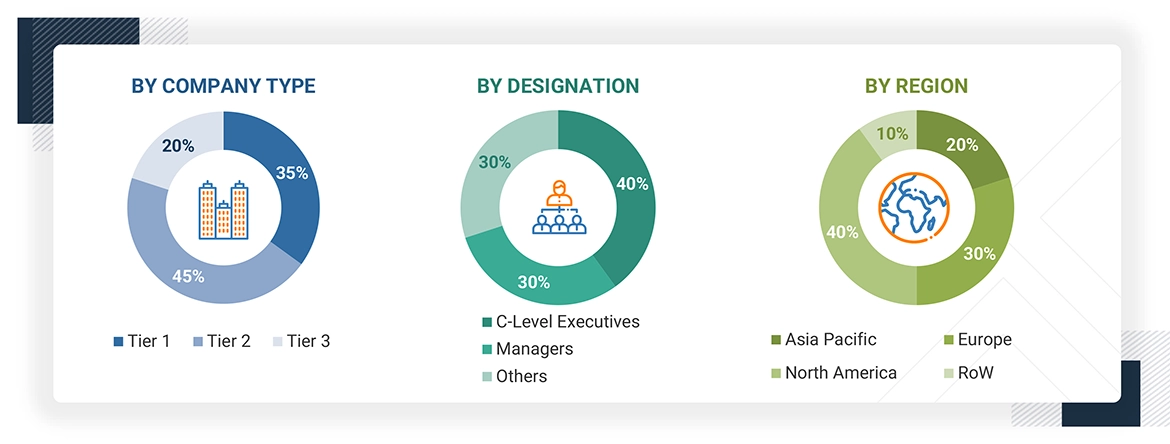
Extensive primary research was conducted after understanding and analyzing the building information modeling market scenario through secondary research. Several primary interviews were conducted with key opinion leaders from demand- and supply-side vendors across four major regions—North America, Europe, Asia Pacific, and RoW. Approximately 20% of the primary interviews were conducted with the demand side and 80% with the supply side. Primary data was collected through questionnaires, e-mails, and telephonic interviews. Various departments within organizations, such as sales, operations, and administration, were contacted to provide a holistic viewpoint in the report.
To know about the assumptions considered for the study, download the pdf brochure
Market Size Estimation
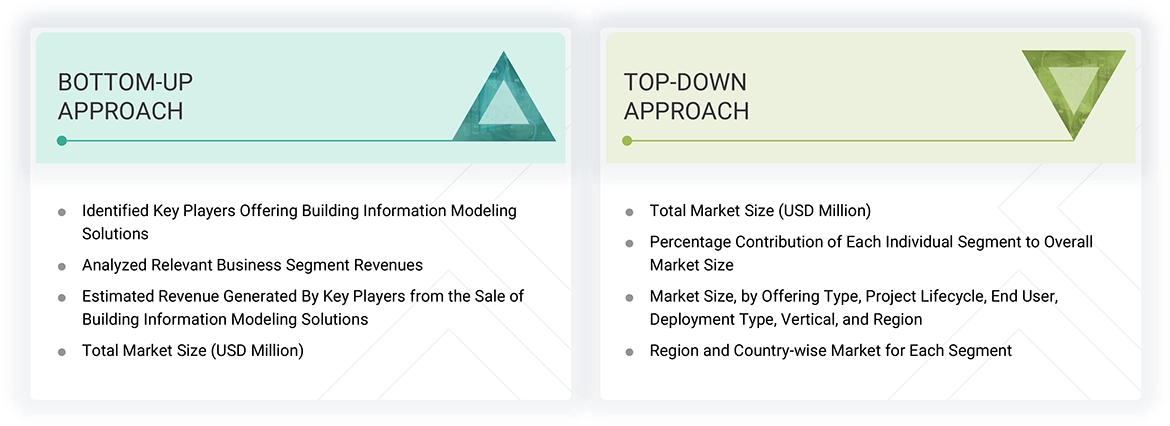
Both top-down and bottom-up approaches were used to estimate and validate the total size of the building information modeling market. These methods were also used extensively to estimate the size of various subsegments in the market. The research methodology used to estimate the market size includes the following:
Building Information Modeling Market : Top-Down and Bottom-Up Approach
Data Triangulation
After arriving at the overall size of the building information modeling market through the process explained above, the overall market has been split into several segments. Data triangulation procedures have been employed to complete the overall market engineering process and arrive at the exact statistics for all the segments, wherever applicable. The data has been triangulated by studying various factors and trends from the demand and supply sides. The market has also been validated using top-down and bottom-up approaches.
Market Definition
Building information modeling (BIM) is a digital process that involves creating and managing intelligent 3D models to support the planning, design, construction, and operation of buildings and infrastructure. It integrates data-rich models with real-time collaboration, allowing AEC (architecture, engineering, and construction) professionals to make more informed decisions throughout the project lifecycle, enhancing efficiency, reducing rework, and improving cost and time outcomes.
Key Stakeholders
- Raw material suppliers
- Original equipment manufacturers (OEMs)
- Original design manufacturers (ODM)
- Research institutes
- Building information modeling solution providers
- Forums, alliances, and associations
- Governments and financial institutions
- Analysts and strategic business planners
- AEC Professionals
- Distributors
- End users
Report Objectives
- To describe and forecast the size of the building information modeling (BIM) market, in terms of offering type, deployment type, project lifecycle, vertical, and end user, in terms of value
- To describe and forecast the market size of various segments across four key regions—North America, Europe, Asia Pacific, and Rest of the World (RoW), in terms of value
- To provide detailed information regarding the drivers, restraints, opportunities, and challenges influencing the growth of the building information modeling market
- To provide an overview of the value chain pertaining to the building information modeling ecosystem and the average subscription prices of building information modeling solutions
- To provide a detailed overview of the impact of AI/Gen AI and the impact of the US 2025 tariff on the building information modeling market
- To provide information about the key technological trends, trade analysis, and patents related to the building information modeling market
- To benchmark the market players using the proprietary company evaluation matrix framework, which analyzes them on various parameters within the broad categories of market ranking/share and product portfolio
- To analyze competitive developments, such as partnerships, acquisitions, agreements, collaborations, and product launches
- To strategically profile key players and analyze their market share, ranking, and core competencies
Available customizations:
With the market data given, MarketsandMarkets offers customizations according to the company’s specific needs. The following customization options are available for the report:
Company Information
- Detailed analysis and profiling of additional market players (up to 7)
Get the Full Building Information Modeling Market Report
Full forecast, segment splits, and company analysis for all Building Information Modeling Market.
- US Building Information Modeling Market
- Canada Building Information Modeling Market
- Mexico Building Information Modeling Market
- UK Building Information Modeling Market
- Germany Building Information Modeling Market
- France Building Information Modeling Market
- Italy Building Information Modeling Market
- Spain Building Information Modeling Market
- Poland Building Information Modeling Market
- China Building Information Modeling Market
- Japan Building Information Modeling Market
- India Building Information Modeling Market
- South Korea Building Information Modeling Market
- Australia Building Information Modeling Market
- Indonesia Building Information Modeling Market
- Malaysia Building Information Modeling Market
- Thailand Building Information Modeling Market
- Vietnam Building Information Modeling Market
- Nordics Building Information Modeling Market
- Rest Of Europe Building Information Modeling Market
- Rest Of Asia Pacific Building Information Modeling Market
- Bahrain Building Information Modeling Market
- Kuwait Building Information Modeling Market
- Oman Building Information Modeling Market
- Rest Of Middle East Building Information Modeling Market
- North America Building Information Modeling Market
- Europe Building Information Modeling Market
- Asia Pacific Building Information Modeling Market
- Rest of World Building Information Modeling Market
- Software Building Information Modeling Market
- Services Building Information Modeling Market
- Middle East Building Information Modeling Market
Need a Tailored Report?
Customize this report to your needs
Get 10% FREE Customization
Customize This Report
