
China Bus Duct Market (2024-2029)

The China Bus Duct Market was valued at $2280.8 Million in 2024 and projected to reach to $3095.7 Million by 2029, representing a compound annual growth rate of CAGR 6.3%. China's bus duct market is positioned for sustained growth, expanding from USD 2,280.8 million in 2024 to USD 3,095.7 million by 2029, representing a robust 6.3% CAGR.


| Market Size in | USD 26.32 MN |
| Market Forecast in | |
| CAGR | |
| Forecast Period | |
| Units Considered | Value (USD MN) |
China Bus Duct Market Trends and Insights
- China's rapid industrialization and infrastructure development are driving demand for efficient power distribution solutions across manufacturing, data centers, and commercial facilities.
- The market in China is benefiting from increased investments in renewable energy integration and smart grid modernization initiatives throughout the forecast period. China's bus duct sector is characterized by strong domestic manufacturing capabilities and competitive pricing advantages.
- China continues to lead in adopting advanced electrical distribution technologies to support its expanding industrial base and urbanization efforts.
- The growth trajectory in China reflects the country's commitment to energy efficiency standards and the modernization of electrical infrastructure across both urban and industrial sectors from 2024 through 2029..
Key Market Statistics
- CAGR (2024-2029) CAGR 6.3%
- Market Size, 2024 ~USD 2280.8 Million
- Forecast, 2029 ~USD 3095.7 Million
- Country China
China Bus Duct Market Overview
Rapid Industrialization :
China's accelerating industrial expansion and manufacturing sector growth are driving substantial demand for advanced bus duct systems to support efficient power distribution across factories and production facilities.
Data Center Boom :
The explosive growth of data centers in China, fueled by cloud computing and AI infrastructure investments, is creating significant opportunities for high-capacity bus duct solutions in server facilities nationwide.
Infrastructure Investment :
Government-backed infrastructure development projects and smart city initiatives across China are accelerating adoption of modern electrical distribution systems, including bus ducts in commercial and residential complexes.
Energy Efficiency Focus :
China's commitment to energy efficiency standards and sustainable power solutions is pushing enterprises to upgrade to bus duct systems that reduce transmission losses and operational costs.
China Bus Duct Market Dynamics
- This outpaces the global growth rate of 5.2%, reflecting China's unique advantages in manufacturing scale, infrastructure investment, and industrial modernization.
- The market is driven by increasing electrification demands across diverse sectors including automotive, electronics, and renewable energy facilities. Looking ahead, China's bus duct market will benefit from ongoing urbanization, the proliferation of data centers supporting digital transformation, and stringent energy efficiency regulations.
- Strategic investments in smart grid infrastructure and industrial automation will further accelerate adoption.
- Market players should focus on innovation in compact designs, enhanced thermal management, and integration with IoT-enabled monitoring systems to capture growing opportunities in this dynamic market..
Market Ecosystem
BUS DUCT MARKET: COMMERCIAL USE CASES ACROSS INDUSTRIES
| COMPANY | USE CASE DESCRIPTION | BENEFITS |
|---|---|---|
 |
ABB supplied busway connections to interconnect four indoor power skids at a hyperscale data center, integrating switchboards, UPS modules, automatic transfer switches, and battery cabinets to support modular power distribution. | Enabled the integration of prefabricated power skids and their electrical equipment, supporting modular installation and scalable power distribution for data center operations |
 |
AP Sensing and STS Group retrofitted continuous fiber-optic temperature monitoring onto an existing 2,000 A Schneider Electric busway system at a major US-based cloud computing provider's data center in Frankfurt, Germany, to detect potential overheating across connections between switch rooms and the data hall. | Enabled 24/7 temperature monitoring, hotspot localization to within approximately one meter, and automatic alarms to the facility monitoring system. This improved early fault detection and supported proactive maintenance without relying solely on periodic thermal inspections |
Logos and trademarks shown above are the property of their respective owners. Their use here is for informational and illustrative purposes only.
Related Ecosystem
Power Infrastructure
- Geographical Information System (GIS)
- Cogeneration
- Battery Electric Vehicle (BEV)
- Cellular Network
- Fuel Cell
- Siemens ag
- ABB India Limited
- SCHNEIDER ELECTRIC SE
- General Electric Company
- Eaton Corporation plc
Key Takeaways
- China's bus duct market is valued at USD 2,280.8 million in 2024 with a projected CAGR of 6.3% through 2029.
- China's industrial expansion and data center growth are primary drivers of bus duct demand across the forecast period.
- China's manufacturing sector benefits from cost-competitive domestic production and advanced electrical infrastructure investments.
- China's renewable energy integration and smart grid modernization initiatives are accelerating bus duct adoption by 2029.
Bus Duct Market Report Scope
| Report Metric | Details |
|---|---|
| Base Year | 2024 |
| Fastest Growing Segment | DATA CENTERS (End User) |
| Forecast Period | 2024–2029 |
| Growth Rate | CAGR of 5.2% from 2024 to 2029 |
| Largest Segment | COPPER (Material) |
| Market Size Base Year (Billions) | ~USD 12.88 (2024) |
| Revenue Forecast (Billions) | ~USD 16.6 (2029) |
| Segments Covered | Voltage, Material, Type, End User |
China Bus Duct Market Report Segmentation
4 segment dimensions are covered across the global market.
By Voltage
- High
- High (Above 35 Kv)
- Low
- Low (Up To 1 Kv)
- Medium
- Medium (1–35 Kv)
- Medium (1-35 Kv)
By Material
- Aluminum
- Copper
By Type
- Isolated
- Isolated Bus Ducts
- Non-Segregated
- Non-Segregated Bus Ducts
- Segregated
- Segregated Bus Ducts
By End User
- Commercial
- Data Centers
- Industrial
- Other End Users
- Renewables
- Utilities
Target Audience
- Manufacturing & Industrial Enterprises : Chinese manufacturers need detailed market insights to evaluate bus duct adoption for facility upgrades, production line electrification, and compliance with energy efficiency mandates.
- Data Center Operators : Data center developers and operators require market intelligence on bus duct solutions to support rapid infrastructure expansion and ensure reliable power distribution for mission-critical facilities.
- Electrical Equipment Suppliers : Bus duct manufacturers and distributors need China-specific market data to assess growth potential, identify customer segments, and develop localized product strategies.
- Infrastructure & Construction Companies : Construction firms and infrastructure developers require market insights to specify appropriate electrical distribution systems in commercial complexes, smart buildings, and industrial parks.
- Investment & Consulting Firms : Private equity, venture capital, and management consultants need validated China market data to support investment theses, due diligence, and strategic recommendations for energy sector clients.
Key Companies in the China Bus Duct Market
| Company | HQ | Ownership | Strongest segments |
|---|---|---|---|
| ABB | Switzerland | Public Company | Electrification,Motion,Automation, |
| SCHNEIDER ELECTRIC | France | Public Company | Low- and Medium-Voltage Electrical Products and Systems,Building Management, Power Metering, and Smart Controls,Industrial Automation, Drives, and Digital Energy Software, |
| SIEMENS | Germany | Public Company | Digital Industries (automation, PLM, simulation),Smart Infrastructure (electrification, buildings, grid),Mobility (rail, automation, services), |
| EATON | Ireland | Public Company | Electrical distribution, protection, and assemblies,Power quality, reliability, and connectivity,Residential and wiring devices, |
| LEGRAND | France | Public Company | Wiring devices and installation accessories,Energy distribution, protection, and management,Building control, connected home, and guestroom solutions, |
| GENERAL ELECTRIC COMPANY | United States | Public Company | Commercial Engines & Services,Defense & Propulsion Technologies,Additive, Components, and Other Systems, |
| VERTIV GROUP CORP. | United States | Private Company | Liquid and advanced thermal management integrated with racks/enclosures,Power distribution and backup tied to immersion deployments,Monitoring, control, and IT management platforms, |
| LS CABLE & SYSTEM LTD. | South Korea | Private Company | Energy cables (extra-high voltage, submarine, overhead, distribution, bus ducts),Telecommunication cables (optical, structured cabling, RF feeder),Industrial cables and harnesses (specialty, devices, automotive, modules, tubes), |
| POWELL INDUSTRIES | United States | Public Company | Integrated power control room substations, electrical houses, and custom-engineered modules,Traditional and arc-resistant distribution switchgear and control gear,Monitoring and control communications systems, motor control centers, switches, and bus duct systems, |
| NISSIN ELECTRIC CO., LTD. | Japan | Private Company | Power Supply and Environment System,Beam and Plasma,Equipment and Parts Solution, |
ABB
ABB is a Swiss multinational public company founded in 1883 with 111,900 employees. The company operates in electrification, industrial automation, and robotics sectors.
SCHNEIDER ELECTRIC
Schneider Electric is a French multinational public company established in 1836 with 158,122 employees. It specializes in energy management and industrial automation solutions.
SIEMENS
Siemens is a German multinational public company founded in 1847 with 310,312 employees. The company operates across electrification, automation, and digitalization sectors.
EATON
Eaton is a public company incorporated in Ireland, founded in 1911 with 97,303 employees. It provides electrical, hydraulic, and mechanical power management solutions.
LEGRAND
Legrand is a French multinational public company established in 1865 with 35,410 employees. The company specializes in electrical and digital building infrastructure.
GENERAL ELECTRIC COMPANY
General Electric Company is a United States-based public company founded in 1892 with 57,000 employees. It operates across power, renewable energy, aviation, and healthcare sectors.
VERTIV GROUP CORP.
Vertiv Group Corp. is a United States-based private company founded in 1965 with 19,000 employees. The company provides critical infrastructure and continuity solutions.
LS CABLE & SYSTEM LTD.
LS Cable & System Ltd. is a South Korean private company established in 1962 with 2,002 employees. It manufactures cables and related electrical systems.
POWELL INDUSTRIES
Powell Industries is a United States-based public company founded in 1947 with 3,143 employees. The company manufactures electrical equipment and systems.
NISSIN ELECTRIC CO., LTD.
Nissin Electric Co., Ltd. is a Japanese private company founded in 1910 with 5,382 employees. The company manufactures electrical equipment and systems.
Reasons to Buy this Report
- Market Size & Growth Validation : Confirm China's bus duct market valuation at USD 2,280.8M (2024) and 6.3% CAGR through 2029, enabling accurate financial forecasting and investment decision-making for regional expansion strategies.
- Competitive Landscape Intelligence : Gain insights into China-specific market dynamics, key players, and competitive positioning to identify partnership opportunities and market entry strategies tailored to local conditions.
- Sector-Specific Demand Analysis : Understand demand drivers across China's manufacturing, data center, and commercial sectors to align product development and marketing efforts with high-growth customer segments.
- Regulatory & Policy Insights : Access China-specific regulatory requirements, energy efficiency standards, and government infrastructure initiatives that influence bus duct specifications and market opportunities.
- Strategic Growth Planning : Leverage detailed China market forecasts to prioritize resource allocation, identify emerging opportunities in smart cities and industrial automation, and optimize go-to-market strategies.
Frequently asked questions
What is the current size of China's bus duct market?
China's bus duct market was valued at USD 2,280.8 million in 2024 and is expected to grow at a CAGR of 6.3% through 2029.
What is the projected market size for China's bus duct market by 2029?
China's bus duct market is forecasted to reach USD 3,095.7 million by 2029, representing significant growth from the 2024 baseline.
What factors are driving growth in China's bus duct market?
China's bus duct market growth is driven by industrial expansion, data center proliferation, renewable energy integration, and smart grid modernization initiatives.
How does China's bus duct market compare to other regions?
China's bus duct market CAGR of 6.3% exceeds the global average of 5.2%, reflecting stronger regional demand and infrastructure investment.
What applications dominate China's bus duct market?
China's bus duct market is primarily driven by manufacturing facilities, data centers, commercial buildings, and renewable energy infrastructure applications.
RESEARCH METHODOLOGY
The research process for this technical, market-oriented, and commercial study of the bus duct market involved systematic collection, validation, and analysis of information related to electrical power distribution infrastructure, including product types, current ratings, voltage levels, conductor materials, end users, and regional developments. Extensive secondary research was conducted using annual reports, investor presentations, technical papers, industry publications, company websites, product catalogs, and financial reports to identify key market participants, product innovations, technology trends, market developments, and competitive strategies. The findings were further validated through primary interviews with executives from bus duct manufacturers, electrical component suppliers, EPC companies, distributors, and industry experts to assess market estimates, product adoption, pricing trends, customer requirements, and competitive positioning. Key market players and their competitive positions were established through a combination of secondary research and primary research involving senior executives, business development managers, product specialists, procurement professionals, and technical experts across the electrical distribution ecosystem.
Secondary Research
In the secondary research process, various sources were reviewed to identify and collect information relevant to the bus duct market. Secondary sources included annual reports, investor presentations, press releases, company websites, technical documents, product catalogs, and industry publications. Information from organizations such as the International Energy Agency (IEA), government energy departments, and electrical safety and standards bodies was examined to understand electricity infrastructure investments, data center expansion, industrial electrification, and power distribution developments. Secondary research focused on market size, key participants, product portfolios, current ratings, voltage specifications, conductor materials, manufacturing capabilities, pricing trends, end-user demand, and regional market developments.
Primary Research
During the primary research phase, bus duct manufacturers, electrical component suppliers, distributors, EPC contractors, procurement specialists, and industry experts were considered for qualitative and quantitative insights into the global bus duct market. Interviews were used to validate market estimates, product adoption, pricing trends, regional demand, competitive positioning, customer requirements, and technological developments. Primary research also helped assess demand across different current ratings, voltage levels, conductor materials, product types, and end users, including data centers, commercial buildings, industrial facilities, utilities, and renewable energy plants. Findings were cross-validated against company disclosures, product specifications, industry statistics, and technical documentation to refine market estimates, segment shares, regional forecasts, and competitive assessments.
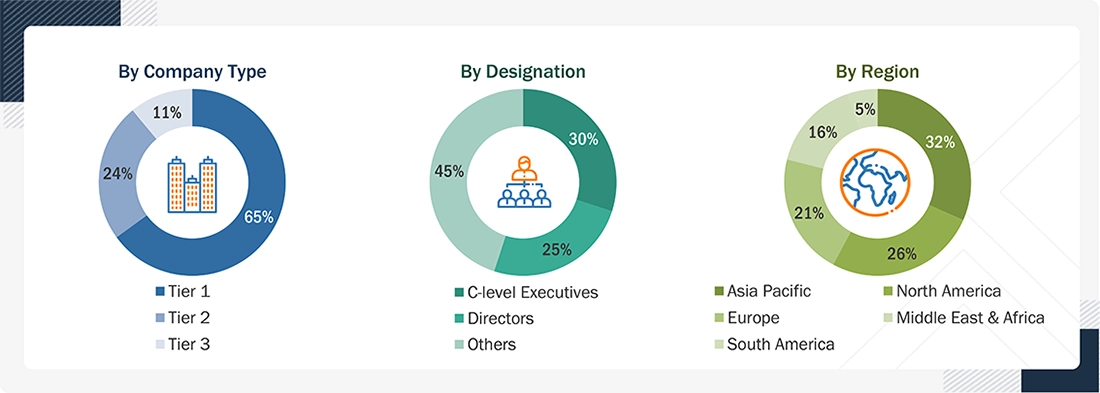
Note: Other designations include sales managers, engineers, and regional managers.
Tier 1 Company Revenue: >USD 5 billion, Tier 2 Company Revenue: between USD 1 and USD 5 billion, and Tier 3 Company Revenue: <USD 1 billion.
To know about the assumptions considered for the study, download the pdf brochure
Market Size Estimation
Both top-down and bottom-up approaches were used to estimate and validate the bus duct market and its dependent submarkets. Key market players were identified through secondary research, with their market shares assessed using primary and secondary sources. The research methodology includes reviewing annual reports, financial disclosures, product portfolios, and interviews with industry experts, including OEM executives, distributors, EPC contractors, and procurement managers, to obtain quantitative and qualitative insights into the global bus duct market.
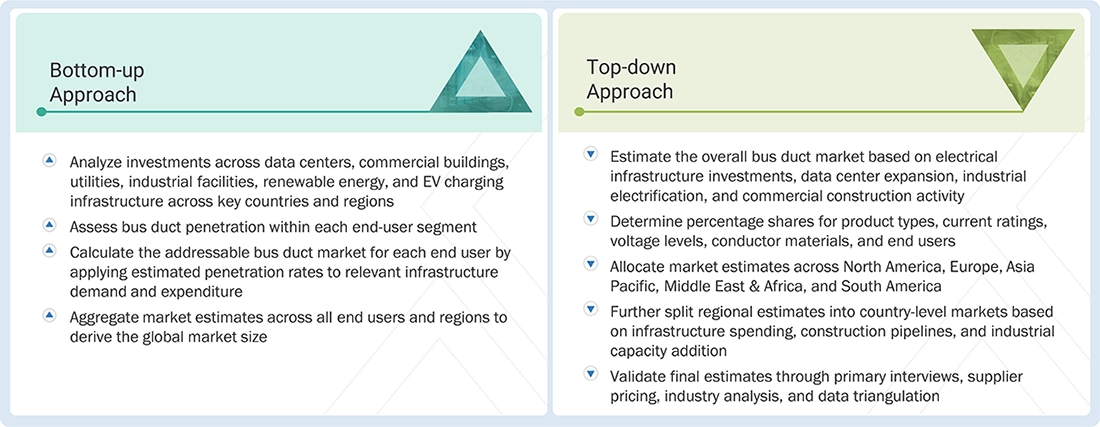
Bottom-up Approach
- Analyze investments and infrastructure developments across key end-user segments, including data centers, commercial buildings, utilities, industrial facilities, renewable energy plants, and EV charging infrastructure, across major countries and regions.
- Estimate bus duct penetration within each end-user segment based on electrical infrastructure requirements, application suitability, project specifications, and industry adoption trends.
- Calculate the addressable bus duct market for each end-user segment by applying estimated penetration rates to relevant infrastructure demand and expenditure.
- Aggregate the estimated market sizes across all end-user segments and regions to derive the global bus duct market size.
- Segment the market by type, current rating, voltage, conductor material, end user, and region, considering product specifications, installation requirements, and regional demand patterns.
- Validate market estimates using OEM pricing, supplier data, project-level cost benchmarks, and primary research to ensure consistency and avoid double counting.
Top-down Approach
- Estimate the overall global bus duct market size based on electrical infrastructure investments, construction activity, industrial electrification, data center expansion, and power distribution infrastructure development
- Determine the percentage share of each market segment, including conductor material, voltage, current rating, product type, and end user, based on industry adoption patterns, product portfolios, supplier data, and primary research
- Allocate the global market size across the five regions: North America, Europe, Asia Pacific, Middle East & Africa, and South America, based on regional infrastructure investments, manufacturing activity, construction trends, and electricity demand
- Further distribute regional market estimates across key countries based on country-level infrastructure development, industrial capacity additions, data center expansion, and investments in electrical distribution systems
- Validate the final market estimates through primary interviews with bus duct manufacturers, suppliers, distributors, EPC contractors, and end users, followed by data triangulation to ensure consistency and accuracy
Global Bus Duct Market: Bottom-up Approach and Top-down Approach
Data Triangulation
The process of determining the global bus duct market size involved applying the previously established market-sizing methodologies, followed by segmenting the market across type, current rating, voltage, material, end user, and region. To establish comprehensive market estimates, data triangulation and market breakdown procedures were applied by cross-verifying demand and supply indicators, including electrical infrastructure investments, data center capacity expansion, industrial electrification, manufacturing facility upgrades, copper and aluminum consumption, busway product specifications, and regional installation requirements.
Market Definition
Bus ducts are engineered electrical distribution systems designed to safely transmit and distribute high-current electricity from power sources to downstream equipment. The systems typically comprise conductive busbars housed within protective enclosures, insulation, joints, and associated fittings. Depending on the application and installation requirements, bus ducts may be designed as isolated-phase, segregated-phase, or non-segregated systems for reliable power distribution across industrial, commercial, utility, and data center facilities. The bus duct market comprises the aggregate revenue generated by manufacturers and suppliers from the sale of bus ducts designed for electrical power distribution applications.
The study includes bus ducts across different materials, types, voltages, current ratings, and end users. The market covers North America, Europe, Asia Pacific, Middle East & Africa, and South America.
Key Stakeholders
- Bus duct and busbar system manufacturers
- Electrical equipment manufacturers and switchgear suppliers
- EPC contractors and electrical engineering companies
- Power generation companies and utility operators
- Data center developers and operators
- Industrial and manufacturing facility owners
- Commercial building developers and facility managers
- Renewable energy project developers and operators
- Electrical contractors and system integrators
- Transformer, switchgear, and power distribution equipment suppliers
- Electrical consultants and infrastructure designers
- Electrical testing, commissioning, and maintenance service providers
- Electrical standards organizations and regulatory authorities
Report Objectives
- To describe, segment, and forecast the global bus duct market by material, type, voltage, current rating, end user, and region, in terms of value
- To forecast the market size across five key regions: North America, Europe, Asia Pacific, South America, and the Middle East & Africa, along with country-level analysis, in terms of value and volume
- To provide the average selling price of bus duct by region, from 2023 to 2025
- To provide detailed information about the key drivers, restraints, opportunities, and industry-specific challenges influencing the growth of the bus duct market.
- To strategically analyze the global bus duct market with respect to individual growth trends, prospects, and contributions of each segment to the market
- To provide value chain analysis, trends/disruptions impacting customer business, market maps, ecosystem analysis, sustainability and regulatory landscape, pricing analysis, patent analysis, case study analysis, technology analysis, key conferences and events, Porter’s five forces analysis, macroeconomic outlook, customer landscape and buyer behavior, regulatory analysis, and AI/Gen AI impact on the market
- To analyze opportunities for stakeholders in the global bus duct market and draw a competitive landscape for market players
- To benchmark players within the market using the company evaluation matrix, which analyzes market players based on several parameters within the broad categories of business and product strategies
- To compare the key market players with respect to the market share, product specifications, and applications
- To strategically profile the key players and comprehensively analyze their market ranking and core competencies.
- To analyze competitive developments in the global bus duct market, such as expansions, product launches, partnerships, acquisitions and collaborations.
Available customizations:
With the given market data, MarketsandMarkets offers customizations based on the company’s specific needs. The following customization options are available for the report:
PRODUCT ANALYSIS
- Product Matrix, which provides a detailed comparison of the product portfolio of each company
COMPANY INFORMATION
- Detailed analyses and profiling of additional market players (up to 5)
Get the Full Bus Duct Market Report
Full forecast, segment splits, and company analysis for all Bus Duct Market.
- Canada Bus Duct Market
- Mexico Bus Duct Market
- US Bus Duct Market
- India Bus Duct Market
- Japan Bus Duct Market
- South Korea Bus Duct Market
- Germany Bus Duct Market
- UK Bus Duct Market
- Italy Bus Duct Market
- France Bus Duct Market
- Brazil Bus Duct Market
- Argentina Bus Duct Market
- Saudi Arabia Bus Duct Market
- UAE Bus Duct Market
- South Africa Bus Duct Market
- Rest Of Europe Bus Duct Market
- Rest Of Asia Pacific Bus Duct Market
- GCC Countries Bus Duct Market
- Rest Of South America Bus Duct Market
- Rest Of GCC Countries Bus Duct Market
Need a Tailored Report?
Customize this report to your needs
Get 10% FREE Customization
Customize This Report