
Brazil Carbon Capture, Utilization, and Storage Market (2025-2030)

The Brazil Carbon Capture, Utilization, and Storage Market was valued at $820.1 Million in 2025 and projected to reach to $1278.4 Million by 2030, representing a compound annual growth rate of 9.3%. Brazil's CCUS market is experiencing accelerated growth driven by strengthened climate policies, industrial decarbonization initiatives, and increased foreign investment in carbon management technologies.


| Market Size in | USD 26.32 MN |
| Market Forecast in | |
| CAGR | |
| Forecast Period | |
| Units Considered | Value (USD MN) |
Brazil Carbon Capture, Utilization, and Storage Market Trends and Insights
- In 2025, Brazil's CCUS market is estimated at USD 820.1 million, reflecting the country's emerging focus on carbon management technologies and climate commitments.
- By 2030, Brazil is projected to reach USD 1,278.4 million, representing a compound annual growth rate of 9.3% over the forecast period. Brazil's CCUS expansion is driven by regulatory pressures, industrial decarbonization initiatives, and growing investment in sustainable technologies across oil, gas, and chemical sectors.
- The country's abundant natural resources and established industrial base position Brazil as a strategic hub for carbon capture deployment in Latin America.
- Brazil's trajectory reflects moderate but steady adoption compared to global markets, underpinned by domestic policy frameworks and international climate agreements. The Brazilian market benefits from technological advancement, cost reduction in capture technologies, and increasing corporate sustainability mandates.
- Brazil's competitive advantage in renewable energy integration and industrial applications supports long-term CCUS viability, making the country an important emerging market within the global carbon management landscape..
Key Market Statistics
- CAGR (2025-2030) 9.3% CAGR
- Market Size, 2025 ~USD 820.1 Million
- Forecast, 2030 ~USD 1278.4 Million
- Country Brazil
Brazil Carbon Capture, Utilization, and Storage Market Overview
Market Valuation Growth :
Brazil's CCUS market is valued at USD 820.1 million in 2025 and is projected to reach USD 1,278.4 million by 2030, demonstrating strong regional investment in carbon management infrastructure.
Robust CAGR Performance :
Brazil's market is expanding at a 9.3% CAGR through 2030, outpacing many emerging markets and reflecting increased adoption of carbon capture technologies across industrial sectors.
Climate Commitment Driver :
Brazil's emerging focus on carbon management technologies is aligned with national climate commitments and international sustainability standards, positioning the country as a South American leader in CCUS adoption.
South American Leadership :
As a key growth segment within South America's chemicals and materials sector, Brazil represents the region's most significant opportunity for CCUS market expansion and technological innovation.
Brazil Carbon Capture, Utilization, and Storage Market Dynamics
- The country's chemical and materials industries are increasingly adopting capture and utilization solutions to meet environmental regulations and corporate sustainability targets.
- By 2030, Brazil is expected to establish itself as South America's primary hub for CCUS innovation, with expanding applications across oil and gas, cement, and chemical manufacturing sectors. The market's 9.3% CAGR reflects growing awareness among Brazilian enterprises of carbon management's competitive advantage and regulatory necessity.
- Government incentives, coupled with private sector investments in pilot projects and commercial-scale facilities, will drive market penetration.
- Strategic partnerships between domestic companies and international CCUS technology providers are anticipated to accelerate deployment, positioning Brazil as a critical market for regional and global carbon management solutions through 2030..
Market Ecosystem
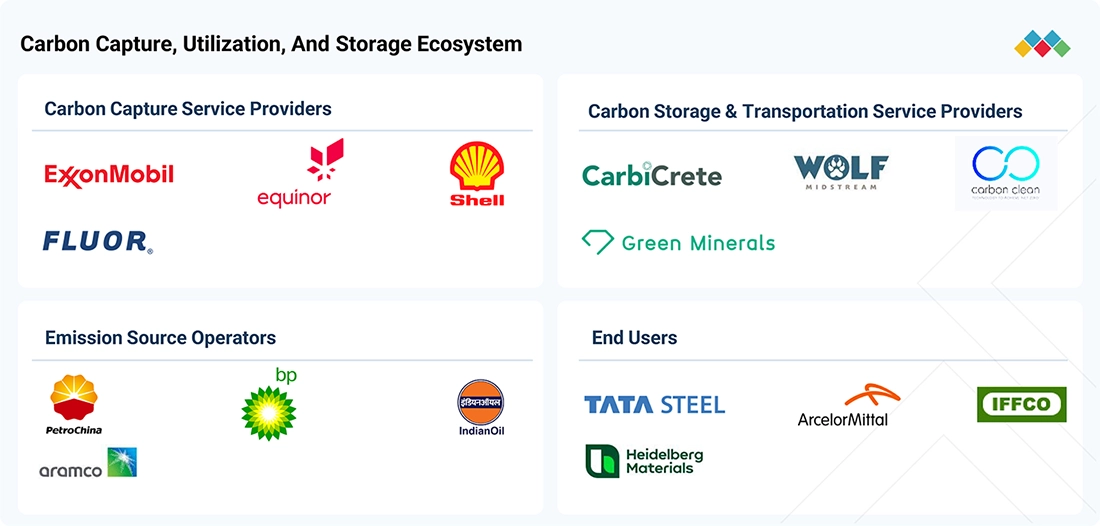
CARBON CAPTURE, UTILIZATION, AND STORAGE MARKET: COMMERCIAL USE CASES ACROSS INDUSTRIES
| COMPANY | USE CASE DESCRIPTION | BENEFITS |
|---|---|---|
 |
Carbon capture and storage across Gulf Coast heavy industrial facilities, including steel production, fertilizer plants, and power generation assets | Emissions reduction, regulatory compliance, asset preservation, scale efficiency |
 |
Carbon capture integration at cement manufacturing plants for industrial flue gas decarbonization and underground storage | Industrial decarbonization, green product differentiation, regulatory alignment, risk mitigation |
 |
Cross-border CO2 transport and offshore subsea geological storage (Northern Lights) for third-party industrial emitters. | Infrastructure access, scalable storage, regulatory compliance, shared Capex model |
 |
Direct Air Capture (STRATOS) for atmospheric CO2 removal and utilization in Enhanced Oil Recovery (EOR) and permanent sequestration | High-integrity removals, carbon credit generation, EOR efficiency, net-zero alignment |
Logos and trademarks shown above are the property of their respective owners. Their use here is for informational and illustrative purposes only.
Related Ecosystem
Green Bio Chemicals
- Animal-Based Sealants
- Bacterial Fermentation
- Corrosion Inhibitors
- Hydrogen Peroxide
- Nitrile Butadiene Rubber (NBR)
- Basf se
- Evonik industries ag
- Solvay sa
- AZELIS HOLDINGS SA
- CARGILL, INCORPORATED
Key Takeaways
- Brazil's CCUS market is valued at USD 820.1 million in 2025 and is forecast to grow to USD 1,278.4 million by 2030, representing a 9.3% CAGR.
- Brazil's growth rate of 9.3% is significantly lower than the global CAGR of 25%, indicating slower but steady market maturation in the region.
- Brazil's industrial base, renewable energy infrastructure, and climate policy framework position the country as a strategic CCUS hub within South America.
- Brazil's CCUS adoption is driven by decarbonization mandates in oil, gas, and chemical sectors, supported by international climate commitments and corporate sustainability goals.
Carbon Capture, Utilization, and Storage Market Report Scope
| Report Metric | Details |
|---|---|
| Base Year | 2025 |
| Fastest Growing Segment | POST-COMBUSTION (Technology) |
| Forecast Period | 2025–2030 |
| Growth Rate | CAGR of 25% from 2025 to 2030 |
| Largest Segment | CAPTURE (Service) |
| Market Size Base Year (Billions) | ~USD 5.82 (2025) |
| Revenue Forecast (Billions) | ~USD 17.75 (2030) |
| Segments Covered | Service, Technology, End-Use Industry |
Brazil Carbon Capture, Utilization, and Storage Market Report Segmentation
3 segment dimensions are covered across the global market.
By Service
- Capture
- Storage
- Transportation
- Utilization
By Technology
- Beccs
- Chemical Looping
- Dac
- Deep Ocean Storage
- Geological Storage
- Membranes
- Other Carbon Capture Technologies
- Other Technologies
- Oxy-Fuel
- Post-Combustion
- Pre-Combustion
- Solvents & Sorbents
By End-Use Industry
- Cement
- Chemical & Petrochemical
- Iron & Steel
- Oil & Gas
- Other End-Use Industries
- Power Generation
BRAZIL: CARBON CAPTURE, UTILIZATION, AND STORAGE MARKET, BY END-USE INDUSTRY, 2025–2030
| Segment | 2025 | 2026 | 2027 | 2028 | 2029 | 2030 | CAGR (%) |
|---|---|---|---|---|---|---|---|
| CEMENT | 1.9 | 2.1 | 2.2 | 2.4 | 2.6 | 2.8 | 7.4 |
| CHEMICAL & PETROCHEMICAL | 4.8 | 5.2 | 5.6 | 6.2 | 6.7 | 7.3 | 8.9 |
| IRON & STEEL | 1.2 | 1.3 | 1.4 | 1.4 | 1.5 | 1.6 | 6.5 |
| OIL & GAS | 43.8 | 48.5 | 53.8 | 59.6 | 66 | 73.1 | 10.8 |
| OTHER END-USE INDUSTRIES | 6 | 6.3 | 6.7 | 7 | 7.3 | 7.7 | 5 |
| POWER GENERATION | 3.9 | 4.4 | 4.8 | 5.4 | 5.9 | 6.6 | 10.8 |
| TOTAL | 61.6 | 67.8 | 74.5 | 81.9 | 90.1 | 99.1 | 10 |
Target Audience
- Chemical & Materials Manufacturers : Brazilian industrial companies need market intelligence to understand CCUS adoption trends, competitive positioning, and technology investment requirements for decarbonization strategies.
- CCUS Technology Providers : International and regional CCUS solution vendors require Brazil-specific market data to assess market size, growth potential, customer segments, and localization strategies for market penetration.
- Investment & Private Equity Firms : Investors evaluating opportunities in Brazil's green technology sector need detailed market valuations, growth forecasts, and sector dynamics to support due diligence and portfolio decisions.
- Government & Policy Makers : Brazilian regulatory bodies and climate policy officials require market data to design effective incentive programs, set realistic decarbonization targets, and allocate resources for CCUS infrastructure development.
- Oil, Gas & Energy Companies : Energy sector operators in Brazil need CCUS market insights to evaluate carbon management solutions, assess regulatory compliance pathways, and identify utilization opportunities for captured carbon.
Key Companies in the Brazil Carbon Capture, Utilization, and Storage Market
| Company | HQ | Ownership | Strongest segments |
|---|---|---|---|
| BAKER HUGHES COMPANY | United States | Public Company | Drilling, Completions & Intervention Services,Pressure Pumping, Wireline & Well Production,Subsea, Flexible Pipe & Surface Pressure Control, |
| PETROBRAS | Brazil | Public Company | Exploration and Production (crude oil, NGLs, natural gas),Refining, Transportation & Marketing (oil products, petrochemicals, fertilizers),Gas & Low Carbon Energies (natural gas, LNG, power, renewables, biodiesel), |
| HOLCIM LTD | Switzerland | Public Company | Cement, clinker, and other cementitious materials,Ready-mix concrete and digital concrete services,Aggregates (crushed stone, gravel, sand), |
| FLUOR CORPORATION | United States | Public Company | Energy Solutions (oil, gas, chemicals, power, energy transition),Urban Solutions (advanced manufacturing, life sciences, mining, infrastructure, staffing, maintenance),Mission Solutions (government, nuclear remediation, security, logistics, O&M), |
| EXXON MOBIL CORPORATION | United States | Public Company | Upstream (crude oil and natural gas),Energy Products (fuels, aromatics, catalysts, licensing),Chemical Products (olefins, polyolefins, intermediates), |
| SHELL PLC | United Kingdom | Public Company | Integrated Gas (incl. LNG and GTL),Upstream (oil, gas, NGLs),Marketing (mobility, lubricants, commercial fuels), |
| EQUINOR ASA | Norway | Public Company | Exploration & Production Norway,Exploration & Production International & USA,Marketing, Midstream & Processing, |
| TOTALENERGIES SE | France | Public Company | Upstream oil and gas production,Refining, fuels marketing, and biofuels,LNG, pipeline gas, and biogas, |
| LINDE PLC | United Kingdom | Public Company | Atmospheric gases (oxygen, nitrogen, argon, rare gases),Process gases (hydrogen, CO2, CO, helium, acetylene, specialty and electronic gases),Engineering & turnkey process plants, |
| MITSUBISHI HEAVY INDUSTRIES, LTD. | Japan | Public Company | Thermal power generation systems (gas turbine combined cycle and steam),Nuclear power systems and post-operational services,Wind power generators and renewable/low-carbon solutions, |
| JGC HOLDINGS CORPORATION | Japan | Public Company | Petroleum and Refining EPC,Petrochemicals and Gas Processing EPC,LNG EPC, |
| SCHLUMBERGER LIMITED | United States | Public Company | Digital & Integration,Reservoir Performance,Well Construction, |
| AKER SOLUTIONS | Norway | Public Company | Field Development (subsea, topsides, facilities),Life Cycle (maintenance, modifications, decommissioning),Renewables & Low-Carbon Solutions (offshore wind, CCUS, hydropower, electrification), |
| HONEYWELL INTERNATIONAL | United States | Public Company | Industrial Automation,Building Automation,Energy and Sustainability Solutions (UOP and related), |
| HITACHI, LTD. | Japan | Public Company | Digital Systems & Services,Green Energy & Mobility,Connective Industries, |
| SIEMENS AG | Germany | Public Company | Digital Industries (automation, control, industrial software),Smart Infrastructure (electrification, buildings, grid solutions),Mobility (rail systems, automation, services), |
| GE VERNOVA | United States | Public Company | Power (gas, nuclear, hydro, steam),Wind (onshore and offshore),Electrification (grid, power conversion, solar and storage, software), |
| HALLIBURTON | United States | Public Company | Completion and Production,Drilling and Evaluation, |
BAKER HUGHES COMPANY
Baker Hughes Company is a U.S.-based public company founded in 2016 with 53,000 employees. The company operates in the energy sector, providing equipment and services to the oil and gas industry.
PETROBRAS
Petrobras is a Brazilian public company founded in 1953 with 43,199 employees. It is a major integrated energy company engaged in exploration, production, refining, and distribution of oil and natural gas.
HOLCIM LTD
Holcim Ltd is a Swiss public company founded in 1833 with 45,595 employees. The company is a leading global manufacturer and distributor of cement, aggregates, and ready-mix concrete.
FLUOR CORPORATION
Fluor Corporation is a U.S.-based public company founded in 1912 with 22,995 employees. The company provides engineering, procurement, and construction services to the energy, chemical, and industrial sectors.
EXXON MOBIL CORPORATION
Exxon Mobil Corporation is a U.S.-based public company founded in 1870 with 57,900 employees. It is one of the world's largest integrated energy companies, engaged in exploration, production, refining, and marketing of oil and natural gas.
SHELL PLC
Shell PLC is a United Kingdom-based public company founded in 1897 with 84,000 employees. It is a major global energy company involved in oil and gas exploration, production, refining, and renewable energy.
EQUINOR ASA
Equinor ASA is a Norwegian public company founded in 1972 with 23,843 employees. The company is an integrated energy company focused on oil and gas exploration, production, and renewable energy development.
TOTALENERGIES SE
TotalEnergies SE is a French public company founded in 1924 with 94,847 employees. It is a major integrated energy company engaged in oil and gas production, refining, and renewable energy projects worldwide.
LINDE PLC
Linde PLC is a United Kingdom-based public company founded in 1879 with 65,034 employees. The company is a leading global supplier of industrial gases and engineering services to various industries.
MITSUBISHI HEAVY INDUSTRIES, LTD.
Mitsubishi Heavy Industries, Ltd. is a Japanese public company founded in 1884 with 78,793 employees. The company operates across multiple sectors including energy, infrastructure, industrial machinery, and aerospace.
JGC HOLDINGS CORPORATION
JGC Holdings Corporation is a Japanese public company founded in 1928 with 8,154 employees. The company provides engineering, procurement, and construction services primarily for the energy and chemical industries.
SCHLUMBERGER LIMITED
Schlumberger Limited is a U.S.-based public company founded in 1926 with 109,000 employees. It is the world's largest oilfield services company, providing technology and services to the oil and gas industry.
AKER SOLUTIONS
Aker Solutions is a Norwegian public company founded in 1841 with 11,731 employees. The company provides engineering, design, and construction services to the oil, gas, and renewable energy sectors.
HONEYWELL INTERNATIONAL
Honeywell International is a U.S.-based public company founded in 1885 with 101,000 employees. The company is a diversified technology and manufacturing conglomerate serving aerospace, building, performance materials, and safety sectors.
HITACHI, LTD.
Hitachi, Ltd. is a Japanese public company founded in 1910 with 287,901 employees. It is a major diversified conglomerate operating across infrastructure, industrial systems, information technology, and other sectors.
SIEMENS AG
Siemens AG is a German public company founded in 1847 with 310,312 employees. It is a global technology conglomerate providing solutions in electrification, automation, and digitalization across multiple industries.
GE VERNOVA
GE Vernova is a U.S.-based public company founded in 2023 with 78,000 employees. The company focuses on energy transition solutions including power generation, grid services, and energy storage technologies.
HALLIBURTON
Halliburton is a U.S.-based public company founded in 1919 with 46,000 employees. The company provides a wide range of services and products to the oil and gas industry, including drilling, completion, and production services.
Reasons to Buy this Report
- Market-Specific Sizing Data : Access precise valuation metrics for Brazil's CCUS market with 2025 baseline (USD 820.1M) and 2030 forecasts (USD 1,278.4M), enabling accurate investment planning and resource allocation decisions.
- Regional Competitive Intelligence : Understand Brazil's position within South America's CCUS landscape and identify competitive advantages, market gaps, and opportunities for technology deployment and partnership development.
- Growth Trajectory Analysis : Leverage Brazil's 9.3% CAGR insights to benchmark performance against global trends (25% CAGR) and identify factors driving localized growth rates for strategic market entry planning.
- Sector-Specific Insights : Gain detailed understanding of CCUS adoption across Brazil's chemicals and materials industries, including regulatory drivers, industrial applications, and technology implementation roadmaps.
- Investment Decision Support : Make informed decisions on market entry, partnership formation, and capital allocation in Brazil's emerging CCUS sector with comprehensive market data and growth projections through 2030.
Frequently asked questions
What is the current size of Brazil's CCUS market in 2025?
Brazil's Carbon Capture, Utilization, and Storage market is estimated at USD 820.1 million in 2025, establishing a baseline for regional growth and investment.
What is Brazil's projected CCUS market size by 2030?
Brazil's CCUS market is forecast to reach USD 1,278.4 million by 2030, reflecting a 9.3% compound annual growth rate over the five-year forecast period.
How does Brazil's CCUS growth compare to global trends?
Brazil's 9.3% CAGR is substantially lower than the global CAGR of 25%, indicating that Brazil's market is developing at a more measured pace relative to international expansion.
What sectors are driving CCUS adoption in Brazil?
Brazil's CCUS growth is primarily driven by the oil and gas, chemical manufacturing, and industrial sectors, where decarbonization mandates and sustainability commitments are accelerating technology deployment.
What factors support long-term CCUS viability in Brazil?
Brazil's competitive advantages include abundant renewable energy resources, established industrial infrastructure, supportive climate policies, and strategic positioning as a Latin American hub for carbon management technologies.
RESEARCH METHODOLOGY
This study consisted of two main tasks to determine the current size of the carbon capture, utilization, and storage market. The first task involved conducting extensive secondary research to gather information on the carbon capture, utilization, and storage market, related markets, and parent markets. The results, assumptions, and market sizing were further verified through primary research with industry players. Market size was estimated using both top-down and bottom-up approaches. Further market segmentation and data triangulation techniques were used to obtain the market size of segments and subsegments.
Secondary Research
Sources used for secondary research for this study include annual reports, financial documents, product portfolios, technical sheets, certificates, company websites, industry magazines, and industry associations. Secondary research was conducted to gain insights into the value chain of carbon capture, utilization, and storage service providers, major market players, market segmentation, and classification by service, technology, end-use industry, and geography. The data gathered through this process was further analyzed to estimate the size of the global carbon capture, utilization, and storage market and its segments and subsegments.
Primary Research
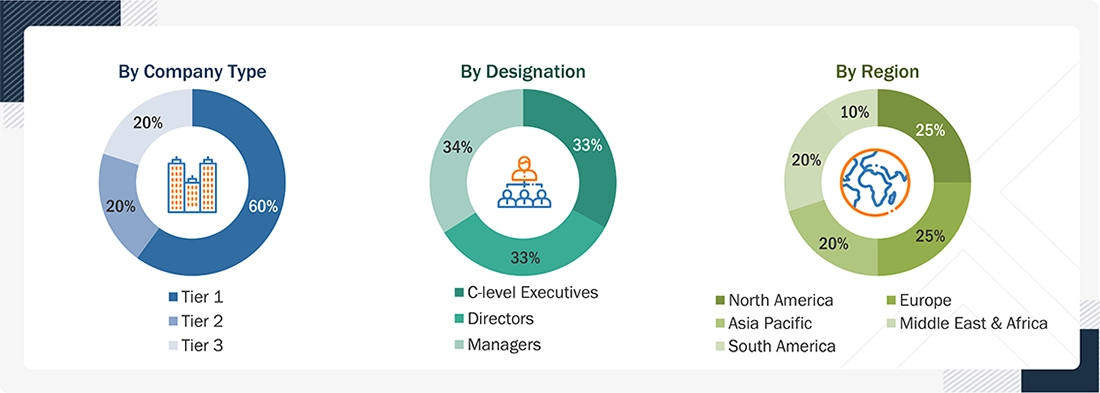
Extensive primary research was conducted after obtaining information regarding the market scenario through secondary research. We conducted several primary interviews with market experts on both the demand and supply sides across major countries. We collected primary data through questionnaires, emails, and telephonic interviews. The primary sources from the supply side included various industry experts, such as chief experience officers (CXOs), vice presidents (VPs), business development/marketing directors, product development/innovation teams, related key executives from the carbon capture, utilization, and storage service industry, system integrators, technology suppliers, EPC contractors, component providers, distributors, and key opinion leaders. Primary interviews were conducted to gather insights such as market statistics, revenue data from products and services, market breakdowns, market size estimates, market forecasts, and data triangulation. Primary research helped in understanding various trends related to service, technology, end-use industry, and region. Stakeholders from the demand side, such as CIOs, CTOs, CSOs, and installation teams of the customers/end users who are seeking carbon capture, utilization, and storage services, were interviewed to understand the buyer’s perspective on product/service providers, as well as their current usage of carbon capture, utilization, and storage products/services and future outlook of their business, which will affect the overall market.
Breakup of Primary Research:
To know about the assumptions considered for the study, download the pdf brochure
Market Size Estimation
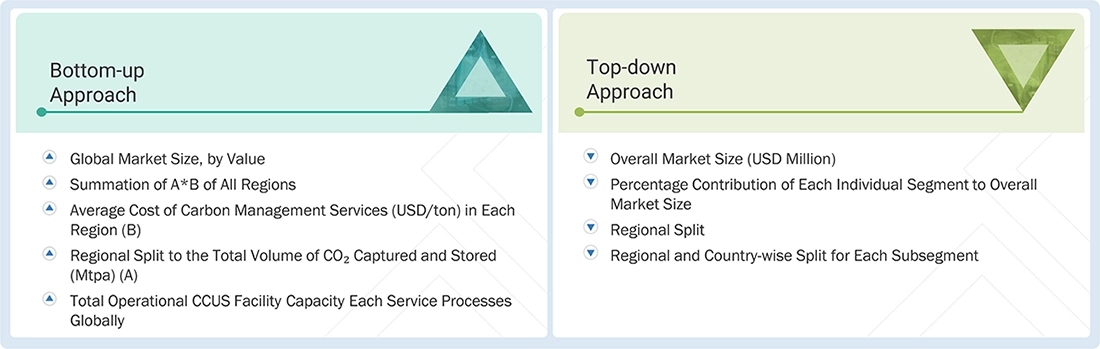
The research methodology used to estimate the size of the carbon capture, utilization, and storage market includes the following details. The market size was estimated from the demand side. The market was expanded based on global demand for carbon capture, utilization, and storage products/services across different industries. These procurements provide demand-side information for each end-use industry in the carbon capture, utilization, and storage market. For each end-use industry, all possible segments of the carbon capture, utilization, and storage market were integrated and mapped.
Data Triangulation
After determining the overall size through the market size estimation process explained above, the total market was split into several segments and subsegments. The data triangulation and market breakdown procedures explained below were implemented, wherever applicable, to complete the overall market engineering process and arrive at the exact statistics for various market segments and subsegments. The data were triangulated by studying factors and trends from both the demand and supply sides. In addition, the market size was validated using both the top-down and bottom-up approaches.
Market Definition
The carbon capture, utilization, and storage market comprises technologies, solutions, and associated services across the CO2 management value chain, including the capture of CO2 from industrial facilities, power generation plants, and the atmosphere; its conditioning, compression, and transportation; and its subsequent utilization or permanent geological storage. The market encompasses solutions/services for CO2 capture, transport, utilization, and storage, as well as integrated systems that connect these stages to enable carbon management and emission reduction across industrial and energy applications.
Key Stakeholders
- CCUS service providers
- Universities, governments, and research organizations
- Associations and industrial bodies
- Environmental support agencies
- Investment banks and private equity firms
- Fire safety testing and certification organizations
- R&D institutes and research organizations
- Raw material suppliers
- Government and regulatory authorities
Report Objectives
- To define, describe, and forecast the carbon capture, utilization, and storage market in terms of volume and value
- To provide detailed information regarding the key factors, such as drivers, restraints, opportunities, and challenges influencing market growth
- To analyze and project the market size by service, technology, end-use industry, and region
- To forecast the global carbon capture, utilization, and storage market size, along with regional and country-level data, and analyze key country-specific trends
- To strategically analyze micromarkets, including individual growth trends, prospects, and submarket contributions to the overall market
- To analyze the market opportunities and the competitive landscape for stakeholders and market leaders
- To assess recent market developments and competitive strategies, such as agreements, contracts, acquisitions, and product developments/product launches, to map the competitive landscape
- To strategically profile the key market players and comprehensively analyze their core competencies
Available customizations:
MarketsandMarkets offers the following customizations for this market report:
- Additional country-level analysis of the carbon capture, utilization, and storage market
Product Analysis
- Product matrix, which provides a detailed comparison of the product portfolio of each company in the market
Get the Full Carbon Capture, Utilization, and Storage Market Report
Full forecast, segment splits, and company analysis for all Carbon Capture, Utilization, and Storage Market.
- US Carbon Capture, Utilization, and Storage Market
- Canada Carbon Capture, Utilization, and Storage Market
- Mexico Carbon Capture, Utilization, and Storage Market
- UK Carbon Capture, Utilization, and Storage Market
- France Carbon Capture, Utilization, and Storage Market
- Netherlands Carbon Capture, Utilization, and Storage Market
- Italy Carbon Capture, Utilization, and Storage Market
- Norway Carbon Capture, Utilization, and Storage Market
- China Carbon Capture, Utilization, and Storage Market
- Japan Carbon Capture, Utilization, and Storage Market
- India Carbon Capture, Utilization, and Storage Market
- Australia Carbon Capture, Utilization, and Storage Market
- Argentina Carbon Capture, Utilization, and Storage Market
- Rest Of Europe Carbon Capture, Utilization, and Storage Market
- Rest Of Asia Pacific Carbon Capture, Utilization, and Storage Market
Need a Tailored Report?
Customize this report to your needs
Get 10% FREE Customization
Customize This Report
