
Canada Carbon Credit Validation, Verification, and Certification Market (2025-2030)

The Canada Carbon Credit Validation, Verification, and Certification Market was valued at $2.5 Million in 2025 and projected to reach to $6.33 Million by 2030, representing a compound annual growth rate of 20.4%. Canada's carbon credit validation, verification, and certification market is positioned for sustained growth as the nation intensifies its climate action agenda.


| Market Size in | USD 26.32 MN |
| Market Forecast in | |
| CAGR | |
| Forecast Period | |
| Units Considered | Value (USD MN) |
Canada Carbon Credit Validation, Verification, and Certification Market Trends and Insights
- This 20.4% compound annual growth rate reflects Canada's strengthening commitment to carbon neutrality and regulatory compliance within the energy and power sector.
- Canada's market expansion is driven by increasing corporate sustainability mandates, federal climate policies, and the rising demand for credible third-party verification of emissions reduction projects across provinces. The Canadian VVC market benefits from the country's established environmental governance framework and growing participation in both domestic and international carbon markets.
- Canada's position as a resource-rich nation with significant energy sector operations creates substantial demand for validation and certification services to support emissions trading schemes and net-zero commitments.
- Between 2025 and 2030, Canada is expected to see accelerated adoption of VVC services as enterprises scale decarbonization initiatives and regulatory bodies enforce stricter reporting standards. Canada's market dynamics are shaped by the interplay of federal carbon pricing mechanisms, provincial climate action plans, and corporate ESG targets.
- The forecast period will likely witness increased investment in Canada's VVC infrastructure, supporting the country's transition toward a low-carbon economy while maintaining competitive advantage in global carbon markets..
Key Market Statistics
- CAGR (2025-2030) 20.4% CAGR
- Market Size, 2025 ~USD 2.5 Million
- Forecast, 2030 ~USD 6.33 Million
- Country Canada
Canada Carbon Credit Validation, Verification, and Certification Market Overview
Rapid Market Expansion :
Canada's carbon credit VVC market is projected to grow from $2.5 million in 2025 to $6.33 million by 2030, representing a robust 20.4% CAGR driven by federal and provincial climate commitments.
Regulatory Compliance Pressure :
Stricter Canadian environmental regulations and the federal carbon pricing system are compelling energy and power sector organizations to invest in validated carbon credit solutions for compliance and reporting.
Net-Zero Commitments :
Canada's commitment to achieving net-zero emissions by 2050 is accelerating demand for third-party validation and certification services across renewable energy, carbon capture, and offset projects.
Provincial Market Variation :
Differences in provincial climate policies and carbon pricing mechanisms create diverse opportunities for VVC service providers across British Columbia, Alberta, Ontario, and Quebec markets.
Canada Carbon Credit Validation, Verification, and Certification Market Dynamics
- The 20.4% CAGR reflects increasing regulatory requirements under the Canadian carbon pricing system and growing corporate sustainability mandates within the energy and power sector.
- Organizations are increasingly recognizing the necessity of third-party validation to ensure credibility and market acceptance of carbon credits. Looking ahead to 2030, market expansion will be fueled by enhanced government incentives for renewable energy projects, mandatory emissions reporting standards, and corporate net-zero pledges.
- The convergence of federal climate legislation, provincial climate plans, and international carbon market participation will create sustained demand for specialized VVC services, positioning Canada as a key market for certification providers and energy sector stakeholders..
Market Ecosystem
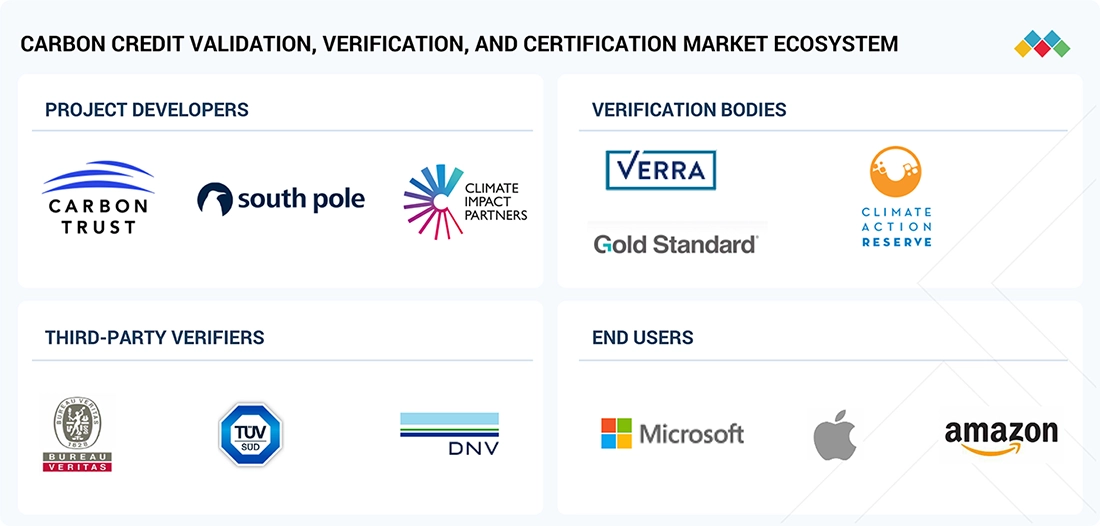
CARBON CREDIT VALIDATION VERIFICATION AND CERTIFICATION MARKET: COMMERCIAL USE CASES ACROSS INDUSTRIES
| COMPANY | USE CASE DESCRIPTION | BENEFITS |
|---|---|---|
 |
Verra partnered with the Forest Carbon Partnership Facility (FCPF) to develop a jurisdictional REDD+ carbon crediting framework that enables countries to generate high-quality carbon credits at the national and sub-national level, aligned with UNFCCC and Paris Agreement requirements. | Enables large-scale, high-integrity carbon credit generation; ensures robust monitoring, reporting, and verification (MRV) at the jurisdictional level; improves data consistency and transparency; supports national climate targets; and facilitates integration of diverse land-use practices into internationally recognized carbon markets. |
 |
Gold Standard introduced a methodology for decentralized organic waste processing, developed by Lomi in consultation with Carbonomics, enabling the generation of carbon credits from home and commercial food waste treatment that avoids landfill disposal and associated methane emissions. | Reduces methane emissions by diverting organic waste from landfills; eliminates transport-related emissions; enables decentralized, scalable carbon credit generation; supports circular economy models by converting waste into valuable by-products such as fertilizers; and strengthens alignment with sustainable development and climate mitigation goals. |
 |
ACR’s GreenTrees reforestation project focuses on restoring degraded lands in the Mississippi Alluvial Valley by partnering with private landowners to plant trees on marginal agricultural land, enabling large-scale carbon sequestration and the issuance of high-quality carbon credits through reforestation. | Restores biodiversity and critical wildlife habitats; enhances carbon sequestration capacity at scale; improves water quality and ecosystem resilience; generates verified, high-integrity carbon credits; and delivers long-term economic benefits to local communities through land restoration incentives. |
 |
SCS Global Services certified Fresh Del Monte Produce Inc.’s New Del Monte Zero pineapples as carbon neutral, following a comprehensive assessment of emissions across cultivation, transportation, distribution, and commercialization, supported by conservation and reforestation initiatives across Del Monte’s Costa Rica operations. | Enables verified carbon-neutral product claims; ensures end-to-end supply-chain emissions accountability; supports market access in North America and Europe; strengthens ESG credibility; and sets a sustainability benchmark for carbon-neutral practices in the global fresh produce industry. |
Logos and trademarks shown above are the property of their respective owners. Their use here is for informational and illustrative purposes only.
Related Ecosystem
Farm Equipment And Irrigation
- Sensors
- Hydroponics
- Aeroponics
- Camera Systems
- Global Positioning System (GPS)
- MSK FARM MACHINERY CORPORATION
- MITSUBISHI AGRICULTURAL MACHINERY
- MITSUBISHI CHEMICAL AGRI DREAM
- RIVULIS IRRIGATION
- AGCO Corporation
Decarbonization
- Battery Electric Vehicle (BEV)
- Energy Management Systems
- Fuel Cell
- Fuel Cell Electric Vehicle (FCEV)
- Geographical Information System (GIS)
- TotalEnergies SE
- Siemens ag
- Mitsui & Co., Ltd.
- General Electric Company
- Thyssenkrupp ag
Key Takeaways
- Canada's VVC market is valued at $2.5 million in 2025 and is forecast to reach $6.33 million by 2030, representing a 20.4% CAGR.
- Canada's federal carbon pricing and provincial climate policies are primary drivers of demand for validation, verification, and certification services.
- Canada's energy sector's scale and decarbonization commitments create substantial opportunities for third-party VVC service providers.
- Canada's participation in international carbon markets and corporate ESG mandates will accelerate VVC adoption through 2030.
Carbon Credit Validation, Verification, and Certification Market Report Scope
| Report Metric | Details |
|---|---|
| Base Year | 2025 |
| Fastest Growing Segment | AGRICULTURE & FORESTRY (Application) |
| Forecast Period | 2025–2030 |
| Growth Rate | CAGR of 22.6% from 2025 to 2030 |
| Largest Segment | VOLUNTARY (Type) |
| Market Size Base Year (Billions) | ~USD 0.16 (2025) |
| Revenue Forecast (Billions) | ~USD 0.45 (2030) |
| Segments Covered | Type, Application |
Canada Carbon Credit Validation, Verification, and Certification Market Report Segmentation
2 segment dimensions are covered across the global market.
By Type
- Compliance
- Voluntary
By Application
- Agriculture & Forestry
- Energy & Utilities
- Industrial
- Other Applications
- Transportation
- Water & Wastewater Management
Target Audience
- Energy & Power Companies : Canadian utilities, renewable energy developers, and fossil fuel operators need market intelligence to navigate carbon credit requirements, validate offset projects, and meet regulatory compliance obligations.
- VVC Service Providers : Validation, verification, and certification firms require detailed market analysis to identify growth opportunities, assess competitive positioning, and develop service offerings tailored to Canadian regulatory requirements.
- Corporate Sustainability Officers : Executives managing net-zero commitments and ESG strategies need insights into Canada's carbon credit market to source credible VVC services and ensure compliance with federal and provincial standards.
- Investment & Financial Institutions : Banks, private equity firms, and impact investors evaluating opportunities in Canada's clean energy and carbon markets require market data to assess growth potential and risk profiles.
- Government & Policy Makers : Federal and provincial climate agencies need market research to evaluate VVC sector effectiveness, identify regulatory gaps, and design policies supporting Canada's net-zero transition goals.
Key Companies in the Canada Carbon Credit Validation, Verification, and Certification Market
| Company | HQ | Ownership | Strongest segments |
|---|---|---|---|
| VERRA | United States | Public Company | Commercial Services,Government Solutions,Parking Solutions, |
| SGS SOCIéTé GéNéRALE DE SURVEILLANCE SA | Switzerland | Public Company | Compliance market services,Voluntary market services,Validation, |
| ACR | Australia | Public Company | Topical hormone therapies (Evamist, Lenzetto, estradiol sprays),Dermatology generics (Dapsone gels, Acyclovir cream),Analgesic and anesthetic topicals (Lidocaine/Prilocaine, Nitroglycerin ointment), |
| INTERTEK GROUP PLC | United Kingdom | Public Company | Verification Services,Certification Services,Validation Services, |
| BUREAU VERITAS | France | Public Company | Compliance Verification & Certification,Voluntary Market Verification,Validation Services, |
VERRA
Verra is a United States-based public company founded in 1987 with 1,895 employees. The company operates as a standards and certification organization in the environmental and sustainability sector.
SGS SOCIéTé GéNéRALE DE SURVEILLANCE SA
SGS Société Générale de Surveillance SA is a Swiss public company founded in 1878 with 83,000 employees. The organization is a leading provider of inspection, verification, testing, and certification services globally.
ACR
ACR is an Australian public company founded in 1998 with 43 employees. The organization operates in the certification and standards sector.
INTERTEK GROUP PLC
Intertek Group PLC is a United Kingdom-based public company founded in 1885 with 45,425 employees. The organization is a leading provider of quality and safety solutions, including testing, inspection, and certification services.
BUREAU VERITAS
Bureau Veritas is a French public company founded in 1828 with 80,449 employees. The organization provides testing, inspection, and certification services across diverse sectors worldwide.
Reasons to Buy this Report
- Regulatory Landscape Intelligence : Gain comprehensive insights into Canada's evolving carbon pricing system, provincial climate policies, and federal emissions regulations to ensure compliance and strategic positioning in the VVC market.
- Market Sizing & Growth Projections : Access precise market valuation ($2.5M in 2025, $6.33M in 2030) and 20.4% CAGR forecasts to inform investment decisions, business expansion, and resource allocation strategies.
- Competitive Positioning Strategy : Identify market opportunities, competitive dynamics, and service differentiation strategies specific to Canada's energy and power sector to capture growing demand for validation and certification services.
- Sector-Specific Insights : Understand how renewable energy projects, carbon capture initiatives, and corporate sustainability programs are driving VVC demand across Canadian provinces and energy subsectors.
- Investment & Partnership Opportunities : Discover high-growth segments, emerging players, and partnership potential within Canada's carbon credit ecosystem to guide M&A, venture, and strategic collaboration decisions.
Frequently asked questions
What is the current market size of Canada's carbon credit VVC sector?
Canada's carbon credit validation, verification, and certification market was valued at $2.5 million in 2025 and is projected to grow to $6.33 million by 2030.
What is the expected growth rate for Canada's VVC market?
Canada's VVC market is expected to grow at a compound annual growth rate (CAGR) of 20.4% from 2025 to 2030.
What factors are driving growth in Canada's carbon credit VVC market?
Canada's VVC market growth is driven by federal carbon pricing mechanisms, provincial climate action plans, corporate ESG commitments, and the need for credible third-party verification of emissions reductions in the energy and power sector.
How does Canada's VVC market compare to global trends?
Canada's VVC market CAGR of 20.4% is slightly below the global average of 22.6%, reflecting Canada's mature regulatory environment and established carbon market infrastructure relative to emerging markets.
What role do provincial policies play in Canada's VVC market?
Provincial climate action plans and emissions trading schemes in Canada create localized demand for VVC services, complementing federal carbon pricing and driving regional market expansion.
RESEARCH METHODOLOGY
This study encompassed significant efforts to determine the current size of the carbon credit validation, verification, and certification market. It commenced with a thorough secondary research process to gather data on the market, related markets, and the broader industry. Subsequently, these findings, assumptions, and market size calculations were rigorously validated by consulting industry experts across the entire supply chain through primary research. The total market size was assessed through analyses specific to each country. Following that, the market was further dissected, and the data was cross-referenced to estimate the size of various segments and sub-segments within the market.
Secondary Research
In this research study, a wide range of secondary sources were utilized, including directories, databases, and reputable references such as Hoover's, Bloomberg BusinessWeek, Factiva, World Bank, International Monetary Fund (IMF), the US Department of Energy (DOE), and the International Energy Agency (IEA). These sources played a crucial role in gathering valuable data for a comprehensive analysis of the global carbon credit validation, verification, and certification market, covering technical, market-oriented, and commercial aspects. Additional secondary sources included annual reports, press releases, investor presentations, whitepapers, authoritative publications, articles authored by well-respected experts, information from industry associations, trade directories, and various database resources.
Primary Research
The carbon credit validation, verification, certification market involves a range of stakeholders, including project developers, certification bodies, auditors/third-party verifiers, and end users within the supply chain. To gather qualitative and quantitative insights, various primary sources from both the supply and demand sides of the market were interviewed. The following breakdown presents the primary respondents involved in the research study.
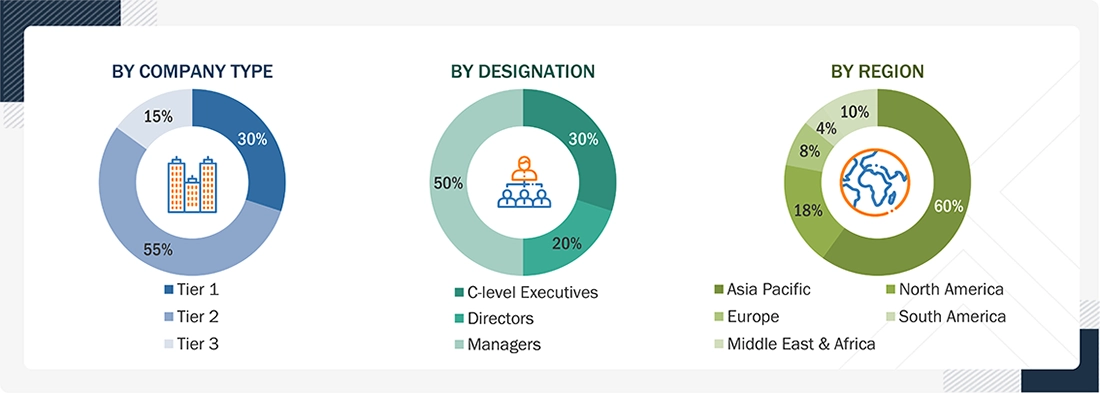
Note: “Others” include sales managers, engineers, and regional managers.
The companies are divided into tiers based on their 2021 total revenue: Tier 1: >USD 1 billion; Tier 2: USD 500 million–1 billion; and Tier 3: <USD 500 million.
To know about the assumptions considered for the study, download the pdf brochure
Market Size Estimation
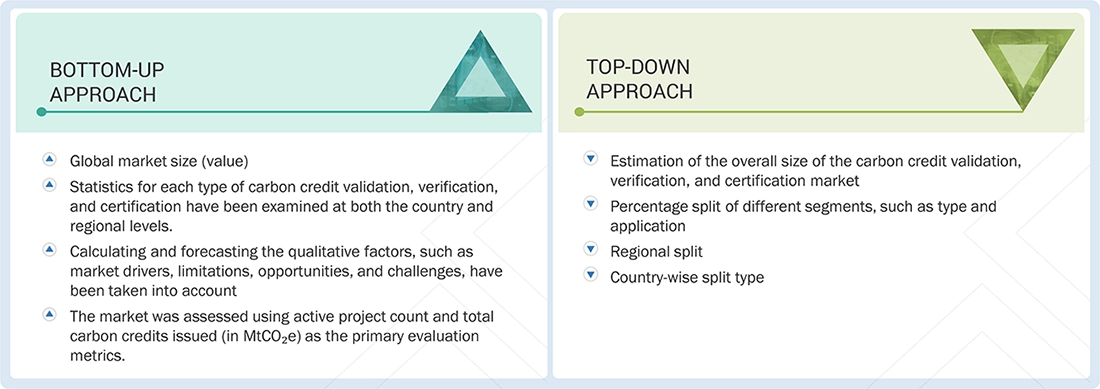
The estimation and validation of the carbon credit validation, verification, and certification market size have been conducted using a bottom-up and top-down approach. This approach was rigorously employed to ascertain the dimensions of multiple subsegments within the market. The research process comprises the following key stages.
- In this method, the statistics for each type of carbon credit validation, verification, and certification have been examined at both the country and regional levels.
- Thorough secondary and primary research has been conducted to gain a comprehensive understanding of the global market landscape for various segments of the carbon credit validation, verification, and certification market.
- When calculating and forecasting the market size, qualitative factors such as market drivers, limitations, opportunities, and challenges have been taken into account.
Global Carbon Credit Validation, Verification, and Certification Market Size: Bottom-Up Approach and Top-Down Approach
Data Triangulation
The process of determining the overall market size involved the methodologies described earlier, followed by segmenting the market into multiple segments and subsegments. To finalize the comprehensive market analysis and obtain precise statistics for each market segment and subsegment, data triangulation and market segmentation techniques were applied, as appropriate. Data triangulation was achieved by examining various factors and trends from both demand and supply perspectives within the carbon credit validation, verification, and certification market.
Market Definition
The carbon credit validation, verification, and certification market encompasses the processes and services that ensure the integrity and credibility of carbon credits used in emissions trading and offset programs. This market includes validating carbon-reduction projects, verifying actual emissions reductions achieved, and certifying these reductions by accredited bodies. These activities provide assurance to buyers and stakeholders that the carbon credits are legitimate, quantifiable, and compliant with established standards and regulations, thereby facilitating transparent and reliable carbon trading and contributing to global climate change mitigation efforts.
Key Stakeholders
- Government & research organizations
- Institutional investors
- Investors/shareholders
- Environmental research institutes
- Project developers
- State and national regulatory authorities
- Manufacturing industry
- Energy efficiency consultancies
- Certification bodies
Report Objectives
- To describe and forecast the carbon credit validation, verification, and certification market, in terms of value, by type, application, and region.
- To forecast the market for various segments, in terms of value, with regard to four regions: North America, Europe, Asia Pacific, and Rest of the World, along with their key countries
- To provide detailed information about the key factors, such as drivers, restraints, opportunities, and challenges, influencing the market’s growth
- To strategically analyze the subsegments with respect to individual growth trends, prospects, and contributions of each segment to the overall market size
- To study the complete supply chain and allied industry segments and perform a supply chain analysis of the carbon credit validation, verification, and certification landscape
- To strategically analyze the regulatory landscape, tariffs, standards, patents, Porter’s five forces, import and export scenarios, trade values, and case studies pertaining to the market under study
- To analyze the opportunities in the market for various stakeholders by identifying the high-growth segments of the carbon credit validation, verification, and certification market
- To profile the key players and comprehensively analyze their market position in terms of ranking and core competencies, along with detailing the competitive landscape for the market leaders
- To analyze competitive developments such as agreements, partnerships, product launches, acquisitions, contracts, expansions, and investments in the carbon credit validation, verification, and certification market
Available customizations:
With the given market data, MarketsandMarkets offers customizations based on the company’s specific needs. The following customization options are available for the report:
Product Analysis
- Product Matrix, which provides a detailed comparison of the product portfolio of each company
Company Information
-
Detailed analyses and profiling of additional market players (up to 5)
Get the Full Carbon Credit Validation, Verification, and Certification Market Report
Full forecast, segment splits, and company analysis for all Carbon Credit Validation, Verification, and Certification Market.
- Mexico Carbon Credit Validation, Verification, and Certification Market
- US Carbon Credit Validation, Verification, and Certification Market
- China Carbon Credit Validation, Verification, and Certification Market
- India Carbon Credit Validation, Verification, and Certification Market
- Germany Carbon Credit Validation, Verification, and Certification Market
- UK Carbon Credit Validation, Verification, and Certification Market
- Rest Of Europe Carbon Credit Validation, Verification, and Certification Market
- Rest Of Asia Pacific Carbon Credit Validation, Verification, and Certification Market
- GCC Carbon Credit Validation, Verification, and Certification Market
- Kenya Carbon Credit Validation, Verification, and Certification Market
- Brazil Carbon Credit Validation, Verification, and Certification Market
- Colombia Carbon Credit Validation, Verification, and Certification Market
- Rest Of South America Carbon Credit Validation, Verification, and Certification Market
- Rest Of GCC Carbon Credit Validation, Verification, and Certification Market
- UAE Carbon Credit Validation, Verification, and Certification Market
Need a Tailored Report?
Customize this report to your needs
Get 10% FREE Customization
Customize This Report
