
UK Carbon Nanotubes Market (2026-2031)

The UK Carbon Nanotubes Market was valued at $52.83 Million in 2026 and projected to reach to $96.15 Million by 2031, representing a compound annual growth rate of 12.72%. The UK carbon nanotubes market is poised for significant expansion through 2031, driven by accelerating adoption in high-performance applications across aerospace, automotive, and electronics sectors.


| Market Size in | USD 26.32 MN |
| Market Forecast in | |
| CAGR | |
| Forecast Period | |
| Units Considered | Value (USD MN) |
UK Carbon Nanotubes Market Trends and Insights
- The UK market is advancing at a compound annual growth rate (CAGR) of 12.72%, driven by increasing demand across electronics, aerospace, and advanced materials sectors.
- The UK's strong research infrastructure and manufacturing capabilities position it as a key hub for carbon nanotube innovation and commercialization within Europe. The UK market benefits from significant investment in nanotechnology research and development, supported by government initiatives and private sector collaboration.
- The UK's aerospace and automotive industries are major consumers of carbon nanotubes, leveraging their superior strength-to-weight ratios and electrical conductivity.
- Between 2026 and 2031, the UK market is expected to nearly double in value, reflecting growing adoption in composite materials, energy storage, and semiconductor applications. The UK's regulatory environment and emphasis on sustainable manufacturing practices are shaping market dynamics, with producers increasingly focusing on environmentally responsible production methods.
- The market's expansion is underpinned by rising demand for lightweight, high-performance materials and the UK's commitment to advanced manufacturing technologies..
Key Market Statistics
- CAGR (2026-2031) 12.72% CAGR
- Market Size, 2026 ~USD 52.83 Million
- Forecast, 2031 ~USD 96.15 Million
- Country UK
UK Carbon Nanotubes Market Overview
Market Valuation Growth :
The UK carbon nanotubes market is valued at USD 52.83 million in 2026 and is projected to reach USD 96.15 million by 2031, representing an 82% increase over the five-year forecast period.
Strong CAGR Performance :
The UK market is expanding at a CAGR of 12.72%, outpacing many developed economies and demonstrating sustained demand for advanced nanomaterial applications across multiple industrial sectors.
Key Industry Drivers :
Growth is primarily driven by increasing adoption in UK electronics manufacturing, aerospace engineering, and advanced materials development, supported by government investment in nanotechnology research and development.
Research & Manufacturing Excellence :
The UK's world-class research infrastructure, including leading universities and innovation hubs, combined with established manufacturing capabilities, positions the country as a significant hub for carbon nanotube production and application development.
UK Carbon Nanotubes Market Dynamics
- Government initiatives supporting advanced materials research and the UK's commitment to green technology development are expected to further stimulate market growth.
- The presence of leading research institutions and manufacturing facilities creates a competitive advantage for innovation and commercialization.
- Investment in sustainable production methods and emerging applications in energy storage and composite materials will unlock new revenue streams.
- The market's 12.72% CAGR reflects strong fundamentals and increasing industrial confidence in carbon nanotube technologies for next-generation products..
Market Ecosystem
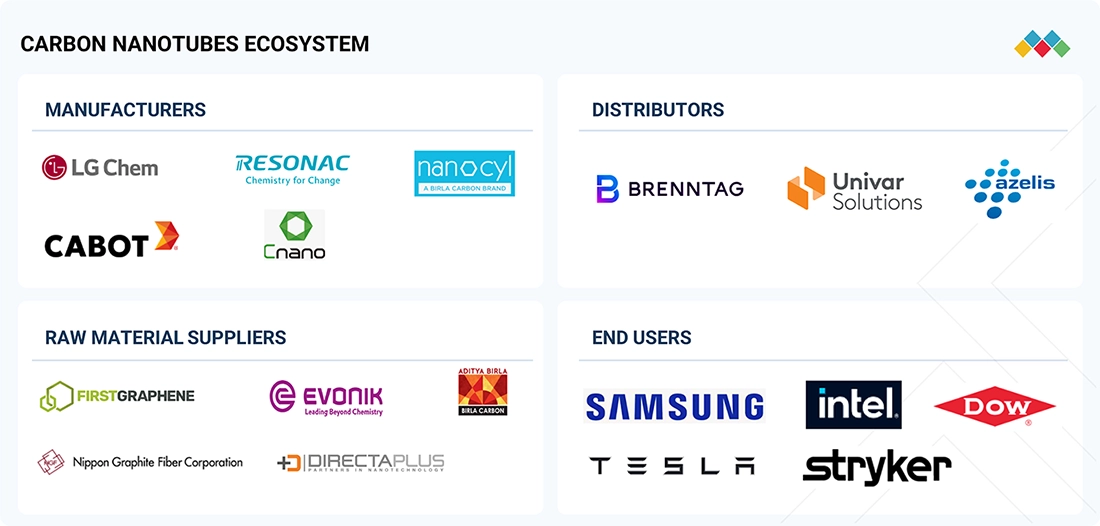
CARBON NANOTUBES (CNT) MARKET: COMMERCIAL USE CASES ACROSS INDUSTRIES
| COMPANY | USE CASE DESCRIPTION | BENEFITS |
|---|---|---|
 |
Integration of carbon nanotubes in conductive films, batteries, and display components for smartphones and electronic devices | Enhanced electrical conductivity, improved battery efficiency, lightweight component design, and superior thermal management performance |
 |
Use of carbon nanotubes in advanced chip interconnects and thermal interface materials for high-performance processors | Reduced heat generation, faster signal transmission, improved energy efficiency, and enhanced reliability of semiconductor devices |
 |
Incorporation of carbon nanotubes into polymer composites and industrial coatings for structural reinforcement applications | Increased mechanical strength, improved chemical resistance, enhanced conductivity, and reduced overall material weight |
 |
Application of carbon nanotube-enhanced composites in orthopedic implants and medical device components | Improved biocompatibility, enhanced material durability, better wear resistance, and lighter high-strength medical products |
Logos and trademarks shown above are the property of their respective owners. Their use here is for informational and illustrative purposes only.
Related Ecosystem
Fibers And Composites
Foam And Insulation
Infrastructure Material
Key Takeaways
- The UK carbon nanotubes market is valued at USD 52.83 million in 2026 and is forecast to reach USD 96.15 million by 2031, representing an 82% increase over the five-year period.
- The UK market is growing at a CAGR of 12.72%, outpacing many mature chemical markets and reflecting strong demand from aerospace, automotive, and electronics sectors.
- The UK's advanced research institutions and manufacturing infrastructure make it a leading center for carbon nanotube innovation and commercialization in Europe.
- Sustainability and regulatory compliance are key drivers shaping the UK market, with manufacturers increasingly adopting eco-friendly production methods to meet stringent environmental standards.
Carbon Nanotubes Market Report Scope
| Report Metric | Details |
|---|---|
| Base Year | 2026 |
| Fastest Growing Segment | STRUCTURAL COMPOSITES APPLICATION (Application) |
| Forecast Period | 2026–2031 |
| Growth Rate | CAGR of 14.88% from 2026 to 2031 |
| Largest Segment | SWCNT (Type) |
| Market Size Base Year (Billions) | ~USD 1.78 (2026) |
| Revenue Forecast (Billions) | ~USD 3.56 (2031) |
| Segments Covered | Type, End-Use Industry, Application, Sub-Application |
UK Carbon Nanotubes Market Report Segmentation
4 segment dimensions are covered across the global market.
By Type
- Multi-Walled Carbon Nanotubes
- Mwcnt
- Single-Walled Carbon Nanotubes
- Swcnt
By End-Use Industry
- Chemical Materials & Polymers
- Electronics & Semiconductor
- Electronics & Semiconductors
- Energy & Storage
- Medical
- Other End-Use Industries
- Structural Composites
By Application
- Aerospace & Others
- Cancer Treatment
- Catalysts
- Chemical Materials & Polymers
- Coatings, Adhesives, & Sealants
- Construction & Infrastructure
- Defense
- Electrochemical Supercapacitors
- Electronics & Semiconductor
- Energy & Storage
- Flexible Displays
- Fuel Cells
- Hydrogen Storage
- Industrial Sensors
- Integrated Circuits
- Light Vehicles/Automotive
- Lithium-Ion Batteries
- Medical
- Other Applications
- Propellants
- Proteomics
- Solar Pv Cells
- Sporting Goods
- Structural Composites Application
- Superconductors
- Transdermal Drug Delivery
- Transistors
- Water Filtration
- Wind Turbine Blades
By Sub-Application
- Aerospace & Others
- Cancer Treatment
- Catalysts
- Coatings, Adhesives & Sealants
- Construction Infrastructures
- Defense
- Electrochemical Supercapacitors
- Flexible Displays
- Fuel Cells
- Hydrogen Storage
- Industrial Sensors
- Integrated Circuits (Ics)
- Light Vehicles/Automotive
- Lithium-Ion Batteries
- Propellants
- Proteomics
- Solar Pv Cells
- Sporting Goods
- Superconductors
- Transdermal Drug Delivery
- Transistors
- Water Filtrations
- Wind Turbine Blades
Target Audience
- UK Materials Manufacturers : Manufacturers need UK-specific market data to assess demand trends, identify growth segments in electronics and aerospace, and plan production capacity investments aligned with domestic market expansion.
- Aerospace & Defense Companies : UK aerospace firms require detailed market insights to evaluate carbon nanotube adoption opportunities, benchmark against competitors, and make informed sourcing and R&D investment decisions.
- Electronics & Semiconductor Firms : Electronics manufacturers need UK market intelligence to understand local demand drivers, identify supply chain opportunities, and develop products meeting UK industry specifications and standards.
- Research Institutions & Universities : UK research organizations require market data to align academic research with commercial opportunities, secure funding, and commercialize innovations within the growing domestic carbon nanotubes sector.
- Investment & Private Equity Firms : Investors need UK-focused market analysis to identify high-growth opportunities, evaluate portfolio companies, and make informed decisions on funding nanotechnology ventures in the British market.
Key Companies in the UK Carbon Nanotubes Market
| Company | HQ | Ownership | Strongest segments |
|---|---|---|---|
| SHELL PLC | United Kingdom | Public Company | Integrated Gas (including LNG and GTL),Upstream (oil, gas, NGLs),Marketing (mobility, lubricants, commercial fuels, EV charging), |
| LG CHEM, LTD. | South Korea | Public Company | Ethylene- and propylene-based synthetic resins (PE, PP, EVA, POE, UNIQABLE),Styrene-based resins (ABS, ASA, PS, EPS, SAN),Battery and electronic materials (cathode, separators, CNT, binders, display, semiconductor), |
| CABOT CORPORATION | United States | Public Company | Reinforcement Materials (tire and industrial rubber blacks, engineered elastomer composites),Specialty Carbons (inks, coatings, plastics, adhesives, toners, batteries, displays),Fumed Silica and Fumed Alumina, |
| RESONAC CORPORATION | Japan | Public Company | Semiconductor and Electronic Materials,Chemicals and Petrochemicals (incl. industrial gases, PP/PE, organic chemicals),Mobility (molded plastics, powder metal, aluminum, friction materials), |
| JIANGSU CNANO TECHNOLOGY CO., LTD. | China | Public Company | Carbon nanotube conductive slurry,Carbon nanotube powder,Graphene composite conductive slurry, |
| ARKEMA S.A. | France | Public Company | Advanced Materials,Coating Solutions,Adhesive Solutions, |
| ZEON CORPORATION | Japan | Public Company | Synthetic rubbers and latices,Chemicals, aroma, and specialty chemicals,Electronic and energy materials, |
| KUMHO PETROCHEMICAL CO., LTD. | South Korea | Public Company | Synthetic rubber (SBR, BR, solution SBR, NBR, TPEs, SBS),Synthetic resins (PS, ABS, HIPS, EPS, SAN, ENERPOR, PPG),Specialty chemicals (antioxidants, accelerators, paint additives), |
| RAYMOR INDUSTRIES INC. | Canada | Private Company | High-purity SWCNTs (PureTubes, IsoSol-S100, inks and solutions),Graphene nanoplatelets and dispersions (PureSheets and related),Plasma-atomized spherical titanium powder and other nanomaterials, |
SHELL PLC
Shell PLC is a British multinational energy company founded in 1897 with 84,000 employees. Operating as a public company, it is one of the world's largest oil and gas corporations.
LG CHEM, LTD.
LG Chem, Ltd. is a South Korean chemical company founded in 1947 with 14,019 employees. As a public company, it operates across multiple chemical and materials sectors.
CABOT CORPORATION
Cabot Corporation is an American materials company founded in 1882 with 4,064 employees. The publicly traded firm specializes in specialty chemicals and performance materials.
RESONAC CORPORATION
Resonac Corporation is a Japanese chemical company founded in 1939 with 21,525 employees. Operating as a public company, it serves diverse industrial and technology markets.
JIANGSU CNANO TECHNOLOGY CO., LTD.
Jiangsu CNano Technology Co., Ltd. is a Chinese nanotechnology company founded in 2011 with 913 employees. The publicly traded firm focuses on carbon nanomaterial production and applications.
ARKEMA S.A.
Arkema S.A. is a French specialty chemicals company founded in 2003 with 20,700 employees. Operating as a public company, it produces high-performance materials and chemicals.
ZEON CORPORATION
Zeon Corporation is a Japanese chemical company founded in 1950 with 4,425 employees. Operating as a public company, it produces specialty chemicals and elastomers.
KUMHO PETROCHEMICAL CO., LTD.
Kumho Petrochemical Co., Ltd. is a South Korean petrochemical company founded in 1970 with 1,490 employees. The publicly traded firm manufactures chemical products and materials.
RAYMOR INDUSTRIES INC.
Raymor Industries Inc. is a Canadian private company founded in 1980. The firm operates in the advanced materials and composites sector.
Reasons to Buy this Report
- Precise UK Market Sizing : Access accurate valuation data specific to the UK market (USD 52.83M in 2026), enabling precise budget allocation and investment decisions tailored to the British market landscape.
- Competitive Intelligence : Understand UK-specific growth drivers, competitive dynamics, and market positioning to identify opportunities and threats within the domestic carbon nanotubes sector.
- Sector-Specific Insights : Gain detailed analysis of UK demand across electronics, aerospace, and advanced materials industries, allowing targeted product development and market entry strategies.
- Forecast-Driven Planning : Leverage the 2031 forecast projection (USD 96.15M) to develop long-term strategic plans, capacity investments, and partnership strategies aligned with market trajectory.
- Regulatory & Infrastructure Context : Understand the UK's research infrastructure, manufacturing capabilities, and government support mechanisms that influence market dynamics and create growth opportunities.
Frequently asked questions
What is the current size of the UK carbon nanotubes market?
The UK carbon nanotubes market is valued at USD 52.83 million in 2026 and is expected to grow to USD 96.15 million by 2031.
What is the growth rate of the UK carbon nanotubes market?
The UK market is growing at a CAGR of 12.72% from 2026 to 2031, reflecting strong demand across multiple industrial sectors.
Which industries drive demand for carbon nanotubes in the UK?
The UK's aerospace, automotive, electronics, and advanced materials industries are the primary drivers of carbon nanotube demand, utilizing their exceptional mechanical and electrical properties.
What factors are contributing to the UK market's growth?
Key growth factors include increased R&D investment, government support for advanced manufacturing, rising demand for lightweight materials, and growing adoption in energy storage and semiconductor applications.
How does the UK market compare to the global carbon nanotubes market?
The UK market is growing at 12.72% CAGR, which is slightly below the global CAGR of 14.88%, indicating that while the UK is a significant market, global demand is expanding at a faster pace.
RESEARCH METHODOLOGY
The study involved four major activities in estimating the market size for carbon nanotubes. Exhaustive secondary research was done to collect information on the market, the peer market, and the parent market. The next step was to validate these findings, assumptions, and sizing with industry experts across the value chain through primary research. Both top-down and bottom-up approaches were employed to estimate the complete market size. After that, the market breakdown and data triangulation procedures were used to estimate the market size of the segments and subsegments.
Secondary Research
Secondary sources used in this study included annual reports, press releases, and investor presentations of companies; white papers; certified publications; articles from recognized authors; and gold-standard and silver-standard websites, such as Factiva, ICIS, Bloomberg, and others. The findings of this study were verified through primary research, which involved conducting extensive interviews with key officials, including CEOs, VPs, directors, and other executives. The breakdown of profiles of the primary interviewees is illustrated in the figure below:
Primary Research
The carbon nanotubes market comprises several stakeholders, such as raw material suppliers, end-product manufacturers, and regulatory organizations in the supply chain. Various primary sources from both the supply and demand sides of the market were interviewed to obtain qualitative and quantitative information.
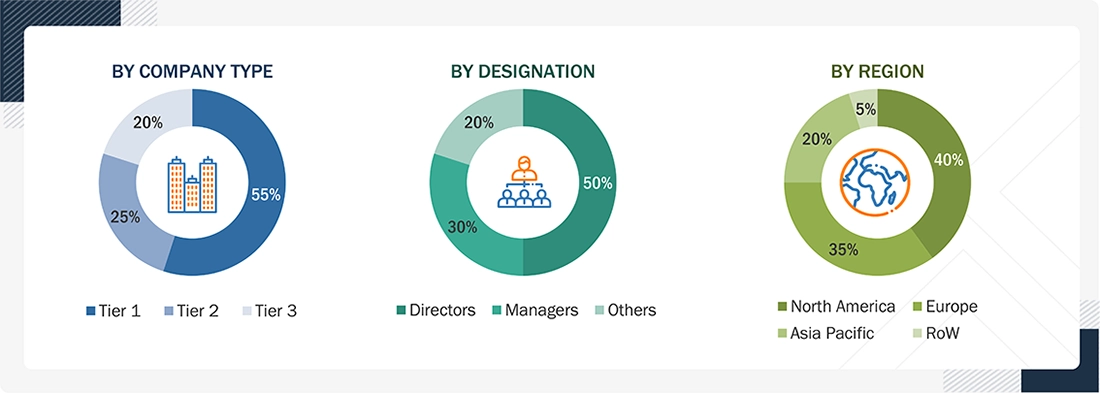
Notes: Tier 1, Tier 2, and Tier 3 companies are classified based on their market revenue in 2024/2025 available in the public domain, product portfolios, and geographical presence.
Other designations include consultants and sales, marketing, and procurement managers.
|
COMPANY NAME |
DESIGNATION |
|
LG Chem Ltd. |
Senior Manager |
|
Cabot Corporation |
Innovation Manager |
|
Resonac Corporation |
Vice-President |
|
Nanocyl SA |
Production Supervisor |
|
Jiangsu Cnano Technology Co., Ltd. |
Sales Manager |
To know about the assumptions considered for the study, download the pdf brochure
Market Size Estimation
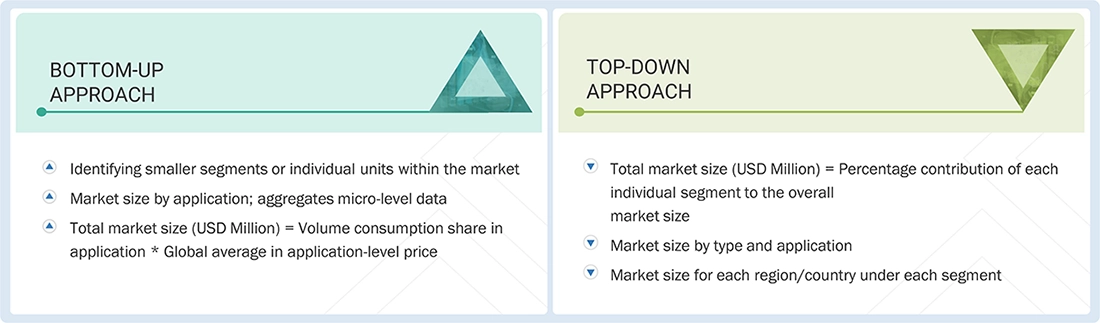
Both top-down and bottom-up approaches were used to estimate and validate the total size of the carbon nanotubes market. These methods were also used extensively to estimate the size of various subsegments in the market. The research methodology used to estimate the market size includes the following:
- The key players in the industry have been identified through extensive secondary research.
- The supply chain of the industry has been determined through primary and secondary research.
- All percentage shares, splits, and breakdowns have been determined using secondary sources and verified through primary sources.
- All possible parameters that affect the markets covered in this research study have been accounted for, viewed in extensive detail, verified through primary research, and analyzed to obtain the final quantitative and qualitative data.
Carbon Nanotubes Market : Top-Down and Bottom-Up Approach
Data Triangulation
After determining the overall market size using the market size estimation processes explained above, the market was divided into several segments and subsegments. To complete the overall market engineering process and determine the exact statistics for each market segment and subsegment, data triangulation and market breakdown procedures were employed, as applicable. The data was triangulated by studying various factors and trends from both the demand and supply sides in the carbon nanotubes industry.
Market Definition
According to the American Carbon Society, carbon nanotubes are cylindrical nanostructures composed of rolled graphene sheets with exceptional mechanical strength, electrical conductivity, and thermal performance. Carbon nanotubes refer to advanced nanomaterials used to enhance conductivity, durability, and lightweight properties in applications such as electronics, energy storage, automotive components, aerospace materials, and conductive polymers. Their multifunctional performance and compatibility with high-performance material systems are driving increasing adoption across advanced manufacturing industries.
Key Stakeholders
- Carbon nanotube manufacturers
- Carbon nanotube distributors
- Raw material suppliers
- Government and research organizations
- Investment banks and private equity firms
Report Objectives
- To analyze and forecast the size of the global carbon nanotubes market in terms of value and volume
- To provide detailed information about the major drivers, restraints, challenges, and opportunities influencing the market growth
- To define, describe, and segment the market based on type, application, and region
- To forecast the size of the market segments based on regions such as Asia Pacific, North America, Europe, the Middle East & Africa, and South America
- To strategically analyze micromarkets with respect to individual growth trends, prospects, and their contribution to the overall market
- To strategically analyze the segmented markets with respect to individual growth trends, prospects, and contributions to the overall market
- To identify and analyze opportunities for stakeholders in the market
- To analyze competitive developments such as expansions, partnerships, joint ventures, mergers & acquisitions, agreements, and product launches in the market
- To strategically profile the key companies and comprehensively analyze their core competencies
Available customizations:
Along with the given market data, MarketsandMarkets offers customizations according to the company’s specific needs. The following customization options are available for the report:
Regional Analysis
- Further breakdown of a region with respect to a particular country or additional application
Company Information
- Detailed analysis and profiles of additional market players (up to five)
Get the Full Carbon Nanotubes Market Report
Full forecast, segment splits, and company analysis for all Carbon Nanotubes Market.
- Netherlands Carbon Nanotubes Market
- Belgium Carbon Nanotubes Market
- Russia Carbon Nanotubes Market
- Turkey Carbon Nanotubes Market
- Poland Carbon Nanotubes Market
- Saudi Arabia Carbon Nanotubes Market
- South Africa Carbon Nanotubes Market
- Brazil Carbon Nanotubes Market
- Argentina Carbon Nanotubes Market
- China Carbon Nanotubes Market
- India Carbon Nanotubes Market
- Japan Carbon Nanotubes Market
- Taiwan Carbon Nanotubes Market
- South Korea Carbon Nanotubes Market
- Malaysia Carbon Nanotubes Market
- Vietnam Carbon Nanotubes Market
- Indonesia Carbon Nanotubes Market
- Canada Carbon Nanotubes Market
- Mexico Carbon Nanotubes Market
- US Carbon Nanotubes Market
- Germany Carbon Nanotubes Market
- France Carbon Nanotubes Market
Need a Tailored Report?
Customize this report to your needs
Get 10% FREE Customization
Customize This Report
