
India Climate Adaption Market (2024-2029)

The India Climate Adaption Market was valued at $3121.2 Million in 2024 and projected to reach to $4762.6 Million by 2029, representing a compound annual growth rate of 7.3%. India's climate adaptation market is poised for sustained growth as the country prioritizes resilience against mounting environmental challenges.


| Market Size in | USD 26.32 MN |
| Market Forecast in | |
| CAGR | |
| Forecast Period | |
| Units Considered | Value (USD MN) |
India Climate Adaption Market Trends and Insights
- Valued at USD 3,121.2 million in 2024, India's market is projected to expand to USD 4,762.6 million by 2029, reflecting a compound annual growth rate of 7.3%.
- This expansion is driven by India's vulnerability to climate impacts, including extreme weather events, water scarcity, and agricultural disruption, which necessitate robust adaptation strategies across the energy and power sectors. India's climate adaptation initiatives focus on resilience-building infrastructure, renewable energy integration, and grid modernization to withstand climate-related disruptions.
- The Indian government's commitment to sustainable development and net-zero targets is catalyzing investments in climate-resilient power systems and water management solutions.
- India's market growth outpaces many emerging economies, reflecting the nation's recognition that climate adaptation is critical to economic stability and energy security through 2029 and beyond..
Key Market Statistics
- CAGR (2024-2029) 7.3% CAGR
- Market Size, 2024 ~USD 3121.2 Million
- Forecast, 2029 ~USD 4762.6 Million
- Country India
India Climate Adaption Market Overview
Market Valuation & Growth :
India's climate adaptation market reached USD 3,121.2 million in 2024 and is projected to grow to USD 4,762.6 million by 2029, representing a 7.3% CAGR, driven by increasing climate vulnerabilities and government initiatives.
Climate Risk Exposure :
India faces severe climate threats including extreme weather events, monsoon variability, droughts, and flooding. These escalating risks are compelling investments in adaptation infrastructure, water management systems, and resilient agricultural practices across the nation.
Government Support & Policy :
India's National Action Plan on Climate Change and state-level adaptation strategies are catalyzing market growth. Government funding, green bonds, and renewable energy mandates are accelerating climate adaptation investments in energy, agriculture, and water sectors.
Sectoral Opportunities :
Key growth areas include renewable energy infrastructure, water conservation technologies, climate-resilient agriculture, disaster management systems, and coastal protection measures. The energy sector dominates adaptation spending as India transitions toward sustainable power generation.
India Climate Adaption Market Dynamics
- With a 7.3% CAGR through 2029, the market reflects India's commitment to integrating climate adaptation into its development agenda.
- Government policies, international climate finance, and private sector participation are accelerating investments in renewable energy, water management, and agricultural adaptation. The market outlook remains positive as India balances economic growth with climate resilience.
- Increasing awareness of climate risks, coupled with technological advancements and infrastructure development, will drive demand for adaptation solutions.
- The energy sector will continue leading growth, supported by India's renewable energy targets and grid modernization initiatives, positioning the country as a key player in global climate adaptation markets..
Market Ecosystem
Related Ecosystem
Decarbonization
- Battery Electric Vehicle (BEV)
- Energy Management Systems
- Fuel Cell
- Fuel Cell Electric Vehicle (FCEV)
- Geographical Information System (GIS)
- TotalEnergies SE
- Siemens ag
- Mitsui & Co., Ltd.
- General Electric Company
- Thyssenkrupp ag
Key Takeaways
- India's climate adaptation market is valued at USD 3,121.2 million in 2024 and is expected to reach USD 4,762.6 million by 2029, growing at a 7.3% CAGR.
- India's vulnerability to climate impacts-including monsoon variability, droughts, and extreme heat-drives urgent demand for adaptation solutions in the energy and power sectors.
- India's government policies and renewable energy targets are accelerating investments in climate-resilient infrastructure and grid modernization across the nation.
- India's market growth reflects the critical importance of adaptation strategies for maintaining energy security and economic resilience in a climate-vulnerable region.
Climate Adaption Market Report Scope
| Report Metric | Details |
|---|---|
| Base Year | 2024 |
| Fastest Growing Segment | DIRECT AIR CAPTURE & CARBON STORAGE (DACCS) (Technology-Based Solution) |
| Forecast Period | 2024-2029 |
| Growth Rate | CAGR of 9.7% from 2024 to 2029 |
| Largest Segment | EARLY CLIMATE WARNING & ENVIRONMENT MONITORING SOLUTIONS (Solution) |
| Market Size Base Year (Billions) | ~USD 23.18 (2024) |
| Revenue Forecast (Billions) | ~USD 36.83 (2029) |
| Segments Covered | Solution, Technology-Based Solution, Solution Type, Application, Application Type, Type, End User, Industry |
India Climate Adaption Market Report Segmentation
8 segment dimensions are covered across the global market.
By Solution
- Early Climate Warning & Environment Monitoring Solutions
- Technology-Based Solutions
By Technology-Based Solution
- Bioenergy With Carbon Capture & Storage (Beccs)
- Carbon Capture & Storage (Ccs)
- Direct Air Capture & Carbon Storage (Daccs)
By Solution Type
- Data Acquisition & Transmission
- Data Communication
- Data Processing & Analysis
By Application
- Early Warning Systems
- Environmental Monitoring Systems
By Application Type
- Air Quality Monitoring Systems
- Land Cover Monitoring Systems
- Water Quality Monitoring Systems
- Weather Monitoring Systems
By Type
- Drought Early Warning Systems
- Flood Early Warning Systems
- Heatwave Early Warning Systems
By End User
- Academia & Research Institutions
- Government Agencies
- Industries
By Industry
- Chemicals & Petrochemicals
- Oil & Gas
- Other Industries
- Power Generation
INDIA: CLIMATE ADAPTION MARKET, BY END USER, 2024–2030
| Segment | 2024 | 2025 | 2026 | 2027 | 2028 | 2029 | 2030 | CAGR (%) |
|---|---|---|---|---|---|---|---|---|
| ACADEMIA & RESEARCH INSTITUTIONS | 510.8 | 547.7 | 591.7 | 645.2 | 707.1 | 780.9 | 868.4 | 9.2 |
| GOVERNMENT AGENCIES | 846.6 | 884.7 | 931.4 | 989.8 | 1057.2 | 1137.8 | 1233 | 6.5 |
| INDUSTRIES | 1763.8 | 1854.5 | 1964.4 | 2100 | 2256 | 2442 | 2661.2 | 7.1 |
| TOTAL | 3121.2 | 3286.9 | 3487.5 | 3735 | 4020.3 | 4360.7 | 4762.6 | 7.3 |
Target Audience
- Energy & Power Companies : Renewable energy developers and power utilities need India-specific market data to identify adaptation investment opportunities, understand grid modernization requirements, and align with government renewable energy targets and climate policies.
- Government & Policy Makers : Indian government agencies and policymakers require detailed market insights to design effective climate adaptation strategies, allocate resources efficiently, and evaluate the impact of national action plans on market growth and resilience.
- Infrastructure & Water Management Firms : Companies in water management, irrigation, and infrastructure development need India market data to assess demand for climate-resilient solutions, understand regional vulnerabilities, and identify investment opportunities in water conservation and disaster management.
- Agricultural & Rural Development Organizations : Agricultural enterprises and rural development agencies require India-specific insights on climate-resilient farming practices, water management, and adaptation technologies to support farmers and enhance agricultural productivity amid climate challenges.
- Investment & Financial Institutions : Investors, venture capitalists, and financial institutions need comprehensive India market analysis to identify promising climate adaptation startups, evaluate sectoral growth potential, and make informed investment decisions in India's growing green economy.
Reasons to Buy this Report
- Market Size & Growth Trajectory : Access comprehensive data on India's USD 3.1 billion climate adaptation market with 7.3% CAGR through 2029. Understand market valuation, growth drivers, and expansion opportunities specific to India's unique climate vulnerabilities and adaptation needs.
- Sectoral Breakdown & Opportunities : Identify high-growth segments within India's adaptation market including renewable energy, water conservation, agricultural resilience, and disaster management. Gain insights into which sectors offer the most promising investment and expansion opportunities.
- Government Policy & Regulatory Landscape : Understand India's climate adaptation policies, national action plans, and state-level initiatives driving market growth. Access analysis of government funding mechanisms, green bonds, and regulatory frameworks shaping the competitive landscape.
- Competitive & Investment Insights : Benchmark against regional performance with India's 7.3% CAGR versus global 9.7% CAGR. Identify market gaps, emerging players, and strategic investment opportunities in India's rapidly evolving climate adaptation ecosystem.
- Risk Assessment & Future Outlook : Evaluate India's climate risk exposure, including extreme weather, monsoon variability, and flooding impacts. Understand how these risks translate into market demand and inform long-term strategic planning for India-focused climate adaptation businesses.
Frequently asked questions
What is the current size of India's climate adaptation market?
India's climate adaptation market was valued at USD 3,121.2 million in 2024 and is projected to grow to USD 4,762.6 million by 2029.
What is the growth rate of India's climate adaptation market?
India's climate adaptation market is growing at a compound annual growth rate (CAGR) of 7.3% from 2024 to 2029.
What are the primary drivers of growth in India's climate adaptation market?
India's market growth is driven by increasing climate vulnerabilities, government sustainability commitments, renewable energy expansion, and the need for resilient power infrastructure.
How does India's climate adaptation market compare to global trends?
India's 7.3% CAGR reflects strong regional demand for adaptation solutions, positioning India as a key growth market within the Asia Pacific region and globally.
What sectors within India's energy and power industry are most affected by climate adaptation needs?
India's power generation, grid infrastructure, water management for thermal plants, and renewable energy integration are the primary sectors driving climate adaptation investments.
RESEARCH METHODOLOGY
This study encompasses significant efforts in determining the present climate adaptation market size. It commenced with a thorough secondary research process to gather data related to the market, similar markets, and the overarching industry. Subsequently, these findings, assumptions, and market size calculations were rigorously validated by consulting industry experts across the entire supply chain through primary research. The total market size was assessed by conducting an analysis specific to each country. Following that, the market was further dissected, and the data was cross-referenced to estimate the size of various segments and sub-segments within the market.
Secondary Research
In this research study, a wide range of secondary sources were utilized, including directories, databases, and reputable references such as, Factiva, World Bank, International Monetary Fund (IMF), the US Department of Energy (DOE), Our world in Data, and the International Energy Agency (IEA). These sources played a crucial role in gathering valuable data for a comprehensive analysis of the global Climate adaptation market, covering technical, market-oriented, and commercial aspects. Additional secondary sources included annual reports, press releases, investor presentations, whitepapers, authoritative publications, articles authored by well-respected experts, information from industry associations, trade directories, and various database resources.
Primary Research
The market involves a range of stakeholders, including raw material suppliers/components, manufacturers/assemblers, climate adaptation solution providers, and distributors/end users. Fluctuations in raw material prices, industrial growth rate, and changes in manufacturing regulations affect the supply chain of the climate adaptation market. The demand for this market is primarily driven by end users such as Industries, Academia and Research Institutions, and Government agencies. On the supply side, there is a notable trend of heightened demand for contracts from the industrial sector and a significant presence of investments and expansions among major players.
To gather qualitative and quantitative insights, various primary sources from both the supply and demand sides of the market were interviewed. The following breakdown presents the primary respondents involved in the research study.
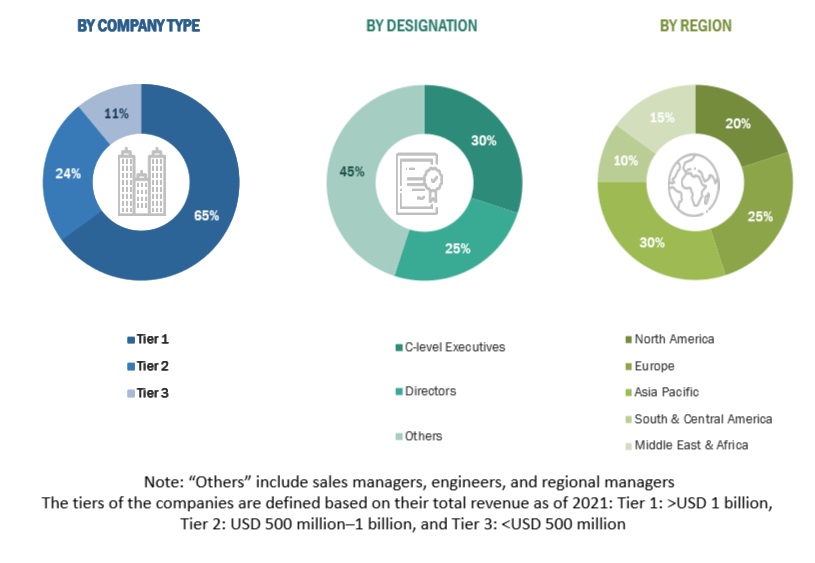
To know about the assumptions considered for the study, download the pdf brochure
Market Size Estimation
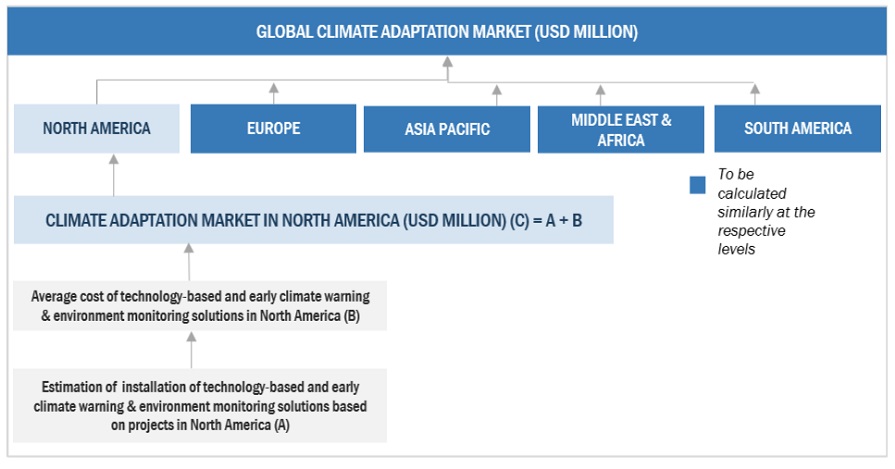
The estimation and validation of the Climate adaptation market size have been conducted using a bottom-up approach. This approach was rigorously employed to ascertain the dimensions of multiple subsegments within the market. The research process comprises the following key stages.
- Thorough secondary and primary research has been conducted to gain a comprehensive understanding of the global market landscape for various segments of market.
- Numerous primary interviews have been undertaken with key experts in the field of Climate adaptation development.
- When calculating and forecasting the market size, qualitative factors such as market drivers, limitations, opportunities, and challenges have been taken into account.
Global Climate Adaptation Market Size: Bottom-Up Approach
To know about the assumptions considered for the study, Request for Free Sample Report
Data Triangulation
The process of determining the overall market size involved the methodologies described earlier, followed by segmenting the market into multiple segments and subsegments. To finalize the comprehensive market analysis and obtain precise statistics for each market segment and subsegment, data triangulation and market segmentation techniques were applied, as appropriate. Data triangulation was accomplished by examining various factors and trends from both the demand and supply perspectives within the ecosystem of the market.
Market Definition
The climate adaptation market is defined as the sum of the revenues generated by global companies offering climate adaptation solutions for end users, such as government agencies, research institutes, and industries. The market has been studied for five key regions, such as North America, Europe, Asia Pacific, the Middle East & Africa, and South America.
Key Stakeholders
- Environmental Agencies
- Direct Air Capture System Manufacturers
- Climate Adaptation Solution Providers
- Carbon Capture Technology Providers
- Energy & Power Sector Consulting Companies
- Energy Regulators
- Government & Research Organizations
- State & National Regulators
- Investment Banks
- Repair & Maintenance Service Providers
- Oil & Gas, Power Generation, Chemical & Petrochemical Industries
Objectives of the Study
- To define, describe, and forecast the climate adaptation market by solution, end-user, and region, in terms of value
- To describe and forecast the market for five key regions, namely, North America, Europe, Asia Pacific, the Middle East & Africa, and South America, in terms of volume and value, along with their country-level market sizes, in terms of value
- To forecast the market by technology-based solution, in terms of volume
- To provide detailed information regarding key drivers, restraints, opportunities, and challenges influencing the growth of the market
- To strategically analyze the micromarkets1 with respect to individual growth trends, prospects, and contributions to the overall market size
- To provide the supply chain analysis, trends/disruptions impacting customers’ businesses, ecosystem/market map, pricing analysis, patent analysis, case study analysis, technology analysis, key conferences and events, trade analysis, Porter’s five forces analysis, key stakeholders and buying criteria, and regulatory analysis of the market
- To analyze opportunities for stakeholders in the market and draw a competitive landscape of the market
- To benchmark players within the market using the company evaluation matrix, which analyzes market players on several parameters within the broad categories of business and product strategies
- To compare key market players with respect to product specifications and applications
- To strategically profile key players and comprehensively analyze their market rankings and core competencies2
- To analyze competitive developments, such as contracts & agreements, investments & expansions, acquisitions, new product launches, partnerships, joint ventures & collaborations, in the market
Available Customization
With the given market data, MarketsandMarkets offers customizations based on the company’s specific needs. The following customization options are available for the report:
Product Analysis
- Product Matrix, which provides a detailed comparison of the product portfolio of each company
Company Information
- Detailed analyses and profiling of additional market players (up to 5)
Get the Full Climate Adaption Market Report
Full forecast, segment splits, and company analysis for all Climate Adaption Market.
- China Climate Adaption Market
- Japan Climate Adaption Market
- Australia Climate Adaption Market
- Canada Climate Adaption Market
- Mexico Climate Adaption Market
- US Climate Adaption Market
- Netherlands Climate Adaption Market
- Italy Climate Adaption Market
- France Climate Adaption Market
- UK Climate Adaption Market
- Norway Climate Adaption Market
- Brazil Climate Adaption Market
- Chile Climate Adaption Market
- Argentina Climate Adaption Market
- Rest Of Europe Climate Adaption Market
- Rest Of Asia Pacific Climate Adaption Market
- GCC Countries Climate Adaption Market
- Rest Of South America Climate Adaption Market
Need a Tailored Report?
Customize this report to your needs
Get 10% FREE Customization
Customize This Report
