
Africa Cloud Storage Market (2023-2028)

The Africa Cloud Storage Market was valued at $74.4 Million in 2023 and projected to reach to $192 Million by 2028, representing a compound annual growth rate of 20.9%. Africa's cloud storage market is positioned for substantial growth through 2028, driven by rapid digital transformation initiatives and increasing enterprise cloud adoption across the continent.


| Market Size in | USD 26.32 MN |
| Market Forecast in | |
| CAGR | |
| Forecast Period | |
| Units Considered | Value (USD MN) |
Africa Cloud Storage Market Trends and Insights
- Kuwait is experiencing accelerated digital transformation across both public and private sectors, driving enterprise adoption of scalable cloud infrastructure solutions.
- The market in Kuwait is projected to reach $192.0 million by 2028, representing a compound annual growth rate of 20.9%, substantially outpacing global trends. The growth trajectory in Kuwait reflects increasing data generation, regulatory compliance requirements, and the nation's strategic investments in digital economy initiatives.
- Kuwait's enterprises are increasingly migrating legacy systems to cloud platforms, supported by improved connectivity and competitive service offerings from regional and global providers.
- By 2028, Kuwait's cloud storage market is expected to capture heightened demand from financial services, government digitalization programs, and emerging technology sectors. Kuwait's market expansion is underpinned by rising cybersecurity awareness and the need for disaster recovery solutions among organizations.
- The competitive landscape in Kuwait continues to attract both established multinational providers and regional specialists, fostering innovation and service differentiation.
- Kuwait's strategic geographic position and economic diversification efforts position the nation as a key growth hub for cloud infrastructure investment in the Middle East region..
Key Market Statistics
- CAGR (2023-2028) 20.9% CAGR
- Market Size, 2023 ~USD 74.4 Million
- Forecast, 2028 ~USD 192 Million
- Country Africa
Africa Cloud Storage Market Overview
Market Size & Growth :
Africa's cloud storage market was valued at $74.4 million in 2023 and is projected to reach $192.0 million by 2028, representing a robust CAGR of 20.9%, outpacing the global average of 18.8%.
Digital Transformation Drivers :
Accelerated digital transformation across African public and private sectors is fueling enterprise adoption of scalable cloud infrastructure solutions, with governments and businesses prioritizing data accessibility and operational efficiency.
Regional Growth Momentum :
Africa demonstrates significant momentum in cloud storage adoption, driven by increasing internet penetration, rising smartphone usage, and growing awareness of cloud-based business solutions among SMEs and large enterprises.
Infrastructure Investment :
Expanding data center capacity and improved connectivity infrastructure across African nations are enabling faster cloud service deployment, reducing latency, and making cloud storage solutions more accessible to regional businesses.
Africa Cloud Storage Market Dynamics
- The region's expanding middle class, growing e-commerce sector, and government digitalization programs are creating strong demand for scalable, cost-effective cloud infrastructure solutions.
- Organizations are increasingly recognizing cloud storage as essential for business continuity, data security, and operational scalability. The forecast period will see intensified competition among global and regional cloud providers, with localized solutions gaining traction.
- Investment in African data centers and improved broadband infrastructure will further accelerate market penetration.
- Key growth opportunities exist in financial services, healthcare, education, and government sectors, where cloud adoption remains in early stages with significant upside potential..
Market Ecosystem
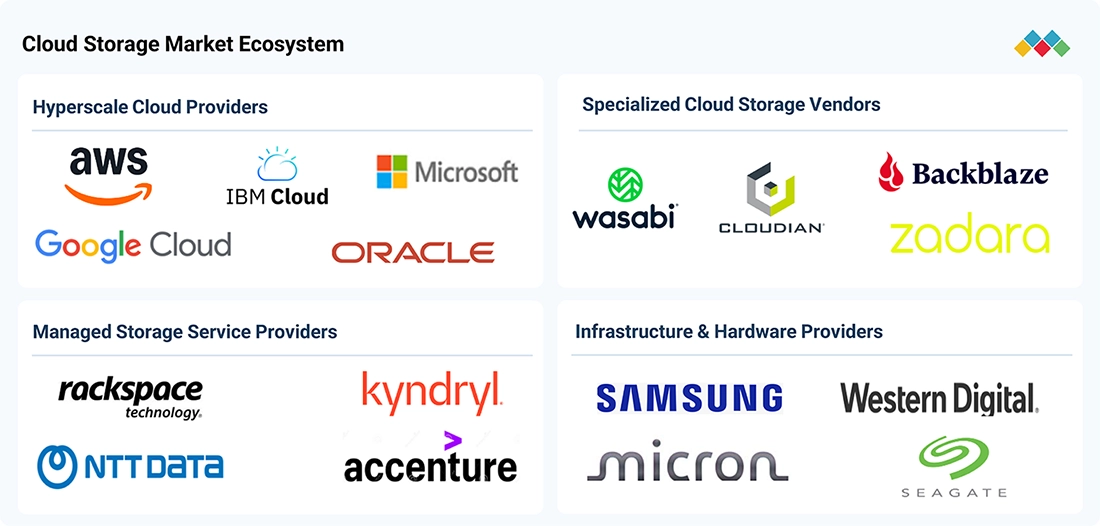
CLOUD STORAGE MARKET: COMMERCIAL USE CASES ACROSS INDUSTRIES
| COMPANY | USE CASE DESCRIPTION | BENEFITS |
|---|---|---|
 |
Woven by Toyota Accelerated AI Training with Cloud Storage FUSE | Reduced AI training time by 14% | Achieved 50% initial cost savings | Reduced storage costs by 97% versus a Luster-like alternative. |
 |
Ryanair Modernized Backup and Archive with Amazon S3 Glacier | Reduced backup costs by 65% | Eliminated ongoing physical tape management | Enabled scalable long-term cloud retention. |
 |
Create Advertising Modernized its 1.5 PB Media Archive | Migrated 1.5 PB of archive data | Cut archive costs approximately in half | Enabled instant retrieval without egress fees. |
Logos and trademarks shown above are the property of their respective owners. Their use here is for informational and illustrative purposes only.
Related Ecosystem
Cloud Computing
- Software as A Service (SaaS)
- Natural Language Processing (NLP)
- Platform as A Service (PaaS)
- Machine Learning
- Supply Chain Management
- International Business Machines Corporation
- MICROSOFT CORPORATION
- Oracle Corporation
- Amazon.com, Inc.
Software And Services
- Natural Language Processing (NLP)
- Machine Learning
- Supply Chain Management
- Predictive Analytics
- Image Sensors
- International Business Machines Corporation
- MICROSOFT CORPORATION
- Oracle Corporation
- SAP SE
- Amazon.com, Inc.
Digitalization And Iot
- Sensors
- Remote Monitoring
- Supply Chain Management
- Passenger Information System (PIS)
- Platform as A Service (PaaS)
- International Business Machines Corporation
- Cisco Systems, Inc.
- MICROSOFT CORPORATION
- Oracle Corporation
- SAP SE
Key Takeaways
- Kuwait's cloud storage market is valued at $74.4 million in 2023 and is forecast to grow to $192.0 million by 2028 at a 20.9% CAGR.
- Kuwait's digital transformation initiatives across government and enterprise sectors are primary catalysts for cloud storage adoption.
- Kuwait's financial services and public sector organizations are driving significant demand for secure, compliant cloud infrastructure solutions.
- Kuwait's market growth outpaces global averages, positioning the nation as a strategic investment destination for cloud service providers in the Middle East.
Cloud Storage Market Report Scope
| Report Metric | Details |
|---|---|
| Base Year | 2023 |
| Fastest Growing Segment | HYBRID CLOUD (Deployment Model) |
| Forecast Period | 2023–2028 |
| Growth Rate | CAGR of 18.8% from 2023 to 2028 |
| Largest Segment | FILE STORAGE (Storage Type) |
| Market Size Base Year (Billions) | ~USD 99.27 (2023) |
| Revenue Forecast (Billions) | ~USD 234.9 (2028) |
| Segments Covered | Offering, Storage Type, Application, Organization Size, Deployment Model, Vertical |
Africa Cloud Storage Market Report Segmentation
6 segment dimensions are covered across the global market.
By Offering
- Services
- Storage Type
By Storage Type
- Block Storage
- File Storage
- Object Storage
By Application
- Backup & Recovery
- Big Data & Analytics
- Content Delivery & Distribution
- Data Archiving
- Database Storage Management
- Other Applications
By Organization Size
- Large Enterprises
- Smes
By Deployment Model
- Hybrid Cloud
- Private Cloud
- Public Cloud
By Vertical
- Bfsi
- Energy & Utilities
- Government & Public Sector
- Healthcare & Life Sciences
- It & Ites
- Manufacturing
- Media & Entertainment
- Other Verticals
- Retail & Consumer Goods
- Telecommunications
MIDDLE EAST & AFRICA: CLOUD STORAGE MARKET, BY APPLICATION, 2023–2028
| Segment | 2023 | 2024 | 2025 | 2026 | 2027 | 2028 | CAGR (%) |
|---|---|---|---|---|---|---|---|
| BACKUP & RECOVERY | 789.5 | 972 | 1184.3 | 1420.3 | 1681.2 | 1969.7 | 20.1 |
| BIG DATA & ANALYTICS | 573.4 | 713.7 | 879.2 | 1066 | 1275.7 | 1511.1 | 21.4 |
| CONTENT DELIVERY & DISTRIBUTION | 710.1 | 888.2 | 1099.4 | 1339.4 | 1610.7 | 1917.1 | 22 |
| DATA ARCHIVING | 428.9 | 526.3 | 639.2 | 764 | 901.4 | 1052.5 | 19.7 |
| DATABASE STORAGE MANAGEMENT | 305.5 | 378.7 | 464.7 | 561.2 | 669.1 | 789.4 | 20.9 |
| OTHER APPLICATIONS | 140.4 | 166.3 | 194.2 | 222.5 | 250.7 | 278.2 | 14.7 |
| TOTAL | 2947.8 | 3645.3 | 4461.1 | 5373.4 | 6388.8 | 7518 | 20.6 |
Target Audience
- Cloud Service Providers : Cloud vendors and infrastructure providers need Africa-specific market data to identify expansion opportunities, assess competitive positioning, and develop localized service offerings for the rapidly growing region.
- Enterprise IT Decision-Makers : CIOs and IT directors in African organizations require market insights to evaluate cloud storage solutions, benchmark against regional peers, and justify cloud infrastructure investments to stakeholders.
- Investment & Private Equity Firms : Investors targeting African tech and digital infrastructure sectors need comprehensive market analysis to identify promising cloud storage companies, assess growth potential, and make informed funding decisions.
- Government & Policy Makers : African government agencies and policymakers need market intelligence to develop digital transformation strategies, understand technology adoption trends, and create supportive regulatory frameworks for cloud services.
- Technology Consultants & Analysts : Consulting firms and research analysts require detailed Africa cloud storage data to advise clients on market trends, competitive dynamics, and strategic opportunities in the region's growing digital economy.
Key Companies in the Africa Cloud Storage Market
| Company | HQ | Ownership | Strongest segments |
|---|---|---|---|
| THE SAGE GROUP PLC | United Kingdom | Public Company | File Storage,Object Storage,Block Storage, |
| ITRON INC | United States | Public Company | Object Storage,File Storage,Block Storage, |
| KPN | Netherlands | Public Company | File Storage,Object Storage,Block Storage, |
| LARSEN & TOUBRO LTD. | India | Public Company | Object Storage Services & Integration,File Storage Services & Integration,Block Storage Services & Integration, |
| PCCW | Hong Kong | Public Company | File Storage,Object Storage,Block Storage, |
| DIMENSION DATA | United Kingdom | Private Company | File Storage,Object Storage,Block Storage, |
| HOYA CORPORATION | Japan | Public Company | Glass disks for HDDs (supporting file/object storage backends),Photomasks and mask blanks for storage-related semiconductors,Imaging and optical components for data center and network equipment, |
| ARROW ELECTRONICS, INC | United States | Public Company | File Storage,Object Storage,Block Storage, |
| PERSISTENT SYSTEMS | India | Public Company | Integration & Implementation,Support & Maintenance,Training & Consulting, |
| MOBILY | Saudi Arabia | Public Company | Object Storage,File Storage,Block Storage, |
| F5 NETWORKS | United States | Public Company | Object-storage–backed workloads,Block-storage–backed workloads,File-storage–backed workloads, |
| HCL TECHNOLOGIES LIMITED | India | Public Company | Integration & Implementation,Support & Maintenance,Training & Consulting, |
| INGRAM MICRO | United States | Public Company | File Storage,Object Storage,Block Storage, |
| IBM | United States | Public Company | Object Storage,Block Storage,File Storage, |
| United States | Public Company | Object Storage,File Storage,Block Storage, | |
| MICROSOFT | United States | Public Company | Object Storage,File Storage,Block Storage, |
| ORACLE | United States | Public Company | Object Storage,Block Storage,File Storage, |
| RACKSPACE TECHNOLOGY | United States | Public Company | File Storage Services,Object Storage Services,Block Storage Services, |
| HEWLETT PACKARD ENTERPRISE | United States | Public Company | File Storage,Object Storage,Block Storage, |
| DELL TECHNOLOGIES | United States | Public Company | File Storage,Object Storage,Block Storage, |
| DROPBOX | United States | Public Company | File Storage (incl. sync & sharing),Object Storage–backed services (archiving, large media),Backup & Recovery solutions, |
| BOX | United States | Public Company | File Storage & Collaboration (core SaaS platform),Content Workflows, Automation & Integration,E-signature and Advanced Security/Governance Add-ons, |
| FUJITSU | Japan | Public Company | File Storage,Object Storage,Block Storage, |
| VMWARE | United States | Private Company | Block Storage (vSAN, VxRail, VM-centric storage),File/Object-adjacent Storage and Data Services,Training & Consulting, |
THE SAGE GROUP PLC
The Sage Group PLC is a United Kingdom-based public company founded in 1981 that employs 11,094 people. The company operates in the software and business services sector.
ITRON INC
Itron Inc is a United States-based public company founded in 1977 with 4,987 employees. The company specializes in technology and software solutions for energy and water utilities.
KPN
KPN is a Netherlands-based public company founded in 1881 with 9,293 employees. The company operates as a telecommunications and technology services provider.
LARSEN & TOUBRO LTD.
Larsen & Toubro Ltd. is an India-based public company founded in 1938 with 55,662 employees. The company operates in engineering, construction, and technology services sectors.
PCCW
PCCW is a Hong Kong-based public company founded in 1925 with 14,600 employees. The company provides telecommunications, media, and technology services.
DIMENSION DATA
Dimension Data is a United Kingdom-based private company founded in 1983 with 11,032 employees. The company offers IT services, consulting, and technology solutions to enterprise clients.
HOYA CORPORATION
Hoya Corporation is a Japan-based public company founded in 1941 with 37,752 employees. The company manufactures optical products, medical devices, and related technology solutions.
ARROW ELECTRONICS, INC
Arrow Electronics, Inc is a United States-based public company founded in 1935 with 22,230 employees. The company operates as a distributor of electronic components and technology products.
PERSISTENT SYSTEMS
Persistent Systems is an India-based public company founded in 1990 with 22,205 employees. The company provides software development, consulting, and IT services to global clients.
MOBILY
Mobily is a Saudi Arabia-based public company founded in 2004 with 3,000 employees. The company operates as a telecommunications and mobile services provider.
F5 NETWORKS
F5 Networks is a United States-based public company founded in 1996 with 6,545 employees. The company develops application delivery and security software solutions.
HCL TECHNOLOGIES LIMITED
HCL Technologies Limited is an India-based public company founded in 1976. The company provides IT services, software development, and technology consulting to enterprise clients.
INGRAM MICRO
Ingram Micro is a United States-based public company founded in 1979 with 22,200 employees. The company operates as a distributor of technology products and IT services.
IBM
IBM is a United States-based public company founded in 1911 with 264,300 employees. The company operates in information technology, software, and business services sectors.
Google is a United States-based public company founded in 1998 with 194,668 employees. The company provides search, advertising, cloud computing, and technology services.
MICROSOFT
Microsoft is a United States-based public company founded in 1975 with 228,000 employees. The company develops software, cloud services, and technology solutions for consumers and enterprises.
ORACLE
Oracle is a United States-based public company founded in 1977 with 141,000 employees. The company develops database software, cloud services, and enterprise technology solutions.
RACKSPACE TECHNOLOGY
Rackspace Technology is a United States-based public company founded in 1998 with 5,000 employees. The company provides cloud computing, managed services, and technology solutions.
HEWLETT PACKARD ENTERPRISE
Hewlett Packard Enterprise is a United States-based public company founded in 1939 with 67,000 employees. The company provides enterprise IT infrastructure, software, and technology services.
DELL TECHNOLOGIES
Dell Technologies is a United States-based public company founded in 1984 with 97,000 employees. The company manufactures and sells computers, servers, storage systems, and technology solutions.
DROPBOX
Dropbox is a United States-based public company founded in 2007 with 2,113 employees. The company provides cloud storage and file synchronization services.
BOX
Box is a United States-based public company founded in 2005 with 2,912 employees. The company provides cloud content management and collaboration software solutions.
FUJITSU
Fujitsu is a Japan-based public company founded in 1935 with 99,203 employees. The company provides IT services, software, hardware, and technology solutions to global clients.
VMWARE
VMware is a United States-based private company founded in 1998 with 38,300 employees. The company develops virtualization, cloud computing, and enterprise software solutions.
Reasons to Buy this Report
- Market Size & Forecast Data : Access precise market valuation ($74.4M in 2023) and 5-year forecasts ($192M by 2028) with detailed CAGR analysis specific to Africa, enabling accurate business planning and investment decisions.
- Competitive Landscape Intelligence : Understand regional and global player positioning, market share distribution, and competitive strategies tailored to Africa's unique business environment and regulatory landscape.
- Growth Driver Analysis : Identify key catalysts for cloud storage adoption in Africa including digital transformation initiatives, sector-specific demand patterns, and infrastructure development trends shaping market expansion.
- Sector-Specific Opportunities : Discover high-potential segments within African markets including financial services, healthcare, education, and government, with detailed insights into adoption rates and growth trajectories.
- Strategic Market Entry Guidance : Develop informed go-to-market strategies for Africa with country-level insights, regulatory considerations, partnership opportunities, and customer segmentation data for successful regional expansion.
Frequently asked questions
What is the current size of Kuwait's cloud storage market?
Kuwait's cloud storage market was valued at $74.4 million in 2023 and is projected to reach $192.0 million by 2028.
What is the expected growth rate for cloud storage in Kuwait?
Kuwait's cloud storage market is expected to grow at a compound annual growth rate (CAGR) of 20.9% from 2023 to 2028.
Which sectors are driving cloud storage demand in Kuwait?
Kuwait's financial services, government digitalization programs, and emerging technology sectors are primary drivers of cloud storage adoption.
How does Kuwait's cloud storage market compare to global trends?
Kuwait's market growth rate of 20.9% CAGR significantly exceeds the global average of 18.8%, reflecting accelerated digital transformation in the nation.
What factors are supporting cloud storage expansion in Kuwait?
Kuwait's expansion is supported by digital economy initiatives, improved connectivity, regulatory compliance requirements, and rising cybersecurity awareness among enterprises.
RESEARCH METHODOLOGY
This research study on the cloud storage market involved extensive secondary and primary research. Secondary sources included company annual reports, regulatory filings, investor presentations, earnings transcripts, product documentation, pricing pages, press releases, technical white papers, government publications, industry associations, cloud architecture documentation, and publicly available data on digital infrastructure and enterprise cloud adoption. Primary sources included industry experts from cloud service providers, enterprise storage vendors, cloud storage specialists, managed service providers, system integrators, technology consulting organizations, and enterprise users. In-depth interviews with market participants and subject-matter experts were conducted to gather and validate critical qualitative and quantitative information, assess vendor positioning, understand storage consumption patterns, and evaluate the market's historical and future growth prospects.
Secondary Research
During the secondary research process, multiple sources were reviewed to identify and collect information relevant to the study. These sources included annual reports, regulatory filings, investor presentations, earnings transcripts, press releases, product portfolios, pricing structures, customer case studies, acquisition announcements, partnership disclosures, and technical documentation from cloud storage vendors. Additional information was gathered from government websites, industry associations, technology standards organizations, cloud provider documentation, data protection and sovereignty regulations, certified technical publications, and publicly available infrastructure statistics. Data on enterprise cloud adoption, storage capacity expansion, unstructured data generation, data lake adoption, artificial intelligence workloads, backup and disaster recovery requirements, cloud-native application deployment, regional cloud infrastructure expansion, and storage pricing was also evaluated. Secondary research was used to establish vendor revenue pools, market boundaries, segmentation assumptions, regional indicators, and the initial market-sizing framework.
Primary Research
During the primary research process, respondents from the supply and demand sides were interviewed to gather qualitative and quantitative market information. Supply-side participants included chief executive officers, vice presidents, directors, product managers, storage architects, engineering leaders, business development executives, marketing executives, and cloud storage specialists. Interviews also included executives from hyperscale cloud providers, enterprise storage vendors, cloud-native storage providers, managed storage service providers, backup and data protection vendors, system integrators, cloud migration specialists, professional service providers, and related technology organizations.
Demand-side participants included CIOs, CTOs, cloud infrastructure leaders, storage administrators, enterprise architects, data platform teams, AI and analytics infrastructure teams, application owners, DevOps and platform engineering teams, backup and disaster recovery leaders, data governance professionals, and enterprise IT decision-makers. Primary research validated storage adoption patterns, pricing assumptions, deployment preferences, application demand, vendor positioning, market segmentation, and regional market estimates.
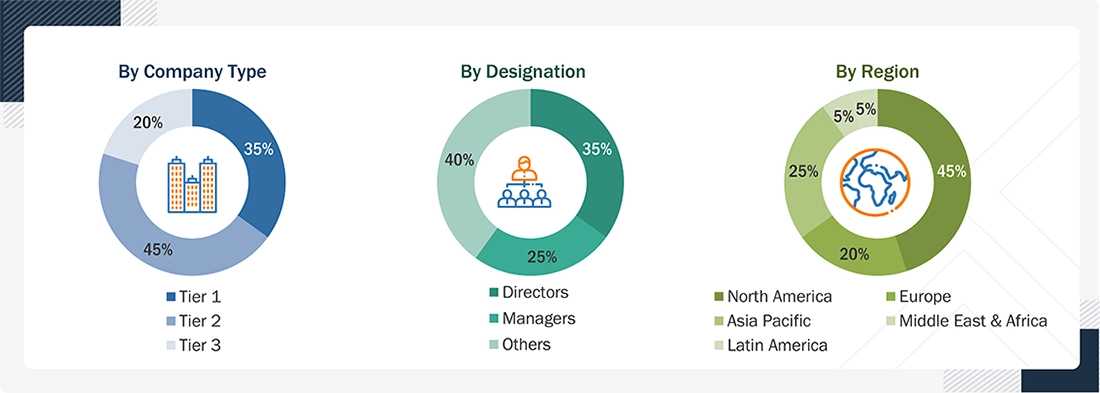
Note: Tier 1 companies have annual revenues of more than USD 1 billion; Tier 2 companies have annual revenues between USD 100 million and USD 1 billion; and Tier 3 companies have annual revenues below USD 100 million. Other designations include professionals working across sales, marketing, engineering, product management, operations, research, cloud architecture, and storage infrastructure.
To know about the assumptions considered for the study, download the pdf brochure
Market Size Estimation
Multiple approaches were used to estimate and forecast the cloud storage market. The first approach estimated market revenue generated by companies from cloud storage infrastructure, cloud storage platforms, and directly associated storage services. Vendor revenues were evaluated and allocated across relevant market segments based on product functionality, storage architecture, deployment model, application exposure, customer profile, geographic presence, and service mix. Only revenue directly attributable to cloud storage was retained, while generic cloud compute, networking, database, cybersecurity, traditional storage hardware, unrelated SaaS, and general IT services were excluded. Estimates were then validated using enterprise cloud adoption, storage capacity requirements, application workload growth, publicly available pricing, customer deployments, regional infrastructure expansion, vendor disclosures, and primary interviews.
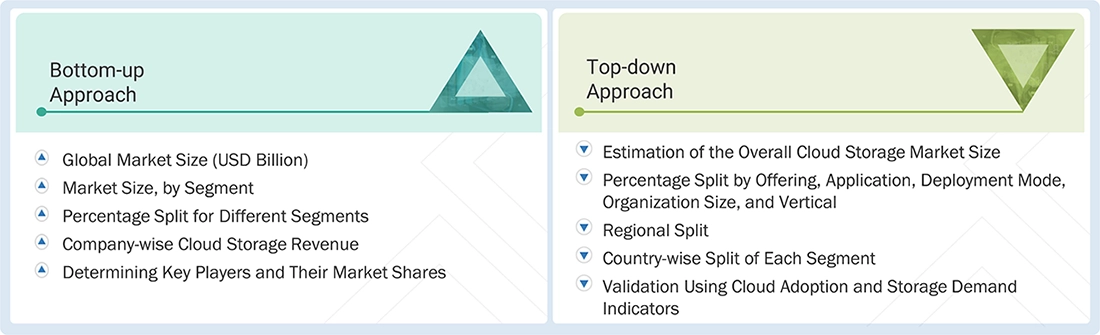
Market Size Estimation Methodology: Top-down Approach
The top-down approach began by defining the addressable revenue pool for cloud-based storage infrastructure, platforms, and related services. Publicly disclosed cloud and infrastructure revenues, company filings, storage-specific disclosures, product portfolios, customer deployments, pricing structures, regional infrastructure expansion, and storage service availability were analyzed to distinguish cloud storage from broader compute, networking, database, software, and infrastructure businesses. Storage-relevant revenue was then assessed using indicators such as adoption of object, block, and file storage; backup and archive requirements; artificial intelligence and analytics workloads; cloud-native applications; data protection; and hybrid-cloud storage deployment. The resulting market envelope was segmented by offering, application, deployment model, organization size, vertical, region, and country. The estimates were then cross-validated against vendor-level revenue analysis and primary research findings.
Market Size Estimation Methodology: Bottom-up Approach
The bottom-up approach involved compiling an extensive list of companies providing cloud storage infrastructure, cloud storage platforms, data protection capabilities, storage management, and related services. Each company's relevant revenue was estimated using annual reports, regulatory filings, investor presentations, earnings transcripts, product documentation, pricing information, customer references, acquisition disclosures, and other official company information. Revenue attributable to object storage, block storage, file storage, migration & integration, managed storage services, and support & maintenance was isolated from broader company revenue.
Company-level estimates were aggregated to calculate the global market size and then allocated across applications, deployment models, organization sizes, verticals, and regions. Revenue from generic cloud compute, networking, databases, cybersecurity, traditional non-cloud storage hardware, unrelated SaaS, and generic professional services was excluded. Regional estimates were further validated using cloud infrastructure availability, enterprise adoption, customer deployments, data residency requirements, storage consumption patterns, and primary interviews.
Data Triangulation
After determining the overall market size using top-down and bottom-up estimation methods, the market was segmented into segments and subsegments. Data triangulation and market breakup procedures were used to validate each market segment and subsegment. Vendor revenues, cloud storage portfolios, customer adoption patterns, deployment models, storage types, application workloads, pricing structures, regional indicators, and primary interview findings were compared to identify inconsistencies.
The final market size was determined by reconciling supply-side vendor revenues with demand-side indicators, including cloud adoption, storage consumption, data growth, infrastructure expansion, application modernization, backup requirements, and enterprise technology spending. Validated percentage splits were then applied across the full market segmentation to derive estimates at the segment, regional, and country levels.
Market Definition
The cloud storage market comprises cloud-based storage infrastructure, platforms, and associated services that enable organizations to store, manage, protect, access, migrate, replicate, and retain data across public, private, and hybrid cloud environments. The market includes object, block, and file storage, along with migration and integration, managed storage services, and support and maintenance directly associated with cloud storage deployments.
Cloud storage supports workloads such as analytics and data lakes, artificial intelligence and high-performance computing, enterprise business applications, cloud-native applications, data protection, compliance and long-term retention, digital content and media, and end-user productivity. The market excludes generic cloud compute and networking revenue; database services for which storage revenue cannot be separated; traditional enterprise storage hardware unrelated to cloud deployments; endpoint and consumer storage; unrelated cybersecurity products; general SaaS applications; generic IT outsourcing; and consulting or managed services without a direct cloud storage component.
Key Stakeholders
- Hyperscale cloud service providers
- Cloud storage service providers
- Object storage providers
- Block storage providers
- Managed file storage providers
- Enterprise and hybrid-cloud storage vendors
- Cloud-native storage platform providers
- Backup and disaster recovery providers
- Data protection and archive solution providers
- Managed storage service providers
- Cloud migration and integration service providers
- System integrators and cloud consulting organizations
- Data center and infrastructure service providers supporting cloud storage delivery
- AI, analytics, and data platform infrastructure teams
- Cloud-native application and Kubernetes ecosystem participants
- Enterprise cloud infrastructure and storage teams
Report Objectives
- To define and describe the cloud storage market by offering, application, deployment mode, organization size, vertical, and region
- To provide detailed information on major factors influencing market growth, including drivers, restraints, opportunities, and challenges across the cloud storage ecosystem
- To strategically analyze micro-markets with respect to individual growth trends, storage adoption patterns, workload requirements, and their contribution to the overall cloud storage market
- To analyze market opportunities for stakeholders and present the competitive landscape across hyperscalers, cloud storage specialists, enterprise storage vendors, and storage service providers
- To project market size and submarket value across North America, Europe, Asia Pacific, Middle East & Africa, and Latin America
- To analyze major countries within each region based on cloud adoption, digital infrastructure development, enterprise data growth, storage workload demand, and regulatory requirements
- To strategically profile leading companies and evaluate their product portfolios, storage capabilities, geographic presence, business strategies, and market positioning
- To examine competitive developments, including product launches, storage platform enhancements, partnerships, integrations, acquisitions, regional expansions, and infrastructure investments
- To assess the impact of artificial intelligence, data lakes, cloud-native applications, cyber resilience, data sovereignty, high-performance storage, and hybrid-cloud architectures on market development
Available customizations:
Based on the market data provided, customization can be tailored to the company's specific research requirements. The following customization options can be offered for the report:
Product Analysis
- A product matrix providing a detailed comparison of company portfolios across object, block, and file storage; cloud storage services; deployment models; storage management capabilities; data protection functionality; workload alignment; and geographic availability.
Geographic Analysis based on feasibility
- Further breakup of the North American cloud storage market
- Further breakup of the European cloud storage market
- Further breakup of the Asia Pacific cloud storage market
- Further breakup of the Middle East & African cloud storage market
- Further breakup of the Latin American cloud storage market
Company Information
- Detailed analysis and profiling of additional market players (up to five)
Get the Full Cloud Storage Market Report
Full forecast, segment splits, and company analysis for all Cloud Storage Market.
- Rest Of Latin America Cloud Storage Market
- Middle East Cloud Storage Market
- Bahrain Cloud Storage Market
- Canada Cloud Storage Market
- US Cloud Storage Market
- UK Cloud Storage Market
- Germany Cloud Storage Market
- France Cloud Storage Market
- Italy Cloud Storage Market
- China Cloud Storage Market
- Japan Cloud Storage Market
- Brazil Cloud Storage Market
- Mexico Cloud Storage Market
- Rest Of Europe Cloud Storage Market
- Rest Of Asia Pacific Cloud Storage Market
Need a Tailored Report?
Customize this report to your needs
Get 10% FREE Customization
Customize This Report
