
Germany Cocoa and Chocolate Market (2025-2030)

The Germany Cocoa and Chocolate Market was valued at $3210 Million in 2025 and projected to reach to $3713.6 Million by 2030, representing a compound annual growth rate of CAGR 3.0%. Germany's cocoa and chocolate market is poised for steady growth through 2030, supported by robust consumer spending on premium confectionery products and the country's strong chocolate manufacturing heritage.


| Market Size in | USD 26.32 MN |
| Market Forecast in | |
| CAGR | |
| Forecast Period | |
| Units Considered | Value (USD MN) |
Germany Cocoa and Chocolate Market Trends and Insights
- Germany maintains a significant position within the European chocolate sector, driven by strong consumer demand for premium and artisanal chocolate products.
- The market in Germany reflects steady expansion as consumers increasingly seek high-quality cocoa-based confectionery and specialty chocolate offerings. The forecast period through 2030 indicates sustained growth momentum for Germany's cocoa and chocolate industry.
- Germany's market growth is supported by innovation in product formulations, rising consumer awareness of sustainable sourcing, and the premiumization trend across chocolate categories.
- Germany continues to be a key hub for chocolate manufacturing and consumption in Europe, with both domestic producers and international brands competing for market share. Germany's cocoa and chocolate market dynamics are shaped by evolving consumer preferences toward healthier options, ethical sourcing, and functional chocolate products.
- The market in Germany is expected to benefit from increased distribution channels, e-commerce expansion, and growing demand from both retail and foodservice segments through 2030..
Key Market Statistics
- CAGR (2025-2030) CAGR 3.0%
- Market Size, 2025 ~USD 3210 Million
- Forecast, 2030 ~USD 3713.6 Million
- Country Germany
Germany Cocoa and Chocolate Market Overview
Market Size & Growth :
Germany's cocoa and chocolate market is valued at USD 3,210.0 million in 2025, with projected growth to USD 3,713.6 million by 2030, reflecting a steady 3.0% CAGR.
Premium Product Dominance :
German consumers show strong preference for premium and artisanal chocolate products, positioning Germany as a key market for high-quality chocolate manufacturers and specialty brands.
European Market Leadership :
Germany maintains a significant position within the European chocolate sector, leveraging its reputation for quality craftsmanship and innovation in cocoa-based confectionery.
Steady Market Expansion :
The German market demonstrates consistent growth driven by sustained consumer demand, established distribution networks, and increasing interest in sustainable and ethically-sourced chocolate products.
Germany Cocoa and Chocolate Market Dynamics
- The market benefits from established retail infrastructure, both traditional and e-commerce channels, and a consumer base that values quality and sustainability.
- German manufacturers continue to innovate with artisanal offerings and functional chocolate products, catering to evolving health-conscious preferences.
- The 3.0% CAGR reflects moderate but consistent expansion, with opportunities in premium segments and specialty chocolate categories driving market development..
Market Ecosystem
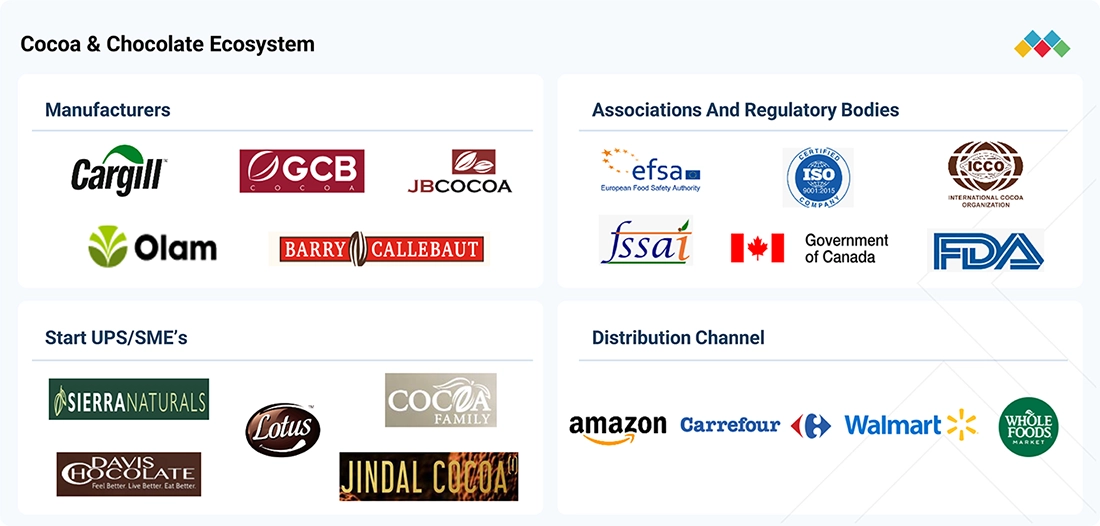
COCOA AND CHOCOLATE MARKET: COMMERCIAL USE CASES ACROSS INDUSTRIES
| COMPANY | USE CASE DESCRIPTION | BENEFITS |
|---|---|---|
 |
Barry Callebaut developed WholeFruit chocolate/Cacao Barry WholeFruit Evocao, using ingredients from the cacao fruit, including cocoa pulp, to create a new chocolate format. The company also developed Cabosse Naturals to utilize more of the cocoa fruit. | Reduces cocoa-fruit waste, creates additional value from underutilized cocoa fractions, enables differentiated chocolate products, and supports circularity in cocoa processing. |
 |
Cargill introduced its NatureFresh Professional Chocolate Indulgence range in India, featuring block chocolates, chocolate chips, and cocoa powder in dark, intense dark, milk, and white variants. The products were developed for bakery and food-service applications, including ganache, mousse, fillings, garnishing, moulding, and enrobing. | Provides manufacturers and bakers with versatile cocoa-based ingredients for multiple applications. The range offers different chocolate profiles, consistent quality, and suitable formats for product development across bakery, confectionery, and ice cream applications. |
Logos and trademarks shown above are the property of their respective owners. Their use here is for informational and illustrative purposes only.
Related Ecosystem
Key Takeaways
- Germany's cocoa and chocolate market is valued at USD 3,210.0 million in 2025 and will reach USD 3,713.6 million by 2030 at a 3.0% CAGR.
- Germany is a leading European market for premium and artisanal chocolate, with strong consumer preference for high-quality cocoa products.
- Sustainable sourcing and ethical production practices are key growth drivers shaping Germany's chocolate market through 2030.
- Germany's market expansion is supported by e-commerce growth, premiumization trends, and innovation in functional chocolate formulations.
Cocoa and Chocolate Market Report Scope
| Report Metric | Details |
|---|---|
| Base Year | 2025 |
| Fastest Growing Segment | COSMETICS (Application) |
| Forecast Period | 2025–2030 |
| Growth Rate | CAGR of 3.6% from 2025 to 2030 |
| Largest Segment | FOOD & BEVERAGES (Application) |
| Market Size Base Year (Billions) | ~USD 23.66 (2025) |
| Revenue Forecast (Billions) | ~USD 28.24 (2030) |
| Segments Covered | Type, Application |
Germany Cocoa and Chocolate Market Report Segmentation
2 segment dimensions are covered across the global market.
By Type
- Bakery
- Cocoa Butter
- Cocoa Liquor
- Cocoa Powder
- Confectionery
- Other Food & Beverage Applications
By Application
- Cosmetics
- Food & Beverages
- Pharmaceuticals
Target Audience
- Chocolate Manufacturers & Producers : Require Germany-specific market data to benchmark production capacity, identify growth opportunities in premium segments, and develop localized product strategies for the German market.
- Retail & Distribution Companies : Need detailed market insights to optimize inventory management, identify emerging consumer trends in German chocolate preferences, and plan retail expansion across traditional and e-commerce channels.
- Investment & Private Equity Firms : Utilize Germany market forecasts and valuation data for due diligence, portfolio company performance benchmarking, and identifying acquisition targets within the German chocolate sector.
- Marketing & Brand Strategy Teams : Require consumer demand analysis and market positioning data specific to Germany to develop targeted campaigns, brand differentiation strategies, and premium product marketing initiatives.
- Supply Chain & Procurement Specialists : Need Germany market intelligence to optimize sourcing strategies, identify supplier opportunities, and understand demand forecasts for cocoa and chocolate raw materials in the German market.
Key Companies in the Germany Cocoa and Chocolate Market
| Company | HQ | Ownership | Strongest segments |
|---|---|---|---|
| AMWAY | Malaysia | Public Company | Nutrition & weight management (NUTRILITE, bodykey, XS),Water & air treatment systems (eSpring, ATMOSPHERE),Beauty & personal care (ARTISTRY, G&H, GLISTER, SATINIQUE), |
AMWAY
Amway is a public company established in Malaysia in 1976 with 308 employees. The company operates in the direct sales and consumer goods sector.
Reasons to Buy this Report
- Market Size & Valuation Data : Access precise market valuation for Germany at USD 3,210.0 million (2025) and USD 3,713.6 million (2030), enabling accurate financial planning and investment decisions specific to the German market.
- Growth Trajectory & CAGR Analysis : Understand Germany's 3.0% CAGR performance relative to the global 3.6% benchmark, identifying market dynamics and competitive positioning within the European chocolate sector.
- Consumer Preference Insights : Gain detailed intelligence on German consumer demand for premium and artisanal chocolate products, informing product development, marketing strategies, and brand positioning decisions.
- Competitive Landscape Assessment : Evaluate market opportunities and competitive dynamics specific to Germany's established chocolate manufacturing base, distribution networks, and retail environment.
- Strategic Market Entry & Expansion : Leverage Germany-specific market data to develop targeted entry strategies, identify growth segments, and optimize resource allocation for manufacturers, retailers, and distributors.
Frequently asked questions
What is the current size of Germany's cocoa and chocolate market?
Germany's cocoa and chocolate market is estimated at USD 3,210.0 million in 2025.
What is the projected market size for Germany by 2030?
Germany's cocoa and chocolate market is forecast to reach USD 3,713.6 million by 2030.
What is the CAGR for Germany's cocoa and chocolate market?
Germany's cocoa and chocolate market is expected to grow at a compound annual growth rate (CAGR) of 3.0% from 2025 to 2030.
What are the main growth drivers in Germany's chocolate market?
Key growth drivers in Germany include premiumization, sustainable sourcing practices, e-commerce expansion, and consumer demand for functional and artisanal chocolate products.
Why is Germany significant in the European cocoa and chocolate market?
Germany is a leading hub for chocolate manufacturing and consumption in Europe, with strong consumer preference for high-quality products and a robust competitive landscape of domestic and international brands.
RESEARCH METHODOLOGY
This study involved two major approaches in estimating the current size of the cocoa and chocolate market. Exhaustive secondary research was done to collect information on the cocoa type, cocoa application, cocoa nature, chocolate type, chocolate distribution channel, chocolate product form, cocoa and chocolate process, cocoa and chocolate technology, and regional segments of the market. The next step involved validating these findings, assumptions, and sizing with industry experts across the value chain through primary research. Both top-down and bottom-up approaches were employed to estimate the complete market size. Thereafter, data triangulation was used to estimate the market size of segments and subsegments.
Secondary Research
This research study involved the use of extensive secondary sources—directories and databases such as Bloomberg Businessweek and Factiva—to identify and collect information useful for a technical, market-oriented, and commercial market study. In the secondary research process, sources such as annual reports, press releases & investor presentations of companies, white papers, food journals, certified publications, articles from recognized authors, directories, and databases were referred to identify and collect information. Secondary research was mainly used to obtain key information about the industry’s supply chain, the pool of key players, and market classification and segmentation as per the industry trends to the bottom-most level, regional markets, and key developments from market- and technology-oriented perspectives.
Primary Research
Extensive primary research was conducted after obtaining information regarding the cocoa and chocolate market scenario through secondary research. Several primary interviews were conducted with market experts from the demand and supply sides across major countries of North America, Europe, Asia Pacific, South America, and the Rest of the World. Primary data were collected through questionnaires, emails, and telephonic interviews. The primary sources from the supply side included various industry experts, such as chief experience officers (CXOs), vice presidents (VPs), directors from business development, marketing, research, and development teams, and related key executives from distributors and key opinion leaders. Primary interviews were conducted to gather insights such as market statistics, data on revenue collected from the products and services, market breakdowns, market size estimations, market forecasting, and data triangulation. Primary research also helped understand the various trends related to cocoa type, cocoa application, cocoa nature, chocolate type, chocolate distribution channel, chocolate product form, cocoa and chocolate process, cocoa and chocolate technology, and region. Stakeholders from the demand side, such as chocolate manufacturers, confectionery manufacturers, cocoa processors, food and beverage manufacturers, bakery and dessert manufacturers, and specialty chocolate manufacturers, were interviewed to understand buyers’ perspectives on cocoa and chocolate products, product specifications, formulation requirements, quality and sensory requirements, pricing, procurement practices, supply availability, sustainability and traceability requirements, and the outlook of their businesses, which will affect the overall market.
Breakdown of Primary Interviews
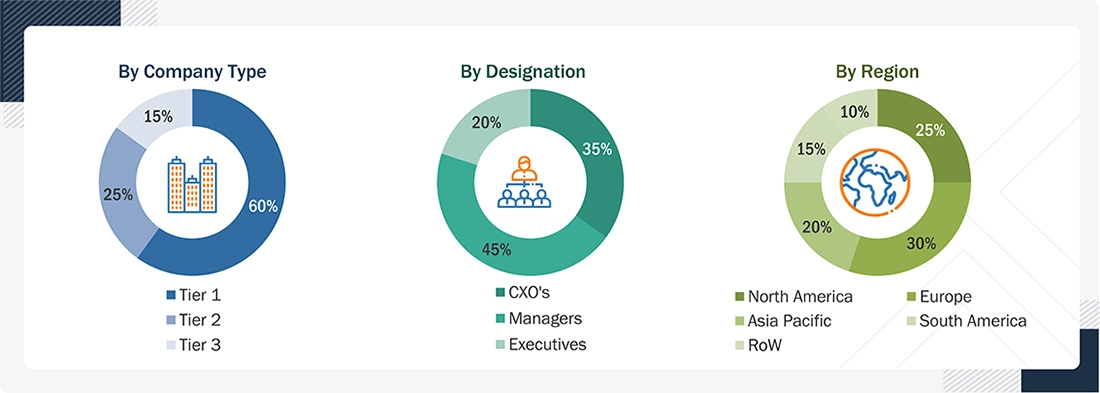
Note: The three tiers of the companies are defined based on their total revenues in 2023 or 2024, as per the availability of financial data: Tier 1: Revenue >USD 1 billion; Tier 2: USD 100 million ≤ revenue ≤ USD 1 billion; Tier 3: Revenue <USD 100 million. RoW includes Africa and the Middle East.
|
COMPANY NAME |
DESIGNATION |
|
Barry Callebaut (Switzerland) |
Product Development Manager |
|
Cargill (US) |
Sales Head |
|
Olam Group |
Marketing Head |
|
Fuji Oil Co., Ltd. |
Sales Head |
|
Guan Chong Berhad (GCB) |
Senior Research Executive |
|
JB Cocoa |
Business Development Manager |
To know about the assumptions considered for the study, download the pdf brochure
Market Size Estimation
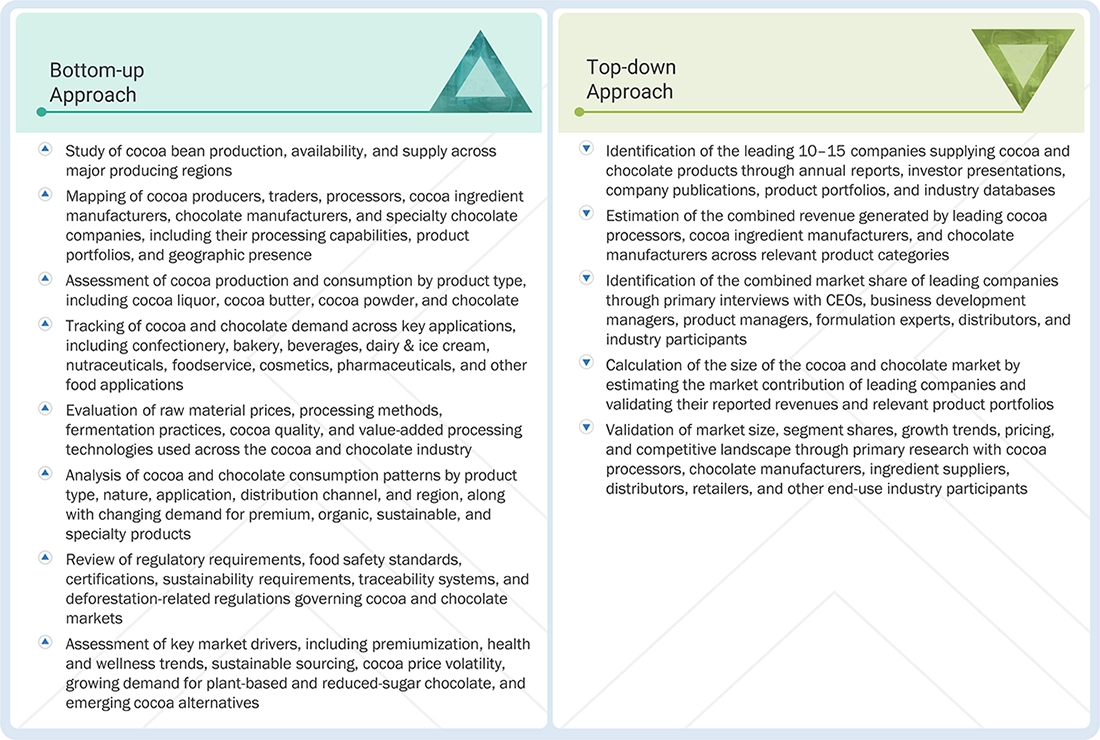
The top-down and bottom-up approaches were used to estimate and validate the total size of the Cocoa and chocolate market. These approaches were also used extensively to determine the size of various subsegments in the market. The research methodology used to estimate the market size includes the following details:
- The key players in the industry and the overall market were identified through extensive secondary research.
- All shares, splits, and breakdowns were determined using secondary sources and verified through primary sources.
- All possible parameters that affect the market covered in this research study were accounted for, viewed in extensive detail, verified through primary research, and analyzed to obtain final quantitative and qualitative data.
- The research included the study of reports, reviews, and newsletters of top market players, along with extensive interviews for opinions from leaders, such as CEOs, directors, and marketing executives.
Cocoa and Chocolate Market : Top-Down and Bottom-Up Approach
Data Triangulation
After determining the overall market size from the estimation process explained above, the total market was split into several segments and subsegments. The data triangulation procedure was employed, wherever applicable, to estimate the overall cocoa and chocolate market and arrive at the exact statistics for all segments and subsegments. The data were triangulated by studying various factors and trends from the demand and supply sides. The market size was also validated using both the top-down and bottom-up approaches.
Market Definition
Cocoa is a product of cocoa tree seeds, which originated in the Latin American region but is heavily grown in Africa. Cocoa beans are used in the manufacturing of various products, including cocoa liquor, cocoa butter, and cocoa powder.
According to the Food Safety and Standards (Food Products Standards and Food Additives) Regulations 2011, chocolate is defined as a “homogeneous product which is produced from an appropriate process of manufacture from a mixture of one or more of the ingredients, such as cocoa beans, cocoa nib, cocoa press cake, and cocoa dust (cocoa fine/powder), cocoa mass, including defatted cocoa powder with or without the addition of sugars, cocoa butter, and milk solids including milk fat.
Key Stakeholders
- Raw material suppliers, including cocoa farmers, farmer cooperatives, cocoa bean producers, and suppliers of sugar, milk solids, nuts, fats, oils, and other raw materials used in cocoa and chocolate production
- Cocoa processors and ingredient manufacturers, including producers of cocoa liquor, cocoa butter, cocoa powder, cocoa extracts, and other specialty cocoa ingredients
- Chocolate manufacturers and processors, including producers of milk chocolate, dark chocolate, white chocolate, compound chocolate, couverture chocolate, and other chocolate formulations
- Intermediate stakeholders, including cocoa traders, importers/exporters, commodity brokers, distributors, logistics providers, packaging suppliers, and storage providers
- Chocolate and confectionery manufacturers and brands, including producers of confectionery, bakery products, biscuits, desserts, dairy products, beverages, and other chocolate-containing products
- Specialty chocolate and ingredient solution providers, including premium chocolate manufacturers, specialty cocoa ingredient suppliers, formulation specialists, and functional chocolate solution providers
- Government organizations and regulatory authorities, responsible for cocoa and chocolate safety, food standards, labeling, quality requirements, import/export regulations, and regulatory compliance
- Research institutions, universities, testing laboratories, and certification organizations, involved in cocoa research, product development, food safety, quality testing, sustainability, traceability, and certification
- Food scientists, chocolatiers, R&D specialists, formulation specialists, and quality assurance professionals, responsible for product formulation, sensory evaluation, ingredient selection, product development, quality control, and safety evaluation
- Industry associations and certification organizations, promoting sustainable cocoa sourcing, responsible production, food safety, traceability, quality standards, and best practices across the cocoa and chocolate industry
-
Associations and industry bodies:
- Food and Agriculture Organization of the United Nations (FAO)
- US Food and Drug Administration (FDA)
- European Food Safety Authority (EFSA)
- US Department of Agriculture (USDA)
- International Organization for Standardization (ISO)
- World Cocoa Foundation (WCF)
- International Cocoa Organization (ICCO)
- European Cocoa Association (ECA)
- International Confectionery Association (ICA)
Report Objectives
- To determine and project the size of the cocoa and chocolate market based on cocoa type, cocoa application, cocoa nature, chocolate type, chocolate distribution channel, chocolate product form, cocoa and chocolate process, cocoa and chocolate technology, and region, over five years, ranging from 2026 to 2031
- To identify the attractive opportunities in the market by determining the largest and fastest-growing segments across regions
- To provide detailed information about the key factors influencing market growth (drivers, restraints, opportunities, and challenges)
- To analyze the opportunities in the market for stakeholders and provide details of the competitive landscape for market leaders
- To analyze the micromarkets with respect to individual growth trends, prospects, and their contribution to the total market
- To identify and profile the key players in the market
- To understand the competitive landscape and identify the major growth strategies adopted by players across the key regions
Available customizations:
With the given market data, MarketsandMarkets offers customizations according to company-specific scientific needs. The following customization options are available for the report:
Product Analysis
- Product matrix, which gives a detailed comparison of the product portfolio of each company.
Geographic Analysis
-
With the given market data, MarketsandMarkets offers customizations according to company-specific scientific needs.
- Further breakdown of the Rest of Europe cocoa and chocolate market into key countries
- Further breakdown of the Rest of Asia Pacific cocoa and chocolate market into key countries
- Further breakdown of the Rest of South America cocoa and chocolate market into key countries
Company Information
-
Detailed analyses and profiling of additional market players (up to five)
Get the Full Cocoa and Chocolate Market Report
Full forecast, segment splits, and company analysis for all Cocoa and Chocolate Market.
- US Cocoa and Chocolate Market
- Canada Cocoa and Chocolate Market
- Mexico Cocoa and Chocolate Market
- France Cocoa and Chocolate Market
- UK Cocoa and Chocolate Market
- Spain Cocoa and Chocolate Market
- Italy Cocoa and Chocolate Market
- Belgium Cocoa and Chocolate Market
- Switzerland Cocoa and Chocolate Market
- China Cocoa and Chocolate Market
- Japan Cocoa and Chocolate Market
- India Cocoa and Chocolate Market
- South Korea Cocoa and Chocolate Market
- Brazil Cocoa and Chocolate Market
- Argentina Cocoa and Chocolate Market
Need a Tailored Report?
Customize this report to your needs
Get 10% FREE Customization
Customize This Report
