
South Korea Cocoa and Chocolate Market (2025-2030)

The South Korea Cocoa and Chocolate Market was valued at $703.4 Million in 2025 and projected to reach to $862.1 Million by 2030, representing a compound annual growth rate of 4.2%. South Korea's cocoa and chocolate market is positioned for sustained growth through 2030, supported by evolving consumer preferences toward premium and health-conscious products.


| Market Size in | USD 26.32 MN |
| Market Forecast in | |
| CAGR | |
| Forecast Period | |
| Units Considered | Value (USD MN) |
South Korea Cocoa and Chocolate Market Trends and Insights
- This 4.2% compound annual growth rate outpaces the global average, reflecting South Korea's strong consumer demand for premium and functional chocolate products.
- South Korea's market is driven by rising disposable incomes, growing health consciousness, and increasing adoption of artisanal and imported chocolate brands among younger demographics. The South Korea cocoa and chocolate sector benefits from robust retail infrastructure and e-commerce penetration, enabling both domestic and international brands to reach consumers efficiently.
- South Korea's confectionery culture and seasonal gifting traditions further support market resilience.
- Between 2025 and 2030, South Korea is expected to see innovation in dark chocolate, plant-based alternatives, and functional chocolate formulations tailored to local taste preferences and wellness trends..
Key Market Statistics
- CAGR (2025-2030) 4.2% CAGR
- Market Size, 2025 ~USD 703.4 Million
- Forecast, 2030 ~USD 862.1 Million
- Country South Korea
South Korea Cocoa and Chocolate Market Overview
Market Valuation & Growth :
South Korea's cocoa and chocolate market is valued at USD 703.4 million in 2025, with a projected growth to USD 862.1 million by 2030, representing a robust 4.2% CAGR that exceeds the global average of 3.6%.
Premium Product Demand :
South Korean consumers demonstrate strong preference for premium and functional chocolate products, driven by rising disposable incomes and increasing health consciousness among the affluent middle class.
Health & Wellness Trend :
The market is increasingly influenced by demand for dark chocolate, sugar-free variants, and chocolate products with added functional ingredients such as probiotics, collagen, and antioxidants.
E-commerce & Retail Expansion :
South Korea's advanced digital infrastructure and high online shopping penetration are accelerating chocolate product distribution through e-commerce platforms and specialty retail channels.
South Korea Cocoa and Chocolate Market Dynamics
- The market's outperformance relative to global trends reflects South Korea's unique demographic characteristics, including high disposable incomes, strong digital adoption, and sophisticated consumer tastes.
- Manufacturers are increasingly investing in innovative product formulations that combine indulgence with functional benefits, catering to health-aware consumers seeking guilt-free chocolate experiences.
- The competitive landscape will intensify as both domestic and international brands vie for market share in this lucrative segment..
Market Ecosystem
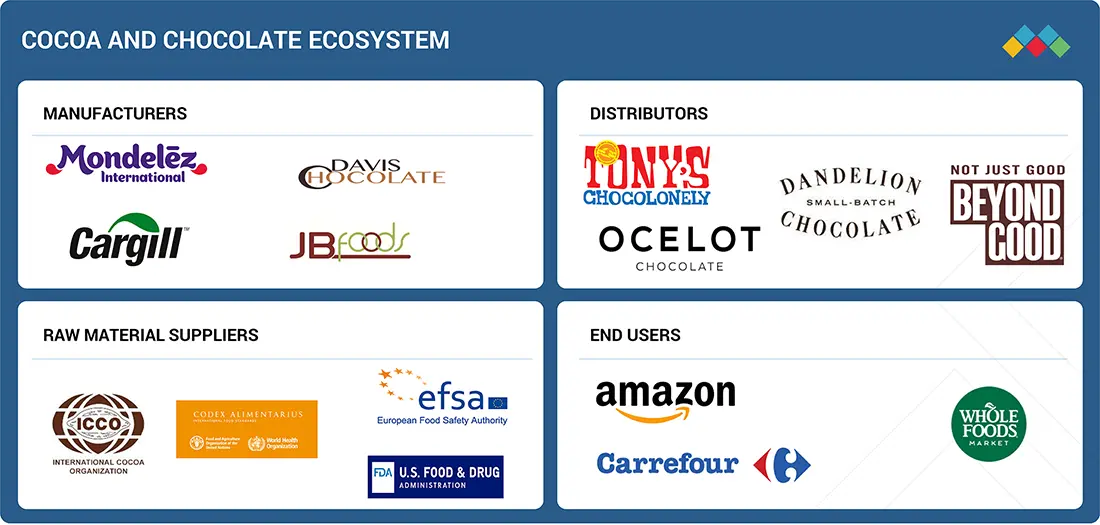
Cocoa and Chocolate Market: COMMERCIAL USE CASES ACROSS INDUSTRIES
| COMPANY | USE CASE DESCRIPTION | BENEFITS |
|---|---|---|
 |
Development of premium dark and organic chocolate ranges, along with cocoa-based functional beverages. | Expands product portfolio, captures health-conscious consumer base, strengthens position in premium and wellness categories. |
 |
Supply of sustainable cocoa ingredients (butter, powder, liquor) to confectionery, bakery, and beverage industries. | Enhances B2B partnerships, ensures traceable supply, supports demand for sustainable and certified cocoa. |
 |
Introduction of cocoa-flavanol-enriched products for nutraceutical and functional food applications. | Diversifies beyond indulgence, leverages health positioning, creates new revenue streams. |
 |
Implementation of traceable cocoa sourcing systems with digital platforms for farmer-to-market transparency. | Builds consumer trust, ensures ethical sourcing, strengthens compliance with global sustainability standards. |
Logos and trademarks shown above are the property of their respective owners. Their use here is for informational and illustrative purposes only.
Related Ecosystem
Key Takeaways
- South Korea's cocoa and chocolate market will grow from USD 703.4M (2025) to USD 862.1M (2030) at a 4.2% CAGR, outpacing global growth.
- South Korea's premium and functional chocolate segment is expanding due to rising health consciousness and disposable income among consumers.
- South Korea's strong e-commerce infrastructure and gifting culture create unique distribution advantages for both local and international brands.
- South Korea's market innovation focuses on dark chocolate, plant-based alternatives, and wellness-oriented formulations aligned with consumer preferences.
Cocoa and Chocolate Market Report Scope
| Report Metric | Details |
|---|---|
| Base Year | 2025 |
| Fastest Growing Segment | COSMETICS (Application) |
| Forecast Period | 2025–2030 |
| Growth Rate | CAGR of 3.6% from 2025 to 2030 |
| Largest Segment | FOOD & BEVERAGES (Application) |
| Market Size Base Year (Billions) | ~USD 23.66 (2025) |
| Revenue Forecast (Billions) | ~USD 28.24 (2030) |
| Segments Covered | Type, Application |
South Korea Cocoa and Chocolate Market Report Segmentation
2 segment dimensions are covered across the global market.
By Type
- Bakery
- Cocoa Butter
- Cocoa Liquor
- Cocoa Powder
- Confectionery
- Other Food & Beverage Applications
By Application
- Cosmetics
- Food & Beverages
- Pharmaceuticals
Target Audience
- Chocolate Manufacturers & Brands : Manufacturers seeking to expand into South Korea or strengthen market presence need detailed competitive analysis, consumer preference data, and growth forecasts to guide product innovation and market positioning.
- Food & Beverage Distributors : Distributors and retailers require insights into South Korea's distribution channels, market segmentation, and consumer demand patterns to optimize inventory management and channel strategy.
- Investment & Private Equity Firms : Investors evaluating opportunities in South Korea's food sector need comprehensive market sizing, growth projections, and competitive landscape analysis to assess investment viability and returns.
- Market Research & Strategy Consultants : Consultants advising clients on South Korean market entry or expansion require detailed market data, trend analysis, and forecasts to develop informed strategic recommendations.
- Ingredient & Supply Chain Providers : Cocoa suppliers and ingredient manufacturers need market demand forecasts and product trend data specific to South Korea to align production capacity and develop targeted supplier relationships.
Key Companies in the South Korea Cocoa and Chocolate Market
| Company | HQ | Ownership | Strongest segments |
|---|---|---|---|
| AMWAY | Malaysia | Public Company | Nutrition & weight management (NUTRILITE, bodykey, XS),Water & air treatment systems (eSpring, ATMOSPHERE),Beauty & personal care (ARTISTRY, G&H, GLISTER, SATINIQUE), |
AMWAY
Amway is a public company established in Malaysia in 1976 with 308 employees. The company operates in the direct sales and consumer goods sector.
Reasons to Buy this Report
- Competitive Market Intelligence : Gain detailed insights into South Korea's chocolate market dynamics, competitive positioning, and market share distribution to inform strategic business decisions and entry strategies.
- Consumer Behavior Analysis : Understand South Korean consumer preferences for premium, functional, and health-oriented chocolate products, enabling targeted product development and marketing strategies.
- Growth Opportunity Identification : Identify high-growth segments and emerging trends within South Korea's 4.2% CAGR market, including functional ingredients, sustainable sourcing, and premium positioning opportunities.
- Distribution Channel Insights : Access comprehensive data on South Korea's retail landscape, e-commerce penetration, and distribution channels to optimize market entry and expansion strategies.
- Forecast-Driven Planning : Leverage accurate market projections through 2030 to develop long-term business plans, investment decisions, and resource allocation strategies specific to the South Korean market.
Frequently asked questions
What is the current size of South Korea's cocoa and chocolate market?
South Korea's cocoa and chocolate market is valued at USD 703.4 million in 2025 and is projected to reach USD 862.1 million by 2030.
What is the growth rate for South Korea's chocolate market?
South Korea's cocoa and chocolate market is growing at a compound annual growth rate (CAGR) of 4.2% from 2025 to 2030.
What drives growth in South Korea's chocolate market?
South Korea's market growth is driven by rising disposable incomes, health consciousness, premium brand adoption, e-commerce expansion, and seasonal gifting traditions.
Which product categories are growing fastest in South Korea?
South Korea is seeing rapid growth in dark chocolate, plant-based chocolate alternatives, and functional chocolate products with added health benefits.
How does South Korea's market compare to global trends?
South Korea's 4.2% CAGR exceeds the global average of 3.6%, indicating stronger regional demand and market maturity in the Asia Pacific region.
RESEARCH METHODOLOGY
The study involved two major approaches in estimating the current size of the cocoa and chocolate market. Exhaustive secondary research was done to collect information on the market, peer, and parent markets. The next step was to validate these findings, assumptions, and sizing with industry experts across the value chain through primary research. Both top-down and bottom-up approaches were employed to estimate the complete market size. After that, market breakdown and data triangulation were used to estimate the market size of segments and subsegments.
Secondary Research
This research study involved the extensive use of secondary sources—directories and databases such as Bloomberg Businessweek and Factiva—to identify and collect information useful for a technical, market-oriented, and commercial study of the market.
In the secondary research process, various sources, such as company annual reports, press releases, investor presentations, white papers, food journals, certified publications, articles from recognized authors, directories, and databases, were used to identify and collect information.
Secondary research was mainly used to obtain key information about the industry’s supply chain, the total pool of key players, and market classification and segmentation as per the industry trends to the bottom-most level, regional markets, and key developments from both market- and technology-oriented perspectives.
Primary Research
Extensive primary research was conducted after obtaining information regarding the cocoa and chocolate market scenario through secondary research. Several primary interviews were conducted with market experts from both the demand and supply sides across major countries of North America, Europe, Asia Pacific, South America, and the Rest of the World. Primary data was collected through questionnaires, emails, and telephonic interviews. The primary sources from the supply side included various industry experts, such as Chief X Officers (CXOs), Vice Presidents (VPs), Directors from business development, marketing, research, and development teams, and key opinion leaders. Primary interviews were conducted to gather insights such as market statistics, data on revenue collected from the products and services, market breakdowns, market size estimations, market forecasting, and data triangulation. Primary research also helped in understanding the various trends related to cocoa and chocolate, cocoa type, application, nature, chocolate type, distribution channel, product form, and region. Stakeholders from the demand side, such as research institutions and universities, third-party vendors, were interviewed to understand the buyer’s perspective on the product, their current usage of cocoa and chocolate, and the outlook of their business, which will affect the overall market.
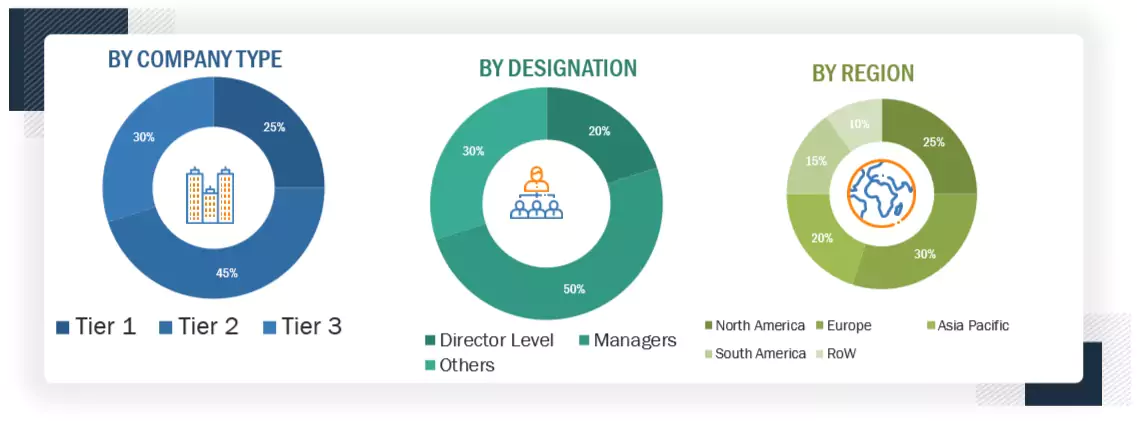
Note: The three tiers of the companies are defined based on their total revenues in 2023 or 2024, as per the
availability of financial data: Tier 1: Revenue >USD 1 billion; Tier 2: USD 100 million = Revenue = USD 1 billion; Tier 3: Revenue
To know about the assumptions considered for the study, download the pdf brochure
|
COMPANY |
DESIGNATION |
|
Barry Callebaut (Switzerland) |
Global Sourcing Manager |
|
Cargill (US) |
R&D Scientist |
|
Mars, Incorporated (US) |
Marketing Director |
|
Mondelez International (US) |
Product Development Lead |
|
Lindt & Sprüngli (Switzerland) |
Sustainability Manager |
Market Size Estimation
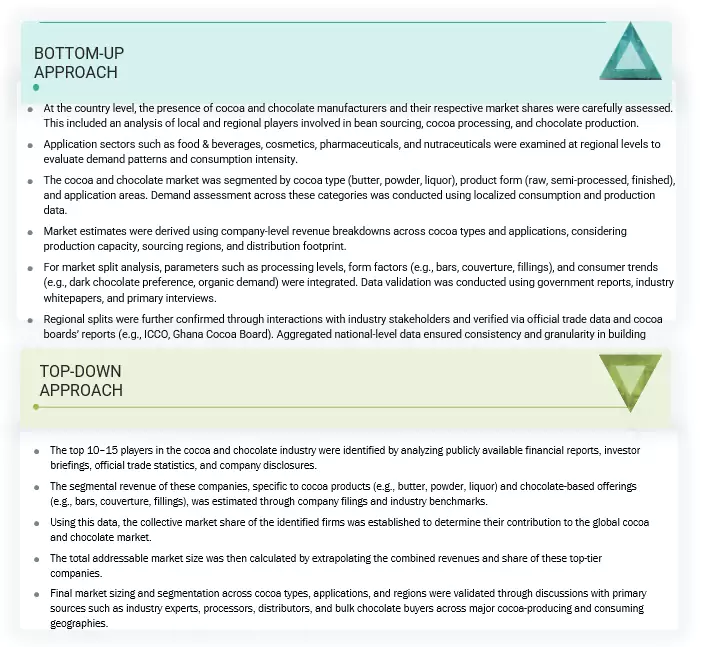
Both the top-down and bottom-up approaches were used to estimate and validate the total size of the cocoa and chocolate market. These approaches were also used extensively to determine the size of various subsegments in the market. The research methodology used to estimate the market size includes the following details:
- The key players in the industry and the overall markets were identified through extensive secondary research.
- All shares, splits, and breakdowns were determined using secondary sources and verified through primary sources.
- All possible parameters that affect the market covered in this research study were accounted for, viewed in extensive detail, verified through primary research, and analyzed to obtain final quantitative and qualitative data.
- The research included the study of reports, reviews, and newsletters of top market players, along with extensive interviews for opinions from leaders, such as CEOs, directors, and marketing executives.
Cocoa and Chocolate Market : Top-Down and Bottom-Up Approach
Data Triangulation
After arriving at the overall market size from the estimation process explained above, the total market was split into several segments and subsegments. The data triangulation and market breakdown procedures were employed, wherever applicable, to estimate the overall cocoa and chocolate market and arrive at the exact statistics for all segments and subsegments. The data was triangulated by studying various factors and trends from the demand and supply sides. The market size was also validated using both the top-down and bottom-up approaches.
Market Definition
Cocoa is a product of cocoa tree seeds, which originated in the Latin American region but is heavily grown in Africa. Cocoa beans are used in the manufacturing of various products, including cocoa liquor, cocoa butter, and cocoa powder.
According to the Food Safety and Standards (Food Products Standards and Food Additives) Regulations 2011, chocolate is defined as a “homogeneous product which is produced from an appropriate process of manufacture from a mixture of one or more of the ingredients, such as cocoa beans, cocoa nib, cocoa press cake, and cocoa dust (cocoa fine/powder), cocoa mass, including defatted cocoa powder with or without the addition of sugars, cocoa butter, and milk solids including milk fat.
Stakeholders
Farmers & Primary Producers
- Smallholder farmers (the main source of the global cocoa supply)
- Farmer cooperatives and associations
- Local buying agents and aggregators
Input & Support Providers
- Agri-input suppliers (fertilizers, seedlings, crop protection)
- Training and extension service providers
- Microfinance and agri-credit institutions
Cocoa Traders & Exporters
- International trading firms (e.g., Olam, Ecom, Sucden)
- National cocoa marketing boards (e.g., COCOBOD – Ghana, CCC – Côte d’Ivoire)
- Licensed local exporters
Processors & Manufacturers
- Cocoa grinders (e.g., Barry Callebaut, Cargill)
- Chocolate manufacturers (e.g., Mars, Nestlé, Ferrero, Mondelez)
- Ingredient suppliers (e.g., cocoa butter, powder, liquor processors)
Retailers & Distributors
- Supermarkets and hypermarkets (e.g., Carrefour, Tesco, Walmart)
- Specialty chocolate retailers and boutiques
- Online direct-to-consumer (DTC) platforms
Certification & Compliance Bodies
- Sustainability certification organizations (e.g., Fairtrade, Rainforest Alliance)
- Traceability solution providers (e.g., SourceMap, Farmforce)
- National and international regulatory authorities (e.g., FDA, EFSA, EU Deforestation Regulation bodies)
Logistics & Infrastructure Providers
- Storage and warehousing operators
- Port handlers and transport companies
- Cold chain and packaging service providers
Research & Development Stakeholders
- Agricultural R&D institutions (e.g., CIRAD, ICCO, national cocoa research institutes)
- Food innovation labs and universities
- Gen AI developers and AI solution partners
NGOs & Development Organizations
- Non-profits working on farmer welfare, child labor prevention, and environmental protection (e.g., IDH, Solidaridad, WCF)
- Donor agencies and multilateral development banks (e.g., IFC, GIZ, USAID)
Report Objectives
- To determine and project the size of the cocoa and chocolate market with respect to the cocoa type, application, nature, chocolate type, distribution channel, product form, and regions in terms of value over five years, ranging from 2025 to 2030
- To identify the attractive opportunities in the market by determining the largest and fastest-growing segments across regions
- To provide detailed information about the key factors influencing market growth (drivers, restraints, opportunities, and challenges)
- To analyze the opportunities in the market for stakeholders and provide details of the competitive landscape for market leaders
- To analyze the micro-markets with respect to individual growth trends, prospects, and their contribution to the total market
- To identify and profile the key players in the market
- To understand the competitive landscape and identify the major growth strategies adopted by players across the key regions.
Available Customizations
With the given market data, MarketsandMarkets offers customizations according to company-specific scientific needs.
The following customization options are available for the report:
Product Analysis
- Service Matrix, which gives a detailed comparison of the service portfolio of each company.
Geographic Analysis as per Feasibility
With the given market data, MarketsandMarkets offers customizations according to company-specific scientific needs.
- Further breakdown of the Rest of Europe cocoa and chocolate market into key countries.
- Further breakdown of the Rest of Asia Pacific cocoa and chocolate market into key countries.
- Further breakdown of the Rest of South America cocoa and chocolate market into key countries.
Company Information
- Detailed analyses and profiling of additional market players (up to five)
Get the Full Cocoa and Chocolate Market Report
Full forecast, segment splits, and company analysis for all Cocoa and Chocolate Market.
- US Cocoa and Chocolate Market
- Canada Cocoa and Chocolate Market
- Mexico Cocoa and Chocolate Market
- France Cocoa and Chocolate Market
- Germany Cocoa and Chocolate Market
- UK Cocoa and Chocolate Market
- Spain Cocoa and Chocolate Market
- Italy Cocoa and Chocolate Market
- Belgium Cocoa and Chocolate Market
- Switzerland Cocoa and Chocolate Market
- China Cocoa and Chocolate Market
- Japan Cocoa and Chocolate Market
- India Cocoa and Chocolate Market
- Brazil Cocoa and Chocolate Market
- Argentina Cocoa and Chocolate Market
Need a Tailored Report?
Customize this report to your needs
Get 10% FREE Customization
Customize This Report
