
North America Collaborative Robot Market (2025-2030)

The North America Collaborative Robot Market was valued at $373.8 Million in 2025 and projected to reach to $906 Million by 2030, representing a compound annual growth rate of 19.4%. North America's collaborative robot market is positioned for sustained expansion through 2030, driven by critical labor shortages in manufacturing and semiconductor sectors, coupled with rising operational costs that make automation economically compelling.


| Market Size in | USD 26.32 MN |
| Market Forecast in | |
| CAGR | |
| Forecast Period | |
| Units Considered | Value (USD MN) |
North America Collaborative Robot Market Trends and Insights
- This growth trajectory reflects North America's leadership in automation adoption across manufacturing and semiconductor sectors, driven by labor shortages and rising operational costs.
- North America's advanced industrial infrastructure and significant R&D investments position the region as a key hub for collaborative robotics innovation. The North America market benefits from strong demand in automotive, electronics, and precision manufacturing industries where collaborative robots enhance productivity and worker safety.
- North America's regulatory environment and emphasis on Industry 4.0 adoption accelerate market penetration.
- By 2030, North America is expected to maintain its competitive advantage through technological advancement and strategic partnerships among leading robotics manufacturers..
Key Market Statistics
- CAGR (2025-2030) 19.4% CAGR
- Market Size, 2025 ~USD 373.8 Million
- Forecast, 2030 ~USD 906 Million
- Geography North America
North America Collaborative Robot Market Overview
Strong Market Valuation :
North America's collaborative robot market is valued at $373.8 million in 2025, with the US alone commanding $604.7 million, establishing the region as a critical hub for cobot adoption and innovation.
Accelerated Growth Trajectory :
The region is projected to reach $906.0 million by 2030, representing a 19.4% CAGR—outpacing the global average of 18.9%—driven by semiconductor manufacturing expansion and labor cost pressures.
US Market Dominance :
The United States represents the largest market segment at $604.7 million in 2025, reflecting advanced automation infrastructure, high labor costs, and significant semiconductor and electronics manufacturing investments.
Multi-Country Growth Engine :
Canada ($129.0 million) and Mexico ($172.2 million) contribute substantially to regional growth, with Mexico emerging as a manufacturing hub attracting cobot deployment for cost-effective automation solutions.
North America Collaborative Robot Market Dynamics
- The region's advanced industrial infrastructure, significant R&D investments, and early adoption of Industry 4.0 technologies create a favorable environment for cobot proliferation across automotive, electronics, and precision manufacturing verticals. The US market leadership, combined with growing adoption in Canada and Mexico's manufacturing corridors, ensures robust regional growth.
- Strategic investments in semiconductor fabrication facilities and reshoring initiatives will further accelerate cobot deployment.
- North America's focus on collaborative safety standards and human-robot interaction capabilities positions it as a technology leader, attracting both established automation vendors and innovative startups to capture market share through 2030..
Market Ecosystem

Collaborative Robot Market Share: COMMERCIAL USE CASES ACROSS INDUSTRIES
| COMPANY | USE CASE DESCRIPTION | BENEFITS |
|---|---|---|
 |
Universal Robots’ cobots are deployed across automotive, electronics, and healthcare sectors for assembly, screw driving, packaging, and quality inspection tasks. The UR+ ecosystem enables easy integration with third-party end-effectors and vision systems. | Delivers fast deployment, high ROI, and improved worker safety through user-friendly programming and flexible automation across varied production scales. |
 |
FANUC’s cobots support applications in electronics, metalworking, and logistics, offering simple setup, intuitive drag-and-drop programming, and compatibility with FANUC’s industrial automation suite. | Increases operational uptime, reduces training costs, and drives scalability through reliability and seamless integration with existing FANUC ecosystems. |
 |
ABB’s cobots are designed for close human collaboration in material handling, assembly, and laboratory automation. Integrated with ABB’s SafeMove and RobotStudio software, they ensure precision and safety. | Enhances productivity and flexibility while maintaining safety standards, enabling hybrid work environments with efficient human-robot collaboration. |
 |
Techman’s vision-integrated cobots combine AI-driven visual recognition for automated inspection, pick-and-place, and packaging applications across electronics and automotive industries. | Reduces quality defects and inspection time, enhances precision in repetitive tasks, and delivers faster adaptation to product variations. |
 |
AUBO’s lightweight cobots are used in small and mid-sized enterprises for tasks like machine tending, polishing, and testing, supported by open-source control platforms for flexible integration. | Enables cost-effective automation for SMEs, increases throughput, and simplifies deployment without the need for complex programming. |
Logos and trademarks shown above are the property of their respective owners. Their use here is for informational and illustrative purposes only.
Related Ecosystem
Automotive Advance Technologies
- Battery Electric Vehicle (BEV)
- Light Commercial Vehicles (LCVs)
- Fuel Cell Electric Vehicle (FCEV)
- Hybrid Electric Vehicle (HEV)
- Internal Combustion Engine (ICE)
- BOSCH LIMITED
- Continental ag
- Visteon Corporation
- DENSO Corporation
- ZF FRIEDRICHSHAFEN AG
Drones And Robotics
- Sensors
- Articulated Robots
- Cartesian Robots
- Scara Robots
- Actuators
- ABB India Limited
- KUKA AG
- MOMENTIVE PERFORMANCE MATERIALS INC.
- Fanuc Corporation
- STAUBLI INTERNATIONAL AG
Industrial Automation
- Sensors
- Image Sensors
- Manufacturing Execution System (MES)
- Actuators
- Flow Sensors
- Siemens ag
- ABB India Limited
- Emerson Electric Co.
- HONEYWELL INTERNATIONAL INC.
- SCHNEIDER ELECTRIC SE
Key Takeaways
- North America's collaborative robot market will grow from $373.8M (2025) to $906.0M (2030), representing a 19.4% CAGR.
- North America leads global adoption due to advanced manufacturing infrastructure and significant labor cost pressures.
- North America's semiconductor and electronics sectors drive primary demand for collaborative automation solutions.
- North America's regulatory support and Industry 4.0 initiatives create favorable conditions for market expansion through 2030.
Collaborative Robot Market Report Scope
| Report Metric | Details |
|---|---|
| Base Year | 2025 |
| Fastest Growing Segment | SOFTWARE (Component) |
| Forecast Period | 2025–2030 |
| Growth Rate | CAGR of 18.9% from 2025 to 2030 |
| Largest Segment | HARDWARE (Component) |
| Market Size Base Year (Billions) | ~USD 1.42 (2025) |
| Revenue Forecast (Billions) | ~USD 3.38 (2030) |
| Segments Covered | Payload, Application, Industry, Component 2021–2024, Component, Type |
North America Collaborative Robot Market Report Segmentation
6 segment dimensions are covered across the global market.
By Payload
- 10–25 Kg
- 11–25 Kg
- 5–10 Kg
- Less Than 5 Kg
- More Than 25 Kg
- Up To 5 Kg
By Application
- Assembling & Disassembling
- Dispensing
- Handling
- Other Applications
- Processing
- Welding & Soldering
By Industry
- Automotive
- Electronics
- Food & Beverages
- Furniture & Equipment
- Healthcare
- Logistics
- Metals & Machining
- Other Industries
- Plastics & Polymers
By Component 2021–2024
- Hardware
- Software
By Component
- Hardware
- Software
By Type
- Cutting
- Grinding
- Machine Tending
- Material Handling
- Milling
- Packaging & Palletizing
- Pick & Place
Target Audience
- Cobot Manufacturers & Vendors : Develop North America-focused product roadmaps, pricing strategies, and distribution partnerships by understanding regional market size, growth rates, and competitive positioning across US, Canada, and Mexico.
- Manufacturing & Semiconductor Companies : Evaluate cobot investment ROI and automation strategies specific to North American labor costs, operational challenges, and industry-specific use cases in semiconductor and electronics production.
- Systems Integrators & Solution Providers : Identify high-growth segments and customer verticals within North America to prioritize service offerings, technical capabilities, and regional expansion initiatives through 2030.
- Private Equity & Investment Firms : Assess market attractiveness, growth potential, and acquisition targets within North America's collaborative robotics ecosystem to inform investment theses and portfolio strategy.
- Government & Economic Development Agencies : Understand automation trends and manufacturing competitiveness across North American regions to inform industrial policy, workforce development, and economic incentive programs.
Key Companies in the North America Collaborative Robot Market
| Company | HQ | Ownership | Strongest segments |
|---|---|---|---|
| FOXCONN INDUSTRIAL INTERNET CO LTD | China | Public Company | Server and storage hardware,Networking equipment,Industrial automation systems and precision components, |
| LEONI AG | Germany | Private Company | Wiring Systems (complete wiring systems and cable harnesses),Wire & Cable Solutions – automotive standard and special cables,Wire & Cable Solutions – charging cables and e-mobility, |
| VOITH | Germany | Private Company | Voith Hydro (turbines, generators, hydro services),Voith Paper (papermaking components and systems),Voith Turbo (drives, transmissions, braking, couplings), |
| FANUC CORPORATION | Japan | Public Company | CNC Systems and Factory Automation Components (servo, lasers),Industrial Robots,Robomachine Equipment, |
| ABB | Switzerland | Public Company | Electrification,Motion,Automation, |
| TECHMAN ROBOT INC. | Taiwan | Public Company | TM Robots & TM S series hardware,TMflow and core software (TMscript, TMcraft, ROS Driver),AI vision and TM AI+ software (Training Server, AOI Edge, Image Manager), |
| KUKA AG | Germany | Private Company | Industrial robots and controllers,Systems and production cells,Logistics, AGVs, and warehouse automation, |
| DOOSAN ROBOTICS INC. | South Korea | Public Company | Industrial collaborative robot arms (hardware),Motion control algorithms and proprietary robotic software,Integration, services, and related robotic solutions, |
| DENSO CORPORATION | Japan | Public Company | Air-conditioning and thermal management systems,Powertrain systems (gasoline, diesel, hybrid, EV, fuel cell),Safety and cockpit systems, |
| YASKAWA ELECTRIC CORPORATION | Japan | Public Company | Motion control (servo motors, amplifiers, controllers, encoders),Industrial robots (welding, handling, collaborative, biomedical, palletizing),Low-voltage AC drives and PM motors, |
| SIASUN ROBOT & AUTOMATION CO., LTD. | China | Public Company | Industrial robots (SCARA, desktop, large and ultra-high payload, truss robots, integrated solutions),Mobile robots (forklift, tote/box handling, industrial cleaning, under-ride lift, industrial park delivery, customized AMRs),Collaborative robots and application workstations (GCR series, explosion-proof, palletizing, welding, DUCO Mobile Cobot), |
| COMAU S.P.A. | Italy | Private Company | Body assembly and press shop automation,Powertrain and machining modules,Robotics and general automation systems, |
FOXCONN INDUSTRIAL INTERNET CO LTD
Foxconn Industrial Internet Co Ltd is a Chinese public company founded in 2015 that operates as a major industrial internet platform. With 217,084 employees, the company provides digital transformation and industrial solutions.
LEONI AG
Leoni AG is a German private company with a history dating back to 1569 and employs 95,090 people, operating as a major industrial conglomerate.
VOITH
Voith is a German private company established in 1867 with 23,224 employees, operating across multiple industrial sectors including drive technology and paper making.
FANUC CORPORATION
Fanuc Corporation is a Japanese public company established in 1950 with 10,040 employees, specializing in industrial robots, CNC systems, and factory automation.
ABB
ABB is a Swiss public company founded in 1883 with 112,700 employees, operating as a global leader in robotics, power, and automation technology.
TECHMAN ROBOT INC.
Techman Robot Inc. is a Taiwanese public company founded in 2015 with 388 employees, specializing in collaborative robotic arms and automation solutions.
KUKA AG
Kuka AG is a German private company founded in 1898 with 14,985 employees, specializing in industrial robots and automation systems.
DOOSAN ROBOTICS INC.
Doosan Robotics Inc. is a South Korean public company founded in 2015 with 237 employees, focused on developing collaborative and industrial robotic solutions.
DENSO CORPORATION
Denso Corporation is a Japanese public company established in 1949 with 154,716 employees, operating as a major supplier of automotive components and industrial systems.
YASKAWA ELECTRIC CORPORATION
Yaskawa Electric Corporation is a Japanese public company founded in 1915 with 12,483 employees, specializing in industrial robots, motion control, and power electronics.
SIASUN ROBOT & AUTOMATION CO., LTD.
Siasun Robot & Automation Co., Ltd. is a Chinese public company established in 2000 with 3,585 employees, specializing in industrial robots and automation systems.
COMAU S.P.A.
Comau S.P.A. is an Italian private company founded in 1970 with 7,103 employees, specializing in industrial automation and robotic systems.
Countries within North America - compare and drill down
| Country | 2025 size (native) |
|---|---|
| US | USD 604.7 Million |
| Canada | USD 129 Million |
| Mexico | USD 172.2 Million |
Country market size visualization
Reasons to Buy this Report
- Country-Level Market Segmentation : Access detailed market sizing for US ($604.7M), Canada ($129.0M), and Mexico ($172.2M) to identify high-potential markets and tailor regional expansion strategies with precision.
- Competitive Landscape Intelligence : Understand North America's unique competitive dynamics, including vendor positioning, technology adoption rates, and market consolidation trends specific to the region's manufacturing ecosystem.
- Sector-Specific Growth Drivers : Identify which North American industries—semiconductor, automotive, electronics—are driving cobot adoption and forecast demand patterns for targeted product development and go-to-market strategies.
- Investment & Expansion Planning : Leverage 2025-2030 forecast data to make informed capital allocation decisions, facility location choices, and partnership strategies across North America's three major markets.
- Regulatory & Standards Compliance : Gain insights into North America-specific safety standards, labor regulations, and compliance requirements that influence cobot design, deployment, and market adoption rates.
Frequently asked questions
What is the projected size of North America's collaborative robot market by 2030?
North America's collaborative robot market is projected to reach $906.0 million by 2030, growing from $373.8 million in 2025.
What is the CAGR for North America's collaborative robot market?
North America's collaborative robot market is expected to grow at a compound annual growth rate (CAGR) of 19.4% between 2025 and 2030.
Which industries drive collaborative robot adoption in North America?
North America's automotive, semiconductor, electronics, and precision manufacturing industries are primary drivers of collaborative robot adoption.
Why is North America a leading market for collaborative robots?
North America leads due to advanced manufacturing infrastructure, labor shortages, high operational costs, strong R&D investment, and supportive Industry 4.0 policies.
What factors will support North America's collaborative robot market growth through 2030?
North America's market growth will be supported by technological advancement, labor cost pressures, regulatory support, strategic partnerships, and increased automation adoption.
RESEARCH METHODOLOGY
The study involved major activities in estimating the current size of the collaborative robot market. Exhaustive secondary research was done to collect information on collaborative robots. The next step was to validate these findings, assumptions, and sizing with industry experts across the value chain using primary research. Different approaches, such as top-down and bottom-up, were employed to estimate the total market size. After that, the market breakup and data triangulation procedures were used to estimate the market size of the segments and subsegments of the collaborative robot.
Secondary Research
In the secondary research process, various secondary sources were referred to identify and collect information relevant to this study. Secondary sources included annual reports, press releases, and investor presentations of companies; white papers, certified publications, and articles from recognized authors; directories; and databases. Secondary research was mainly carried out to obtain critical information about the industry’s supply chain, value chain, the total pool of key players, and market classification and segmentation according to industry trends, geographic markets, and key developments from both market- and technology-oriented perspectives. Secondary sources included corporate filings (such as annual reports, investor presentations, and financial statements); trade, business, and professional associations; white papers; IoT technologies journals and certified publications; articles by recognized authors; gold-and silver-standard websites; directories; and databases. Data was also collected from secondary sources, such as the International Federation of Robotics (IFR), the International Trade Centre (ITC) (Switzerland), and the Robotics Business Review (RBR).
Secondary research was mainly used to obtain critical information about the supply chain of the industry, the value chain of the market, the total pool of key players, market classification and segmentation according to industry trends to the bottom-most level, geographic markets, and key developments from both the market and technology-oriented perspectives. Secondary data was collected and analyzed to arrive at the overall market size, which was further validated by primary research.
Primary Research
Extensive primary research was conducted after understanding and analyzing the current scenario of the collaborative robot market through secondary research. Several primary interviews were conducted with key opinion leaders from both the demand and supply sides across four major regions: North America, Europe, Asia Pacific, and the Rest of the World. Approximately 25% of the primary interviews were conducted with the demand side, while 75% were conducted with the supply side. This primary data was collected mainly through telephonic interviews, which accounted for 80% of the total primary interviews. Questionnaires and e-mails were also used to collect data.
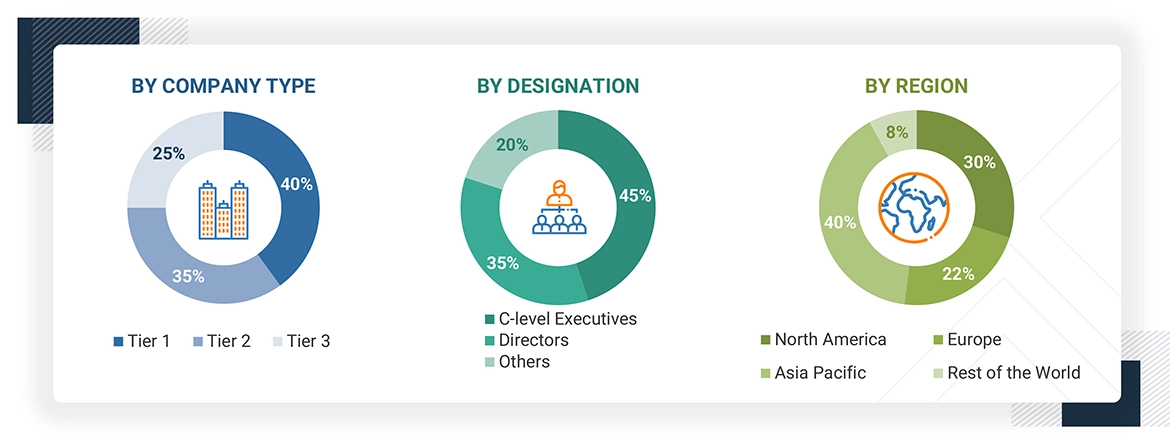
Note: Three tiers of companies are defined based on their total revenue as of 2024; tier 1: revenue more than or equal to USD 500 million, tier 2: revenue between USD 100 million and USD 500 million, and tier 3: revenue less than or equal to USD 100 million. Other designations include sales and marketing executives and researchers, as well as members of various collaborative robot organizations
To know about the assumptions considered for the study, download the pdf brochure
Market Size Estimation
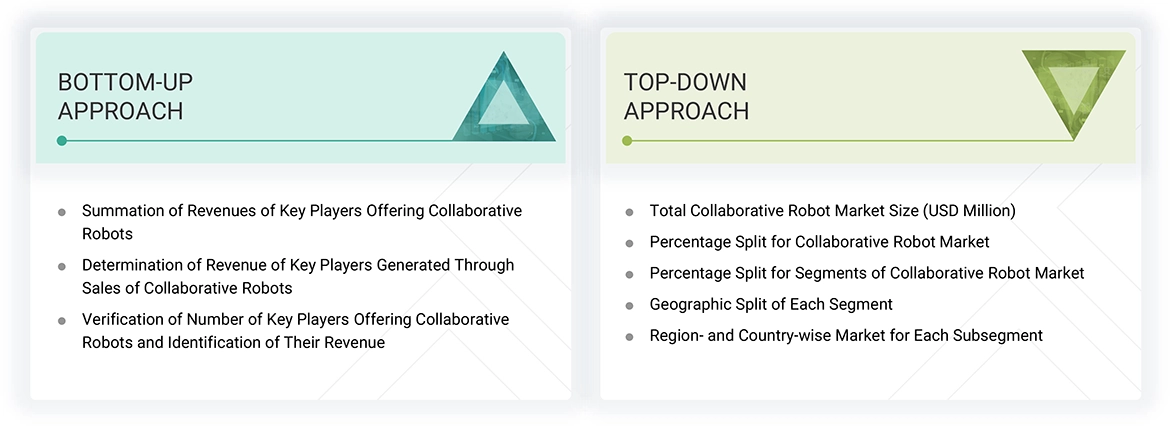
This report implements both top-down and bottom-up approaches to estimate and validate the size of the collaborative robot market and various other dependent submarkets. Secondary research identifies key players in this market, and their market shares in the respective regions are determined through primary and secondary research.
This report implements both top-down and bottom-up approaches to estimate and validate the size of the collaborative robot market and various other dependent submarkets. Secondary research identifies key players in this market, and their market shares in the respective regions are determined through primary and secondary research.
Top-Down Approach
- Identifying key participants in the collaborative robot market that influence the entire market
- Analyzing major manufacturers of collaborative robots involves studying their portfolios and understanding the various types of products they offer to strengthen their market presence and strategic positioning within the industry
- Analyzing trends pertaining to the use of collaborative robots for different industries
- Tracking the ongoing and upcoming developments in the market, such as investments, R&D activities, product/service launches, collaborations, and partnerships, and forecasting the market based on these developments and other critical parameters
- Carrying out multiple discussions with key opinion leaders to understand recent trends in the collaborative robot (cobot) market, thereby analyzing the breakup of the scope of work carried out by major companies
- Deriving market estimates involves analyzing the revenues generated by companies and then aggregating them to obtain the overall market estimate
- classifying the overall market into various other market segments
- Verifying and cross-checking the estimate at every level from the discussion with key opinion leaders such as CXOs, directors, and operations managers, and finally with the domain experts in MarketsandMarkets
- Studying various paid and unpaid sources of information, such as annual reports, press releases, white papers, and databases
- Focusing initially on the top-line investments and expenditures being made in the ecosystem of the collaborative robot market, further splitting the key market areas based on payload, application, industry, and region, and listing the key developments
- Identifying all leading players in the collaborative robot market based on payload, application, and industry through secondary research and thoroughly verifying them through a brief discussion with industry experts
- Analyzing revenues, product mix, geographic presence, and key applications served by all identified players to estimate and arrive at percentage splits for all key segments
- Discussing splits with industry experts to validate the information and identify key growth pockets across all key segments
- Breaking down the total market based on verified splits and key growth pockets across all segments
Collaborative Robot Market : Top-Down and Bottom-Up Approach
Data Triangulation
After arriving at the overall size of the collaborative robot market from the estimation process explained above, the market was split into several segments and subsegments. The data triangulation and market breakdown procedures were employed (wherever applicable) to complete the overall market engineering process and arrive at the exact statistics for all segments and subsegments. The data was triangulated by studying various factors and trends from both the demand and supply sides. The size of the collaborative robot market was validated using both top-down and bottom-up approaches..
Market Definition
According to the International Federation of Robotics (IFR), robots intended for collaborative use need to adhere to the International Organization for Standards (ISO) standard 10218-1. This standard establishes essential criteria and recommendations to guarantee the safe design, effective protective measures, and comprehensive usage guidelines for industrial robots. By adhering to these standards, a secure and efficient environment can be ensured for both operators and machinery.
Collaborative robots (also known as cobots) are designed to work alongside humans with precision, strength, and speed to achieve greater efficiency in production. Using robots to assist humans can help significantly reduce the workload of human workers and relieve them of monotonous, repetitive tasks. As an emerging automation technology, cobots complement the existing industrial robotics market. The total cost of ownership of factory automation solutions, especially for small and medium-sized enterprises (SMEs), can be significantly reduced by adopting cobots. Cobot operations are primarily governed by the ISO 15066:2016 standard that further specifies various safety requirements. Other standards governing the safe operations of cobots include ISO 10218-1:2011, RIA/ANSI R15.06-2012, ISO 12100:2010, and ISO 13849-1:2008.
Key Stakeholders
- Original equipment manufacturers (OEMs)
- OEM technology solution providers
- Research institutes
- Market research and consulting firms
- Forums, alliances, and associations
- Technology investors
- Governments and financial institutions
- Analysts and strategic business planners
- End users who want to know more about technology and the latest technological developments in industry
Report Objectives
- To describe and forecast the collaborative robot market by payload, component, application, and industry, in terms of value and volume
- To describe and forecast the market for four main regions, namely, North America, Europe, Asia Pacific, and Rest of the World, in terms of value and volume
- To provide detailed information regarding factors, including drivers, restraints, opportunities, and challenges, influencing the growth of the market
- To provide a detailed overview of the cobot value chain
- To provide an ecosystem analysis, case study analysis, patent analysis, technology analysis, ASP analysis, Porter’s five forces analysis, 2025 US tariff and AI/Gen AI impact analyses, and regulations pertaining to the market
- To strategically analyze micromarkets with respect to individual growth trends, prospects, and contributions to the total market
- To analyze opportunities in the market for various stakeholders by identifying high-growth segments
- To benchmark players operating in the market using the proprietary Competitive Leadership Mapping framework, which analyzes market players using multiple parameters within the broad categories of business and product strategy
- To strategically profile key players and comprehensively analyze their market position in terms of ranking and core competencies, along with detailing the competitive landscape for market leaders
- To analyze competitive developments such as collaborations, agreements, partnerships, product developments, and research and development (R&D) in the market
- To evaluate the impact of macroeconomic factors on the regional market
Available Customizations
With the market data given, MarketsandMarkets offers customizations according to the company’s specific needs. The following customization options are available for the report:
Company Information
- Detailed analysis and profiling of additional market players (up to 7)
Get the Full Collaborative Robot Market Report
Full forecast, segment splits, and company analysis for all Collaborative Robot Market.
- US Collaborative Robot Market
- Canada Collaborative Robot Market
- Mexico Collaborative Robot Market
- Germany Collaborative Robot Market
- UK Collaborative Robot Market
- France Collaborative Robot Market
- Spain Collaborative Robot Market
- Italy Collaborative Robot Market
- Rest Of Europe Collaborative Robot Market
- China Collaborative Robot Market
- Japan Collaborative Robot Market
- India Collaborative Robot Market
- South Korea Collaborative Robot Market
- Thailand Collaborative Robot Market
- Taiwan Collaborative Robot Market
- Rest Of Asia Pacific Collaborative Robot Market
Need a Tailored Report?
Customize this report to your needs
Get 10% FREE Customization
Customize This Report
