
Rest Of Asia Pacific Collagen Market (2023-2028)

The Rest Of Asia Pacific Collagen Market was valued at $305 Million in 2023 and projected to reach to $450 Million by 2028, representing a compound annual growth rate of 5.7%. Rest Of Asia Pacific's collagen market is poised for sustained growth through 2028, driven by increasing health consciousness and rising disposable incomes across emerging economies in the region.


| Market Size in | USD 26.32 MN |
| Market Forecast in | |
| CAGR | |
| Forecast Period | |
| Units Considered | Value (USD MN) |
Rest Of Asia Pacific Collagen Market Trends and Insights
- Rest Of Asia Pacific is experiencing robust demand for collagen-based products driven by rising consumer awareness of health and wellness benefits, particularly in beauty, joint health, and functional food applications.
- The region's growing middle-class population and increasing disposable incomes are fueling adoption of premium collagen supplements and fortified food products across Rest Of Asia Pacific. Rest Of Asia Pacific's collagen market is characterized by a shift toward natural and clean-label products, with consumers increasingly seeking plant-based and marine collagen alternatives.
- The forecast period through 2028 indicates sustained growth momentum in Rest Of Asia Pacific, supported by expanding distribution channels, e-commerce penetration, and strategic product innovation by both multinational and regional manufacturers.
- Rest Of Asia Pacific's younger demographic and strong interest in preventive healthcare position the region as a high-potential market for collagen-infused beverages, snacks, and cosmeceuticals..
Key Market Statistics
- CAGR (2023-2028) 5.7% CAGR
- Market Size, 2023 ~USD 305 Million
- Forecast, 2028 ~USD 450 Million
- Country Rest Of Asia Pacific
Rest Of Asia Pacific Collagen Market Overview
Market Valuation Growth :
Rest Of Asia Pacific collagen market valued at USD 305.0 million in 2023, with projected expansion to USD 450.0 million by 2028, demonstrating strong regional demand and investment potential.
Regional CAGR Performance :
Rest Of Asia Pacific exhibits a 5.7% CAGR, outpacing the global average of 5.3%, indicating accelerated market growth and emerging opportunities in secondary Asian markets.
Consumer Wellness Trend :
Rising consumer awareness of health and wellness benefits drives robust demand for collagen products, particularly in beauty, joint health, and functional food segments across Rest Of Asia Pacific.
Product Category Expansion :
Diverse application opportunities in beauty supplements, functional beverages, and joint health formulations position Rest Of Asia Pacific as a high-growth segment within the broader Asian collagen market.
Rest Of Asia Pacific Collagen Market Dynamics
- The market's 5.7% CAGR reflects growing consumer adoption of collagen-based products for preventive health and beauty applications.
- Expanding distribution channels, including e-commerce platforms and modern retail, are making collagen products more accessible to middle-class consumers.
- Additionally, local manufacturers are developing region-specific formulations that cater to traditional wellness preferences, further accelerating market penetration and consumer engagement..
Market Ecosystem
Related Ecosystem
Fandb Ingredients
- Dairy Products
- Bakery Products
- Microorganism
- Polydextrose
- Carbohydrates
- AZELIS HOLDINGS SA
- Archer-Daniels-Midland Company
- Kerry Group plc
- Amway
- DSM FIRMMENICH
Proteins Vitamins And Minerals
- Dairy Products
- Bakery Products
- Porcine
- Enzymatic Hydrolysis
- Hyaluronic Acid
- AZELIS HOLDINGS SA
- Archer-Daniels-Midland Company
- Glanbia plc
- Amway
- DSM FIRMMENICH
Key Takeaways
- Rest Of Asia Pacific's collagen market is projected to grow from USD 305.0 million (2023) to USD 450.0 million (2028) at a 5.7% CAGR.
- Rest Of Asia Pacific consumers are increasingly adopting collagen products for beauty, joint health, and functional nutrition applications.
- Rest Of Asia Pacific's expanding middle class and e-commerce infrastructure are key drivers accelerating market penetration and product accessibility.
- Rest Of Asia Pacific shows strong demand for natural, clean-label, and plant-based collagen alternatives reflecting evolving consumer preferences.
Collagen Market Report Scope
| Report Metric | Details |
|---|---|
| Base Year | 2023 |
| Fastest Growing Segment | MARINE (Source) |
| Forecast Period | 2023-2028 |
| Growth Rate | CAGR of 5.3% from 2023 to 2028 |
| Largest Segment | DRY (Form) |
| Market Size Base Year (Billions) | ~USD 5.16 (2023) |
| Revenue Forecast (Billions) | ~USD 6.67 (2028) |
| Segments Covered | Application, Subapplication, Form, Subtype, Source, Type, Product Type |
Rest Of Asia Pacific Collagen Market Report Segmentation
7 segment dimensions are covered across the global market.
By Application
- Cosmetics & Personal Care Products
- Food & Beverage Products
- Medical Devices & Research Grades
- Nutritional Products
- Pharmaceutical Products
- Textile
By Subapplication
- Beverages
- Confectionery Products
- Dairy Products
- Dietary Supplements
- Meat Products
- Other Food & Beverage Products
- Pet Food
- Snacks, Soups, And Sauces
- Sports Nutrition
By Form
- Dry
- Liquid
By Subtype
- Fiber
- Powder
- Sponge
By Source
- Bones & Tendons
- Bovine
- Marine
- Marine & Poultry
- Other Sources
- Porcine
- Poultry
- Skin, Scales, And Muscles
- Vegan Collagen
By Type
- Other Types
- Type I
- Type Ii
By Product Type
- Gelatin
- Hydrolyzed Collagen
- Native Collagen
- Other Product Types
Target Audience
- Food & Beverage Manufacturers : Develop collagen-enriched functional beverages and supplements tailored to Rest Of Asia Pacific consumers seeking beauty and wellness solutions with regional flavor preferences and health claims.
- Beauty & Personal Care Companies : Expand collagen-based skincare and beauty supplement portfolios in Rest Of Asia Pacific markets where beauty-from-within trends are accelerating and consumer spending on premium products is rising.
- Nutraceutical & Supplement Brands : Capitalize on growing demand for joint health and preventive wellness collagen products in Rest Of Asia Pacific by understanding regional health concerns and distribution channel preferences.
- Retail & Distribution Partners : Identify high-potential product categories and consumer segments in Rest Of Asia Pacific to optimize inventory, shelf placement, and promotional strategies for collagen product lines.
- Investment & Private Equity Firms : Evaluate acquisition and investment opportunities in Rest Of Asia Pacific collagen market with clear growth projections, competitive dynamics, and regional market entry strategies.
Reasons to Buy this Report
- Regional Growth Outperformance : Rest Of Asia Pacific's 5.7% CAGR exceeds global average, providing investors and businesses with higher growth potential and market expansion opportunities in emerging Asian economies.
- Emerging Market Opportunity : Secondary Asian markets within Rest Of Asia Pacific represent untapped consumer bases with rising disposable incomes and increasing health consciousness, offering first-mover advantages for market entrants.
- Segment-Specific Insights : Detailed analysis of beauty, joint health, and functional food collagen applications enables targeted product development and marketing strategies tailored to Rest Of Asia Pacific consumer preferences.
- Distribution Channel Intelligence : Comprehensive understanding of e-commerce penetration, retail expansion, and local distribution networks in Rest Of Asia Pacific informs go-to-market strategies and partnership opportunities.
- Competitive Landscape Clarity : Identify local and international competitors, market gaps, and differentiation opportunities specific to Rest Of Asia Pacific to optimize product positioning and capture market share.
Frequently asked questions
What is the market size of collagen in Rest Of Asia Pacific?
Rest Of Asia Pacific's collagen market was valued at USD 305.0 million in 2023 and is expected to reach USD 450.0 million by 2028.
What is the growth rate of the collagen market in Rest Of Asia Pacific?
Rest Of Asia Pacific's collagen market is growing at a CAGR of 5.7% from 2023 to 2028.
What are the main drivers of collagen market growth in Rest Of Asia Pacific?
Rest Of Asia Pacific's collagen market growth is driven by rising health consciousness, increasing disposable incomes, expanding e-commerce channels, and growing demand for beauty and wellness products.
Which product types are most popular in Rest Of Asia Pacific's collagen market?
Rest Of Asia Pacific consumers show strong preference for collagen supplements, beauty products, functional beverages, and joint health formulations, with increasing interest in plant-based alternatives.
How is Rest Of Asia Pacific's collagen market expected to evolve by 2028?
Rest Of Asia Pacific's collagen market is expected to see continued expansion driven by product innovation, clean-label trends, and deeper market penetration in emerging economies within the region.
RESEARCH METHODOLOGY
The study involved five major segments in estimating the current size of the collagen market. Exhaustive secondary research was done to collect information on the market, peer, and parent markets. The next step was to validate these findings, assumptions, and sizing with industry experts across the value chain through primary research. Both top-down and bottom-up approaches were employed to estimate the complete market size. After that, market breakdown and data triangulation were used to estimate the market size of segments and subsegments.
Secondary Research
This research study involved the extensive use of secondary sources—directories and databases such as Bloomberg Businessweek and Factiva—to identify and collect information useful for a technical, market-oriented, and commercial study of the collagen market.
In the secondary research process, various sources such as annual reports, press releases & investor presentations of companies, white papers, food journals, certified publications, articles from recognized authors, gold & silver standard websites, directories, and databases, were referred to identify and collect information. This research study involved the extensive use of secondary sources—directories and databases such as Bloomberg Businessweek and Factiva—to identify and collect information useful for a technical, market-oriented, and commercial study of the collagen market.
Secondary research was mainly used to obtain key information about the industry’s supply chain, the total pool of key players, and market classification and segmentation as per the industry trends to the bottom-most level, regional markets, and key developments from both market- and technology-oriented perspectives.
Primary Research
Extensive primary research was conducted after obtaining information regarding the collagen market scenario through secondary research. Several primary interviews were conducted with market experts from both the demand and supply sides across major countries of North America, Europe, Asia Pacific, South America, and the Rest of the World. Primary data was collected through questionnaires, emails, and telephonic interviews. The primary sources from the supply side included various industry experts, such as Chief X Officers (CXOs), Vice Presidents (VPs), Directors, from business development, marketing, research, and development teams, and related key executives from distributors, and key opinion leaders. Primary interviews were conducted to gather insights such as market statistics, data on revenue collected from the products and services, market breakdowns, market size estimations, market forecasting, and data triangulation. Primary research also helped in understanding the various trends related to collagen products, product types, application, source, form, type, extraction process and region. Stakeholders from the demand side, such as collagen companies who manufacture the collagen were interviewed to understand the buyer’s perspective on the suppliers, products, and their current usage of collagen products and the outlook of their business which will affect the overall market.
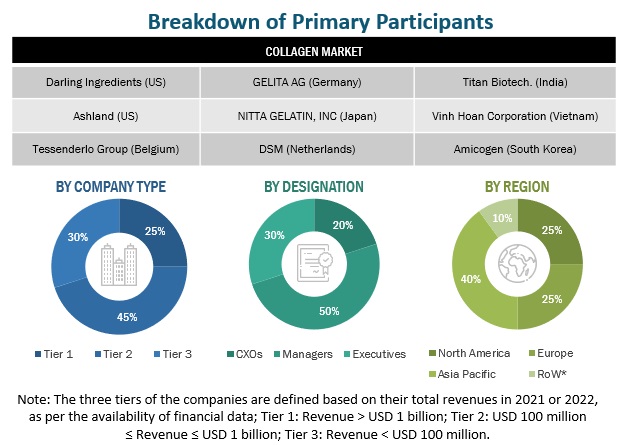
To know about the assumptions considered for the study, download the pdf brochure
Coolagen Market Size Estimation
Both the top-down and bottom-up approaches were used to estimate and validate the total size of the collagen market. These approaches were also used extensively to determine the size of various subsegments in the market. The research methodology used to estimate the market size includes the following details:
- The key players in the industry and the overall markets were identified through extensive secondary research.
- All shares, splits, and breakdowns were determined using secondary sources and verified through primary sources.
- All possible parameters that affect the market covered in this research study were accounted for, viewed in extensive detail, verified through primary research, and analyzed to obtain final quantitative and qualitative data.
- The research included the study of reports, reviews, and newsletters of top market players, along with extensive interviews for opinions from leaders, such as CEOs, directors, and marketing executives.
Global Collagen Products Market: Bottom-Up Approach
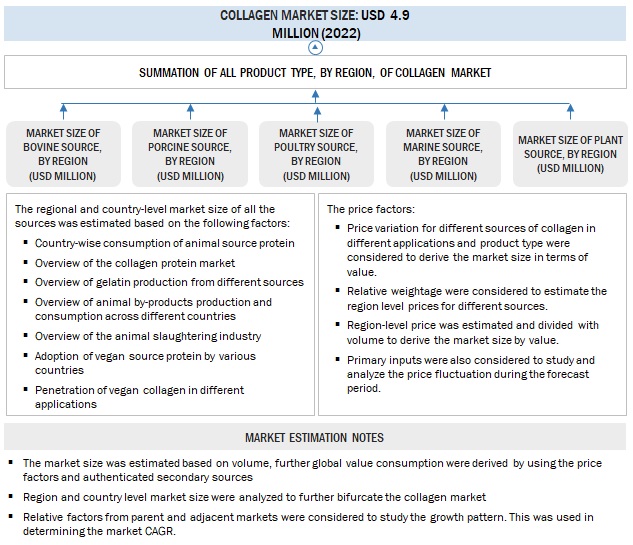
Global collagen Market: Top-Down Approach
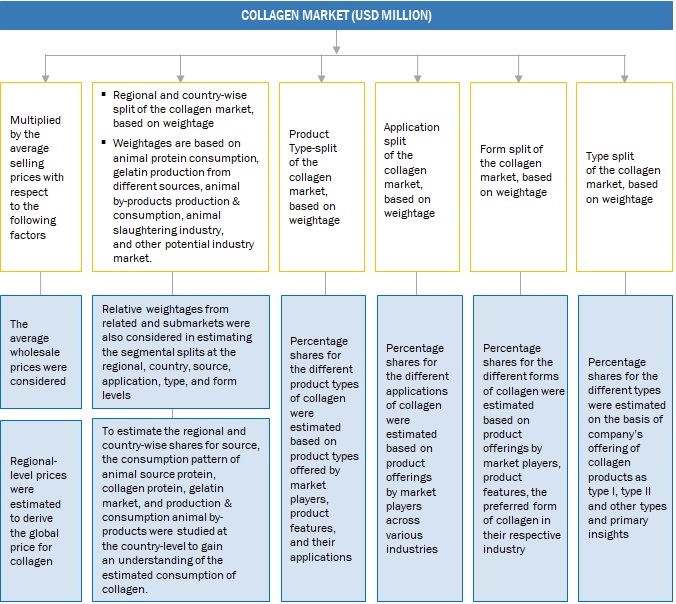
Data Triangulation
After arriving at the overall market size from the estimation process explained above, the total market was split into several segments and subsegments. Data triangulation and market breakdown procedures were employed to estimate the collagen market and arrive at the exact statistics for all segments and subsegments. The data was triangulated by studying numerous factors and trends from the demand and supply sides. The market size was also validated using both the top-down and bottom-up approaches.
Market Definition
- Collagen is one of the key structural proteins found in the extracellular matrices of many connective tissues in mammals, making up about 25%–35% of the whole-body protein content. It is mostly found in fibrous tissues such as tendons, ligaments, and skin (about one-half of total body collagen) and is abundant in corneas, cartilage, bones, blood vessels, and the gut.
- Gelatin is obtained by the partial hydrolysis of collagen. This process occurs when collagen triple helices are broken down to the point of being pulled apart into individual strands. Gelatin will only dissolve in hot water and jellify when cooled. Due to its gelling, foaming, emulsifying, and binding functions, gelatin is often used in culinary applications, such as gummy candies, jellies, and sauce thickeners. Gelatin also has an irreplaceable role in pharma applications, where it is often used as an excipient for making soft and hard capsules.
Key Stakeholders
- Manufacturers, dealers, and suppliers of collagen
- Technology providers to collagen manufacturers
- Food & beverage, pharmaceuticals, and cosmetics & personal care products manufacturers
- Raw material suppliers
- Trade associations and industry bodies
- Importers and exporters of collagen
-
Associations. regulatory bodies, and other industry-related bodies
- US Food and Drug Administration (US FDA)
- Gelatine Manufacturers of Europe (GME)
- US Department of Agriculture (USDA)
- European Food Safety Authority (EFSA)
- The International Food Additives Council (IFAC)
- Food Processing Suppliers Associations (FPSA)
- Center for Innovative Food Technology (CIFT)
- European Food Information Council (EUFIC)
Report Objectives
- To determine and project the size of the collagen market with respect to the product type, application, source, form, type, extraction process (Qualitative), and region in terms of value and volume over seven years, ranging from 2023 to 2030.
- To identify the attractive opportunities in the market by determining the largest and fastest-growing segments across regions
- To provide detailed information about the key factors influencing market growth (drivers, restraints, opportunities, and challenges)
- To analyze the opportunities in the market for stakeholders and provide details of the competitive landscape for market leaders.
- To analyze the micro-markets with respect to individual growth trends, prospects, and their contribution to the total market.
- To identify and profile the key players in the collagen market.
- To understand the competitive landscape and identify the major growth strategies adopted by players across the key regions.
- To provide insights on key product innovations and investments in the collagen market.
Available Customizations:
With the given market data, MarketsandMarkets offers customizations according to company-specific scientific needs.
The following customization options are available for the report:
Product Analysis
- Product Matrix, which gives a detailed comparison of the product portfolio of each company.
Geographic Analysis
With the given market data, MarketsandMarkets offers customizations according to company-specific scientific needs.
- Further breakdown of the Rest of Europe into Netherlands, Belgium, Russia, Sweden, and other EU & non-EU countries.
- Further breakdown of the Rest of Asia Pacific collagen market into Thailand, the Philippines, Malaysia, Singapore, and Vietnam.
- Further breakdown of the Rest of South American collagen market into Chile, Colombia, Paraguay, and other South American countries.
Company Information
- Detailed analyses and profiling of additional market players (up to five)
Get the Full Collagen Market Report
Full forecast, segment splits, and company analysis for all Collagen Market.
- US Collagen Market
- Canada Collagen Market
- Mexico Collagen Market
- Germany Collagen Market
- UK Collagen Market
- Spain Collagen Market
- Italy Collagen Market
- France Collagen Market
- China Collagen Market
- India Collagen Market
- Japan Collagen Market
- Brazil Collagen Market
- Argentina Collagen Market
- Rest Of Europe Collagen Market
- Rest Of South America Collagen Market
Need a Tailored Report?
Customize this report to your needs
Get 10% FREE Customization
Customize This Report
