
Italy Compounding Pharmacy Market (2025-2030)

The Italy Compounding Pharmacy Market was valued at $155.2 Million in 2025 and projected to reach to $211.2 Million by 2030, representing a compound annual growth rate of 6.4%. Italy's compounding pharmacy market is positioned for sustained growth through 2030, supported by regulatory frameworks that encourage specialized pharmaceutical services and rising healthcare provider adoption of personalized medicine approaches.


| Market Size in | USD 26.32 MN |
| Market Forecast in | |
| CAGR | |
| Forecast Period | |
| Units Considered | Value (USD MN) |
Italy Compounding Pharmacy Market Trends and Insights
- This growth trajectory reflects Italy's increasing demand for personalized pharmaceutical solutions and regulatory support for specialized compounding services.
- Italy's healthcare system continues to recognize the clinical and economic value of customized medications, particularly for pediatric, geriatric, and specialty patient populations. The Italian compounding pharmacy sector is driven by rising prevalence of chronic diseases, growing patient preference for tailored dosage forms, and enhanced reimbursement frameworks.
- Italy's aging demographic and expanding specialty care infrastructure are key catalysts for market expansion through 2030.
- Regulatory harmonization within the European Union also supports Italy's compounding pharmacy growth, enabling cross-border best practices and standardized quality protocols..
Key Market Statistics
- CAGR (2025-2030) 6.4% CAGR
- Market Size, 2025 ~USD 155.2 Million
- Forecast, 2030 ~USD 211.2 Million
- Country Italy
Italy Compounding Pharmacy Market Overview
Market Valuation Growth :
Italy's compounding pharmacy market is valued at USD 155.2 million in 2025 and is projected to reach USD 211.2 million by 2030, demonstrating robust expansion driven by personalized medicine adoption.
Strong CAGR Performance :
Italy's market is growing at a CAGR of 6.4% (2025-2030), outpacing the global average of 5.7%, indicating accelerated demand for specialized compounding services within the Italian healthcare ecosystem.
Regulatory Support Framework :
Italy's healthcare system actively supports specialized compounding pharmacy services through favorable regulatory policies, enabling pharmacists to deliver customized pharmaceutical solutions tailored to patient needs.
Personalized Medicine Demand :
Increasing patient preference for personalized pharmaceutical solutions in Italy is driving market expansion, with healthcare providers recognizing the clinical and economic benefits of customized compounding services.
Italy Compounding Pharmacy Market Dynamics
- The market's 6.4% CAGR reflects growing recognition among Italian patients and clinicians of the therapeutic advantages offered by customized pharmaceutical formulations.
- Healthcare modernization initiatives and increased investment in specialized pharmacy services are expected to further accelerate market penetration across Italian regions.
- The convergence of regulatory support, clinical demand, and patient preference for tailored solutions creates a favorable environment for compounding pharmacy expansion throughout the forecast period..
Market Ecosystem
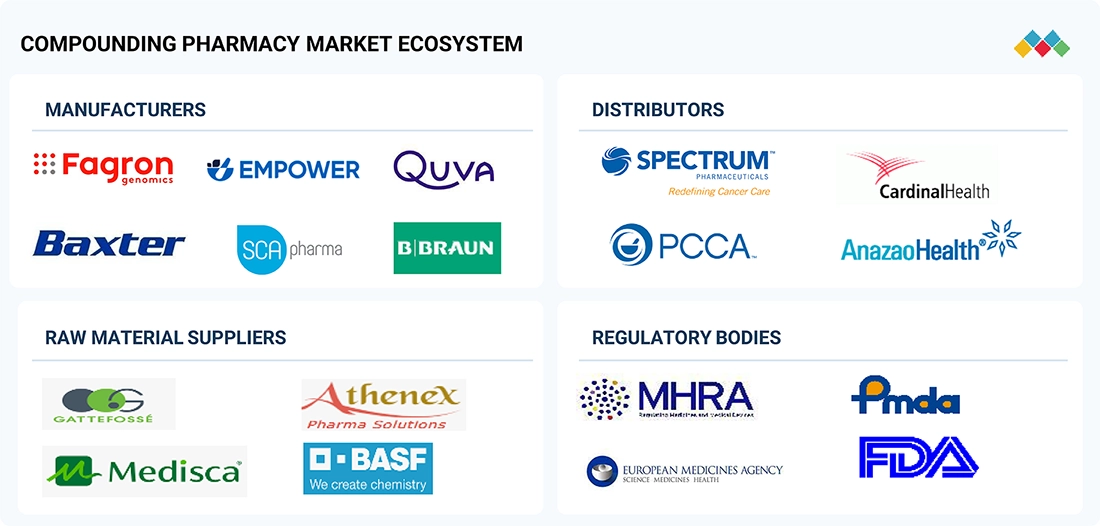
Compounding Pharmacy Market: COMMERCIAL USE CASES ACROSS INDUSTRIES
| COMPANY | USE CASE DESCRIPTION | BENEFITS |
|---|---|---|
 |
Specializes in Bioidentical Hormone Replacement Therapy (BHRT) for menopause and hormonal imbalances | Personalized hormone formulations (creams, gels, capsules) based on lab results |
 |
Creates custom pain creams combining NSAIDs, anesthetics, and muscle relaxants | Tailored topical treatments for chronic pain and neuropathy; avoids systemic side effects |
 |
Compounds veterinary and human medications, including hormone therapies and dermatological treatments | Offers niche formulations not available commercially; supports individualized care |
Logos and trademarks shown above are the property of their respective owners. Their use here is for informational and illustrative purposes only.
Related Ecosystem
Pharmaceuticals
- Bioreactors
- Analytical Testing
- Bioanalytical Testing Services
- Cell Counters
- Data Management Services
- Thermo Fisher Scientific Inc.
- Merck KGaA
- SANOFI
- Pfizer Inc.
- NOVARTIS
Key Takeaways
- Italy's compounding pharmacy market is valued at USD 155.2 million in 2025 and is forecast to reach USD 211.2 million by 2030.
- Italy is experiencing a 6.4% CAGR, outpacing the global average of 5.7%, driven by personalized medicine adoption.
- Italy's aging population and chronic disease prevalence are primary growth drivers for customized pharmaceutical solutions.
- EU regulatory alignment strengthens Italy's compounding pharmacy infrastructure and cross-border operational efficiency.
Compounding Pharmacy Market Report Scope
| Report Metric | Details |
|---|---|
| Base Year | 2025 |
| Fastest Growing Segment | HORMONE REPLACEMENT THERAPIES (Therapeutic Application) |
| Forecast Period | 2025–2030 |
| Growth Rate | CAGR of 5.7% from 2025 to 2030 |
| Largest Segment | PHARMACEUTICAL DOSAGE ALTERATION (Compounding Type) |
| Market Size Base Year (Billions) | ~USD 14.71 (2025) |
| Revenue Forecast (Billions) | ~USD 19.41 (2030) |
| Segments Covered | Product, Compounding Type, Therapeutic Application |
Italy Compounding Pharmacy Market Report Segmentation
3 segment dimensions are covered across the global market.
By Product
- Nasal Drugs
- Ophthalmic Drugs
- Oral Drugs
- Other Products
- Parenteral Drugs
- Rectal Drugs
- Topical Drugs
By Compounding Type
- Currently Unavailable Pharmaceutical Manufacturing
- Pharmaceutical Dosage Alteration
- Pharmaceutical Ingredient Alteration
By Therapeutic Application
- Dermal Disorders
- Hormone Replacement Therapies
- Nutritional Supplements
- Other Therapeutic Applications
- Pain Management
ITALY: COMPOUNDING PHARMACY MARKET, BY END USER, 2023–2030
| Segment | 2023 | 2024 | 2025 | 2026 | 2027 | 2028 | 2029 | 2030 | CAGR (%) |
|---|---|---|---|---|---|---|---|---|---|
| ADULTS | 214.1 | 240.1 | 263.6 | 284.6 | 303 | 319.5 | 337.2 | 356.9 | 6.3 |
| GERIATRIC PATIENTS | 95.2 | 106 | 115.5 | 123.8 | 130.8 | 136.9 | 143.3 | 150.5 | 5.4 |
| PEDIATRIC PATIENTS | 64.1 | 72.9 | 81.1 | 88.7 | 95.7 | 102.2 | 109.2 | 117.1 | 7.6 |
| TOTAL | 373.5 | 419 | 460.2 | 497.2 | 529.5 | 558.6 | 589.7 | 624.6 | 6.3 |
Target Audience
- Pharmaceutical Manufacturers : Italian and international pharmaceutical companies need Italy-specific market data to identify compounding opportunities, assess competitive positioning, and develop localized product strategies for the Italian market.
- Pharmacy Operators & Networks : Independent and chain pharmacies in Italy require detailed market insights to evaluate compounding service expansion opportunities, understand demand drivers, and benchmark performance against market growth trends.
- Healthcare Investors & PE Firms : Investment firms targeting Italian healthcare assets need precise market valuations, growth forecasts, and regulatory insights to evaluate acquisition targets and investment returns in the compounding pharmacy sector.
- Healthcare Consultants & Advisors : Management consulting firms and healthcare advisors serving Italian clients require country-specific market data to support strategic recommendations, feasibility studies, and business case development for compounding pharmacy initiatives.
- Government & Regulatory Bodies : Italian healthcare policymakers and regulatory agencies need market intelligence to inform healthcare policy decisions, resource allocation, and regulatory frameworks supporting specialized compounding pharmacy services.
Key Companies in the Italy Compounding Pharmacy Market
| Company | HQ | Ownership | Strongest segments |
|---|---|---|---|
| BAXTER | United States | Public Company | Medical Products & Therapies (IV, infusion, parenteral nutrition, renal-related therapies),Healthcare Systems & Technologies (smart beds, monitoring, OR integration, surgical equipment),Pharmaceuticals (generic and specialty injectables, inhaled anesthetics, compounding services), |
| FAGRON | Belgium | Public Company | Essentials (APIs, excipients, bases),Brands (derma, immunology, hair, scar care),Compounding Services, |
BAXTER
Baxter is a publicly traded American healthcare company founded in 1931 that employs 37,500 people. The company operates as a major medical device and pharmaceutical manufacturer serving global markets.
FAGRON
Fagron is a publicly traded Belgian pharmaceutical company founded in 1990 with 4,880 employees. The company focuses on pharmaceutical compounding and specialty pharmacy solutions.
Reasons to Buy this Report
- Market-Specific Sizing Data : Access precise valuation figures for Italy's compounding pharmacy market (USD 155.2M in 2025) with detailed 5-year forecasts, enabling accurate business planning and investment decisions specific to the Italian market.
- Competitive Intelligence : Understand Italy's unique market dynamics, regulatory environment, and growth drivers that differentiate it from global trends, providing strategic advantages for market entry or expansion within Italian healthcare.
- Growth Opportunity Assessment : Leverage Italy's above-average 6.4% CAGR to identify high-potential market segments and geographic regions within the country, optimizing resource allocation and revenue projections for Italian operations.
- Regulatory & Healthcare Insights : Gain detailed understanding of Italy's supportive regulatory framework for compounding pharmacies and healthcare system dynamics, essential for compliance and partnership development with Italian healthcare providers.
- Strategic Market Positioning : Develop targeted go-to-market strategies for Italy by analyzing personalized medicine adoption trends, patient preferences, and healthcare provider demand patterns specific to the Italian pharmaceutical landscape.
Frequently asked questions
What is the current market size of Italy's compounding pharmacy sector?
Italy's compounding pharmacy market is valued at USD 155.2 million in 2025 and is projected to grow to USD 211.2 million by 2030.
What is the expected growth rate for Italy's compounding pharmacy market?
Italy's compounding pharmacy market is expected to grow at a CAGR of 6.4% from 2025 to 2030, exceeding the global average.
What factors are driving growth in Italy's compounding pharmacy market?
Key drivers include Italy's aging demographic, rising chronic disease prevalence, increased demand for personalized medications, and supportive EU regulatory frameworks.
How does Italy's compounding pharmacy growth compare to global trends?
Italy's 6.4% CAGR outpaces the global compounding pharmacy market CAGR of 5.7%, reflecting stronger regional demand for customized pharmaceutical solutions.
What patient populations benefit most from compounding pharmacies in Italy?
Pediatric, geriatric, and specialty care patients in Italy benefit most from compounding pharmacies due to personalized dosage forms and tailored therapeutic solutions.
RESEARCH METHODOLOGY
This research extensively used secondary sources, directories, and databases to gather valuable information for analyzing the global compounding pharmacy market. In-depth interviews were conducted with various primary respondents, including key industry players, subject-matter experts (SMEs), C-level executives of major market companies, and industry consultants, to obtain and verify critical qualitative and quantitative data and evaluate the market's growth prospects. The global market size estimated through secondary research was then validated and refined with inputs from primary research to determine the final market size.
Secondary Research
Secondary research was used mainly to identify and collect information for the extensive, technical, market-oriented, and commercial study of the compounding pharmacy market. The secondary sources used for this study include US Food and Drug Administration (FDA), American Pharmacists Association (APhA), International Academy of Compounding Pharmacists (IACP), National Community Pharmacists Association (NCPA), Parenteral Drug Association (PDA), American Society of Health-System Pharmacists (ASHP), Pharmacy Compounding Accreditation Board (PCAB), European Directorate for the Quality of Medicines & HealthCare (EDQM), European Medicines Agency (EMA), International Pharmaceutical Federation (FIP), Journal of Compounding & Specialty Pharmacy (JCSP), National Center for Biotechnology Information (NCBI), Pharmaceutical Research and Manufacturers of America (PhRMA), Pharma & Biopharma Outsourcing Association (PBOA), World Journal of Pharmaceutical Research (WJPR). Secondary sources also include corporate and regulatory filings, such as annual reports, SEC filings, investor presentations, and financial statements; business magazines & research journals; press releases; and trade, business, and professional associations, and MarketsandMarkets Analysis. These sources were also used to obtain key information about major players, market classification, and segmentation according to industry trends, regional/country-level markets, market developments, and technology perspectives.
Primary Research
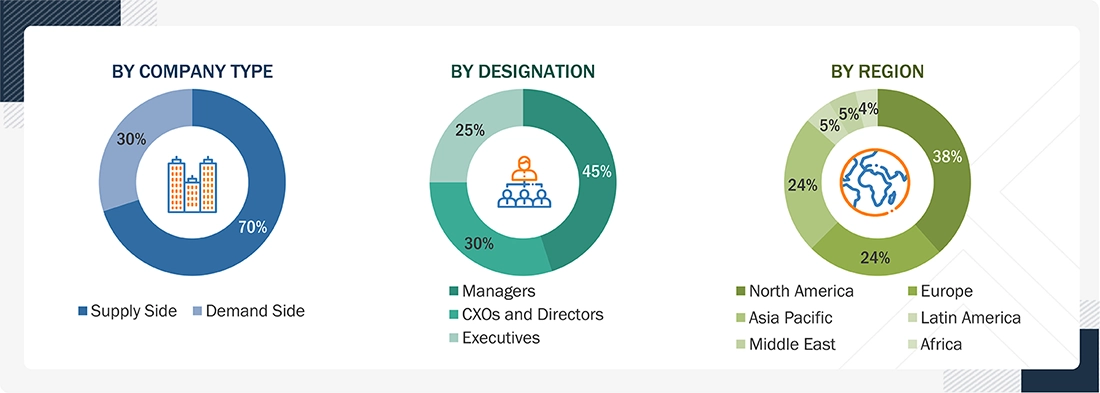
After an initial assessment of the global compounding pharmacy market landscape through secondary research, comprehensive primary research was conducted. This included in-depth interviews with market experts from the demand side, such as stakeholders from pharmaceutical and biotechnology companies, CROs, CMOs, and academic and research institutions. Additionally, interviews were held with key supply-side participants, including C-suite and senior executives, product managers, and marketing and sales leaders from leading manufacturers, distributors, and channel partners. The research covered six major regions: North America, Europe, the Asia Pacific, Latin America, the Middle East, and Africa. About 70% of the primary interviews involved supply-side participants, while 30% involved demand-side experts. Data collection methods included structured questionnaires, email correspondence, online surveys, personal interviews, and telephonic discussions to understand market dynamics comprehensively.
The following is a breakdown of the primary respondents:
To know about the assumptions considered for the study, download the pdf brochure
Market Size Estimation
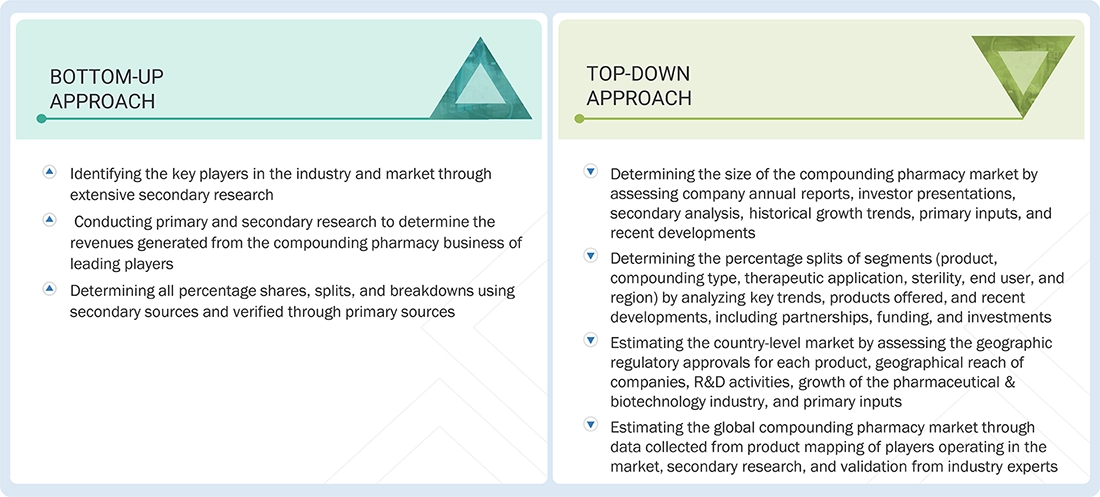
Both bottom-up and top-down approaches were used to estimate and validate the total size of the compounding pharmacy market. These methods were also used extensively to estimate the size of various subsegments in the market. The research methodology used to estimate the market size includes the following:
- A list of the major global players operating in the compounding pharmacy market was generated.
- The revenues generated from their compounding pharmacy product have been determined through annual reports and secondary sources (including paid databases)
- The products were mapped according to the segments of the market. Percentage shares and splits were determined based on the revenue contributed to each segment. This was verified using secondary sources and by industry experts.
- All assumptions, approaches, and individual shares/revenue estimates were validated through expert interviews.
Global Compounding Pharmacy Market Size: Bottom-up and Top-down Approach
Data Triangulation
After estimating the market size using the process described above, the total market was divided into several segments and subsegments. To finish the overall market analysis and obtain precise statistics for all segments and subsegments, data triangulation and market breakdown methods were used where applicable. The data was triangulated by examining various factors and trends from both the demand and supply sides.
Market Definition
A compounding pharmacy is a practice in which a licensed pharmacist combines, mixes, or alters the ingredients of a drug to create a medication tailored to the needs of an individual patient.
Stakeholders
- Pharmaceutical and Biotechnology Companies
- Compounding Pharmacies
- Research and Consulting Firms
- Academic Medical Centers
- Government Regulatory and Research Organizations
- Quality Assurance and Accreditation Bodies
- Clinical Research Institutes
Report Objectives
- To define, describe, and forecast the compounding pharmacy market based on product, compounding type, therapeutic application, sterility, end user, and region
- To provide detailed information regarding the major factors influencing market growth (such as drivers, restraints, opportunities, and challenges)
- To strategically analyze micromarkets1 concerning individual growth trends, prospects, and contributions to the compounding pharmacy market
- To analyze the opportunities in the market for stakeholders and provide details of the competitive landscape for market leaders
- To forecast the size of the market segments concerning five main regions—North America, Europe, the Asia Pacific, Latin America, the Middle East, and Africa
- To profile the key players in the global compounding pharmacy market and comprehensively analyze their product portfolios, market positions, and core competencies
- To track and analyze competitive developments such as product approvals and launches, expansions, agreements, and collaborations in the Compounding pharmacy market
- To benchmark players within the compounding pharmacy market using the company evaluation matrix framework, which analyzes market players based on various parameters within the broad categories of business and service strategy
Get the Full Compounding Pharmacy Market Report
Full forecast, segment splits, and company analysis for all Compounding Pharmacy Market.
- Canada Compounding Pharmacy Market
- US Compounding Pharmacy Market
- Germany Compounding Pharmacy Market
- UK Compounding Pharmacy Market
- France Compounding Pharmacy Market
- Spain Compounding Pharmacy Market
- China Compounding Pharmacy Market
- Japan Compounding Pharmacy Market
- India Compounding Pharmacy Market
- Australia Compounding Pharmacy Market
- South Korea Compounding Pharmacy Market
- Brazil Compounding Pharmacy Market
- Mexico Compounding Pharmacy Market
- Rest Of Europe Compounding Pharmacy Market
- Rest Of Asia Pacific Compounding Pharmacy Market
- Rest Of Latin America Compounding Pharmacy Market
Need a Tailored Report?
Customize this report to your needs
Get 10% FREE Customization
Customize This Report
