
Europe Connected Worker Market (2025-2030)

The Europe Connected Worker Market was valued at $420 Million in 2025 and projected to reach to $875.4 Million by 2030, representing a compound annual growth rate of 15.8%. Europe's Connected Worker Market within the semiconductor and electronics sector is positioned for sustained growth through 2030, driven by increasing automation investments and digital workplace modernization.


| Market Size in | USD 26.32 MN |
| Market Forecast in | |
| CAGR | |
| Forecast Period | |
| Units Considered | Value (USD MN) |
Europe Connected Worker Market Trends and Insights
- Valued at $420.0 million in 2025, Europe is projected to reach $875.4 million by 2030, representing a compound annual growth rate of 15.8%.
- This growth trajectory reflects Europe's commitment to digital transformation and Industry 4.0 initiatives across manufacturing and electronics production facilities. The European market is driven by stringent workplace safety regulations, advanced manufacturing infrastructure, and significant investment in smart factory technologies.
- Europe's emphasis on worker productivity and real-time operational visibility is accelerating adoption of connected worker solutions throughout the semiconductor supply chain.
- By 2030, Europe is expected to solidify its position as a key regional hub for connected worker innovation and deployment. Europe's competitive advantage stems from its skilled workforce, regulatory frameworks promoting workplace digitalization, and collaboration between technology providers and industrial manufacturers.
- The region's focus on sustainable and efficient production methods continues to fuel demand for integrated connected worker platforms across the forecast period..
Key Market Statistics
- CAGR (2025-2030) 15.8% CAGR
- Market Size, 2025 ~USD 420 Million
- Forecast, 2030 ~USD 875.4 Million
- Geography Europe
Europe Connected Worker Market Overview
Market Valuation Growth :
Europe's Connected Worker Market in Semiconductor & Electronics is valued at $420.0 million in 2025, with projections reaching $875.4 million by 2030, demonstrating strong market maturation and investment confidence across the region.
Regional CAGR Performance :
Europe's 15.8% CAGR from 2025-2030 reflects steady adoption of connected worker technologies, driven by stringent regulatory frameworks, advanced manufacturing capabilities, and widespread Industry 4.0 implementation across semiconductor facilities.
Industry 4.0 Adoption :
European semiconductor and electronics manufacturers are accelerating digital transformation initiatives, leveraging connected worker solutions to enhance productivity, safety compliance, and real-time operational visibility in manufacturing environments.
Regulatory & Compliance Drivers :
Europe's robust data protection regulations (GDPR) and workplace safety standards are propelling demand for secure, compliant connected worker platforms that enable real-time monitoring while maintaining employee privacy and security standards.
Europe Connected Worker Market Dynamics
- The region's mature manufacturing base and commitment to Industry 4.0 standards create favorable conditions for connected worker technology adoption, particularly among large-scale semiconductor fabrication facilities and electronics assembly operations. Key growth catalysts include rising labor costs driving efficiency improvements, heightened focus on workplace safety and ergonomics, and integration of AI and IoT technologies into production environments.
- European manufacturers are increasingly recognizing connected worker solutions as critical enablers for maintaining competitive advantage, improving asset utilization, and meeting evolving supply chain resilience requirements in an increasingly complex global market..
Market Ecosystem
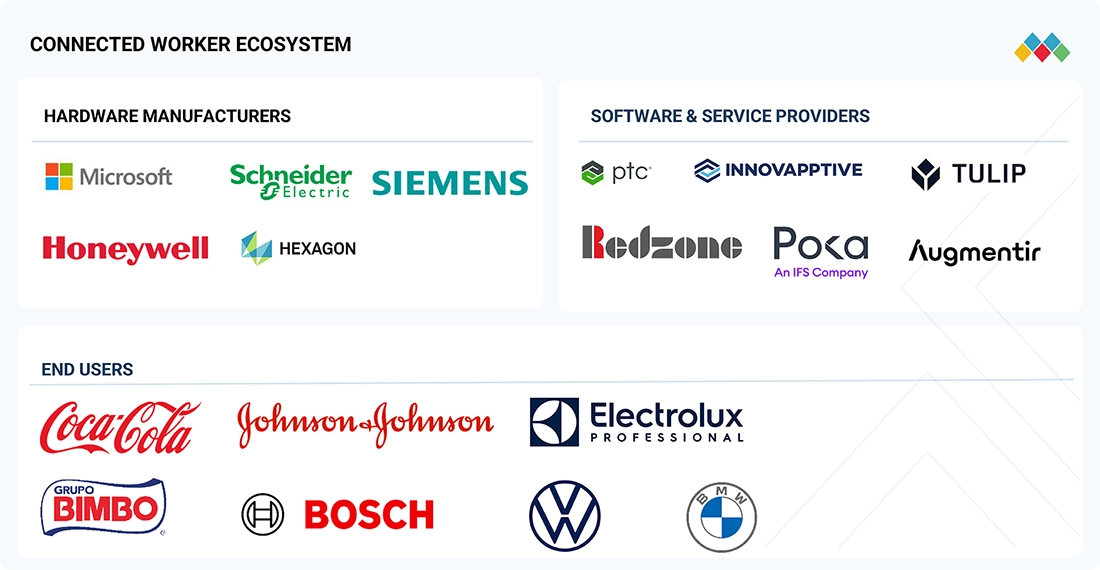
Connected Worker Market: COMMERCIAL USE CASES ACROSS INDUSTRIES
| COMPANY | USE CASE DESCRIPTION | BENEFITS |
|---|---|---|
 |
Provides an integrated suite of connected worker solutions combining hardware (wearables, sensors) and software (Honeywell Forge) to link field workers with control rooms, digitize workflows, enable mobile inspections, and offer real-time for safety and productivity; deploys AR-enabled devices for maintenance, guided task execution, and compliance in manufacturing, energy, and critical infrastructure sectors | Enhanced workforce safety | Accelerated onboarding | Reduced downtime | Optimized regulatory compliance | Increased Plant Productivity | Business continuity, quality, and rapid incident resolution | Support for remote assistance and operational efficiency |
 |
Offers cloud-based connected worker solutions leveraging Microsoft Teams, Dynamics 365, and Azure IoT for sharing work instructions, enabling AR/VR remote guidance (via HoloLens), and automating compliance; facilitates seamless communication, mobile collaboration, and asset visibility in manufacturing, field service, and healthcare | High workforce productivity (up to 30%) | Reduced time spent searching for data (up to 50%) | Enhanced decision-making | Simplified maintenance tasks | Improved collaboration, especially through hands-free, secure communication and remote support for frontline staff |
 |
Integrates field personnel, IoT devices, AR-guided workflows, and analytics for manufacturing and utility clients; features include mobile access to operational data, visual instructions, remote expert support, and real-time updates for inspection and maintenance rounds | 30% reduction in maintenance time | Increased uptime and worker safety | Rapid resolution of field issues | Continuous process improvement | Better knowledge retention and workforce training, leading to higher operational agility |
 |
Enables operational agility through a digitally connected workforce using sensors, mobile devices, and cloud technology for asset management, compliance, workflow digitization, and real-time collaboration; applies AR/VR for visual guidance (leveraging platforms such as AVEVA Teamwork) and integrates process knowledge directly into work environments | Improved productivity by streamlining work execution | Enhanced quality and regulatory compliance | Continuous improvement and better collaboration | Reduced risk | Enhanced data-driven decision-making | Shortened onboarding | Sustained process knowledge despite workforce turnover |
 |
Delivers comprehensive connected worker solutions using ThingWorx IIoT, Vuforia AR, and Windchill PLM platforms; automates workflows, provides digital work instructions, enables real-time performance, and facilitates remote coaching for manufacturing and service sectors | Double-digit KPI improvements in workforce productivity, quality, and enterprise collaboration | Reduced assembly time | Service efficiency | Accelerated new hire training | Minimized process deviations through closed-loop feedback and digitalized best practices |
Logos and trademarks shown above are the property of their respective owners. Their use here is for informational and illustrative purposes only.
Related Ecosystem
Electronics System And Components
- Sensors
- Temperature Sensors
- Pressure Sensors
- Actuators
- Image Sensors
- Lenovo
- Samsung
- Texas Instruments Incorporated
- HONEYWELL INTERNATIONAL INC.
- Teledyne Technologies Incorporated
Key Takeaways
- Europe's Connected Worker Market will more than double from $420.0M (2025) to $875.4M (2030) at a 15.8% CAGR.
- Europe leads in regulatory compliance and safety-driven adoption of connected worker technologies in semiconductor manufacturing.
- Industry 4.0 initiatives and digital transformation investments are primary growth catalysts across European electronics facilities.
- Europe's skilled workforce and collaborative ecosystem position the region as a competitive hub for connected worker innovation through 2030.
Connected Worker Market Report Scope
| Report Metric | Details |
|---|---|
| Base Year | 2025 |
| Fastest Growing Segment | 5G (Connectivity) |
| Forecast Period | 2025–2030 |
| Growth Rate | CAGR of 18.5% from 2025 to 2030 |
| Largest Segment | HARDWARE (Offering) |
| Market Size Base Year (Billions) | ~USD 8.64 (2025) |
| Revenue Forecast (Billions) | ~USD 20.18 (2030) |
| Segments Covered | Offering, Type, Vertical, Deployment Type, Connectivity, Application, Technology |
Europe Connected Worker Market Report Segmentation
7 segment dimensions are covered across the global market.
By Offering
- Hardware
- Services
- Software
By Type
- Communication & Connectivity Devices
- Consulting & Advisory Services
- Handheld Devices
- Handheld Mobile Computers
- Helmets & Body Sensors
- Helmets And Body Sensors
- Industrial IoT Sensors & Edge Devices
- Maintenance & Upgrades
- Other Handheld Devices
- Other Services
- Other Wearable Devices
- Robotics & Automation Hardware
- Smart Glasses & Ar Headsets
- Smart Gloves
- Training & Support Services
- Wearable Devices
- Wristbands
By Vertical
- Aerospace & Defense
- Automotive
- Construction
- Healthcare & Pharmaceutical
- Manufacturing
- Mining
- Oil & Gas
- Other Verticals
- Retail & Warehousing
- Transportation & Logistics
- Utilities & Energy
By Deployment Type
- Cloud-Based Software
- On-Premises Software
By Connectivity
- 5G
- Bluetooth
- Lpwan
- Lpwan (Low Power Wide Area Network)
- Other Connectivities
- Other Connectivity
- Rfid & Nfc
- Wi-Fi
By Application
- Inventory & Asset Management
- Other Applications
- Predictive Maintenance
- Remote Assistance & Collaboration
- Task Management & Productivity Optimization
- Training & Skill Development
- Workforce Safety & Compliance
By Technology
- Artificial Intelligence & Machine Learning
- Augmented Reality & Virtual Reality
- Edge Computing
- Industrial Internet Of Things
- Other Technologies
CONNECTED WORKER MARKET FOR EUROPE, BY APPLICATION, 2025–2030
| Segment | 2025 | 2026 | 2027 | 2028 | 2029 | 2030 | CAGR (%) |
|---|---|---|---|---|---|---|---|
| INVENTORY & ASSET MANAGEMENT | 134.4 | 149.1 | 163.2 | 176.1 | 187.4 | 197.2 | 8 |
| OTHER APPLICATIONS | 109.2 | 123.9 | 136.7 | 143.2 | 147.3 | 149.8 | 6.5 |
| PREDICTIVE MAINTENANCE | 197.7 | 223 | 248.3 | 272.4 | 294.9 | 315.5 | 9.8 |
| REMOTE ASSISTANCE & COLLABORATION | 420 | 499.6 | 586.9 | 682 | 779.2 | 875.4 | 15.8 |
| TASK MANAGEMENT & PRODUCTIVITY OPTIMIZATION | 322 | 373.5 | 427.8 | 482.7 | 537.5 | 591.5 | 12.9 |
| TRAINING & SKILL DEVELOPMENT | 543.9 | 656.9 | 783.3 | 920.2 | 1067 | 1222.4 | 17.6 |
| WORKFORCE SAFETY & COMPLIANCE | 343.8 | 393.6 | 444.9 | 495.5 | 544.6 | 591.5 | 11.5 |
| TOTAL | 2071 | 2419.6 | 2791.3 | 3171.9 | 3558 | 3943.2 | 13.7 |
Target Audience
- Semiconductor Manufacturers : European semiconductor fabrication plants require connected worker solutions to optimize production efficiency, ensure compliance with safety regulations, and maintain competitive positioning in advanced manufacturing operations.
- Electronics Assembly Operators : Electronics manufacturers across Europe need market insights to evaluate connected worker technology investments that enhance workforce productivity, reduce operational costs, and improve quality control in assembly environments.
- Technology Solution Providers : Software and hardware vendors targeting European industrial markets require detailed market data to identify growth opportunities, understand customer requirements, and develop region-specific connected worker solutions.
- Industrial Equipment Manufacturers : Equipment suppliers serving European semiconductor and electronics sectors need market intelligence to integrate connected worker capabilities into their offerings and align product development with regional demand trends.
- Enterprise Operations & IT Leaders : Manufacturing executives and IT decision-makers in European companies require market analysis to justify connected worker investments, benchmark against industry peers, and align technology strategies with digital transformation roadmaps.
Key Companies in the Europe Connected Worker Market
| Company | HQ | Ownership | Strongest segments |
|---|---|---|---|
| HONEYWELL INTERNATIONAL INC. | United States | Public Company | Industrial Automation,Building Automation,Energy and Sustainability Solutions (UOP and related), |
| MICROSOFT | United States | Public Company | Productivity and Business Processes,Intelligent Cloud,Personal Computing, |
| SIEMENS | Germany | Public Company | Digital Industries (automation, PLM, simulation),Smart Infrastructure (energy, buildings, electrification),Mobility (rail systems, automation, services), |
| SCHNEIDER ELECTRIC | France | Public Company | Low- and medium-voltage equipment and switchgear,Building management, power metering, and smart controls,Industrial automation, drives, and control equipment, |
| PTC | United States | Public Company | PLM (Windchill, Arena, FlexPLM, Arbortext),CAD and Product Development (Creo, Onshape, Mathcad, PTC Products),Industrial IoT and Connectivity (ThingWorx, Kepware, Kepware Edge, KEPServerEX), |
| ZEBRA TECHNOLOGIES CORP. | United States | Public Company | Printers and Supplies (labels, wristbands, cards, RFID tags),Rugged Mobile Computing and Accessories,Barcode Scanners, Imagers, and Fixed Industrial Scanners, |
| HEXAGON AB | Sweden | Public Company | Manufacturing Intelligence (metrology, CAD/CAM, CAE, QA software),Geosystems (survey, laser scanning, airborne/mobile mapping, AEC tools),Autonomous Solutions & Mining (autonomy, machine control, multi-sensor, safety), |
| POKA INC. | India | Public Company | Granite raw blocks,Granite processed slabs, tiles, countertops, monuments,Quartz surfaces (Quantra), |
| LIBRESTREAM TECHNOLOGIES | Canada | Private Company | Onsight SaaS platform (licenses and subscriptions),Ruggedized devices and peripherals,Professional services and implementation, |
HONEYWELL INTERNATIONAL INC.
Honeywell International Inc. is a diversified technology and manufacturing company founded in 1885 and headquartered in the United States. With 101,000 employees, the publicly traded company operates across multiple industrial sectors including aerospace, building technologies, and performance materials.
MICROSOFT
Microsoft is a global technology company founded in 1975 that develops software, cloud services, and hardware products. As a publicly traded company with 228,000 employees, Microsoft is one of the world's largest and most influential technology corporations.
SIEMENS
Siemens is a German multinational conglomerate founded in 1847 that operates in electrification, automation, and digitalization. With 310,312 employees worldwide, the publicly traded company serves customers across industrial, infrastructure, and mobility sectors.
SCHNEIDER ELECTRIC
Schneider Electric is a French multinational company founded in 1836 specializing in energy management and automation solutions. The publicly traded company employs 158,122 people and serves customers in industrial, commercial, and residential markets globally.
PTC
PTC is a United States-based software company founded in 1985 that provides product lifecycle management and industrial IoT solutions. As a publicly traded company with 7,000 employees, PTC serves manufacturing and industrial enterprises worldwide.
ZEBRA TECHNOLOGIES CORP.
Zebra Technologies Corp. is a United States company founded in 1969 that manufactures and sells data capture and printing solutions. With 10,700 employees, the publicly traded company provides barcode, RFID, and mobile computing technologies for enterprise customers.
HEXAGON AB
Hexagon AB is a Swedish technology company founded in 1975 that provides digital solutions for industrial and geospatial applications. With 16,118 employees, the publicly traded company serves customers in manufacturing, construction, and public sector markets.
POKA INC.
Poka Inc. is an India-based public company founded in 1991 with 170 employees that provides software and technology solutions. The company serves enterprise and industrial customers with digital transformation and operational software.
LIBRESTREAM TECHNOLOGIES
Librestream Technologies is a Canadian company founded in 2003 that develops augmented reality and remote collaboration software solutions. The private company specializes in wearable technology and video communication platforms for industrial and enterprise applications.
Countries within Europe - compare and drill down
| Country | 2025 size (native) |
|---|
Country market size visualization
Reasons to Buy this Report
- Regional Market Sizing & Forecasts : Obtain precise market valuation data specific to Europe's Connected Worker Market, including detailed 2025-2030 projections and CAGR analysis to support strategic planning and investment decisions in the semiconductor and electronics sector.
- Competitive Landscape Intelligence : Gain insights into Europe's key market players, their positioning strategies, and competitive dynamics within the connected worker space, enabling informed vendor selection and partnership evaluation for your organization.
- Regulatory & Compliance Framework : Understand Europe-specific regulatory requirements (GDPR, workplace safety directives) and how connected worker solutions address compliance needs, ensuring your technology investments meet regional standards and risk management requirements.
- Industry-Specific Growth Drivers : Identify sector-specific opportunities within European semiconductor and electronics manufacturing, including adoption trends, technology integration patterns, and emerging use cases driving market expansion and ROI potential.
- Strategic Market Entry & Expansion : Leverage Europe-focused market intelligence to develop targeted go-to-market strategies, identify high-growth sub-segments, and prioritize geographic expansion opportunities across key European manufacturing hubs and industrial centers.
Frequently asked questions
What is the current size of Europe's Connected Worker Market?
Europe's Connected Worker Market is valued at $420.0 million in 2025 and is projected to grow to $875.4 million by 2030.
What is the growth rate for Europe's Connected Worker Market?
Europe's Connected Worker Market is expected to grow at a compound annual growth rate (CAGR) of 15.8% from 2025 to 2030.
What are the main drivers of growth in Europe's Connected Worker Market?
Key drivers include stringent workplace safety regulations, Industry 4.0 adoption, digital transformation initiatives, and investment in smart factory technologies across European semiconductor and electronics manufacturers.
Which industries in Europe are adopting connected worker solutions most rapidly?
The semiconductor and electronics manufacturing sectors in Europe are leading adoption, driven by the need for enhanced worker safety, productivity monitoring, and operational efficiency.
How does Europe's Connected Worker Market compare to global trends?
Europe's 15.8% CAGR is slightly below the global average of 18.5%, but Europe maintains a strong market position due to regulatory compliance requirements and advanced manufacturing infrastructure.
RESEARCH METHODOLOGY
The study involved major activities in estimating the current market size for the connected worker market. Exhaustive secondary research was done to collect information on the connected worker industry. The next step was to validate these findings and assumptions and size them with industry experts across the supply chain using primary research. Different approaches, such as top-down and bottom-up, were employed to estimate the total market size. After that, the market breakup and data triangulation procedures were used to estimate the market size of the segments and subsegments of the connected worker market.
Secondary Research
Extensive primary research was conducted after gaining knowledge about the current scenario of the connected worker market through secondary research. Several primary interviews were conducted with experts from the demand and supply sides across four major regions—North America, Europe, Asia Pacific, and RoW. This primary data was collected through questionnaires, emails, and telephonic interviews.
Primary Research
Extensive primary research has been conducted after obtaining information about the current scenario of the Direct-to-Device (D2D) market through secondary research. Several primary interviews have been conducted with market experts from the demand and supply sides across North America, Europe, the Asia Pacific, the Middle East, and the Rest of the World. This primary data has been collected through questionnaires, emails, and telephonic interviews.
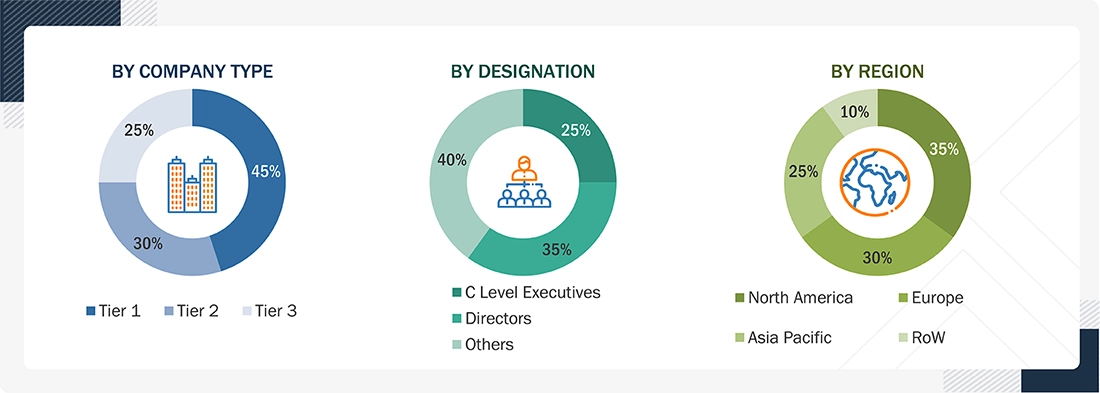
Notes: RoW mainly comprises the Middle East, Africa, and South America.
Other designations include product managers, sales managers, and marketing managers.
Tier 1 companies include market players with revenues above USD 500 million; tier 2 companies earn revenues between USD 100 million and USD 500 million; and tier 3 companies earn up to USD 100 million.
To know about the assumptions considered for the study, download the pdf brochure
Market Size Estimation
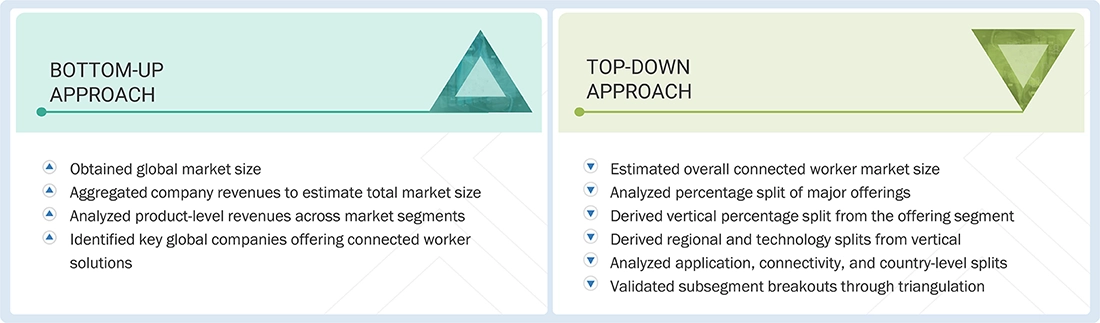
The bottom-up procedure has been employed to arrive at the overall size of the connected worker market.
- Collected company-level revenues from annual reports, investor presentations, and financial disclosures to understand individual contributions to the connected worker market.
- Aggregated product-level revenues across hardware components (wearable devices, handheld devices, industrial IoT sensors & edge devices, robotics & automation hardware), software (cloud-based software & on-premises software), and services to estimate market segments.
- Summed up the company and segment-level revenues to calculate the total global market size of connected workers.
- Analyzed regional presence and deployment of connected worker solutions to validate revenue estimates and refine regional market size.
- Cross-verified data using secondary sources, industry reports, and expert interviews to ensure accuracy and reliability of the market estimation.
The top-down approach has been used to estimate and validate the total size of the connected worker market.
- The overall connected worker market size is estimated using comprehensive industry benchmarks and market data.
- Analyze the percentage split of major offerings, including hardware, software, and services.
- Derive vertical-wise percentage splits based on the offering segmentation to understand industry-specific adoption.
- Determine regional and technology splits within each vertical to capture geographic and technological nuances.
- Analyze application use cases, connectivity methods, and country-level adoption patterns for detailed granularity.
- Validate all subsegment breakouts through triangulation of primary research, expert interviews, and secondary data to ensure accuracy and reliability.
Connected Worker Market: Top-Down and Bottom-Up Approach
Data Triangulation
After arriving at the overall market size using the market size estimation processes as explained above, the market has been split into several segments and subsegments. Data triangulation and market breakdown procedures have been employed to complete the entire market engineering process and arrive at the exact statistics of each market segment and subsegment. The data has been triangulated by studying various factors and trends from the demand and supply sides in the connected worker market.
Market Definition
A connected worker is a frontline employee empowered with digital technologies that seamlessly link them to enterprise systems, operational processes, and colleagues in real time. Through the integration of wearables, mobile devices, augmented and virtual reality tools, IoT-enabled sensors, and cloud-based platforms, connected workers gain instant access to critical information, remote expertise, and data-driven insights while performing tasks in the field or on the shop floor. This digital enablement enhances situational awareness, streamlines workflows, and reduces reliance on manual or paper-based procedures. Beyond improving productivity, connected worker solutions prioritize safety by continuously monitoring worker health, location, and environmental risks, enabling organizations to proactively mitigate hazards. They also support workforce development by providing immersive, on-demand training and guided instructions. As a result, organizations adopting connected worker strategies benefit from greater operational efficiency, enhanced compliance, faster problem resolution, and a more agile and engaged workforce. Positioned at the core of Industry 4.0, the connected worker represents a fundamental shift toward smarter, safer, and more collaborative industrial operations.
Key Stakeholders
- Hardware manufacturers
- Software developers
- Telecom and connectivity providers
- Industrial enterprises (manufacturing, energy, utilities, construction, logistics, etc.)
- Frontline workers
- Labor unions and worker councils
- System integrators
- Service providers (deployment, maintenance, training)
- Regulatory bodies and standards organizations
- Investors and venture capital firms
- Research institutions and universities
Report Objectives
- To define, describe, and forecast the size of the connected worker market, by offering, technology, connectivity, application, vertical, and region, in terms of value
- To describe and forecast the size of the connected worker market, by offering, in terms of volume
-
To forecast the market for various segments with respect to four regions, namely
North America, Europe, Asia Pacific, and RoW, in terms of value - To provide macroeconomic outlooks with respect to the main regions, namely, North America, Europe, Asia Pacific, and RoW
- To provide detailed information regarding the drivers, restraints, opportunities, and challenges influencing the market’s growth
- To strategically analyze micromarkets1 with respect to individual growth trends, prospects, and contributions to the total market
- To provide ecosystem analysis, supply chain, trends/disruptions impacting customer business, technology analysis, pricing analysis, technology analysis, key stakeholders & buying criteria, case study analysis, trade analysis, patent analysis, Porter’s five forces, key conferences & events, AI impact, impact of 2025 US tariff, and regulations related to the connected worker market
- To analyze the opportunities in the market for stakeholders by identifying high-growth segments and detailing the competitive landscape for market players
- To strategically profile key players and comprehensively analyze their market rankings, core competencies, company valuation, and financial metrics, and product/brand comparison, along with detailing the competitive landscape for the market leaders
- To analyze the competitive developments, such as product launches, software launches, agreements, collaborations, and acquisitions, carried out by market players
- To map competitive intelligence based on company profiles, key player strategies, and game-changing developments, such as product developments, collaborations, and acquisitions
- To benchmark players within the market using the competitive leadership mapping framework, which analyzes market players on various parameters within the broad categories of business strategy excellence and strength of product portfolio.
Customization Options:
With the given market data, MarketsandMarkets offers customizations according to the company‘s specific needs. The following customization options are available for the report.
Company Information:
- Detailed analysis and profiling of additional market players (up to five)
Get the Full Connected Worker Market Report
Full forecast, segment splits, and company analysis for all Connected Worker Market.
Need a Tailored Report?
Customize this report to your needs
Get 10% FREE Customization
Customize This Report
