
New Zealand Construction Glass Market (2024-2029)

The New Zealand Construction Glass Market was valued at $2771 Million in 2024 and projected to reach to $3528.9 Million by 2029, representing a compound annual growth rate of 5.0%. New Zealand's construction glass market is poised for sustained expansion through 2029, supported by ongoing urbanization, infrastructure investment, and the country's commitment to building sustainability standards.


| Market Size in | USD 26.32 MN |
| Market Forecast in | |
| CAGR | |
| Forecast Period | |
| Units Considered | Value (USD MN) |
New Zealand Construction Glass Market Trends and Insights
- This 5.0% compound annual growth rate reflects New Zealand's robust construction sector and increasing demand for energy-efficient glazing solutions in residential and commercial projects.
- New Zealand's market is driven by urbanization, infrastructure development, and stricter building codes that mandate high-performance glass products. The construction glass sector in New Zealand benefits from the country's focus on sustainable building practices and climate-resilient architecture.
- New Zealand's growing population and economic development are spurring demand for modern commercial spaces, retail environments, and residential properties that require advanced glass solutions.
- Between 2024 and 2029, New Zealand is expected to see increased adoption of laminated, tempered, and insulated glass products across both new construction and renovation projects. New Zealand's market positioning within the Asia Pacific region reflects its developed economy status and stringent building standards.
- New Zealand's construction glass market remains competitive, with local and international suppliers meeting demand for specialized applications in hospitality, healthcare, and institutional facilities..
Key Market Statistics
- CAGR (2024-2029) 5.0% CAGR
- Market Size, 2024 ~USD 2771 Million
- Forecast, 2029 ~USD 3528.9 Million
- Country New Zealand
New Zealand Construction Glass Market Overview
Market Valuation :
New Zealand's construction glass market is valued at USD 2,771.0 million in 2024, with strong growth trajectory driven by the country's expanding construction sector and infrastructure development initiatives.
Energy Efficiency Demand :
Increasing adoption of energy-efficient glazing solutions in New Zealand's residential and commercial projects is a key growth driver, reflecting stricter building codes and sustainability requirements.
Urbanization Impact :
Rapid urbanization across New Zealand's major cities including Auckland, Wellington, and Christchurch is fueling demand for modern construction glass in high-rise residential and commercial developments.
Forecast Growth :
The market is projected to reach USD 3,528.9 million by 2029, representing a steady 5.0% CAGR, outpacing global average growth and indicating strong regional market fundamentals.
New Zealand Construction Glass Market Dynamics
- The 5.0% CAGR reflects consistent demand from both residential and commercial construction segments, particularly in major metropolitan areas experiencing population growth and urban renewal projects. The market will be shaped by regulatory drivers including the Building Code requirements for thermal performance and the government's focus on reducing carbon emissions in the built environment.
- Manufacturers and suppliers focusing on innovative, energy-efficient glazing solutions will capture significant opportunities as New Zealand's construction industry increasingly prioritizes environmental performance and long-term operational efficiency..
Market Ecosystem
Related Ecosystem
Building And Construction
- HVAC System
- Acoustic Insulation
- Alkyd Resins
- Fiberglass
- Thermal Insulation
- Snc-lavalin group inc.
- Saint-gobain
- LHOIST S.A
- USG CORPORATION
- Basf se
Ceramics And Glass
- Zirconia
- Alumina Ceramics
- Silicon Carbide
- Silicon Nitride
- Titanate Ceramics
- Saint-gobain
- 3M COMPANY
- Kyocera Corporation
- CERAMTEC GMBH
- COORSTEK INCORPORATED
Infrastructure Material
- Alumina Ceramics
- Ceramic Coatings
- Monolithic Ceramics
- Polyphenylene Sulfide (PPS)
- Titanate Ceramics
- Saint-gobain
- Simpson Manufacturing Co., Inc.
- Basf se
- DOW CHEMICAL COMPANY
- Sika ag
Key Takeaways
- New Zealand's construction glass market is valued at USD 2,771.0 million in 2024 and will grow to USD 3,528.9 million by 2029 at a 5.0% CAGR.
- New Zealand's market growth is driven by urbanization, infrastructure investment, and adoption of energy-efficient building standards.
- New Zealand's construction sector increasingly demands laminated, tempered, and insulated glass for safety and thermal performance.
- New Zealand's developed economy and stringent building codes position it as a premium market within the Asia Pacific region.
Construction Glass Market Report Scope
| Report Metric | Details |
|---|---|
| Base Year | 2024 |
| Fastest Growing Segment | COMMERCIAL (Application) |
| Forecast Period | 2024-2029 |
| Growth Rate | CAGR of 5.2% from 2024 to 2029 |
| Largest Segment | FLOAT GLASS PROCESS (Manufacturing Process) |
| Market Size Base Year (Billions) | ~USD 111.99 (2024) |
| Revenue Forecast (Billions) | ~USD 144.3 (2029) |
| Segments Covered | Type, Chemical Composition, Manufacturing Process, Application, Fiber Type, Applications |
New Zealand Construction Glass Market Report Segmentation
6 segment dimensions are covered across the global market.
By Type
- Double Glazing
- Laminated Glass
- Low-E Glass
- Other Types
- Special Glass
By Chemical Composition
- Potash-Lead
- Potash-Lead Glass
- Potash-Lime
- Potash-Lime Glass
- Soda-Lime
- Soda-Lime Glass
By Manufacturing Process
- Float
- Float Glass Process
- Rolled
- Rolled/Sheet Process
By Application
- Commercial
- Other Applications
- Residential
By Fiber Type
- Low-E Glass
- Special Glass
By Applications
- Commercial
- Other Applications
- Residential
Target Audience
- Construction Glass Manufacturers : Manufacturers need New Zealand-specific market data to assess production capacity requirements, identify distribution partnerships, and develop product portfolios aligned with local energy efficiency standards and urbanization trends.
- Construction & Real Estate Developers : Developers require market insights to forecast material costs, understand glazing demand patterns across residential and commercial projects, and optimize procurement strategies for major urban development initiatives.
- Building Material Suppliers & Distributors : Suppliers need detailed market segmentation and growth forecasts to plan inventory levels, negotiate supplier contracts, and identify emerging opportunities in energy-efficient glazing segments across New Zealand regions.
- Architectural & Engineering Firms : A&E professionals require market data to inform material specifications, understand cost trends, and advise clients on sustainable glazing solutions that comply with New Zealand's building regulations and performance standards.
- Investment & Strategy Consultants : Consultants need comprehensive New Zealand market analysis to support investment decisions, M&A strategies, and business expansion plans in the construction glass sector with validated growth projections and regional dynamics.
Reasons to Buy this Report
- Market-Specific Sizing : Access precise valuation data for New Zealand's construction glass market with verified 2024 baseline (USD 2,771.0M) and 2029 forecasts, enabling accurate budget allocation and revenue projections for regional operations.
- Growth Trajectory Insights : Understand New Zealand's 5.0% CAGR performance relative to global 5.2% growth, identifying market maturity levels and competitive positioning opportunities specific to the Australasian region.
- Urbanization-Driven Opportunities : Leverage detailed analysis of urbanization trends across Auckland, Wellington, and Christchurch to identify high-growth construction segments and target geographic markets for glass product expansion.
- Regulatory & Sustainability Drivers : Gain insights into New Zealand's Building Code requirements and energy efficiency mandates shaping demand for advanced glazing solutions, informing product development and market entry strategies.
- Competitive Intelligence : Benchmark your New Zealand operations against market dynamics, identify gaps in energy-efficient glazing adoption, and develop targeted strategies to capture market share in this growing regional market.
Frequently asked questions
What is the current size of New Zealand's construction glass market?
New Zealand's construction glass market is valued at USD 2,771.0 million in 2024.
What is the projected market size for New Zealand's construction glass by 2029?
New Zealand's construction glass market is forecast to reach USD 3,528.9 million by 2029.
What is the CAGR for New Zealand's construction glass market?
New Zealand's construction glass market is expected to grow at a compound annual growth rate of 5.0% from 2024 to 2029.
What types of glass products are most in demand in New Zealand?
New Zealand's construction sector shows strong demand for laminated, tempered, and insulated glass products due to safety requirements and energy efficiency standards.
What factors are driving growth in New Zealand's construction glass market?
New Zealand's market growth is driven by urbanization, infrastructure development, stricter building codes, and increased focus on sustainable and climate-resilient architecture.
RESEARCH METHODOLOGY
The study involves two major activities in estimating the current market size for the construction glass market. Exhaustive secondary research was done to collect information on the market, peer market, and parent market. The next step was to validate these findings, assumptions, and sizing with industry experts across the value chain through primary research. Both top-down and bottom-up approaches were employed to estimate the complete market size. After that, market breakdown and data triangulation were used to estimate the market size of segments and subsegments.
Secondary Research
Secondary sources referred to for this research study include financial statements of companies offering construction glass and information from various trade, business, and professional associations. Secondary research has been used to obtain critical information about the industry’s value chain, the total pool of key players, market classification, and segmentation according to industry trends to the bottom-most level and regional markets. The secondary data was collected and analyzed to arrive at the overall size of the construction glass market, which was validated by primary respondents.
Primary Research
Extensive primary research was conducted after obtaining information regarding the construction glass market scenario through secondary research. Several primary interviews were conducted with market experts from both the demand and supply sides across major countries of North America, Europe, Asia Pacific, the Middle East & Africa, and Latin America. Primary data was collected through questionnaires, emails, and telephonic interviews. The primary sources from the supply side included various industry experts, such as Chief X Officers (CXOs), Vice Presidents (VPs), Directors from business development, marketing, product development/innovation teams, and related key executives from organic pigments industry vendors; system integrators; component providers; distributors; and key opinion leaders. Primary interviews were conducted to gather insights such as market statistics, data on revenue collected from the products and services, market breakdowns, market size estimations, market forecasting, and data triangulation. Primary research also helped in understanding the various trends related to type, application, and region. Stakeholders from the demand side, such as CIOs, CTOs, CSOs, and installation teams of the customer/end users who are using organic pigments products were interviewed to understand the buyer’s perspective on the suppliers, products, component providers, and their current usage of organic pigments and outlook of their business which will affect the overall market.
The Breakup of Primary Research:
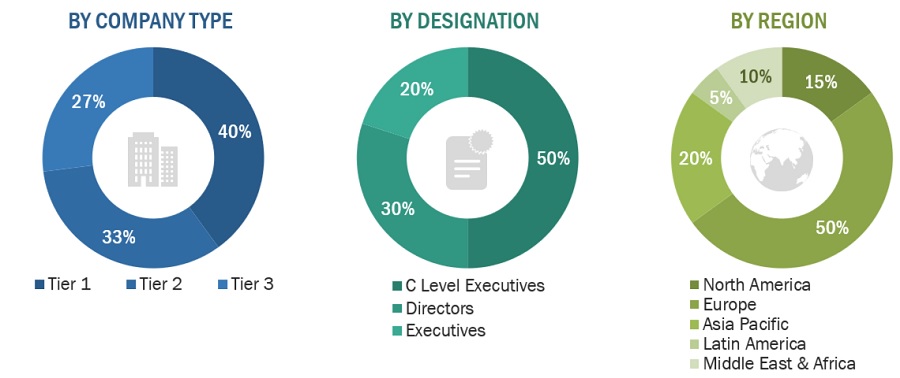
To know about the assumptions considered for the study, download the pdf brochure
Market Size Estimation
The research methodology used to estimate the size of the construction glass market includes the following details. The market sizing of the market was undertaken from the demand side. The market was upsized based on procurements and modernizations in organic pigments products in different applications at a regional level. Such procurements provide information on the demand aspects of the organic pigments industry for each application. For each application, all possible segments of the construction glass market were integrated and mapped.
Construction Glass Market Size: Botton Up Approach
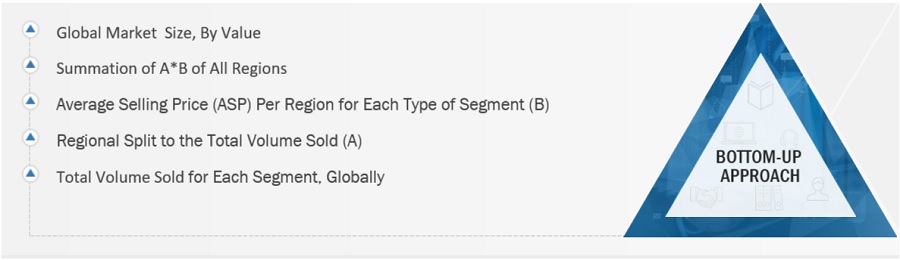
To know about the assumptions considered for the study, Request for Free Sample Report
Construction Glass Market Size: Top-Down Approach
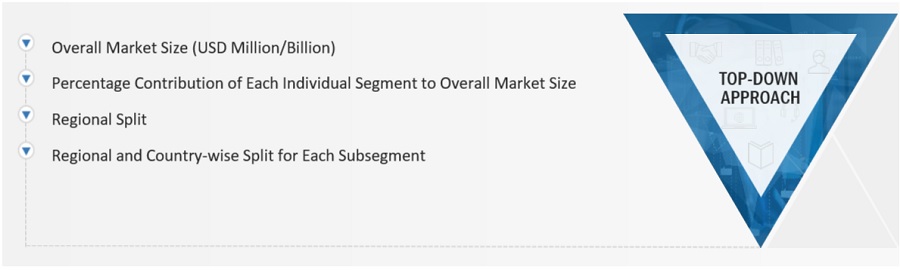
Data Triangulation
After arriving at the overall size from the market size estimation process explained above, the total market was split into several segments and subsegments. The data triangulation and market breakdown procedures explained below were implemented, wherever applicable, to complete the overall market engineering process and arrive at the exact statistics for various market segments and subsegments. The data was triangulated by studying various factors and trends from the demand and supply sides. Along with this, the market size was validated using both the top-down and bottom-up approaches.
Market Definition
Glass is a material made up from liquid sand. Glass is a very commonly used material due to the wide possibilities to get manipulated into suitable for.ms for variety of applications. Construction glass is used in glazing, in the construction of transparent and semitransparent partitions, in the covering of walls, and in the facing and decoration of stairways and other parts of buildings.
Glass making has been in existence since 2500 BC. Flat glass was produced by means such as casting and cylinder technology before industrialization. This was followed by sheet glass and plate glass means of manufacturing till the 1960s. Due to increasing demand for high-quality flat glass, Pilkington Brothers developed the automated float glass manufacturing process. Till date, 90% of flat glass is produced through the float glass manufacturing process. Glass was first used for architectural purposes by the Romans after they discovered clear glass in Alexandria. The development, manufacturing, and use of glass increased rapidly after 1890. Window glass has been in use since 1st century AD.
Key Stakeholders
- Construction glass manufacturers
- Construction glass suppliers
- Raw material suppliers
- End-use industries
- Government bodies
- Universities, governments, and research organizations
- Research and consulting firms
- R&D institutions
- Investment banks and private equity firms
Report Objectives
- To define, describe, and forecast the construction glass market size in terms of volume and value.
- To provide detailed information regarding the key factors, such as drivers, restraints, opportunities, and challenges influencing market growth
- To analyze and project the global construction glass market by type, chemical composition, manufacturing process, application, and region.
- To forecast the market size concerning five main regions (along with country-level data), namely, North America, Europe, Asia Pacific, Latin America, and the Middle East & Africa, and analyze the significant region-specific trends.
- To strategically analyze micro markets with respect to individual growth trends, prospects, and contributions of the submarkets to the overall market
- To analyze the market opportunities and the competitive landscape for stakeholders and market leaders
- To assess recent market developments and competitive strategies, such as agreements, contracts, acquisitions, and new product developments/new product launches, to draw the competitive landscape.
- To strategically profile the key market players and comprehensively analyze their core competencies.
Available Customizations
MarketsandMarkets offers following customizations for this market report:
- Additional country-level analysis of the construction glass market
Product Analysis
- Product matrix, which provides a detailed comparison of the product portfolio of each company's market.
Get the Full Construction Glass Market Report
Full forecast, segment splits, and company analysis for all Construction Glass Market.
- Canada Construction Glass Market
- US Construction Glass Market
- Germany Construction Glass Market
- France Construction Glass Market
- UK Construction Glass Market
- Italy Construction Glass Market
- Spain Construction Glass Market
- Belgium Construction Glass Market
- Russia Construction Glass Market
- China Construction Glass Market
- Japan Construction Glass Market
- India Construction Glass Market
- Australia Construction Glass Market
- Brazil Construction Glass Market
- Mexico Construction Glass Market
- South Africa Construction Glass Market
- Rest Of Europe Construction Glass Market
- Rest Of Asia Pacific Construction Glass Market
- Rest Of Latin America Construction Glass Market
- GCC Countries Construction Glass Market
- -Rest Of GCC Construction Glass Market
Need a Tailored Report?
Customize this report to your needs
Get 10% FREE Customization
Customize This Report
