
Germany Consumer Packaged Goods Market (2025-2030)

The Germany Consumer Packaged Goods Market was valued at $148270 Million in 2025 and projected to reach to $166750 Million by 2030, representing a compound annual growth rate of 2.4%. Germany's CPG market is projected to grow from USD 148,270 million in 2025 to USD 166,750 million by 2030, with a conservative 2.4% CAGR reflecting market maturity and saturation.


| Market Size in | USD 26.32 MN |
| Market Forecast in | |
| CAGR | |
| Forecast Period | |
| Units Considered | Value (USD MN) |
Germany Consumer Packaged Goods Market Trends and Insights
- Germany maintains a mature and stable CPG sector characterized by strong consumer demand for quality products, sustainability-focused purchasing, and established distribution networks.
- The market in Germany reflects broader European trends toward premium offerings and eco-conscious consumption patterns. Germany's CPG market growth through 2030 will be driven by evolving consumer preferences, digital retail expansion, and innovation in product formulations.
- Germany continues to lead European markets in adopting sustainable packaging and organic product lines, positioning the country as a key innovation hub within the region.
- The moderate growth trajectory in Germany reflects market saturation in traditional categories offset by emerging opportunities in health-focused and convenience-driven segments..
Key Market Statistics
- CAGR (2025-2030) 2.4% CAGR
- Market Size, 2025 ~USD 148270 Million
- Forecast, 2030 ~USD 166750 Million
- Country Germany
Germany Consumer Packaged Goods Market Overview
Mature Market Stability :
Germany's CPG market demonstrates steady growth at 2.4% CAGR through 2030, reflecting a mature and saturated market with established consumer preferences and strong brand loyalty among German consumers.
Sustainability Leadership :
German consumers prioritize eco-friendly and sustainable products, driving manufacturers to invest in green packaging, organic certifications, and ethical sourcing practices across the CPG sector.
Premium Quality Focus :
The German market emphasizes high-quality, locally-produced goods with strong regulatory compliance and transparency standards, supporting premium product positioning and commanding higher price points.
Robust Distribution Networks :
Germany benefits from well-established retail infrastructure, efficient supply chains, and strong relationships between manufacturers and major retailers, ensuring consistent market accessibility.
Germany Consumer Packaged Goods Market Dynamics
- Despite slower growth compared to the global average of 4.2%, the German market remains resilient due to consistent consumer spending, strong purchasing power, and established brand ecosystems. Future growth will be driven by sustainability trends, premiumization of product lines, and digital retail expansion.
- E-commerce adoption continues to reshape distribution channels, while health-conscious consumers fuel demand for organic and functional food products.
- Market consolidation among retailers and manufacturers will likely intensify competition, requiring innovation and differentiation strategies..
Market Ecosystem
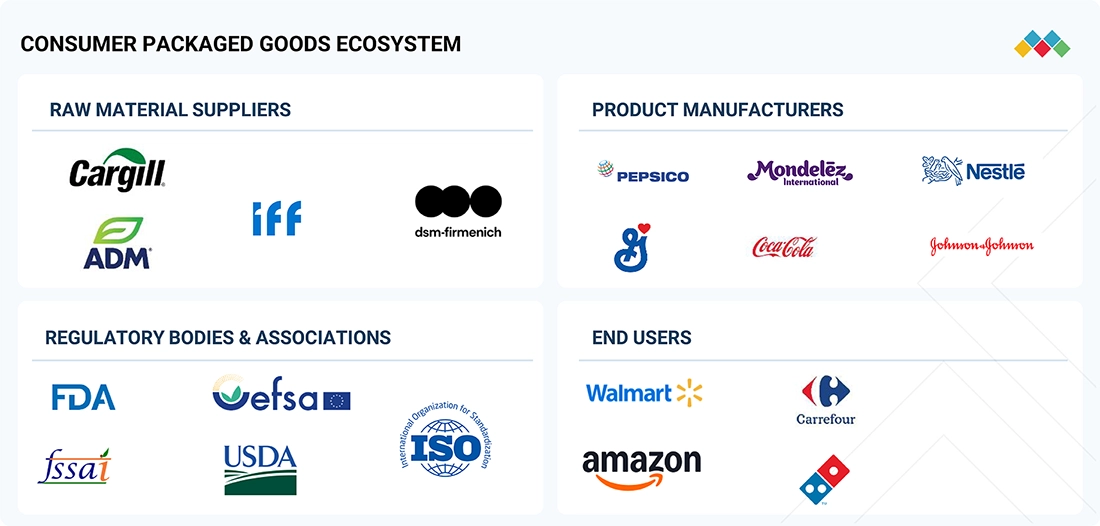
Consumer Packaged Goods Market: COMMERCIAL USE CASES ACROSS INDUSTRIES
| COMPANY | USE CASE DESCRIPTION | BENEFITS |
|---|---|---|
 |
Implementing AI-driven demand forecasting and digital twins for food & beverages to match production with consumption patterns | Minimizes food waste, lowers supply chain costs, ensures product availability, improves forecasting accuracy |
 |
Deploying smart vending machines with IoT sensors for personalization (flavor-mix options, portion control) and digital engagement | Increased consumer engagement, better data capture, optimized inventory in vending networks |
 |
Integrating QR-enabled smart packaging to provide recycling instructions and authenticity checks for baby and feminine care products | Enhances consumer trust, ensures regulatory compliance, supports sustainability commitments |
 |
Investing in plant-based snacks and alternative protein beverages (e.g., Beyond Meat collaborations) to diversify portfolio | Access to health-conscious consumers, category diversification, premium pricing opportunities |
Logos and trademarks shown above are the property of their respective owners. Their use here is for informational and illustrative purposes only.
Related Ecosystem
Fandb Logistics Cold Chain And Packaging
- Rigid Packaging
- Acrylics
- Active Packaging
- Dairy Products
- Gravure Process
- Amcor plc
- Essentra plc
- Basf se
- AZELIS HOLDINGS SA
- Sonoco Products Company
Key Takeaways
- Germany's CPG market will expand from USD 148.3B (2025) to USD 166.8B (2030) at a 2.4% CAGR, reflecting steady but moderate growth.
- Germany leads Europe in sustainability initiatives, with consumers increasingly demanding eco-friendly packaging and organic products.
- Digital retail channels are reshaping distribution in Germany, with e-commerce becoming a critical growth driver for CPG companies.
- Germany's mature market structure creates opportunities for premium and niche product categories targeting health-conscious consumers.
Consumer Packaged Goods Market Report Scope
| Report Metric | Details |
|---|---|
| Base Year | 2025 |
| Fastest Growing Segment | METAL (Material) |
| Forecast Period | 2025-2030 |
| Growth Rate | CAGR of 4.2% from 2025 to 2030 |
| Largest Segment | FOOD & BEVERAGES (Product Type) |
| Market Size Base Year (Billions) | ~USD 3447.59 (2025) |
| Revenue Forecast (Billions) | ~USD 4235.01 (2030) |
| Segments Covered | Product Type, Distribution Channel, Packaging Format, Packaging Material, Packaging Type, Material, Material Type |
Germany Consumer Packaged Goods Market Report Segmentation
7 segment dimensions are covered across the global market.
By Product Type
- Cosmetics & Personal Care Products
- Food & Beverages
- Healthcare Products
- Household Care Products
- Other Product Types
By Distribution Channel
- Convenience Stores
- E-Commerce
- Other Distribution Channels
- Supermarket/Hypermarkets
- Supermarkets
- Supermarkets/Hypermarkets
By Packaging Format
- Flexible Packaging
- Rigid Packaging
By Packaging Material
- Glass
- Metal
- Paper & Paperboard
- Plastic
By Packaging Type
- Bottles
- Boxes
- Cans
- Glass
- Metal
- Paper & Paperboard
- Plastic
- Pouches
By Material
- Glass
- Metal
- Other Material Types
- Paper & Paperboard
- Plastic
By Material Type
- Aluminum
- Steel
Target Audience
- CPG Manufacturers & Brand Owners : Need Germany-specific market data to develop localized product strategies, assess market entry feasibility, and benchmark performance against regional competitors.
- Retail & Distribution Companies : Require detailed market insights to optimize inventory management, negotiate supplier contracts, and identify emerging product categories with growth potential in Germany.
- Investment & Private Equity Firms : Seek comprehensive market valuations and growth forecasts for Germany to evaluate acquisition targets, assess portfolio company performance, and identify investment opportunities.
- Market Research & Consulting Professionals : Need reliable, Germany-focused CPG data to support client engagements, validate market hypotheses, and develop strategic recommendations for regional expansion.
- Government & Trade Organizations : Require market intelligence to inform trade policy, support industry development initiatives, and provide stakeholders with competitive positioning data for Germany's CPG sector.
Reasons to Buy this Report
- Market Size & Growth Projections : Access precise valuation data for Germany's CPG market (USD 148.3B in 2025) with detailed 5-year forecasts to 2030, enabling accurate financial planning and investment decisions.
- Competitive Landscape Analysis : Understand Germany's mature market dynamics, key player strategies, and consolidation trends to identify competitive positioning opportunities and market entry strategies.
- Consumer Behavior Insights : Gain deep insights into German consumer preferences for sustainability, quality, and premium products to tailor product development and marketing strategies effectively.
- Regional Growth Opportunities : Identify high-potential segments within Germany's CPG sector, including organic products, functional foods, and eco-friendly packaging solutions driving above-average growth.
- Strategic Market Intelligence : Leverage comprehensive Germany-specific data for market entry planning, partnership development, and resource allocation decisions in Europe's largest CPG market.
Frequently asked questions
What is the current size of Germany's CPG market?
Germany's Consumer Packaged Goods market is valued at USD 148,270 million in 2025.
What is the projected market size for Germany's CPG sector by 2030?
Germany's CPG market is forecast to reach USD 166,750 million by 2030.
What is the growth rate for Germany's CPG market?
Germany's CPG market is expected to grow at a CAGR of 2.4% from 2025 to 2030.
What are the main drivers of growth in Germany's CPG market?
Key growth drivers in Germany include digital retail expansion, consumer demand for sustainable products, innovation in health-focused categories, and premiumization trends.
How does Germany's CPG market compare to global trends?
Germany's 2.4% CAGR is lower than the global average of 4.2%, reflecting a mature market with slower growth but higher quality and sustainability standards.
RESEARCH METHODOLOGY
The study involved two major approaches in estimating the current size of the CPG market. Exhaustive secondary research was done to collect information on the market, peer, and parent markets. The next step was to validate these findings, assumptions, and sizing with industry experts across the value chain through primary research. Both top-down and bottom-up approaches were employed to estimate the complete market size. After that, market breakdown and data triangulation were used to estimate the market size of segments and subsegments.
Secondary Research
This research study involved the extensive use of secondary sources—directories and databases such as Bloomberg Businessweek and Factiva—to identify and collect information useful for a technical, market-oriented, and commercial study of the market.
In the secondary research process, various sources, such as company annual reports, press releases, investor presentations, white papers, food journals, certified publications, articles from recognized authors, directories, and databases, were used to identify and collect information.
Secondary research was mainly used to obtain key information about the industry’s supply chain, the total pool of key players, and market classification and segmentation as per the industry trends to the bottom-most level, regional markets, and key developments from both market- and technology-oriented perspectives.
Primary Research
Extensive primary research was conducted after obtaining information regarding the CPG market scenario through secondary research. Several primary interviews were conducted with market experts from both the demand and supply sides across major countries of North America, Europe, Asia Pacific, South America, and the Rest of the World. Primary data was collected through questionnaires, emails, and telephonic interviews. The primary sources from the supply side included various industry experts, such as Chief X Officers (CXOs), Vice Presidents (VPs), Directors from business development, marketing, research, and development teams, and key opinion leaders. Primary interviews were conducted to gather insights such as market statistics, data on revenue collected from the products and services, market breakdowns, market size estimations, market forecasting, and data triangulation. Primary research also helped in understanding the various trends related to consumer packaged goods, product type, packaging type, distribution channel, packaging material, and region. Stakeholders from the demand side, such as research institutions and universities, third-party vendors, were interviewed to understand the buyer’s perspective on the product, and their current usage of consumer packaged goods and the outlook of their business, which will affect the overall market.
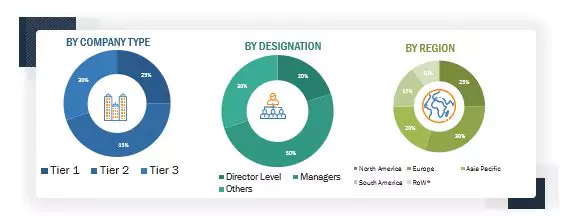
Note: The three tiers of the companies are defined based on their total revenues in 2023 or 2024,
as per the availability of financial data: Tier 1: Revenue > USD 1 billion; Tier 2: USD 100
million ≤ Revenue ≤ USD 1 billion; Tier 3: Revenue < USD 100 million.
To know about the assumptions considered for the study, download the pdf brochure
|
COMPANY NAME |
DESIGNATION |
|
Procter & Gamble (US) |
R&D expert |
|
Unilever (UK) |
Sales Manager |
|
Nestlé (Switzerland) |
Manager |
|
Danone (France) |
Sales Manager |
|
The Coca-Cola Company (US) |
Marketing Manager |
Market Size Estimation
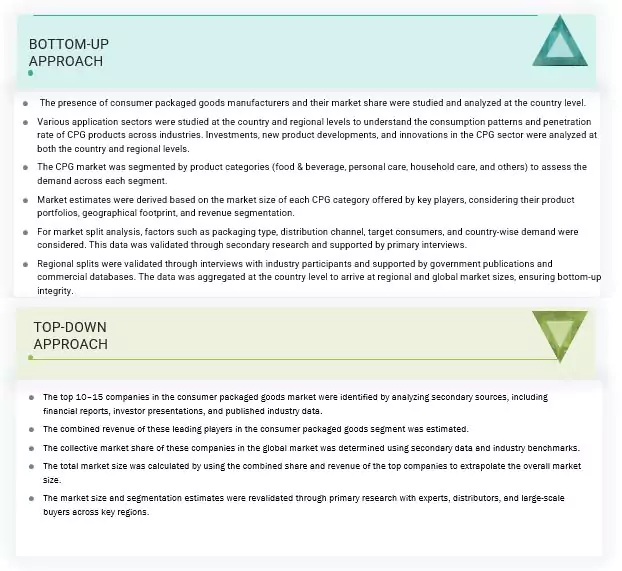
Both the top-down and bottom-up approaches were used to estimate and validate the total size of the consumer packaged goods market. These approaches were also used extensively to determine the size of various subsegments in the market. The research methodology used to estimate the market size includes the following details:
- The key players in the industry and the overall markets were identified through extensive secondary research.
- All shares, splits, and breakdowns were determined using secondary sources and verified through primary sources.
- All possible parameters that affect the market covered in this research study were accounted for, viewed in extensive detail, verified through primary research, and analyzed to obtain final quantitative and qualitative data.
- The research included the study of reports, reviews, and newsletters of top market players, along with extensive interviews for opinions from leaders, such as CEOs, directors, and marketing executives.
Consumer Packaged Goods Market : Top-Down and Bottom-Up Approach
Data Triangulation
After arriving at the overall market size from the estimation process explained above, the total market was split into several segments and subsegments. The data triangulation and market breakdown procedures were employed, wherever applicable, to estimate the overall CPG market and arrive at the exact statistics for all segments and subsegments. The data was triangulated by studying various factors and trends from the demand and supply sides. The market size was also validated using both the top-down and bottom-up approaches.
Market Definition
Consumer Packaged Goods (CPG) are products that consumers use on a daily or frequent basis and that are consumed quickly, requiring regular repurchase. These goods are typically low-cost, non-durable items packaged for retail sale, including categories such as food and beverages, personal care products, cosmetics, cleaning supplies, and household items.
Stakeholders
- Raw Material Suppliers – Providers of essential ingredients and inputs required for the production and processing of consumer goods, including food, beverages, personal care products, and more.
- Manufacturers & Processors – Companies that transform raw materials into finished or semi-finished products through various production and processing techniques.
- Contract Manufacturers & Co-packers – Third-party firms that produce, assemble, or package products on behalf of brand owners, enabling scalability and efficiency in production.
- Packaging & Labeling Companies – Businesses that design and supply packaging materials and labeling solutions to ensure product safety, branding, and regulatory compliance.
- Logistics & Supply Chain Partners – Organizations responsible for the transportation, warehousing, and distribution of products across the supply chain to ensure timely delivery and inventory management.
- Distributors & Wholesalers – Entities that purchase goods in bulk from manufacturers and sell them to retailers or other businesses within the supply chain.
- Retailers – Businesses that sell finished products directly to consumers through physical stores or online platforms.
- Marketing & Advertising Agencies – Firms that develop and implement promotional strategies, brand campaigns, and market research to boost product visibility and consumer engagement.
- Regulatory Bodies & Certification Agencies – Organizations that establish and enforce standards for safety, quality, and compliance, and issue necessary certifications for market entry (e.g., FDA, USDA, ISO).
- Consumers – End-users who purchase and use products, influencing market trends and demand through preferences, feedback, and purchasing behavior.
- Investors & Financial Stakeholders – Individuals or institutions that provide funding and financial support to companies across the value chain in exchange for returns or equity.
- Technology Providers – Companies offering digital tools, automation solutions, data analytics, and software platforms to improve operational efficiency and innovation.
- Sustainability & ESG Stakeholders – Entities focused on environmental, social, and governance (ESG) criteria, driving sustainable practices, ethical sourcing, and responsible business conduct throughout the value chain.
Report Objectives
- To determine and project the size of the CPG market with respect to the product type, packaging type, distribution channel, packaging material, and regions in terms of value over five years, ranging from 2025 to 2030
- To identify the attractive opportunities in the market by determining the largest and fastest-growing segments across regions
- To provide detailed information about the key factors influencing market growth (drivers, restraints, opportunities, and challenges)
- To analyze the opportunities in the market for stakeholders and provide details of the competitive landscape for market leaders
- To analyze the micro-markets with respect to individual growth trends, prospects, and their contribution to the total market
- To identify and profile the key players in the CPG market
- To understand the competitive landscape and identify the major growth strategies adopted by players across the key regions
Available Customizations
With the given market data, MarketsandMarkets offers customizations according to company-specific scientific needs.
The following customization options are available for the report:
Product Analysis
- Service Matrix, which gives a detailed comparison of the service portfolio of each company.
Geographic Analysis as per Feasibility
With the given market data, MarketsandMarkets offers customizations according to company-specific scientific needs.
- Further breakdown of the Rest of European consumer packaged goods market into key countries.
- Further breakdown of the Rest of Asia Pacific consumer packaged goods market into key countries.
- Further breakdown of the Rest of South American consumer packaged goods market into key countries.
Company Information
- Detailed analyses and profiling of additional market players (up to five)
Get the Full Consumer Packaged Goods Market Report
Full forecast, segment splits, and company analysis for all Consumer Packaged Goods Market.
- Canada Consumer Packaged Goods Market
- Mexico Consumer Packaged Goods Market
- US Consumer Packaged Goods Market
- UK Consumer Packaged Goods Market
- Italy Consumer Packaged Goods Market
- France Consumer Packaged Goods Market
- Spain Consumer Packaged Goods Market
- China Consumer Packaged Goods Market
- Japan Consumer Packaged Goods Market
- India Consumer Packaged Goods Market
- Argentina Consumer Packaged Goods Market
- Rest Of Europe Consumer Packaged Goods Market
- Rest Of Asia Pacific Consumer Packaged Goods Market
- Chile Consumer Packaged Goods Market
- Rest Of South America Consumer Packaged Goods Market
Need a Tailored Report?
Customize this report to your needs
Get 10% FREE Customization
Customize This Report
