
Asia Pacific CT Simulators Market (2025-2030)

The Asia Pacific CT Simulators Market was valued at $61.2 Million in 2025 and projected to reach to $74.9 Million by 2030, representing a compound annual growth rate of 4.1%. The Asia Pacific CT Simulators Market is positioned for steady growth through 2030, supported by expanding healthcare infrastructure and increasing investments in medical technology across the region.


| Market Size in | USD 26.32 MN |
| Market Forecast in | |
| CAGR | |
| Forecast Period | |
| Units Considered | Value (USD MN) |
Asia Pacific CT Simulators Market Trends and Insights
- Asia Pacific's healthcare infrastructure expansion and increasing adoption of advanced diagnostic imaging technologies are driving this steady market growth.
- The region's rising investment in medical education and training facilities continues to fuel demand for CT simulation solutions. Asia Pacific's CT Simulators Market benefits from growing awareness of radiation safety protocols and the need for clinician training in emerging economies.
- Between 2025 and 2030, Asia Pacific is expected to see increased penetration of simulation technology in hospitals and medical institutions.
- The region's focus on improving diagnostic accuracy and reducing patient exposure to radiation supports the adoption of CT simulators across Asia Pacific healthcare systems..
Key Market Statistics
- CAGR (2025-2030) 4.1% CAGR
- Market Size, 2025 ~USD 61.2 Million
- Forecast, 2030 ~USD 74.9 Million
- Geography Asia Pacific
Asia Pacific CT Simulators Market Overview
Market Valuation & Growth :
Asia Pacific CT Simulators Market is valued at $61.2 million in 2025, projected to reach $74.9 million by 2030, with a steady CAGR of 4.1%, reflecting consistent regional demand for advanced diagnostic imaging solutions.
Healthcare Infrastructure Expansion :
Rapid expansion of healthcare infrastructure across Asia Pacific nations is driving adoption of CT simulation technologies, with increased government investments in medical facilities and diagnostic centers supporting market growth.
Medical Education Investment :
Rising investment in medical education and training programs throughout Asia Pacific is accelerating the adoption of CT simulators in academic institutions, enhancing clinical training capabilities and workforce development.
Advanced Imaging Technology Adoption :
Increasing adoption of advanced diagnostic imaging technologies in Asia Pacific healthcare systems is propelling demand for CT simulators, driven by growing awareness of precision medicine and improved patient outcomes.
Asia Pacific CT Simulators Market Dynamics
- Key drivers include rising adoption of advanced diagnostic imaging, growing medical education initiatives, and improving healthcare accessibility in emerging economies.
- The region's focus on modernizing healthcare facilities and training facilities continues to create sustained demand for CT simulation solutions. Looking ahead, Asia Pacific's market growth will be bolstered by government healthcare initiatives, private sector investments, and the region's expanding middle-class population seeking advanced medical services.
- As countries like China and India strengthen their healthcare systems and medical education frameworks, CT simulator adoption is expected to accelerate, positioning Asia Pacific as a significant growth market within the global healthcare technology landscape..
Market Ecosystem
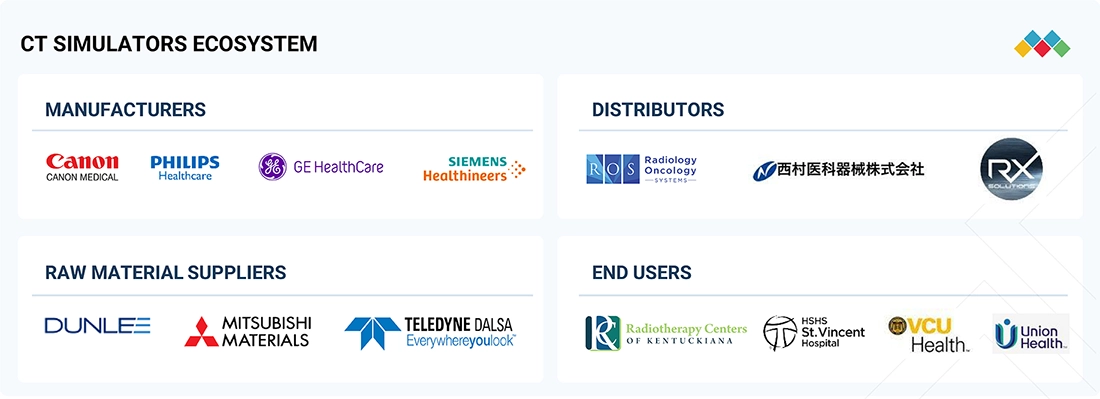
CT Simulators Market: COMMERCIAL USE CASES ACROSS INDUSTRIES
| COMPANY | USE CASE DESCRIPTION | BENEFITS |
|---|---|---|
 |
Somatom Go.Open Pro and Go.Sim wide-bore CT simulators designed for radiotherapy planning, with Direct i4D and Direct Organs auto-contouring. | Personalised 4D imaging for motion management; up to 70% reduction in OAR contouring time; improved workflow efficiency in adaptive RT. |
 |
Discovery RT and Revolution RT simulators with large-bore design and AI-based reconstruction for oncology workflows. | High image quality at lower dose, robust integration with treatment planning, and optimized positioning for complex radiotherapy cases. |
 |
Big Bore CT simulators optimized for radiation oncology with wide bore clearance and advanced imaging packages. | Improved patient positioning and immobilization, compatibility with brachytherapy and proton workflows, and enhanced treatment accuracy. |
 |
Aquilion Exceed LB and Aquilion RT systems offering ultra-wide bore and advanced 4D CT imaging for radiotherapy. | Greater bore size for flexible patient setup, precise motion management, and reliable datasets for adaptive and proton therapy planning. |
Logos and trademarks shown above are the property of their respective owners. Their use here is for informational and illustrative purposes only.
Related Ecosystem
Diagnostic Imaging
- Magnetic Resonance Imaging (MRI)
- Computed Tomography (CT)
- CT Scanners
- Nuclear Imaging
- Positron Emission Tomography
- Siemens healthineers
- PHILIPS HEALTHCARE
- CANON INC.
- FUJIFILM Holdings Corporation
- UNITED IMAGING HEALTHCARE CO., LTD.
Healthcare Analytics
- Machine Learning
- Natural Language Processing (NLP)
- Blood Pressure Monitors
- Computed Tomography (CT)
- Magnetic Resonance Imaging (MRI)
- Oracle Corporation
- PHILIPS HEALTHCARE
- Siemens healthineers
- Zensar Technologies Limited
- International Business Machines Corporation
Medical Devices
Key Takeaways
- Asia Pacific CT Simulators Market is valued at $61.2 million in 2025 with projected growth to $74.9 million by 2030.
- Asia Pacific is experiencing a 4.1% CAGR, driven by healthcare infrastructure expansion and medical training investments.
- Asia Pacific's emphasis on radiation safety and clinician training is accelerating CT simulator adoption across the region.
- Asia Pacific's emerging economies are increasingly prioritizing diagnostic imaging simulation technology in healthcare institutions.
CT Simulators Market Report Scope
| Report Metric | Details |
|---|---|
| Base Year | 2025 |
| Fastest Growing Segment | INDEPENDENT RADIOLOGY CENTERS (End User) |
| Forecast Period | 2025–2030 |
| Growth Rate | CAGR of 4.6% from 2025 to 2030 |
| Largest Segment | 3D/4D SIMULATION TECHNOLOGY (Technology) |
| Market Size Base Year (Billions) | ~USD 0.59 (2025) |
| Revenue Forecast (Billions) | ~USD 0.74 (2030) |
| Segments Covered | Technology, Product Type, Application, End User |
Asia Pacific CT Simulators Market Report Segmentation
4 segment dimensions are covered across the global market.
By Technology
- 2D/3D Ct Simulation Technology
- 2D/3D Simulation Technology
- 3D/4D Ct Simulation Technology
- 3D/4D Simulation Technology
By Product Type
- Multi-Slice Ct Simulators
- Single Slice Ct Simulators
- Single-Slice Ct Simulators
By Application
- 3D Conformal Radiation Therapy
- Adaptive Radiotherapy/ Surface-Guided Radiotherapy
- Adaptive Radiotherapy/Surface-Guided Radiotherapy
- Brachytherapy
- Image-Guided Radiation Therapy
- Other Applications
- Proton Therapy
By End User
- Hospitals
- Independent Radiology Centers
- Independent Radiotherapy Centers
- Other End Users
Target Audience
- Medical Device Manufacturers : Manufacturers of CT simulators need Asia Pacific market data to identify growth opportunities, assess regional demand, and develop localized product strategies for this expanding healthcare market.
- Healthcare Facility Operators : Hospital networks and diagnostic centers across Asia Pacific require market insights to benchmark investments in CT simulation technology, understand adoption trends, and optimize capital allocation decisions.
- Medical Education Institutions : Universities and medical training centers need regional market analysis to justify CT simulator investments, understand peer adoption rates, and align training programs with industry standards.
- Healthcare Investors & Consultants : Investment firms and management consultants require Asia Pacific-specific market data to evaluate healthcare technology opportunities, assess market attractiveness, and guide client investment strategies.
- Government & Healthcare Policy Makers : Regional health authorities and government agencies need market intelligence to inform healthcare infrastructure planning, medical education policies, and technology adoption initiatives across Asia Pacific.
Key Companies in the Asia Pacific CT Simulators Market
| Company | HQ | Ownership | Strongest segments |
|---|---|---|---|
| SIEMENS HEALTHINEERS AG | Germany | Public Company | Multi-slice CT simulators,Single-slice CT simulators,Software, upgrades, and service linked to CT simulation, |
| GE HEALTHCARE | United States | Public Company | Multi-slice CT simulators,Single-slice CT simulators,2D simulation, |
| ELEKTA | Sweden | Public Company | 3D/4D Simulation CT (multi-slice),2D Simulation CT (single-slice and legacy),Hybrid CT-Linac solutions (Elekta Evo and related), |
| SHANGHAI UNITED IMAGING HEALTHCARE CO., LTD. | China | Public Company | Multi-slice CT simulators,Single-slice CT simulators,2D simulation solutions, |
| HITACHI HIGH-TECH CORPORATION | Japan | Private Company | 3D/4D Simulation CT Simulators,2D Simulation CT Simulators,Multi-slice CT Simulators, |
| SHINVA MEDICAL INSTRUMENT CO., LTD. | China | Public Company | Multi-slice CT simulators,Single-slice CT simulators,2D simulation solutions, |
| ACCURAY INCORPORATED | United States | Public Company | 3D/4D Simulation – Multi-slice (integrated with Radixact/TomoTherapy),3D Simulation – Single-slice / legacy TomoTherapy configurations,IGRT-focused planning and data management (iDMS, Accuray Precision), |
SIEMENS HEALTHINEERS AG
Siemens Healthineers AG is a German public company founded in 1896 that operates in the healthcare sector with 72,369 employees. The company is a major provider of medical imaging, diagnostics, and healthcare IT solutions.
GE HEALTHCARE
GE Healthcare is a United States public company founded in 2022 with 54,000 employees providing medical imaging, monitoring, and healthcare technology solutions.
ELEKTA
Elekta is a Swedish public company established in 1972 with 3,704 employees focused on precision radiation medicine and software solutions for cancer care.
SHANGHAI UNITED IMAGING HEALTHCARE CO., LTD.
Shanghai United Imaging Healthcare Co., Ltd. is a Chinese public company established in 2011 with 8,703 employees providing medical imaging and healthcare IT solutions.
HITACHI HIGH-TECH CORPORATION
Hitachi High-Tech Corporation is a Japanese private company established in 1947 with 11,482 employees operating across multiple industrial and healthcare technology sectors.
SHINVA MEDICAL INSTRUMENT CO., LTD.
Shinva Medical Instrument Co., Ltd. is a Chinese public company founded in 1943 with 7,982 employees manufacturing medical devices and healthcare equipment.
ACCURAY INCORPORATED
Accuray Incorporated is a United States public company established in 1990 with 990 employees specializing in radiation oncology and radiosurgery systems.
Countries within Asia Pacific - compare and drill down
| Country | 2025 size (native) |
|---|---|
| China | USD 18.04 Million |
| Japan | USD 6.99 Million |
| India | USD 6.17 Million |
| South Korea | USD 2.01 Million |
| Australia | USD 1.29 Million |
| Rest Of Asia Pacific | USD 3.55 Million |
Country market size visualization
Reasons to Buy this Report
- Regional Market Sizing & Forecasts : Obtain precise market valuation data for Asia Pacific CT Simulators at $61.2M (2025) and detailed forecasts through 2030, enabling accurate business planning and investment decisions specific to the region.
- Country-Level Market Breakdown : Access granular market data for key Asia Pacific countries including China, Japan, India, South Korea, and Australia, allowing targeted market entry strategies and competitive positioning analysis.
- Growth Driver Analysis : Understand the specific factors driving 4.1% CAGR in Asia Pacific, including healthcare infrastructure expansion, medical education investments, and technology adoption trends unique to the region.
- Competitive Landscape Intelligence : Gain insights into regional market dynamics, competitive positioning, and emerging opportunities across Asia Pacific's diverse healthcare markets to inform strategic business decisions.
- Investment & Expansion Planning : Leverage comprehensive Asia Pacific market data to identify high-growth opportunities, assess market potential by country, and develop informed expansion strategies for healthcare technology providers.
Frequently asked questions
What is the current size of the Asia Pacific CT Simulators Market?
The Asia Pacific CT Simulators Market is valued at $61.2 million in 2025.
What is the projected market size for Asia Pacific CT Simulators by 2030?
The Asia Pacific CT Simulators Market is projected to reach $74.9 million by 2030.
What is the CAGR for Asia Pacific CT Simulators Market?
The Asia Pacific CT Simulators Market is growing at a CAGR of 4.1% from 2025 to 2030.
What factors are driving growth in Asia Pacific's CT Simulators Market?
Asia Pacific's market growth is driven by healthcare infrastructure expansion, medical training investments, radiation safety awareness, and increased adoption of diagnostic imaging simulation technology.
Which countries in Asia Pacific are leading CT Simulators adoption?
Asia Pacific's developed healthcare systems and emerging economies are both contributing to CT simulator adoption, with significant growth in medical education and hospital training programs across the region.
RESEARCH METHODOLOGY
The size of the CT simulators market was determined based on primary studies to ensure precision. Initial data for the market and related niches were collected from 3 to 5 secondary sources. This information was then validated through primary research to confirm assumptions and overall market size. Both top-down and bottom-up methods were used to estimate the total market, which was then broken down into segment and subsegment sizes. Finally, data triangulation was performed to verify the accuracy of the data findings.
Secondary Research
Secondary research sources included directories, Factiva, white papers, Bloomberg Business, annual reports, SEC filings, business filings, and investor presentations. These sources provided valuable insights into market leaders, sector divisions, and technological differences within various segments of the CT simulators industry.
Primary Research
Primary research involved both quantitative and qualitative insights collected through interviews with key stakeholders. On the demand side, participants included physicians, researchers, department heads, and staff from diagnostic centers, hospitals, and research institutes. On the supply side, interviews were held with CEOs, area sales managers, territory and regional sales managers, and other top executives from relevant companies. These direct conversations helped verify the secondary research findings and provided an opportunity to directly ask questions and confirm details and assumptions.
A breakdown of the primary respondents is provided below.
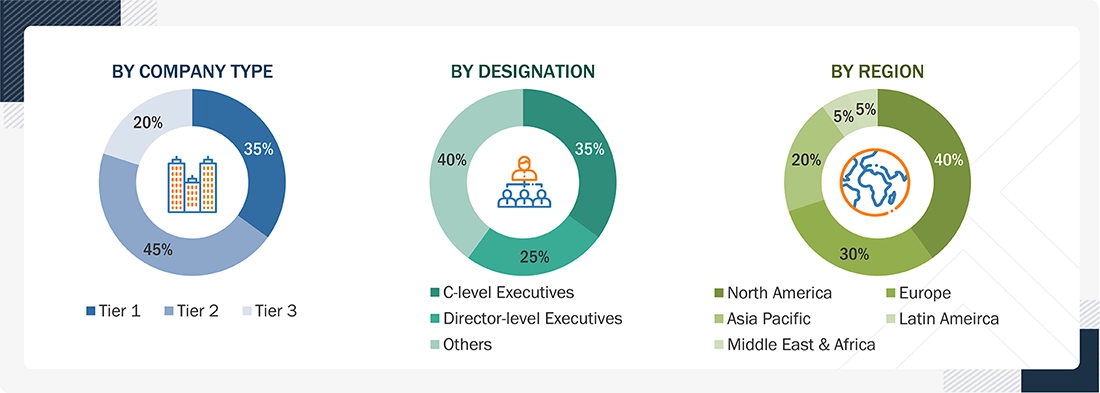
Note 1: Others include sales managers, marketing managers, business development managers, product managers, distributors, and suppliers
Note 2: Companies are classified into tiers based on their total revenue. As of 2024, Tier 1 = >USD 1 billion, Tier 2 = < USD 500 million, and Tier 3 = < USD 100 million
To know about the assumptions considered for the study, download the pdf brochure
Market Size Estimation
This report used the revenue share analysis of major companies to assess the size of the global CT simulators market. This analysis involved identifying key market players and calculating their revenue from CT simulators using data collected during both primary and secondary research phases. One part of the secondary research included reviewing the annual and financial reports of leading market companies. In contrast, primary research consisted of detailed interviews with influential thought leaders, including directors, CEOs, and key marketing executives.
To determine the overall market value, the segmental revenue was calculated by mapping the revenue of the leading solution and service providers. The process involved several steps.
- Making a list of leading international companies in the CT Simulators industry
- Charting annual profits made by leading companies in the CT Simulators sector (or the closest stated business unit/product category)
- 2024 revenue mapping of leading companies to cover a significant portion of the global market
- Calculating the global value of the CT Simulators industry
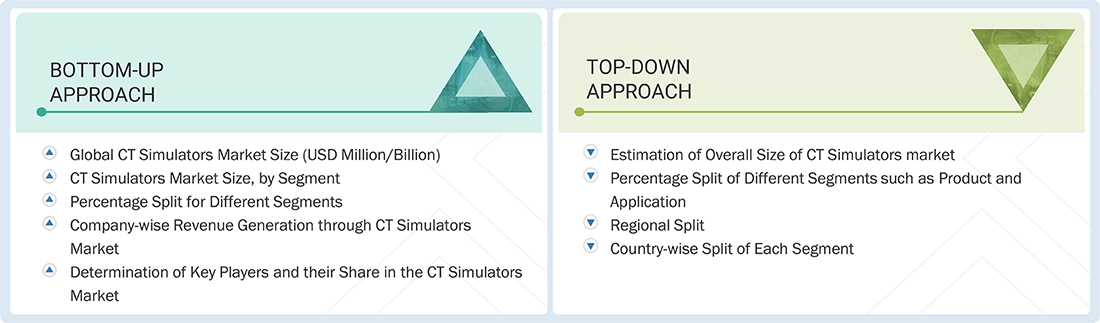
Global CT Simulators Market: Bottom-up and Top-down Approach
Data Triangulation
CT simulators are specialized medical imaging devices used in radiation therapy planning. They combine the processes of acquiring CT images and designing radiation treatment fields, allowing clinicians to accurately outline tumor volumes and nearby organs for precise and effective treatment planning. They provide three-dimensional images of patient anatomy in the treatment position. The CT simulators assist with patient positioning and immobilization, ensuring reproducibility during daily treatment. They integrate with treatment planning systems for dose calculation and optimal targeting of tumours.
Market Definition
To ensure accurate data, the CT simulators market was divided into various segments and subsegments. A data triangulation process that used both top-down and bottom-up approaches was applied. This involved analyzing factors and trends from both the demand and supply sides to validate the findings for each segment. The combination of this segmentation with the triangulation process helps ensure that the market data is both accurate and reliable.
Stakeholders
- Manufacturers of CT simulators
- Healthcare providers such as hospitals, independent radiotherapy centers
- Patients using CT simulators for various conditions
- Healthcare professionals, including radiologists, radiotherapists
- Regulatory bodies overseeing product standards and safety
- Suppliers and distributors of CT simulators products
- Research & development firms focusing on innovation and technology in CT simulators
Report Objectives
- To define, describe, and forecast the CT simulators market based on product type, technology, application, end user, and region
- To provide detailed information regarding the major factors influencing the growth of the market (drivers, restraints, opportunities, and industry-specific challenges)
- To strategically analyze micromarkets with respect to individual growth trends, prospects, and contributions to the total market
- To analyze opportunities in the market for stakeholders and provide details of the competitive landscape for market leaders
- To forecast the revenue of the market segments with respect to five regions: North America, Europe, the Asia Pacific, Latin America, and the Middle East & Africa
- To profile the key players and comprehensively analyze their market ranking and core competencies
- To benchmark players within the market using a proprietary Company Evaluation Matrix framework, which analyzes market players on various parameters within the broad categories of business strategy excellence and strength of product portfolio
- To analyze competitive developments such as product launches, agreements, expansions, collaborations, and acquisitions in the CT Simulators market
Get the Full CT Simulators Market Report
Full forecast, segment splits, and company analysis for all CT Simulators Market.
- Canada CT Simulators Market
- US CT Simulators Market
- Germany CT Simulators Market
- UK CT Simulators Market
- Italy CT Simulators Market
- Spain CT Simulators Market
- China CT Simulators Market
- Japan CT Simulators Market
- India CT Simulators Market
- South Korea CT Simulators Market
- Australia CT Simulators Market
- Brazil CT Simulators Market
- Mexico CT Simulators Market
- France CT Simulators Market
- Rest Of Europe CT Simulators Market
- Rest Of Asia Pacific CT Simulators Market
- Rest Of Latin America CT Simulators Market
Need a Tailored Report?
Customize this report to your needs
Get 10% FREE Customization
Customize This Report
