
UAE Custom Antibody Market (2024-2029)

The UAE Custom Antibody Market was valued at $1.2 Million in 2024 and projected to reach to $1.6 Million by 2029, representing a compound annual growth rate of 6.0%. The UAE custom antibody market is poised for steady expansion, supported by the nation's commitment to diversifying its economy and strengthening its healthcare and life sciences sectors.


| Market Size in | USD 26.32 MN |
| Market Forecast in | |
| CAGR | |
| Forecast Period | |
| Units Considered | Value (USD MN) |
UAE Custom Antibody Market Trends and Insights
- The UAE's advanced healthcare infrastructure and increasing investment in biotechnology research are driving demand for customized antibody solutions across diagnostic and therapeutic applications.
- The UAE's strategic position as a regional hub for life sciences innovation supports the adoption of specialized antibody development services among research institutions and pharmaceutical companies. Growth in the UAE custom antibody market is fueled by rising prevalence of chronic diseases, expanding clinical research activities, and government initiatives promoting precision medicine.
- The UAE's emphasis on healthcare modernization and collaboration with international research organizations accelerates the integration of custom antibody technologies.
- Between 2024 and 2029, the UAE market is expected to benefit from increased pharmaceutical R&D spending and growing partnerships between local and global biotech firms, positioning the UAE as an emerging center for antibody manufacturing and development in the Gulf region..
Key Market Statistics
- CAGR (2024-2029) 6.0% CAGR
- Market Size, 2024 ~USD 1.2 Million
- Forecast, 2029 ~USD 1.6 Million
- Country UAE
UAE Custom Antibody Market Overview
Market Valuation :
The UAE custom antibody market is valued at USD 1.2 million in 2024, with a projected CAGR of 6% through 2029, reaching USD 1.6 million by forecast end.
Healthcare Infrastructure :
UAE's advanced healthcare infrastructure and state-of-the-art research facilities are driving adoption of customized antibody solutions in diagnostic and therapeutic applications.
Biotechnology Investment :
Significant government and private sector investments in biotechnology research and development are accelerating demand for specialized antibody products across the UAE.
Regional Hub Status :
UAE's strategic position as a regional hub for life sciences and healthcare innovation is attracting international biotech companies and research institutions to establish operations.
UAE Custom Antibody Market Dynamics
- With a 6% CAGR, the market reflects growing demand from research institutions, diagnostic laboratories, and pharmaceutical companies operating within the UAE.
- The country's investment in biotechnology infrastructure and skilled workforce development continues to create favorable conditions for market growth. Looking ahead, the UAE's role as a regional healthcare leader and innovation hub will likely drive increased adoption of customized antibody solutions.
- Collaborations between local research centers and international biotech firms, combined with regulatory support for advanced therapeutics, are expected to sustain market momentum through 2029 and beyond..
Market Ecosystem
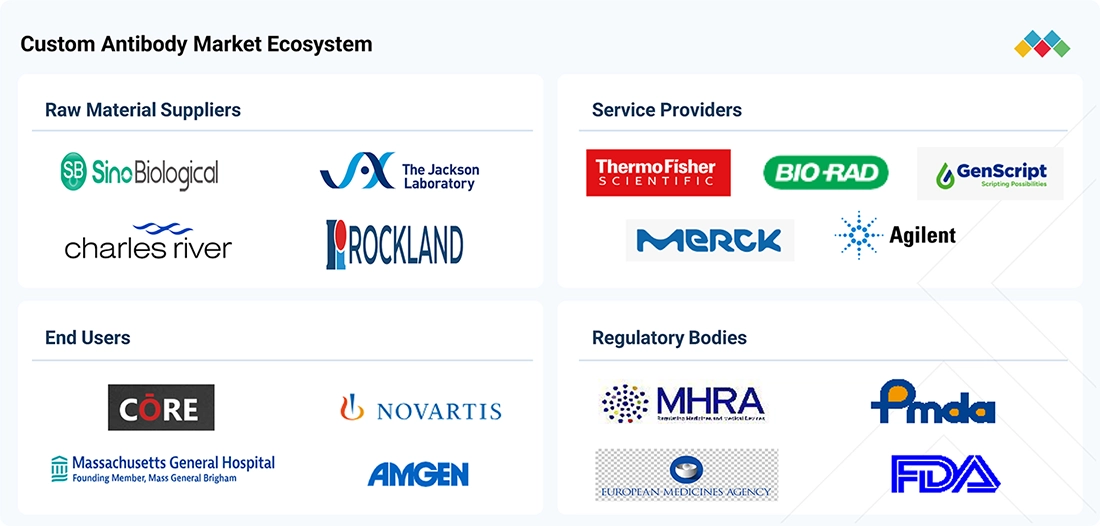
CUSTOM ANTIBODY MARKET: COMMERCIAL USE CASES ACROSS INDUSTRIES
| COMPANY | USE CASE DESCRIPTION | BENEFITS |
|---|---|---|
 |
Provides custom antibody development and production services, including monoclonal, polyclonal, and recombinant antibody generation. Its services cover antigen design, antibody screening, purification, and characterization for research and diagnostic applications. | Supports the development of application-specific antibodies with defined target specificity and performance, helping pharmaceutical companies, biotechnology firms, and academic researchers accelerate target validation and assay development. |
 |
Offers custom antibody production and engineering services through its antibody development capabilities, including GeneArt high-throughput antibody expression, gene synthesis, cloning, transient expression, purification, and quality control. | Enables researchers to obtain custom antibodies for research and development workflows, supporting faster antibody production, consistent quality, and applications in biologics development, protein analysis, and diagnostic research. |
Logos and trademarks shown above are the property of their respective owners. Their use here is for informational and illustrative purposes only.
Related Ecosystem
Biotechnology
- Reagents
- Polymerase Chain Reaction (PCR)
- Stem Cells
- Assay Kits
- Flow Cytometers
- Thermo Fisher Scientific Inc.
- Merck KGaA
- Danaher Corporation
- Agilent Technologies, Inc.
- Bio-Rad Laboratories, Inc.
Key Takeaways
- The UAE custom antibody market is valued at USD 1.2 million in 2024 and is forecast to reach USD 1.6 million by 2029, representing a 6.0% CAGR.
- The UAE's advanced healthcare infrastructure and government support for biotechnology innovation are primary drivers of market expansion.
- Rising chronic disease prevalence and increased clinical research activities in the UAE are accelerating demand for custom antibody solutions.
- The UAE is positioning itself as a regional hub for antibody development, supported by international partnerships and pharmaceutical R&D investments.
Custom Antibody Market Report Scope
| Report Metric | Details |
|---|---|
| Base Year | 2024 |
| Fastest Growing Segment | ONCOLOGY (Indication) |
| Forecast Period | 2024-2029 |
| Growth Rate | CAGR of 9.2% from 2024 to 2029 |
| Largest Segment | RESEARCH (Application) |
| Market Size Base Year (Billions) | ~USD 0.58 (2024) |
| Revenue Forecast (Billions) | ~USD 0.9 (2029) |
| Segments Covered | Service, Type, Source, Application, Indication, End User |
UAE Custom Antibody Market Report Segmentation
6 segment dimensions are covered across the global market.
By Service
- Antibody Development
- Antibody Fragmentation & Labeling
- Antibody Fragmentation & Labelling
- Antibody Production & Purification
By Type
- Antibody Characterization
- Antigen Preparation
- Immunization & Hybridoma Production
- Monoclonal Antibodies
- Other Antibodies
- Other Custom Antibodies
- Polyclonal Antibodies
- Recombinant Antibodies
By Source
- Mice
- Other Sources
- Rabbits
By Application
- Research
- Therapeutic
By Indication
- Cardiovascular Diseases
- Immunology
- Infectious Diseases
- Neurobiology
- Oncology
- Other Indications
By End User
- Academic & Research Institutes
- Contract Research Organizations
- Cros
- Pharmaceutical & Biotechnology Companies
Target Audience
- Biotechnology Companies : Biotech firms seeking to expand into the UAE market need detailed insights on market size, growth trends, and competitive dynamics to inform market entry and product development strategies.
- Pharmaceutical Manufacturers : Pharmaceutical companies developing therapeutic antibodies require market intelligence on UAE demand patterns, regulatory requirements, and partnership opportunities to optimize regional commercialization.
- Research Institutions : Academic and research centers in the UAE need market data to understand funding opportunities, collaboration potential, and demand for customized antibody solutions in their research programs.
- Diagnostic Laboratory Operators : Diagnostic labs and clinical testing facilities require market insights to assess demand for custom antibody solutions and identify suppliers for their diagnostic and research applications.
- Healthcare Investors & Consultants : Investment firms and management consultants focused on Middle Eastern healthcare need comprehensive market analysis to evaluate investment opportunities and advise clients on UAE's life sciences sector.
Reasons to Buy this Report
- Market Entry Strategy : Gain comprehensive insights into UAE's custom antibody market dynamics to develop targeted market entry strategies and identify key growth opportunities in this emerging regional market.
- Competitive Positioning : Understand the competitive landscape specific to UAE, including local players, international competitors, and market gaps to position your offerings effectively in this strategic healthcare market.
- Investment Decision Support : Access detailed market sizing and forecast data to support investment decisions, partnership evaluations, and resource allocation for UAE-based operations and regional expansion.
- Regulatory & Infrastructure Insights : Obtain critical information on UAE's healthcare regulations, research infrastructure, and government initiatives that influence custom antibody adoption and market development.
- Growth Opportunity Identification : Identify high-potential segments and applications within the UAE market, including diagnostic and therapeutic sectors, to prioritize business development and product development efforts.
Frequently asked questions
What is the current size of the UAE custom antibody market?
The UAE custom antibody market was valued at USD 1.2 million in 2024 and is expected to grow to USD 1.6 million by 2029.
What is the projected growth rate for the UAE custom antibody market?
The UAE custom antibody market is projected to grow at a compound annual growth rate (CAGR) of 6.0% from 2024 to 2029.
What factors are driving growth in the UAE custom antibody market?
Key drivers include the UAE's advanced healthcare infrastructure, government support for biotechnology, rising chronic disease prevalence, expanding clinical research activities, and increased pharmaceutical R&D investments.
How is the UAE positioning itself in the global custom antibody market?
The UAE is emerging as a regional hub for antibody development through international partnerships, precision medicine initiatives, and strategic investments in life sciences innovation.
Which sectors are driving demand for custom antibodies in the UAE?
Demand is driven by pharmaceutical companies, research institutions, diagnostic laboratories, and clinical research organizations operating in the UAE's growing biotechnology ecosystem.
RESEARCH METHODOLOGY
The global custom antibody market is projected to reach USD 1.13 billion by 2031, up from USD 0.72 billion in 2026, reflecting a 9.5% CAGR over the forecast period. Market estimation involved four major activities to estimate the current size of the custom antibody market. Exhaustive secondary research was conducted to gather information on the market, its peer markets, and its parent market. These findings, assumptions, and sizing were then validated with industry experts across the value chain through primary research. Both top-down and bottom-up approaches were employed to estimate the total market size. Following this, data triangulation was used to estimate the market size of segments and subsegments.
Secondary Research
Secondary research was used mainly to identify and collect information for the extensive, technical, market-oriented, and commercial study of the custom antibody market. The secondary sources used for this study include Antibody Society, Antibody Therapeutics, Pharmaceutical Research and Manufacturers of America (PhRMA), National Center for Biotechnology Information (NCBI), National Institutes of Health (NIH), American Medical Association (AMA), Association of Medical Laboratory Immunologists (AMLI), Central Drugs Standard Control Organisation (CDSCO), Center for Drug Evaluation and Research (CDER), Centers for Disease Control and Prevention (CDC), National Cancer Institute (NCI), European Medicines Agency (EMA), Biotechnology and Biological Sciences Research Council (BBSRC), World Health Organization (WHO), and United States Food & Drug Administration (USFDA).
Secondary sources also include corporate and regulatory filings (annual reports, SEC filings, investor presentations, and financial statements); business magazines & research journals; press releases; trade, business, and professional associations; and MarketsandMarkets Analysis. These sources were also used to obtain key information about major players, market classification, and segmentation according to industry trends, regional/country-level markets, market developments, and technology perspectives.
Primary Research
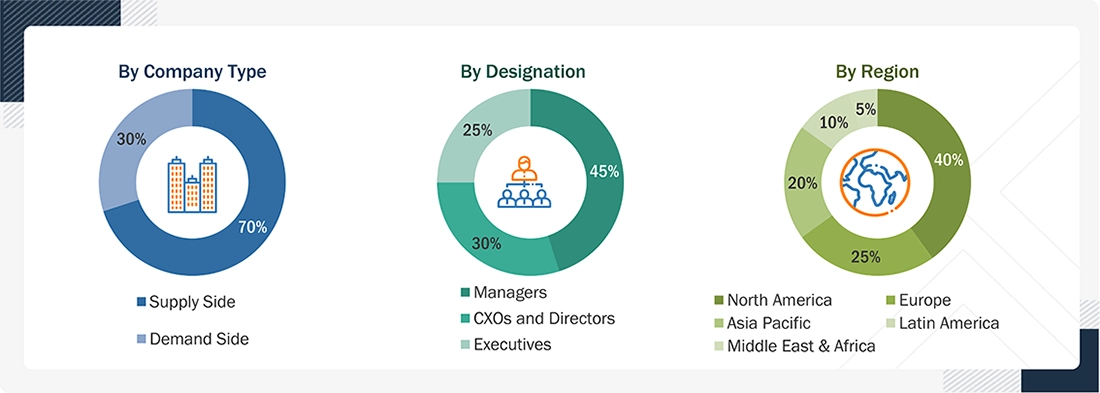
In-depth interviews were conducted with primary respondents, including key industry participants, subject-matter experts (SMEs), C-level executives of key market players, and industry consultants, among others, to obtain and verify critical qualitative and quantitative information and to assess market prospects. Primary sources from both the supply and demand sides of the market were interviewed to gather qualitative and quantitative data. The following is a breakdown of the primary respondents:
Breakup of Primary Profiles:
To know about the assumptions considered for the study, download the pdf brochure
Market Size Estimation
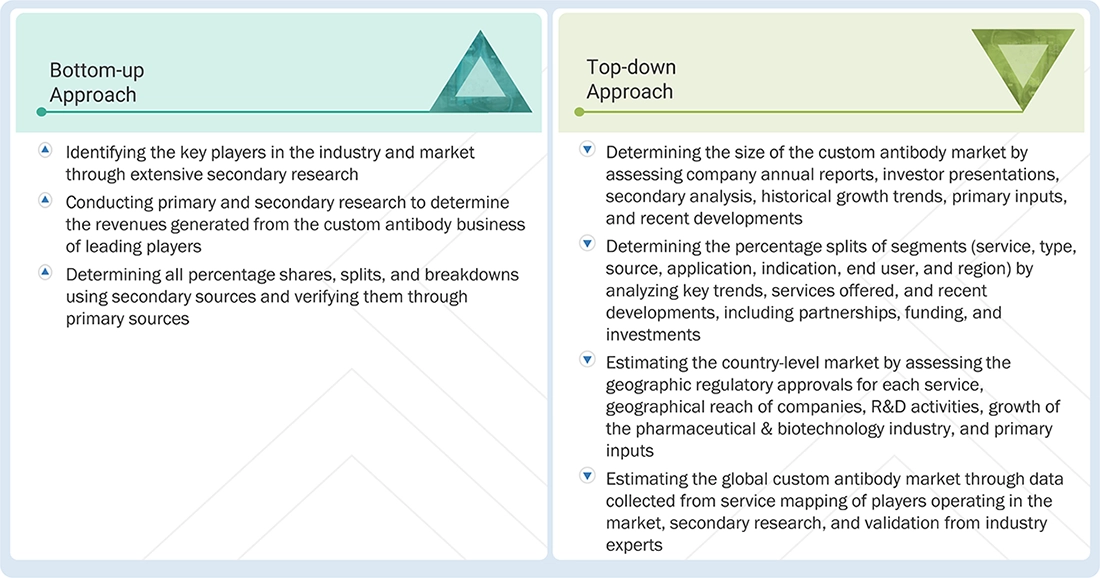
The global size of the custom antibody market was estimated using multiple approaches. A detailed market estimation approach was used to estimate and validate the market value and other dependent submarkets. These methods were also used extensively to estimate the size of various market subsegments. The research methodology used to estimate the market size includes the following.
Custom Antibody Market: Top-Down and Bottom-Up Approach
Data Triangulation
After estimating the market size using the process described above, the total market was divided into several segments and subsegments. To finish the overall market analysis and obtain precise statistics for all segments and subsegments, data triangulation and market breakdown methods were used where applicable. The data were triangulated by examining various factors and trends from both the demand and supply sides.
Market Definition
Custom antibody services include the production of antibodies from a wide variety of host species, depending on the desired outcome of the research study. These services range from antigen preparation, immunization, hybridoma production, and antibody characterization to production, purification, and labeling. The report includes the market size and forecast for custom antibody development, production, purification, and labeling services.
Key Stakeholders
- Academic & Research Institutes
- Custom Antibody Service Vendors
- Contract Research Organizations (CROs)
- Medical Device Companies
- Market Research and Consulting Firms
- Pharmaceutical & Biotechnology Companies
- Regulatory Agencies
- Venture Capitalists
- Government Organizations
- Private Research Firms
Report Objectives
- To define, describe, and forecast the custom antibody market based on service, type, source, application, indication, end user, and region
- To analyze micromarkets with respect to individual growth trends, prospects, and contributions to the overall custom antibody market
- To analyze opportunities for stakeholders and provide details of the competitive landscape for market leaders
- To forecast the size of the market segments with respect to six regions: North America (US and Canada), Europe (Germany, France, the UK, Italy, Spain, and the Rest of Europe), Asia Pacific (China, Japan, South Korea, India, Australia, and the Rest of Asia Pacific), Latin America (Brazil, Mexico, and the Rest of Latin America), the Middle East (GCC Countries), and Africa
- To profile the key players and analyze their market share and core competencies
- To analyze competitive developments, such as service launches, partnerships, agreements, collaborations, and expansions
- To benchmark players within the market using the proprietary “Company Evaluation Matrix” framework, which analyzes market players on various parameters within the broad categories of business and product excellence strategy
Available customizations:
With the provided market data, MarketsandMarkets offers customization to meet the company’s specific needs. The following options are available for the report:
Geographical Analysis
- A further breakdown of the Rest of Asia Pacific custom antibody market into countries
- A further breakdown of the Rest of Europe custom antibody market into countries
- A further breakdown of the Rest of Latin America custom antibody market into countries
Company Information
- Detailed analysis and profiling of additional market players (up to five).
Segment Analysis
- Cross-segment analysis.
Get the Full Custom Antibody Market Report
Full forecast, segment splits, and company analysis for all Custom Antibody Market.
- Rest Of Europe Custom Antibody Market
- Rest Of Asia Pacific Custom Antibody Market
- Rest Of Latin America Custom Antibody Market
- GCC Countries Custom Antibody Market
- Rest Of Middle East Custom Antibody Market
- Rest Of GCC Countries Custom Antibody Market
- Canada Custom Antibody Market
- US Custom Antibody Market
- Germany Custom Antibody Market
- UK Custom Antibody Market
- France Custom Antibody Market
- Italy Custom Antibody Market
- Spain Custom Antibody Market
- China Custom Antibody Market
- Japan Custom Antibody Market
- India Custom Antibody Market
- South Korea Custom Antibody Market
- Australia Custom Antibody Market
- Brazil Custom Antibody Market
- Mexico Custom Antibody Market
- Saudi Arabia Custom Antibody Market
Need a Tailored Report?
Customize this report to your needs
Get 10% FREE Customization
Customize This Report
