
GCC Countries Cybersecurity Certification Market (2024-2029)

The GCC Countries Cybersecurity Certification Market was valued at $191.2 Million in 2024 and projected to reach to $389.2 Million by 2029, representing a compound annual growth rate of 12.6%. The GCC cybersecurity certification market is positioned for exceptional growth, expanding from USD 191.2 million in 2024 to USD 389.2 million by 2029.


| Market Size in | USD 26.32 MN |
| Market Forecast in | |
| CAGR | |
| Forecast Period | |
| Units Considered | Value (USD MN) |
GCC Countries Cybersecurity Certification Market Trends and Insights
- GCC Countries are witnessing accelerating demand for certified cybersecurity professionals driven by rapid digital transformation, increased regulatory compliance requirements, and heightened cyber threat awareness across government and private sectors.
- The 12.6% compound annual growth rate reflects GCC Countries' strategic investments in building a skilled cybersecurity workforce to protect critical infrastructure and financial systems. GCC Countries' market expansion is underpinned by substantial government initiatives, including Vision 2030 programs and national cybersecurity strategies that mandate professional certifications.
- Organizations across GCC Countries are increasingly recognizing the value of internationally recognized credentials such as CISSP, CEH, and CompTIA Security+ to enhance their security posture.
- The forecast period through 2029 indicates that GCC Countries will continue to be a high-growth region, supported by rising IT spending, cloud adoption, and the emergence of new cyber threats requiring specialized expertise..
Key Market Statistics
- CAGR (2024-2029) 12.6% CAGR
- Market Size, 2024 ~USD 191.2 Million
- Forecast, 2029 ~USD 389.2 Million
- Country GCC Countries
GCC Countries Cybersecurity Certification Market Overview
Rapid Market Expansion :
The GCC cybersecurity certification market is growing at 12.6% CAGR, outpacing the global rate of 12.4%, driven by aggressive digital transformation initiatives across UAE, Saudi Arabia, and Qatar.
Regulatory Compliance Surge :
GCC governments are implementing stringent cybersecurity regulations and mandatory compliance frameworks, creating urgent demand for certified professionals across banking, energy, and government sectors.
Digital Transformation Catalyst :
Vision 2030 initiatives and smart city projects in Saudi Arabia, UAE's digital economy strategy, and Qatar's tech investments are accelerating the need for qualified cybersecurity talent.
Enterprise Investment Growth :
Major GCC enterprises and multinational corporations operating in the region are significantly increasing cybersecurity budgets, directly boosting demand for certified professionals and training programs.
GCC Countries Cybersecurity Certification Market Dynamics
- This trajectory reflects the region's strategic pivot toward digital infrastructure and heightened awareness of cyber threats targeting critical sectors including finance, oil and gas, and government institutions.
- Saudi Arabia, UAE, and Qatar are leading investments in cybersecurity talent development through national initiatives and public-private partnerships. Looking ahead, the market will be shaped by increasing regulatory mandates, growing foreign direct investment in tech hubs, and the emergence of specialized certification programs tailored to GCC-specific compliance requirements.
- Educational institutions and training providers are expanding offerings to meet regional demand, while enterprises are prioritizing certified talent acquisition to strengthen their security posture against evolving threats..
Market Ecosystem
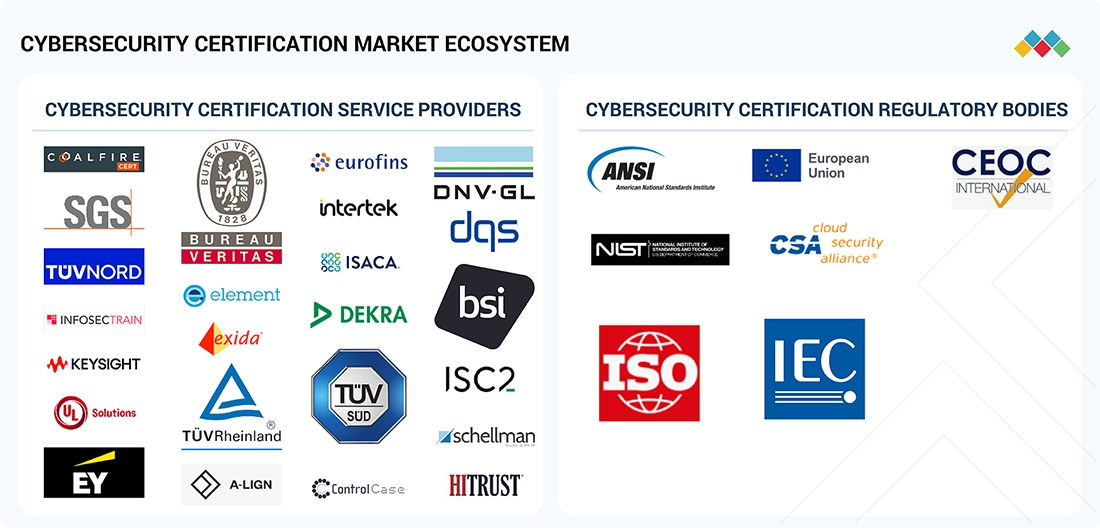
Cybersecurity Certification Market: COMMERCIAL USE CASES ACROSS INDUSTRIES
| COMPANY | USE CASE DESCRIPTION | BENEFITS |
|---|---|---|
 |
The client faced the challenge of managing sensitive client data while ensuring compliance with industry standards. | Simplified tender processes, reduced client audit complexities, and instilled confidence in clients and employees, improved focus on quality enhanced staff performance. |
 |
Expanding customer base, increased enterprise inquiries, GDPR compliant, pursue ISO 27001 Certification, first ISO audit, need expert guidance, identify gaps, implement changes, harmonize security with European regulations, ensure transparency, accountability in data handling. | Achieved ISO 27001 Certification, strengthened data security, competitive advantage Nordic and European markets, increased customer confidence, boosted sales, improved documentation and organizational practices, better incident handling, demonstrated commitment to data protection, enhanced security program. |
 |
Need to ensure trust and compliance, handling sensitive consumer data, income and employment verification, safeguarding data, efficient resource management, manual processes, time-consuming evidence collection, audit preparation errors, hindered operational speed. | Improved efficiency, automated compliance checks, reduced manual tasks, streamlined operations, continuous compliance, ongoing monitoring, simplified adherence to SOC 2 and ISO 27001, scalability, enhanced governance, added new compliance frameworks, cost reduction, lowered compliance expenses, optimized resource usage, maintained security and regulatory adherence. |
Logos and trademarks shown above are the property of their respective owners. Their use here is for informational and illustrative purposes only.
Related Ecosystem
Cyber Security
- Cloud Security
- Biometric Systems
- Data Loss Prevention (DLP)
- Multi-Factor Authentication
- Security Analytics
- REDINGTON
- International Business Machines Corporation
- Cisco Systems, Inc.
- MITSUI BUSSAN SECURE DIRECTIONS INC
- MICROSOFT CORPORATION
Key Takeaways
- GCC Countries' cybersecurity certification market is valued at USD 191.2 million in 2024 and will nearly double to USD 389.2 million by 2029, representing a 12.6% CAGR.
- GCC Countries are prioritizing cybersecurity workforce development through government mandates and Vision 2030 initiatives that drive certification adoption.
- Organizations in GCC Countries are increasingly investing in internationally recognized certifications to meet regulatory compliance and strengthen security infrastructure.
- GCC Countries' market growth is accelerated by digital transformation, cloud migration, and rising cyber threats requiring specialized certified professionals.
Cybersecurity Certification Market Report Scope
| Report Metric | Details |
|---|---|
| Base Year | 2024 |
| Fastest Growing Segment | HEALTHCARE (Vertical) |
| Forecast Period | 2024-2029 |
| Growth Rate | CAGR of 12.4% from 2024 to 2029 |
| Largest Segment | NETWORK SECURITY (Security Type) |
| Market Size Base Year (Billions) | ~USD 3.98 (2024) |
| Revenue Forecast (Billions) | ~USD 7.14 (2029) |
| Segments Covered | Offering, Certification Category, Target User, Delivery Mode, Vertical, Solution Type, Deployment Mode, Organization Size, Security Type, Solution, Service, Solution Usage, Business Function |
GCC Countries Cybersecurity Certification Market Report Segmentation
13 segment dimensions are covered across the global market.
By Offering
- Certification Services
- Platforms & Tools
- Services
- Solution
- Solutions
By Certification Category
- Application Security Certifications
- Artificial Intelligence (AI) Certifications
- Cloud Security Certifications
- Device & IoT Security Certifications
- Governance, Risk, And Compliance (Grc) Certifications
- Information Security Certifications
- Information Security Certifications/Privacy & Data Protection Certifications
- Network Security Certifications
- Other Certification Categories
- Other Certifications
By Target User
- Enterprises
- Individual Professionals
By Delivery Mode
- In-Person
- Online
By Vertical
- Aerospace And Defense
- Automotive
- Bfsi
- Energy & Utilities
- Energy And Utilities
- Government
- Government & Defense
- Healthcare
- Healthcare & Life Science
- It & Ites
- Manufacturing
- Media & Entertainment
- Other Verticals
- Retail & Ecommerce
- Telecommunication
- Telecommunications
- Transportation & Logistics
By Solution Type
- Antivirus/Antimalware
- Compliance & Policy Management
- Encryption & Tokenization
- Firewall
- Iam
- Log Management & Siem
- Other Solution Types
- Patch Management
By Deployment Mode
- Cloud
- Hybrid
- On-Premises
By Organization Size
- Large Enterprises
- Smes
By Security Type
- Application Security
- Cloud Security
- Endpoint & IoT Security
- Network Security
By Solution
- Audit Management
- Compliance Management
- Policy Management
- Privacy Management
- Risk Management
By Service
- Managed
- Professional
By Solution Usage
- External
- Internal
By Business Function
- Finance
- It
- Legal
- Operations
Target Audience
- Certification Training Providers : Need GCC market data to expand training programs, establish regional partnerships, and develop localized curriculum aligned with Gulf regulatory requirements and enterprise demand.
- Cybersecurity Solution Vendors : Require market insights to identify GCC enterprise customers, understand certification-driven procurement decisions, and position security solutions to certified professional segments.
- Educational Institutions & Universities : Seek market intelligence to develop cybersecurity degree programs and certification pathways meeting GCC employer needs and supporting regional digital transformation goals.
- Government & Policy Makers : Need market analysis to inform cybersecurity talent development strategies, regulatory frameworks, and national digital security initiatives across GCC member states.
- Enterprise IT & Security Leaders : Require market data to benchmark certification hiring trends, identify talent acquisition strategies, and align workforce development with GCC regulatory compliance mandates.
Reasons to Buy this Report
- Regional Market Sizing & Forecasts : Obtain precise market valuations specific to GCC Countries with detailed 5-year projections (2024-2029), enabling accurate budget allocation and investment planning for regional expansion strategies.
- Country-Level Competitive Intelligence : Analyze market dynamics across individual GCC nations (UAE, Saudi Arabia, Qatar, Kuwait, Bahrain, Oman) to identify high-growth segments and competitive opportunities within each market.
- Regulatory & Compliance Insights : Understand GCC-specific regulatory drivers, mandatory compliance frameworks, and government initiatives shaping certification demand, critical for tailoring solutions to regional requirements.
- Sector-Specific Demand Analysis : Identify which GCC industries (banking, energy, government, telecom) are driving certification adoption, allowing targeted marketing and product development for high-value segments.
- Strategic Market Entry Planning : Leverage GCC-focused data to develop market entry strategies, partnership opportunities, and localization approaches for training providers, certification bodies, and technology vendors.
Frequently asked questions
What is the current market size of cybersecurity certifications in GCC Countries?
The cybersecurity certification market in GCC Countries was valued at USD 191.2 million in 2024 and is expected to reach USD 389.2 million by 2029.
What is the projected growth rate for cybersecurity certifications in GCC Countries?
GCC Countries' cybersecurity certification market is projected to grow at a compound annual growth rate (CAGR) of 12.6% from 2024 to 2029.
Which certifications are most in demand in GCC Countries?
In GCC Countries, internationally recognized certifications such as CISSP, CEH, CompTIA Security+, and CCNA Security are among the most sought-after credentials by organizations and professionals.
What factors are driving growth in GCC Countries' cybersecurity certification market?
Key drivers in GCC Countries include government cybersecurity mandates, Vision 2030 digital transformation initiatives, increased regulatory compliance requirements, cloud adoption, and rising cyber threats.
How are GCC Countries addressing the cybersecurity skills gap?
GCC Countries are addressing the skills gap through government-backed training programs, mandatory certification requirements for critical infrastructure roles, and partnerships with international certification bodies to develop local expertise.
RESEARCH METHODOLOGY
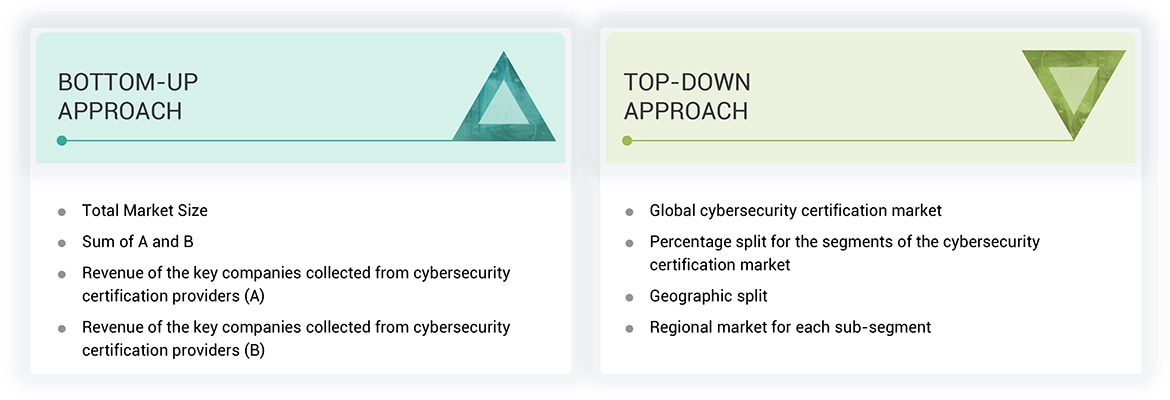
The study involved significant activities in estimating the current market size for the Cybersecurity Certification market. Exhaustive secondary research was done to collect information on the Cybersecurity Certifications market. The next step was to validate these findings, assumptions, and sizing with industry experts across the value chain using primary research. Different approaches, such as top-down and bottom-up, were employed to estimate the total market size. After that, the market breakdown and data triangulation procedures were used to estimate the market size of the segments and subsegments of the Cybersecurity Certification market.
In the complete market engineering process, the top-down and bottom-up approaches and several data triangulation methods were extensively used to perform the market estimation and market forecasting for the overall market segments and subsegments listed in this report. Extensive qualitative and quantitative analysis was performed on the complete market engineering process to list the critical information and insights throughout the report to list the key information/insights throughout the report.
Secondary Research
During the secondary research phase, various sources were looked into to gather information for the study. These secondary sources included annual reports, press releases, investor presentations from Cybersecurity Certifications software and service providers, online forums, accredited publications, and white papers. The secondary research was used to get insights into the industry supply chain, key players, market segmentation down to a granular level, regional markets, and notable developments from a market and technology perspective. These findings were then validated through primary sources. Factors considered to estimate regional market size included government and technology initiatives, Gross Domestic Product (GDP) growth rates, Information and Communication Technology (ICT) spending, recent market developments, and a thorough analysis of major Cybersecurity Certifications providers’ market position.
Primary Research
In the primary research process, various supply and demand sources were interviewed to obtain qualitative and quantitative information for this report. The primary sources from the supply side included industry experts, such as Chief Executive Officers (CEOs), Vice Presidents (VPs), marketing directors, technology and innovation directors, and related key executives from various key companies and organizations operating in the Cybersecurity Certifications market.
After the complete market engineering (calculations for market statistics, market breakdown, market size estimations, market forecasting, and data triangulation), extensive primary research was conducted to gather information and verify and validate the critical numbers arrived at. Primary research was also undertaken to identify the segmentation types, industry trends, competitive landscape of Cybersecurity Certifications offered by various market players, and fundamental market dynamics, such as drivers, restraints, opportunities, challenges, industry trends, and key player strategies.
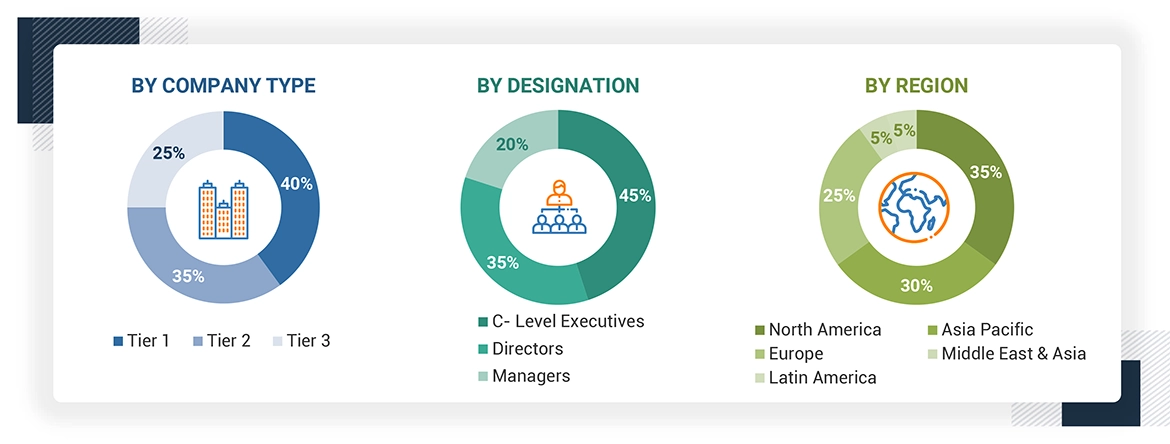
*Others include Sales Managers, Marketing Managers, and Product Managers.
Note: Tier 1 companies are those with total annual revenue > USD 10 billion; tier 2 companies are
those with total annual revenue between USD 1 and 10 billion, and tier 3 companies are those
with total annual revenue between USD 500 million and 1 billion
Source: MarketsandMarkets Analysis
To know about the assumptions considered for the study, download the pdf brochure
Market Size Estimation
Top-down and bottom-up approaches were used to estimate and validate the size of the global Cybersecurity Certifications market and the size of various other dependent sub-segments in the overall Cybersecurity Certifications market. The research methodology used to estimate the market size includes the following details:
Key players in the market were identified through secondary research, and their market shares in the respective regions were determined through primary and secondary research. This entire procedure included the study of the annual and financial reports of the top market players, and extensive interviews were conducted for key insights from the industry leaders, such as CEOs, VPs, directors, and marketing executives.
All percentage splits and breakdowns were determined using secondary sources and verified through primary sources. All possible parameters that affect the market covered in this research study have been accounted for, viewed in extensive detail, verified through primary research, and analyzed to get the final quantitative and qualitative data. This data is consolidated and added to detailed inputs and analysis from MarketsandMarkets.
Cybersecurity Certification Market : Top-Down and Bottom-Up Approach
Data Triangulation
The market was split into several segments and subsegments after arriving at the overall market size using the market size estimation processes explained above. The data triangulation and market breakup procedures were employed, wherever applicable, to complete the overall market engineering process and arrive at the exact statistics of each market segment and subsegment. The data was triangulated by studying various factors and trends from both the demand and supply sides.
Market Definition
According to MarketsandMarkets, cybersecurity certification focuses on validating the skills, knowledge, and competencies of professionals, as well as the security measures of enterprises' products, services, and processes against established standards. Offered by independent certification bodies and technology vendors, these certifications enhance the credibility and expertise of individuals while helping enterprises assess their workforce's security capabilities, ensure compliance with industry standards and regulations, and build trust with clients and stakeholders.
Stakeholders
- Government Agencies and Regulatory Bodies
- Standardization Bodies
- Industry Associations and Networks
- Developers
- Business Analysts
- Quality Assurance (QA)/Test Engineers
- Certification Bodies and Organizations
- Cybersecurity Certification Specialists
- Cybersecurity Certification Solution Vendors
- Cybersecurity Certification Service Providers
- Third-Party Vendors
- Investors and Venture Capitalists
- Educational Institutions and Training Providers
- System Integrators
- Value-added Resellers (VARs)
- Information Technology (IT) Security Agencies
- Distribution Partners
- Consulting Firms
- Managed Security Service Providers (MSSPs)
- Private Sector Companies
- Cybersecurity Professionals
Report Objectives
- To define, describe, and forecast the Cybersecurity Certifications market based on Offering, Certification Category, Target User, Delivery Mode, Vertical, and Region.
- To forecast the market size of five central regions: North America, Europe, Asia Pacific (APAC), Middle East & Africa (MEA), and Latin America.
- To analyze the subsegments of the market concerning individual growth trends, prospects, and contributions to the overall market.
- To provide detailed information related to the primary factors (drivers, restraints, opportunities, and challenges) influencing the growth of the Cybersecurity Certifications market.
- To analyze opportunities in the market for stakeholders by identifying high-growth segments of the Cybersecurity Certifications market.
- To profile the key players of the Cybersecurity Certifications market and comprehensively analyze their market size and core competencies.
- Track and analyze competitive developments in the global Cybersecurity Certifications market, such as new product launches, mergers and acquisitions, partnerships, agreements, and collaborations.
Available Customizations
With the given market data, MarketsandMarkets offers customizations based on company-specific needs. The following customization options are available for the report:
Geographic Analysis as per Feasibility
- Further breakup of the Asia Pacific market into major countries.
- Further breakup of the North American market into major countries.
- Further breakup of the Latin American market into major countries.
- Further breakup of the Middle East African market into major countries
- Further breakup of the European market into major countries.
Company Information
- Detailed analysis and profiling of additional market players (up to 5)
Get the Full Cybersecurity Certification Market Report
Full forecast, segment splits, and company analysis for all Cybersecurity Certification Market.
- US Cybersecurity Certification Market
- Canada Cybersecurity Certification Market
- UK Cybersecurity Certification Market
- Germany Cybersecurity Certification Market
- France Cybersecurity Certification Market
- Italy Cybersecurity Certification Market
- China Cybersecurity Certification Market
- Japan Cybersecurity Certification Market
- India Cybersecurity Certification Market
- Singapore Cybersecurity Certification Market
- Rest Of Europe Cybersecurity Certification Market
- Rest Of Asia Pacific Cybersecurity Certification Market
- Brazil Cybersecurity Certification Market
- Mexico Cybersecurity Certification Market
- Rest Of Latin America Cybersecurity Certification Market
- South Africa Cybersecurity Certification Market
Need a Tailored Report?
Customize this report to your needs
Get 10% FREE Customization
Customize This Report
