
Japan Data Center Chip Market (2026-2031)

The Japan Data Center Chip Market was valued at $28159.3 Million in 2026 and projected to reach to $79761.2 Million by 2031, representing a compound annual growth rate of 18.9%. Japan's data center chip market is positioned for exceptional growth over the next five years, driven by accelerating cloud adoption and enterprise AI implementation across financial services, manufacturing, and telecommunications sectors.


| Market Size in | USD 26.32 MN |
| Market Forecast in | |
| CAGR | |
| Forecast Period | |
| Units Considered | Value (USD MN) |
Japan Data Center Chip Market Trends and Insights
- Japan is positioned as a critical hub for semiconductor innovation in the Asia Pacific region, driven by increasing cloud infrastructure investments and AI adoption across enterprises.
- The market in Japan reflects strong demand for advanced processing capabilities as domestic and regional data center operators expand capacity to support digital transformation initiatives. The 18.9% compound annual growth rate in Japan significantly outpaces global trends, underscoring the country's strategic importance in the semiconductor supply chain.
- Japan's established manufacturing ecosystem, coupled with government support for semiconductor self-sufficiency, creates favorable conditions for data center chip vendors.
- Between 2026 and 2031, Japan is expected to capture an expanding share of Asia Pacific data center chip demand, driven by edge computing deployment, 5G infrastructure buildout, and enterprise AI workloads requiring specialized processors..
Key Market Statistics
- CAGR (2026-2031) 18.9% CAGR
- Market Size, 2026 ~USD 28159.3 Million
- Forecast, 2031 ~USD 79761.2 Million
- Country Japan
Japan Data Center Chip Market Overview
Explosive Growth Trajectory :
Japan's data center chip market is projected to grow from $28,159.3 million in 2026 to $79,761.2 million by 2031, representing a robust 18.9% CAGR, outpacing the global average of 15.9%.
AI and Cloud Infrastructure Boom :
Japanese enterprises are rapidly adopting AI technologies and expanding cloud infrastructure investments, driving unprecedented demand for advanced data center processors and accelerators across the nation.
Asia Pacific Innovation Hub :
Japan is establishing itself as a critical semiconductor innovation center in the Asia Pacific region, attracting major investments in chip design, manufacturing, and R&D facilities.
Advanced Processing Demand :
Strong demand for cutting-edge processing capabilities in data centers reflects Japan's digital transformation initiatives and the nation's commitment to becoming a global AI technology leader.
Japan Data Center Chip Market Dynamics
- The nation's strategic focus on semiconductor self-sufficiency and advanced chip development will further bolster market expansion.
- Government initiatives supporting digital infrastructure and AI research are expected to sustain momentum through 2031.
- Japan's established semiconductor expertise and manufacturing capabilities provide a competitive advantage in capturing growing demand for specialized data center processors and GPU accelerators..
Market Ecosystem
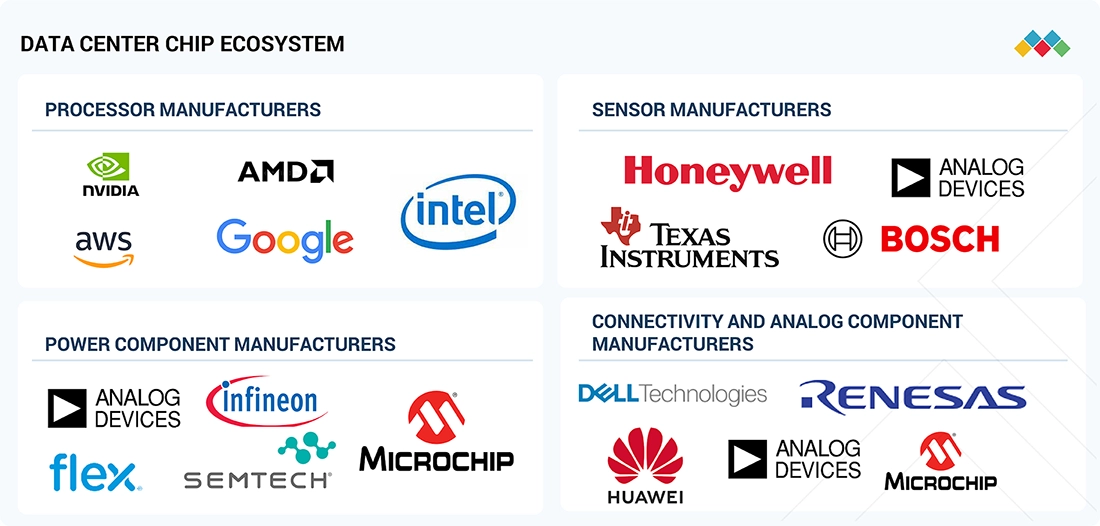
DATA CENTER CHIP MARKET SIZE, SHARE AND TRENDS: COMMERCIAL USE CASES ACROSS INDUSTRIES
| COMPANY | USE CASE DESCRIPTION | BENEFITS |
|---|---|---|
 |
STMicroelectronics improved its R&D data center performance by deploying servers powered by AMD EPYC processors. This enabled the better handling of complex chip design workloads while improving computational efficiency and maintaining sustainability goals. The solution delivered higher performance and optimized energy use across data center operations. | Delivered 12% performance improvement and 30% lower power consumption per core, leading to a 33% reduction in overall electricity usage while supporting efficiency and sustainability goals |
|
|
JOCDN enhanced its broadcast video streaming capabilities by integrating AMD EPYC processors into its server infrastructure. The upgrade improved processing power and optimized resource utilization, enabling the system to handle increasing streaming demand while maintaining quality and performance standards efficiently. | Enabled 2x throughput while reducing CPU usage by 40% and power consumption by 20%, improving operational efficiency and lowering overall infrastructure costs |
|
|
DBS Bank modernized its data center infrastructure by deploying Dell servers powered by AMD EPYC processors. The transition improved workload virtualization, enhanced overall system performance, and addressed challenges related to high hardware costs and energy consumption, while supporting the bank’s efficiency and sustainability objectives. | Achieved 75% reduction in hardware costs, 50% lower power consumption, and nearly 99% workload virtualization, significantly improving operational efficiency and sustainability |
 |
NVIDIA Corporation deployed its H100 Tensor Core GPUs across hyperscale and enterprise data centers to support generative AI and large language model workloads. Integrated with high-speed interconnects and optimized AI software stacks, the solution enabled efficient parallel processing and reduced latency. | Delivered faster AI training and inference with improved energy efficiency and scalability, enabling high-performance processing of large-scale generative AI workloads across data centers |
Logos and trademarks shown above are the property of their respective owners. Their use here is for informational and illustrative purposes only.
Related Ecosystem
Information System And Analytics
- Machine Learning
- Natural Language Processing (NLP)
- Sensors
- Software as A Service (SaaS)
- Data Loss Prevention (DLP)
- International Business Machines Corporation
- MICROSOFT CORPORATION
- Amazon.com, Inc.
- Oracle Corporation
Key Takeaways
- Japan's data center chip market will grow from $28.2B (2026) to $79.8B (2031), representing 183% total growth over the forecast period.
- Japan's 18.9% CAGR outpaces the global average of 15.9%, reflecting accelerated digital infrastructure investment and AI adoption.
- Japan's semiconductor manufacturing capabilities and government policy support position it as a strategic production and innovation center for data center chips.
- Edge computing, 5G deployment, and enterprise AI workloads are primary growth drivers for Japan's data center chip market through 2031.
Data Center Chip Market Report Scope
| Report Metric | Details |
|---|---|
| Base Year | 2026 |
| Fastest Growing Segment | ENTERPRISES (End User) |
| Forecast Period | 2026–2031 |
| Growth Rate | CAGR of 15.9% from 2026 to 2031 |
| Largest Segment | ARTIFICIAL INTELLIGENCE (Application) |
| Market Size Base Year (Billions) | ~USD 283.7 (2026) |
| Revenue Forecast (Billions) | ~USD 593.31 (2031) |
| Segments Covered | Component, Type, Processor Type, Technology Type, Network Type, Interconnect Type, Data Center Size, Application, Model Type, End User, Enterprise Type |
Japan Data Center Chip Market Report Segmentation
11 segment dimensions are covered across the global market.
By Component
- Analog & Mixed-Signal Ics
- Memory
- Network
- Network Interfaces/Interconnects
- Power Management Solutions
- Processors
- Sensors
By Type
- 48V Intermediate Bus Converters
- AI Processors
- Airflow Sensors
- Asic
- Baseboard Management Controllers
- Clock Ics
- Cpu
- Current Sensor Amplifiers
- Fan Controllers
- Fpga
- General-Purpose Computing Processors
- Gpu
- Hot Swap Controllers/ Efuses
- Hot Swap Controllers/Efuses
- Humidity Sensors
- Low Dropout
- Multichannel Adcs/Dacs
- Multiphase Controllers
- Muxes
- Other Sensors
- Point-Of-Load (Dc/Dc Converters)
- Power Sequencers
- Supervisory Ics
- Switches
- Temperature Sensors
By Processor Type
- Cpu
- Fpga
- Gpu
By Technology Type
- Computer Vision
- Ddr
- Generative AI
- Hbm
- Machine Learning
- Natural Language Processing
By Network Type
- Interconnects
- Nics/Network Adapters
By Interconnect Type
- Ethernet
- Infiniband
- Other Nics/Network Adapters
By Data Center Size
- Large
- Medium
- Small
By Application
- Artificial Intelligence
- General-Purpose Computing
By Model Type
- Autoencoders
- Convolutional Neural Networks (Cnns)
- Deep Learning
- Generative Adversarial Networks (Gans)
- Rule-Based Models
- Statistical Models
- Transformer Models
By End User
- Cloud Service Providers
- Enterprises
- Government Organizations
By Enterprise Type
- Automotive
- Bfsi
- Healthcare
- Media & Entertainment
- Other Enterprises
- Retail & E-Commerce
Target Audience
- Semiconductor Manufacturers : Chip designers and manufacturers need Japan-specific market data to optimize product portfolios, plan capacity investments, and identify partnership opportunities in this high-growth market.
- Data Center Operators : Japanese and international data center providers require detailed chip market insights to forecast infrastructure costs, evaluate supplier options, and plan technology upgrades.
- Technology Investors : Venture capital and private equity firms targeting Japan's semiconductor and cloud sectors need comprehensive market analysis to identify investment opportunities and assess growth potential.
- Enterprise IT Decision Makers : CIOs and IT procurement leaders in Japan need market intelligence on chip availability, pricing trends, and technology roadmaps to optimize data center infrastructure investments.
- Government & Policy Bodies : Japanese government agencies and economic development organizations require market data to inform semiconductor policy, industrial strategy, and technology self-sufficiency initiatives.
Key Companies in the Japan Data Center Chip Market
| Company | HQ | Ownership | Strongest segments |
|---|---|---|---|
| NVIDIA CORPORATION | United States | Public Company | Processors (GPU/accelerators and related compute platforms),Memory (HBM attachment, GPU memory subsystems),Network (InfiniBand, Ethernet, DPUs), |
| ADVANCED MICRO DEVICES, INC. | United States | Public Company | Processors (EPYC and related data center CPUs/APUs),AI Accelerators & Data Center GPUs (Instinct, Radeon PRO V-series),FPGA & Adaptive SoCs (Versal, Zynq, Alveo boards), |
| SAMSUNG | Korea, South | Public Company | Memory (DRAM, HBM, NAND for data centers),Processors & custom SoCs for servers/networking,Network, Sensors, Power Management, Analog & Mixed-Signal ICs, |
| SK HYNIX INC. | South Korea | Public Company | Server DRAM (standard and high-capacity),High-Bandwidth Memory for AI accelerators,Enterprise / Data Center SSD (NAND-based), |
| MICRON TECHNOLOGY, INC. | United States | Public Company | Data Center DRAM (incl. CXL-based, LPDDR for servers, graphics/HBM for accelerators),Data Center SSD (NVMe and SATA),Managed NAND, MCPs, and Standalone NAND for Data Center Appliances, |
| INTEL CORPORATION | United States | Public Company | Processors,Memory,Network, |
| United States | Public Company | Processors (incl. TPUs and CPUs),Memory,Network, | |
| MONOLITHIC POWER SYSTEMS, INC | United States | Public Company | Power Management ICs for Servers and AI Systems,Power Solutions for Memory and Storage,Analog & Mixed-Signal ICs (Sensors, Drivers, Control), |
| TEXAS INSTRUMENTS INCORPORATED | United States | Public Company | Power Management ICs,Analog & Mixed-Signal ICs (Signal Chain),Embedded Processing (MCUs/MPUs for Data Center Systems), |
| ANALOG DEVICES, INC. | United States | Public Company | Power Management ICs,Analog & Mixed-Signal ICs,Sensors and MEMS, |
| MICROSOFT | United States | Public Company | Processors (CPU/GPU/Accelerators),Memory,Network, |
| IMAGINATION TECHNOLOGIES | United Kingdom | Private Company | Processors (GPU and MIPS IP for data center SoCs),Network (Ensigma wireless and wired IP for switching/routing),Analog & Mixed-Signal ICs (IP blocks and design services), |
| CEREBRAS | United States | Public Company | Processors (Wafer-Scale Engine and AI accelerators),Memory,Network, |
NVIDIA CORPORATION
NVIDIA Corporation is a publicly traded U.S. technology company founded in 1993 that employs 42,000 people. The company designs and manufactures graphics processing units and system-on-chip units.
ADVANCED MICRO DEVICES, INC.
Advanced Micro Devices, Inc. is a publicly traded U.S. semiconductor company founded in 1969 with 31,000 employees. The company designs and manufactures microprocessors and graphics processing units.
SAMSUNG
Samsung is a publicly traded South Korean conglomerate founded in 1969 with 128,735 employees. The company operates across multiple industries including electronics, semiconductors, and consumer appliances.
SK HYNIX INC.
SK Hynix Inc. is a publicly traded South Korean semiconductor company founded in 1949 with 47,639 employees. The company specializes in the design and manufacture of memory chips and semiconductor products.
MICRON TECHNOLOGY, INC.
Micron Technology, Inc. is a publicly traded U.S. semiconductor company founded in 1978 with 53,000 employees. The company designs and manufactures memory and storage products for various computing applications.
INTEL CORPORATION
Intel Corporation is a publicly traded U.S. semiconductor company founded in 1968 with 85,100 employees. The company designs and manufactures microprocessors and other semiconductor products for computing and data center markets.
Google is a publicly traded U.S. technology company founded in 1998 with 194,668 employees. The company provides search, advertising, cloud computing, and various digital services and products.
MONOLITHIC POWER SYSTEMS, INC
Monolithic Power Systems, Inc. is a publicly traded U.S. semiconductor company founded in 1997 with 4,501 employees. The company designs and manufactures analog and mixed-signal integrated circuits.
TEXAS INSTRUMENTS INCORPORATED
Texas Instruments Incorporated is a publicly traded U.S. semiconductor company founded in 1930 with 33,000 employees. The company designs and manufactures analog and embedded processing semiconductors.
ANALOG DEVICES, INC.
Analog Devices, Inc. is a publicly traded U.S. semiconductor company founded in 1965 with 24,500 employees. The company designs and manufactures analog, mixed-signal, and digital signal processing integrated circuits.
MICROSOFT
Microsoft is a publicly traded U.S. technology company founded in 1975 with 228,000 employees. The company develops and sells software, cloud computing services, and hardware products.
IMAGINATION TECHNOLOGIES
Imagination Technologies is a privately held United Kingdom technology company founded in 1994 with 1,273 employees. The company designs graphics processing and semiconductor intellectual property.
CEREBRAS
Cerebras is a publicly traded U.S. technology company founded in 2015 with 784 employees. The company designs and manufactures artificial intelligence and machine learning processors.
Reasons to Buy this Report
- Market Size & Growth Validation : Obtain precise market valuation data for Japan ($28.2B in 2026, $79.8B in 2031) with detailed CAGR analysis to support investment decisions and competitive positioning strategies.
- Japan-Specific Trend Analysis : Access localized insights on AI adoption rates, cloud infrastructure investments, and enterprise digital transformation initiatives unique to the Japanese market landscape.
- Competitive Intelligence : Identify key players, market share distribution, and competitive dynamics specific to Japan's data center chip ecosystem to inform go-to-market strategies.
- Regulatory & Policy Insights : Understand Japan's semiconductor self-sufficiency initiatives, government support programs, and policy frameworks driving market growth through 2031.
- Segment & Application Breakdown : Gain detailed segmentation by chip type, data center tier, and industry verticals (finance, manufacturing, telecom) to identify high-growth opportunities in Japan.
Frequently asked questions
What is the projected size of Japan's data center chip market in 2031?
Japan's data center chip market is forecast to reach $79,761.2 million by 2031, up from $28,159.3 million in 2026.
What is the CAGR for Japan's data center chip market?
Japan's data center chip market is expected to grow at a compound annual growth rate of 18.9% between 2026 and 2031.
How does Japan's growth rate compare to global trends?
Japan's 18.9% CAGR exceeds the global average of 15.9%, indicating faster market expansion in Japan relative to worldwide data center chip demand.
What factors are driving growth in Japan's data center chip market?
Key drivers include increased cloud infrastructure investments, AI adoption among enterprises, edge computing deployment, 5G infrastructure expansion, and government support for semiconductor self-sufficiency in Japan.
Why is Japan strategically important for the data center chip market?
Japan possesses established semiconductor manufacturing capabilities, strong innovation ecosystems, government policy support, and serves as a critical hub for Asia Pacific data center chip supply and development.
RESEARCH METHODOLOGY
The research process for this technical, market-focused, and commercial study of the data center chip market involved systematic collection, recording, and analysis of data concerning companies operating within the market. It relied heavily on secondary sources, directories, and databases (Factiva, Oanda) to identify and gather relevant information. In-depth interviews were conducted with various primary respondents, including experts from core and related industries and preferred manufacturers, to obtain and verify essential qualitative and quantitative data, as well as to evaluate the market's growth prospects. Key players in the data center chip market were identified through secondary research, and their market rankings were established through a combination of primary and secondary research. This process included reviewing annual reports of leading companies and interviewing key industry figures, such as CEOs, directors, and marketing executives.
Secondary Research
In the secondary research process, various secondary sources have been consulted to identify and gather information relevant to this study. Secondary sources include annual reports, press releases, and investor presentations from companies; white papers, certified publications, and articles by recognized authors; directories; and databases. The main purpose of secondary research has been to obtain key information about the industry supply, identify a total pool of key players, and segment the market based on industry trends, geographic regions, and significant developments from both market and technology perspectives.
Primary Research
In the primary research process, interviews were conducted with primary sources from both the supply and demand sides to gather qualitative and quantitative information for this report. Supply-side sources include experts such as CEOs, vice presidents, marketing directors, technology and innovation directors, subject-matter experts, consultants, and other key executives from major companies and organizations operating in the data center chip market.
After completing the market engineering process—which includes market statistics calculations, market breakdown, market size estimations, market forecasting, and data triangulation—extensive primary research has been conducted to gather information and verify and validate the critical market figures.
Several primary interviews were conducted with experts from both demand and supply sides across four major regions—North America, Europe, Asia Pacific, and RoW. About 25% of these interviews involved demand-side experts, while 75% involved supply-side experts. The primary data was collected through questionnaires, emails, and telephonic interviews.
BREAKDOWN OF PRIMARY INTERVIEW PARTICIPANTS
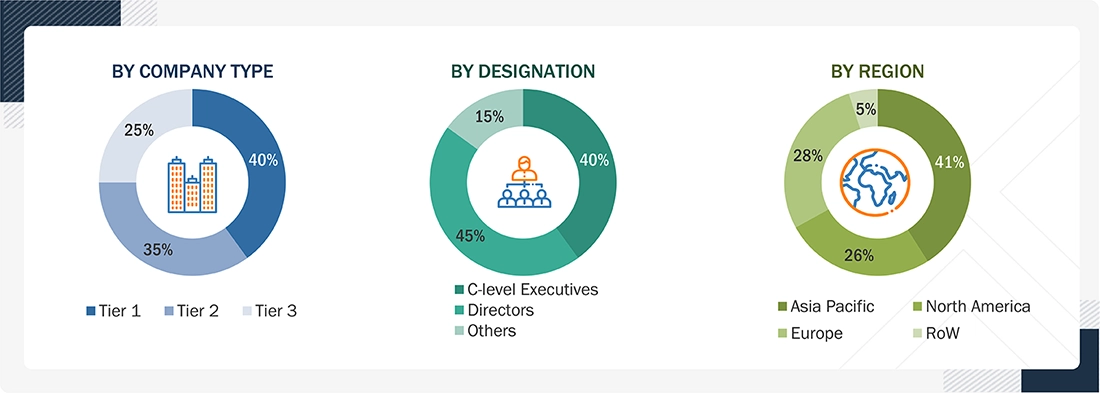
Notes: Tier 1 companies include market players with revenues above USD 500 million; tier 2 companies earn revenues between USD 100 million and USD 500 million; and tier 3 companies earn revenues up to USD 100 million.
To know about the assumptions considered for the study, download the pdf brochure
Market Size Estimation
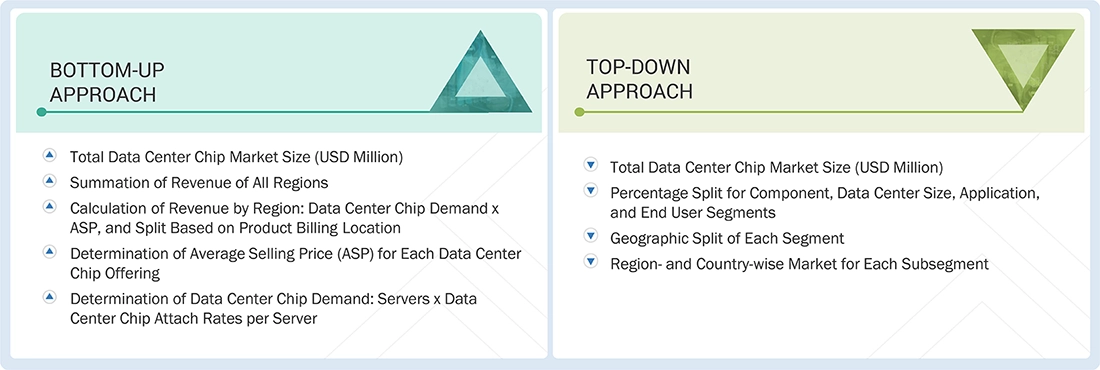
In the comprehensive market estimation process, both top-down and bottom-up approaches were employed, along with several data triangulation methods, to estimate and forecast the size of the market and its segments and subsegments listed in the report. Extensive qualitative and quantitative analyses have been conducted on the entire market engineering process to identify key information and insights related to the data center chip market.
Key players in the data center chip market were identified through secondary research, and their rankings in each region have been determined through both primary and secondary research. This process involved analyzing the annual and financial reports of leading companies and conducting interviews with industry experts such as chief executive officers, vice presidents, directors, and marketing executives to gather both quantitative and qualitative insights. All percentage shares, splits, and breakdowns were established using secondary sources and verified through primary sources. Every parameter influencing the markets covered in this study was thoroughly examined, verified through primary research, and analyzed to produce the final quantitative and qualitative data. This information was consolidated and enhanced with detailed inputs from MarketsandMarkets and presented in this report.
DATA CENTER CHIP MARKET - BOTTOM-UP AND TOP-DOWN APPROACHES
Data Triangulation
After estimating the overall market size as described above, the market has been divided into several segments and subsegments. To finalize the market engineering process and obtain precise statistics for all segments and subsegments, market breakdown and data triangulation methods have been used where applicable. Data has been triangulated by examining various factors and trends from both the demand and supply sides. Additionally, the market size has been validated using both top-down and bottom-up approaches.
Market Definition
A data center is a centralized facility that houses computing, storage, and networking equipment, along with the necessary infrastructure for managing and processing large volumes of data, supporting organizations' IT needs. The data center chip market encompasses a wide range of components and technologies aimed at optimizing, managing, and improving the efficiency, reliability, and security of data centers.
Key Stakeholders
- Government and financial institutions and investment communities
- Analysts and strategic business planners
- Semiconductor product designers and fabricators
- Application providers
- AI solution providers
- AI platform providers
- Business providers
- Professional service/solution providers
- Research organizations
- Technology standard organizations, forums, alliances, and associations
- Technology investors.
Report Objectives
- To define, describe, and forecast the data center chip market size, in terms of value and volume, by component, application, data center size, end user, and region
- To describe and forecast the market size across four key regions, namely, North America, Europe, Asia Pacific, and the Rest of the World (RoW), along with their respective country-level market size, in terms of value
- To provide detailed information regarding the drivers, restraints, opportunities, and challenges in the data center chip market
- To strategically analyze micromarkets concerning the individual growth trends, prospects, and their contribution to the data center chip market
- To map competitive intelligence based on company profiles, key player strategies, and key developments
- To analyze trends/disruptions impacting customer business; interconnected markets and cross-sector opportunities; strategic moves by tier-1/2/3 players; pricing analysis; patents analysis; trade analysis (export and import scenario); Porter's Five Forces analysis; macroeconomic indicators; case studies; investment and funding scenario; decision-making process; buyer stakeholders and buying evaluation criteria; adoption barriers & internal challenges; unmet needs from various industries; technology analysis; technology roadmap; ecosystem analysis; regional regulations and compliance; impact of 2025 US tariff; and key conferences and events related to the data center chip market.
- To benchmark market players using the proprietary Company Evaluation Matrix framework, which analyzes them on various parameters within the broad categories of market ranking/share and product portfolio
- To analyze competitive developments such as contracts, acquisitions, product launches & developments, collaborations, and partnerships, along with research & development (R&D), in the data center chip market.
Available customizations:
With the given market data, MarketsandMarkets offers customizations according to the company’s specific needs. The following customization options are available for the report:
COMPANY INFORMATION
- Detailed analysis and profiling of additional market players (up to 7)
Get the Full Data Center Chip Market Report
Full forecast, segment splits, and company analysis for all Data Center Chip Market.
- US Data Center Chip Market
- Canada Data Center Chip Market
- Mexico Data Center Chip Market
- Germany Data Center Chip Market
- UK Data Center Chip Market
- France Data Center Chip Market
- Rest Of Europe Data Center Chip Market
- China Data Center Chip Market
- India Data Center Chip Market
- Rest Of Asia Pacific Data Center Chip Market
- GCC Countries Data Center Chip Market
Need a Tailored Report?
Customize this report to your needs
Get 10% FREE Customization
Customize This Report
