
AUSTRALIA Data Center Liquid Cooling Fluids Market (2025-2030)

The AUSTRALIA Data Center Liquid Cooling Fluids Market was valued at $389 Million in 2025 and projected to reach to $2276 Million by 2030, representing a compound annual growth rate of 28.7%. Australia's data center liquid cooling fluids market is positioned for exceptional growth driven by increasing computational demands from cloud service providers, financial institutions, and technology companies establishing regional hubs.


| Market Size in | USD 26.32 MN |
| Market Forecast in | |
| CAGR | |
| Forecast Period | |
| Units Considered | Value (USD MN) |
AUSTRALIA Data Center Liquid Cooling Fluids Market Trends and Insights
- This exceptional growth trajectory reflects Australia's increasing investment in advanced data center infrastructure to support cloud computing, artificial intelligence, and digital transformation initiatives.
- Australia's strategic position in the Asia Pacific region and rising demand for energy-efficient cooling solutions are driving adoption of liquid cooling technologies among hyperscalers and enterprise data center operators. The Australian market is characterized by heightened competition and technological innovation as major cooling fluid manufacturers expand their regional presence.
- Australia's commitment to sustainability and carbon neutrality targets is accelerating the transition from traditional air cooling to liquid cooling systems, which offer superior thermal efficiency and reduced energy consumption.
- Between 2025 and 2030, Australia is expected to witness significant capital investments in next-generation data center facilities, particularly in major metropolitan areas, further propelling demand for specialized liquid cooling fluids..
Key Market Statistics
- CAGR (2025-2030) 28.7% CAGR
- Market Size, 2025 ~USD 389 Million
- Forecast, 2030 ~USD 2276 Million
- Country AUSTRALIA
AUSTRALIA Data Center Liquid Cooling Fluids Market Overview
Explosive Growth Trajectory :
Australia's data center liquid cooling fluids market is projected to grow from USD 389.0 million in 2025 to USD 2,276.0 million by 2030, representing a robust 28.7% CAGR, outpacing many developed markets in the Asia-Pacific region.
Cloud & AI Infrastructure Expansion :
Rapid adoption of cloud computing, artificial intelligence, and digital transformation initiatives across Australian enterprises is driving unprecedented demand for advanced thermal management solutions in data center operations.
Strategic Infrastructure Investment :
Australia's government and private sector are significantly investing in next-generation data center infrastructure to support regional digital economy growth and reduce reliance on offshore computing resources.
Competitive Global Position :
Australia's 28.7% CAGR demonstrates strong market momentum, though slightly below the global average of 32.7%, indicating localized growth opportunities and potential for market consolidation among key players.
AUSTRALIA Data Center Liquid Cooling Fluids Market Dynamics
- The shift toward energy-efficient cooling solutions and sustainability mandates is accelerating adoption of advanced liquid cooling technologies across major metropolitan data centers in Sydney, Melbourne, and Brisbane. The forecast period through 2030 will witness intensified competition among cooling fluid manufacturers and system integrators targeting Australian data center operators.
- Strategic partnerships with local infrastructure providers, combined with investments in R&D for environmentally-friendly cooling solutions, will be critical for capturing market share in this high-growth segment..
Market Ecosystem
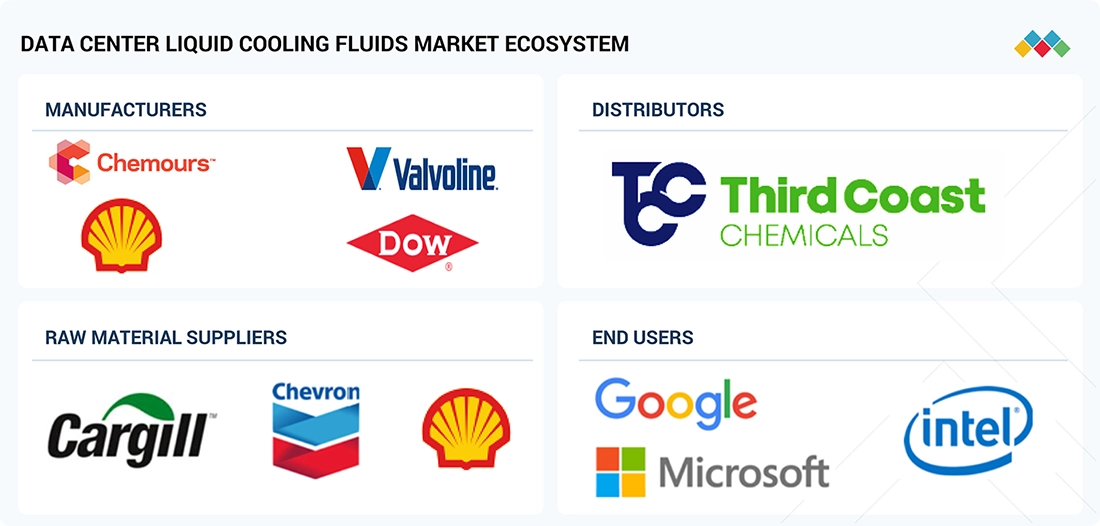
DATA CENTER LIQUID COOLING FLUIDS MARKET: COMMERCIAL USE CASES ACROSS INDUSTRIES
| COMPANY | USE CASE DESCRIPTION | BENEFITS |
|---|---|---|
 |
The company creates and delivers advanced liquid cooling fluids which function as thermal management solutions for high-density data center environments and support direct-to-chip and immersion cooling methods. | The system gains four advantages from its ability to effectively release heat. Higher computing capacities become possible because the system enables data centers to achieve better energy efficiency and operational reliability. |
 |
The company produces specialized dielectric fluids which serve immersion cooling and advanced liquid cooling systems used in data centers to achieve safe and efficient thermal management. | The system delivers electrical insulation which enables effective heat dissipation while decreasing the chances of equipment breakdown and maintaining consistent operation under high-power computing conditions. |
 |
The company develops engineered cooling fluids and materials which function with data center liquid cooling systems while their design focuses on thermal performance and material protection. | The invention enhances thermal efficiency while it boosts fluid-material compatibility and it decreases the risk of corrosion and it extends the operational life of cooling systems and electronic components. |
 |
Produces liquid cooler fluids for the purpose of handling heat in data centres with the equivalent increasingly rising power densities and ongoing operational requirements. | The system provides efficient thermal management which maintains constant cooling performance and increases equipment reliability while enabling data center infrastructure to operate without interruptions. |
 |
The company provides synthetic fluids and specialty fluids which are specifically formulated for data center cooling systems that use immersion and single-phase cooling technologies. | The system provides consistent thermal performance while enabling high-temperature operation which decreases maintenance needs and increases the cooling systems' long operational life. |
Logos and trademarks shown above are the property of their respective owners. Their use here is for informational and illustrative purposes only.
Related Ecosystem
Bulk Chemicals And Inorganics
- Corrosion Inhibitors
- Glycol Ethers
- Acetic Acid
- Acetone
- Ammonium Nitrate
- Basf se
- DOW CHEMICAL COMPANY
- Exxon Mobil Corporation
- AZELIS HOLDINGS SA
- Sinopec limited
Infrastructure Material
- Alumina Ceramics
- Ceramic Coatings
- Monolithic Ceramics
- Polyphenylene Sulfide (PPS)
- Titanate Ceramics
- Saint-gobain
- Simpson Manufacturing Co., Inc.
- Sika ag
- DOW CHEMICAL COMPANY
- Basf se
Speciality Chemicals
- Corrosion Inhibitors
- Polyetheretherketone (PEEK)
- Acrylonitrile Butadiene Styrene (ABS)
- Epoxy Resin
- Polycarbonate
- Basf se
- DOW CHEMICAL COMPANY
- Evonik industries ag
- Clariant ag.
- Solvay sa
Key Takeaways
- Australia's data center liquid cooling fluids market will grow from USD 389.0M (2025) to USD 2,276.0M (2030), representing a 28.7% CAGR.
- Australia's hyperscale data center expansion and AI infrastructure investments are primary drivers of liquid cooling fluid adoption.
- Australia's sustainability regulations and energy efficiency mandates are accelerating the shift from air cooling to advanced liquid cooling technologies.
- Australia's competitive landscape is intensifying as global and regional cooling fluid manufacturers establish local operations to capture market share.
Data Center Liquid Cooling Fluids Market Report Scope
| Report Metric | Details |
|---|---|
| Base Year | 2025 |
| Fastest Growing Segment | SYNTHETIC HYDROCARBONS (Fluid Type) |
| Forecast Period | 2025–2030 |
| Growth Rate | CAGR of 32.7% from 2025 to 2030 |
| Largest Segment | SYNTHETIC HYDROCARBONS (Fluid Types) |
| Market Size Base Year (Billions) | ~USD 0.28 (2025) |
| Revenue Forecast (Billions) | ~USD 1.14 (2030) |
| Segments Covered | Fluid Type, Fluid Types |
AUSTRALIA Data Center Liquid Cooling Fluids Market Report Segmentation
2 segment dimensions are covered across the global market.
By Fluid Type
- Fluorocarbon-Based Fluids
- Other Fluid Types
- Synthetic Hydrocarbons
- Water Glycol Mixture
By Fluid Types
- Fluorocarbon-Based Fluids
- Other Fluid Types
- Synthetic Hydrocarbons
- Water Glycol Mixture
Target Audience
- Data Center Operators & Facility Managers : Need detailed market insights to evaluate cooling fluid investments, optimize thermal management strategies, and benchmark operational costs against industry standards in Australia's competitive data center market.
- Cooling Fluid Manufacturers & Suppliers : Require comprehensive market data to identify growth opportunities, assess competitive positioning, and develop targeted product strategies for the rapidly expanding Australian data center segment.
- Cloud Service Providers & Tech Companies : Seek market intelligence to inform infrastructure expansion decisions, cooling technology investments, and supplier selection for new data center facilities across Australia's major metropolitan regions.
- Investment & Private Equity Firms : Need validated market forecasts and growth metrics to evaluate investment opportunities in Australian data center infrastructure, cooling technology companies, and related service providers.
- System Integrators & Engineering Consultants : Require Australia-specific market data to advise clients on cooling solution selection, forecast demand for thermal management services, and develop competitive proposals for data center projects.
Key Companies in the AUSTRALIA Data Center Liquid Cooling Fluids Market
| Company | HQ | Ownership | Strongest segments |
|---|---|---|---|
| SHELL PLC | United Kingdom | Public Company | Integrated Gas (LNG and GTL),Upstream (oil, gas, NGLs),Marketing (mobility, lubricants, commercial fuels), |
| THE CHEMOURS COMPANY | United States | Public Company | Titanium Technologies (Ti-Pure TiO2 pigments),Thermal & Specialized Solutions (Freon, Opteon, blowing agents, solvents),Advanced Performance Materials (Teflon, Viton, Krytox, Nafion and related), |
| DOW INC. | United States | Public Company | Packaging & Specialty Plastics,Industrial Intermediates & Infrastructure,Performance Materials & Coatings, |
| EXXON MOBIL CORPORATION | United States | Public Company | Upstream (crude oil and natural gas),Energy Products (fuels, aromatics, catalysts, licensing),Chemical Products (olefins, polyolefins, intermediates), |
| LUBRIZOL | United States | Private Company | Lubricant Additives (engine oil, driveline, industrial),Fuel Additives and Transportation Fluids,Specialty Polymers, CPVC, and Engineered Materials, |
| FUCHS SE | Germany | Public Company | Automotive lubricants and service fluids,Industrial oils and hydraulic fluids,Lubricating greases, |
| CARGILL, INCORPORATED | United States | Private Company | Grains and Oilseeds Origination, Trading, and Processing,Animal Nutrition and Feed (including Aquaculture),Food and Beverage Products, Meat and Poultry, |
| ENEOS CORPORATION | Japan | Public Company | Petroleum product refining and sales,Petrochemicals and functional materials,Lubricants, |
| TOTALENERGIES | France | Public Company | Crude oil and natural gas production,Refined products and petrochemicals,Gas, LNG, and gas-to-power, |
SHELL PLC
Shell PLC is a British multinational energy company founded in 1897 that operates globally in oil, gas, and renewable energy sectors. With 84,000 employees, it is one of the world's largest publicly traded energy corporations.
THE CHEMOURS COMPANY
The Chemours Company is a U.S.-based public company established in 2014 that specializes in chemical manufacturing and materials science. The company employs 5,700 people and operates across various industrial and consumer markets.
DOW INC.
Dow Inc. is a U.S.-based public chemical company founded in 1897 with 32,800 employees that produces materials, chemicals, and plastics for industrial and consumer applications. The company operates globally across multiple sectors including packaging, infrastructure, and specialty products.
EXXON MOBIL CORPORATION
ExxonMobil Corporation is an American multinational energy company founded in 1870 with 57,900 employees that engages in oil and gas exploration, production, refining, and marketing. As a publicly traded corporation, it is one of the world's largest energy companies.
LUBRIZOL
Lubrizol is a U.S.-based private company founded in 1928 with 7,000 employees that specializes in manufacturing additives and specialty chemicals for lubricants and fuels. The company serves automotive, industrial, and transportation markets globally.
FUCHS SE
Fuchs SE is a German public company founded in 1931 with 6,857 employees that specializes in manufacturing lubricants and related specialty chemicals. The company serves automotive, industrial, and manufacturing sectors worldwide.
CARGILL, INCORPORATED
Cargill, Incorporated is an American private company founded in 1865 with 155,000 employees that operates as a global leader in agriculture, food production, and commodity trading. The company provides products and services across animal nutrition, crop inputs, and food ingredients.
ENEOS CORPORATION
ENEOS Corporation is a Japanese public company founded in 1888 with 34,099 employees that operates in petroleum refining, marketing, and energy distribution. The company is a major energy supplier in Japan and the Asia-Pacific region.
TOTALENERGIES
TotalEnergies is a French multinational public company founded in 1924 with 94,847 employees that operates in oil, gas, renewable energy, and electricity generation. The company is one of the world's largest integrated energy producers and a leader in the energy transition.
Reasons to Buy this Report
- Market Size & Growth Validation : Obtain precise market valuation for Australia (USD 389M in 2025) with verified 28.7% CAGR through 2030, enabling accurate financial forecasting and investment decision-making for regional expansion strategies.
- Competitive Landscape Intelligence : Identify key market players, their positioning, and competitive dynamics specific to Australia's data center sector, allowing strategic differentiation and targeted go-to-market approaches for cooling fluid solutions.
- Regional Growth Driver Analysis : Understand Australia-specific catalysts including cloud adoption rates, AI infrastructure investments, and digital transformation initiatives that are uniquely driving demand for advanced liquid cooling technologies.
- Investment & Partnership Opportunities : Discover high-potential segments, emerging data center hubs, and partnership opportunities with Australian infrastructure operators, cloud providers, and technology companies seeking cooling solutions.
- Risk Mitigation & Regulatory Insights : Access Australia-specific regulatory requirements, sustainability mandates, and environmental compliance standards affecting cooling fluid selection and market entry strategies for new competitors.
Frequently asked questions
What is the current market size of data center liquid cooling fluids in Australia?
Australia's data center liquid cooling fluids market was valued at USD 389.0 million in 2025 and is projected to grow to USD 2,276.0 million by 2030.
What is the expected growth rate for Australia's liquid cooling fluids market?
Australia's market is expected to grow at a compound annual growth rate (CAGR) of 28.7% from 2025 to 2030.
What factors are driving growth in Australia's data center cooling market?
Key drivers include Australia's expanding hyperscale data center infrastructure, increasing AI and cloud computing adoption, sustainability mandates, and energy efficiency requirements.
Which types of liquid cooling fluids are most in demand in Australia?
Australia's market demand is concentrated in dielectric fluids, synthetic coolants, and environmentally compliant cooling solutions designed for high-density data center applications.
How is Australia's regulatory environment affecting the liquid cooling fluids market?
Australia's carbon neutrality targets and environmental regulations are incentivizing data center operators to adopt liquid cooling systems that reduce energy consumption and operational costs.
RESEARCH METHODOLOGY
The research methodology used to estimate the current size of the data center liquid cooling fluids market consisted of four major activities. Extensive secondary research was conducted to obtain detailed information on the market, peer markets, and parent markets. These findings, assumptions, and metrics were verified through primary research with experts from both the demand and supply sides of the Data center liquid cooling fluids value chain. Both top-down and bottom-up approaches were used to estimate the total market size. The market sizes for various segments and subsegments were finalized using full market segmentation and data triangulation.
Secondary Research
The research methodology for estimating and forecasting the data center liquid cooling fluids market begins with gathering data on key vendors' revenues by doing secondary research. The secondary research process involves consulting a range of secondary sources, including Hoover's, Bloomberg Businessweek, Factiva, the World Bank, and industry-specific journals. These secondary sources encompass annual reports, press releases, investor presentations, white papers, certified publications, articles from recognized authors, regulatory notifications, trade directories, and databases. Also, vendor offerings are taken into consideration to inform market segmentation.
Primary Research
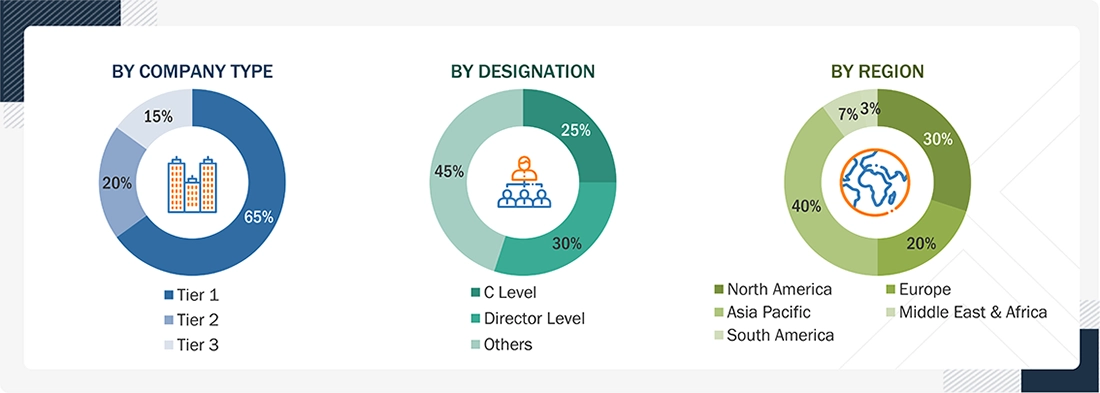
The data center liquid cooling fluids market comprises several stakeholders, including raw material suppliers, processors, end-product manufacturers, and regulatory organizations, throughout the supply chain. The demand side of this market is characterized by the development of various industries, including mobility, power, chemicals, industrial, and grid injection, among others. The supply side is characterized by technological advancements and a wide range of diverse applications. Various primary sources from both the supply and demand sides of the market were interviewed to obtain qualitative and quantitative information. The following is the breakdown of the primary respondents:
To know about the assumptions considered for the study, download the pdf brochure
Market Size Estimation
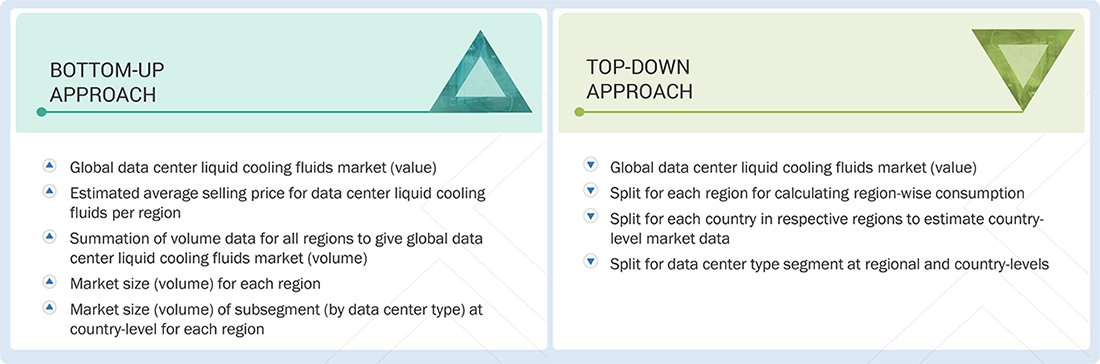
The top-down and bottom-up approaches have been used to estimate and validate the total size of the data center liquid cooling fluids market. These approaches have also been used extensively to estimate the size of various dependent market subsegments. The research methodology used to estimate the market size included the following.
The following segments provide details about the overall market size estimation process employed in this study:
- Extensive primary and secondary research was done to identify the key players.
- The value chain and market size in terms of value of the data center liquid cooling fluids market were determined through primary and secondary research.
- All percentage shares, splits, and breakdowns were collected through secondary sources and verified through primary sources.
- All possible parameters that affect the market were covered in this research study and are viewed in extensive detail, verified through primary research, and analyzed to obtain the final quantitative and qualitative data.
- The study of reports, reviews, and newsletters of top market players, along with extensive interviews for opinions from key leaders, such as CEOs, directors, and marketing executives, is included in this research.
Data Center Liquid Cooling Fluids Market : Top-Down and Bottom-Up Approach
Data Triangulation
After estimating the overall market size using the above estimation process, the market was split into various segments and subsegments. Data triangulation and market segmentation techniques, along with the market engineering process, were employed to obtain precise market analysis data for each segment and its subsegments.
Research Methodology: The research methodology used to estimate and forecast the market size began by aggregating data and information from various levels, including country-level data.
Market Definition
The data center liquid-cooling fluids market is a segment of the data center cooling industry focused on liquid substances that provide thermal management for IT equipment, including servers, processors, and accelerators. These fluids are deployed in cooling architectures that include direct-to-chip, cold plate, immersion, and rear-door heat exchanger systems that use liquid as their primary heat transfer medium, either alone or in combination with air. The market includes multiple fluid categories, including water-based mixtures, engineered coolants, and dielectric fluids that operate under specific thermal and environmental conditions. The need for liquid cooling fluids stems from growing computing density and increasing heat loads, as well as the need for efficiency in hyperscale, colocation, and enterprise data centers. The market includes all aspects of cooling fluid supply, formulation, and application, serving both new data center designs and retrofitted facilities that operate as essential elements of current thermal management systems.
Key Stakeholders
- Data center immersion cooling fluids manufacturers
- Data center immersion cooling fluids suppliers
- Data center immersion cooling fluids traders, distributors, and suppliers
- Investment banks and private equity firms
- Raw material suppliers
- Government and research organizations
- Consulting companies/consultants in the chemicals and materials sectors
- Industry associations
Report Objectives
- To define, describe, and forecast the size of the data center liquid cooling fluids market, in terms of volume and value, based on fluid type, data center type, cooling technology, cooling method, and region
- To provide detailed information regarding the key factors, such as drivers, restraints, opportunities, and industry–specific challenges, influencing the growth of the data center liquid cooling fluids market
- To strategically analyze micromarkets1 with respect to individual growth trends, prospects, and their contribution to the total market
- To analyze opportunities in the market for stakeholders and provide a competitive landscape of the market leaders
- To project the size of the market and its submarkets, in terms of value and volume, with respect to five main regions: North America, Asia Pacific, Europe, South America, and the Middle East & Africa, along with their respective key countries
- To provide ecosystem analysis, case study analysis, value chain, patent analysis, technology analysis, pricing analysis, Porter’s five forces analysis, key stakeholders and buying criteria, investment and funding scenario, trade analysis, impact of AI/Gen AI and 2025 US tariff, key conferences and events, regulatory bodies, government agencies, and regulations pertaining to the market under study
- To strategically profile the key players and comprehensively analyze their core competencies
- To analyze competitive developments such as mergers & acquisitions, product launches, and research & development in the data center liquid cooling fluids market
- To provide the macroeconomic outlook for all regions considered under the study
Available customizations:
Based on the given market data, MarketsandMarkets offers customizations tailored to client-specific needs.
The following customization options are available for the report:
- Additional country-level analysis of the data center liquid cooling fluids market
- Profiling of additional market players (up to 5)
Product Analysis
- Product matrix, which provides a detailed comparison of each company's product portfolio.
Get the Full Data Center Liquid Cooling Fluids Market Report
Full forecast, segment splits, and company analysis for all Data Center Liquid Cooling Fluids Market.
- US Data Center Liquid Cooling Fluids Market
- CANADA Data Center Liquid Cooling Fluids Market
- MEXICO Data Center Liquid Cooling Fluids Market
- UK Data Center Liquid Cooling Fluids Market
- GERMANY Data Center Liquid Cooling Fluids Market
- SPAIN Data Center Liquid Cooling Fluids Market
- FRANCE Data Center Liquid Cooling Fluids Market
- CHINA Data Center Liquid Cooling Fluids Market
- SOUTH KOREA Data Center Liquid Cooling Fluids Market
- JAPAN Data Center Liquid Cooling Fluids Market
- INDIA Data Center Liquid Cooling Fluids Market
- MALAYSIA Data Center Liquid Cooling Fluids Market
- SAUDI ARABIA Data Center Liquid Cooling Fluids Market
- UAE Data Center Liquid Cooling Fluids Market
- SOUTH AFRICA Data Center Liquid Cooling Fluids Market
- BRAZIL Data Center Liquid Cooling Fluids Market
- ARGENTINA Data Center Liquid Cooling Fluids Market
Need a Tailored Report?
Customize this report to your needs
Get 10% FREE Customization
Customize This Report
