
South Korea Data Center Liquid Cooling Market (2026-2031)

The South Korea Data Center Liquid Cooling Market was valued at $33.5 Million in 2026 and projected to reach to $215.2 Million by 2031, representing a compound annual growth rate of 30.4%. South Korea's data center liquid cooling market is positioned for exceptional growth, driven by the country's emergence as a critical regional technology hub and the intensifying thermal management challenges of hyperscale operations.


| Market Size in | USD 26.32 MN |
| Market Forecast in | |
| CAGR | |
| Forecast Period | |
| Units Considered | Value (USD MN) |
South Korea Data Center Liquid Cooling Market Trends and Insights
- This represents a compound annual growth rate of 30.4%, reflecting South Korea's strategic position as a regional technology hub and the escalating thermal management demands of hyperscale data center operations.
- South Korea's advanced semiconductor and cloud infrastructure sectors are driving adoption of liquid cooling solutions to enhance energy efficiency and operational performance. The market growth in South Korea is underpinned by increasing data center investments from major technology companies and the nation's commitment to digital transformation.
- Between 2026 and 2031, South Korea is expected to see substantial capital deployment in cooling infrastructure as operators prioritize sustainability and cost optimization.
- South Korea's competitive advantage in manufacturing and innovation positions it as both a key market and potential supply hub for liquid cooling technologies across the Asia Pacific region..
Key Market Statistics
- CAGR (2026-2031) 30.4% CAGR
- Market Size, 2026 ~USD 33.5 Million
- Forecast, 2031 ~USD 215.2 Million
- Country South Korea
South Korea Data Center Liquid Cooling Market Overview
Explosive Growth Trajectory :
South Korea's data center liquid cooling market is projected to grow from $33.5 million in 2026 to $215.2 million by 2031, representing a 30.4% CAGR, driven by hyperscale data center expansion and AI infrastructure investments.
Regional Technology Hub Status :
As a leading semiconductor and technology manufacturing center, South Korea's strategic position attracts major cloud providers and tech companies requiring advanced thermal management solutions for mission-critical operations.
Hyperscale Data Center Demands :
Escalating thermal management requirements from hyperscale data center operations in South Korea are accelerating liquid cooling adoption, with major operators prioritizing energy efficiency and operational reliability.
Advanced Infrastructure Investment :
South Korea's government and private sector investments in AI, 5G, and cloud computing infrastructure are creating sustained demand for sophisticated liquid cooling technologies to support next-generation data center facilities.
South Korea Data Center Liquid Cooling Market Dynamics
- The 30.4% CAGR reflects strong demand from major cloud service providers, semiconductor manufacturers, and AI infrastructure developers establishing facilities across the country.
- Government initiatives supporting digital transformation and AI development further accelerate market expansion.
- By 2031, the market is expected to reach $215.2 million, establishing South Korea as a significant player in the Asia-Pacific liquid cooling sector.
- Continued investment in data center infrastructure, coupled with rising energy efficiency standards, will sustain robust market growth through the forecast period..
Market Ecosystem
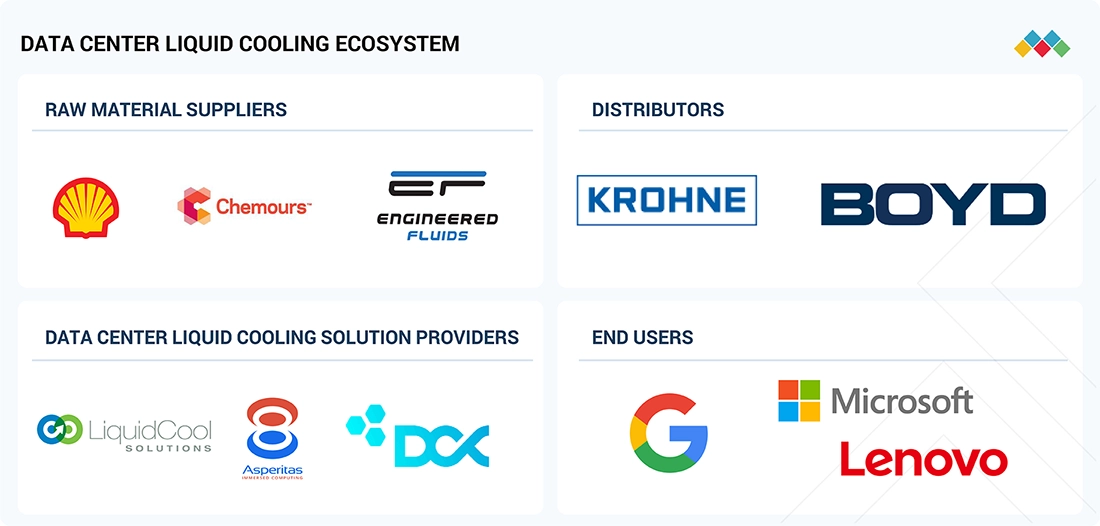
DATA CENTER LIQUID COOLING MARKET: COMMERCIAL USE CASES ACROSS INDUSTRIES
| COMPANY | USE CASE DESCRIPTION | BENEFITS |
|---|---|---|
 |
High-density GPU clusters for GenAI training and inference in hyperscale clouds; Operators deploy immersion or direct-to-chip to pack many GPUs per rack and keep temperatures under control. | Supports much higher rack power (100s of kW) and GPU density; lower footprint and land/space cost per PFLOP |
 |
Liquid cooling of dense CPU/GPU HPC clusters solving simulations (climate, physics, biology) | Enables high sustained FLOPS with lower energy consumption |
 |
Cooling ultra-dense compute and FPGA clusters colocated near exchanges for extremely low latency and 24/7 reliability; Liquid-cooled racks keep temperatures steady under bursty loads. | Reduced failure rates and improved server lifespan |
 |
Liquid cooling for edge data centers and central offices hosting compute for low-latency 5G workloads and network functions | Allows dense compute near cell towers or central offices with smaller site footprints |
 |
Liquid cooling for GPU clusters conducting large-scale simulation, sensor-data training, and digital twins for autonomous systems | High throughput for training AI perception stacks |
Logos and trademarks shown above are the property of their respective owners. Their use here is for informational and illustrative purposes only.
Related Ecosystem
Equipment Machine And Tooling
Speciality Chemicals
Key Takeaways
- South Korea's data center liquid cooling market will grow from $33.5M (2026) to $215.2M (2031), a 30.4% CAGR expansion.
- South Korea's advanced tech ecosystem and hyperscale data center buildout are primary catalysts for liquid cooling adoption.
- South Korea is positioned as both a high-growth market and emerging manufacturing hub for cooling solutions in Asia Pacific.
- Energy efficiency mandates and sustainability initiatives in South Korea are accelerating enterprise adoption of liquid cooling technologies.
Data Center Liquid Cooling Market Report Scope
| Report Metric | Details |
|---|---|
| Base Year | 2026 |
| Fastest Growing Segment | IMMERSION (Cooling Type) |
| Forecast Period | 2026–2031 |
| Growth Rate | CAGR of 31.5% from 2026 to 2031 |
| Largest Segment | DIRECT-TO-CHIP (Cooling Type) |
| Market Size Base Year (Billions) | ~USD 4.07 (2026) |
| Revenue Forecast (Billions) | ~USD 15.99 (2031) |
| Segments Covered | Component, Cooling Type, Data Center Type, End User, Enterprise, Data Center Cooling Type |
South Korea Data Center Liquid Cooling Market Report Segmentation
6 segment dimensions are covered across the global market.
By Component
- Services
- Solutions
By Cooling Type
- Direct-To-Chip
- Immersion
By Data Center Type
- Large
- Large Data Centers
- Small & Mid-Sized
- Small & Mid-Sized Data Centers
By End User
- Colocation Providers
- Enterprises
- Hyperscale Data Centers
By Enterprise
- Bfsi
- Government & Defence
- Government & Defense
- Healthcare
- It & Telecom
- Media & Entertainment
- Other Enterprises
- Research & Academia
- Retail
By Data Center Cooling Type
- Direct-To-Chip Cooling
- Immersion Liquid Cooling
Target Audience
- Data Center Operators & Hyperscalers : South Korean and international data center operators need market intelligence to optimize cooling infrastructure investments, evaluate technology solutions, and plan capacity expansion in this rapidly growing market.
- Liquid Cooling Technology Providers : Equipment manufacturers and solution providers require South Korea-specific market data to identify growth opportunities, assess competitive positioning, and develop localized product strategies for this high-CAGR market.
- Private Equity & Venture Capital : Investment firms targeting South Korea's technology infrastructure sector need detailed market analysis to identify acquisition targets, evaluate portfolio company growth potential, and support exit strategies.
- Government & Policy Makers : South Korean government agencies and policy bodies require market insights to inform infrastructure development initiatives, sustainability standards, and technology roadmaps supporting digital transformation goals.
- Strategic Consultants & Advisors : Management consulting firms and business advisors need South Korea-specific market data to support client strategy development, competitive analysis, and market entry planning in the data center cooling sector.
Key Companies in the South Korea Data Center Liquid Cooling Market
| Company | HQ | Ownership | Strongest segments |
|---|---|---|---|
| PCCW | Hong Kong | Public Company | Fixed and mobile telecom (HKT),Enterprise ICT and managed services,Media and OTT (Viu, TV, advertising), |
| MUNTERS AB | Sweden | Public Company | AirTech (industrial and commercial dehumidification & climate control),Data Center Technologies,FoodTech (farm management and agricultural climate solutions), |
| TELIA COMPANY | Sweden | Public Company | Consumer mobile,Fixed broadband and fiber (consumer and SME),TV and media, |
| THE HCI GROUP | United States | Public Company | Homeowners’ Property and Casualty Insurance,Insurance Technology Platforms (Exzeo, SAMSTM, Harmony, ClaimColony, AtlasViewer),Real Estate and Ancillary Services, |
| PENTAIR PLC | United Kingdom | Public Company | Pool segment (residential and commercial pool equipment and accessories),Flow segment (fluid treatment, pumps, and systems),Water Solutions segment (residential and commercial water treatment), |
| VERTIV GROUP CORP. | United States | Private Company | Integrated power and thermal solutions for data centers,Advanced liquid and immersion-ready thermal subsystems,Racks, enclosures, and IT management platforms, |
| SUPER MICRO COMPUTER, INC. | United States | Public Company | AI and GPU-optimized servers (liquid and air-cooled, PCIe and integrated GPU architectures),Blade, multi-node, and MicroCloud systems (SuperBlade, MicroBlade, FlexTwin, GrandTwin, BigTwin),Storage and rackmount systems (SuperStorage, Hyper, CloudDC, WIO, general rackmount), |
| SCHNEIDER ELECTRIC | France | Public Company | Low- and Medium-Voltage Products and Systems,Building Management, Power Metering, and Critical Power (UPS, Cooling),Industrial Automation and Drives, |
| MODINE MANUFACTURING COMPANY | United States | Public Company | Building HVAC and unit heaters (including makeup air, unit ventilators, modular chillers),Data center and IT cooling solutions,Transportation and powertrain cooling (ICE and electrified), |
| DAIKIN INDUSTRIES, LTD. | Japan | Public Company | Split/Multi-split and Unitary Air Conditioners,VRV, Packaged, Rooftops, and Chillers,Air-to-water Heat Pumps and Heating Systems, |
PCCW
PCCW is a Hong Kong-based public company founded in 1925 with 14,600 employees. The company operates as a major telecommunications and technology services provider in Asia.
MUNTERS AB
Munters AB is a Swedish public company founded in 1955 with 5,153 employees. The company provides air treatment and moisture control solutions for industrial and commercial applications.
TELIA COMPANY
Telia Company is a Swedish public company founded in 1853 with 14,552 employees. The company is a major telecommunications provider serving the Nordic and Baltic regions.
THE HCI GROUP
The HCI Group is a United States-based public company founded in 2006 with 594 employees. The company operates in the insurance and financial services sector.
PENTAIR PLC
Pentair PLC is a United Kingdom-based public company founded in 1966 with 9,000 employees. The company manufactures and distributes water and fluid management solutions globally.
VERTIV GROUP CORP.
Vertiv Group Corp. is a United States-based private company founded in 1965 with 19,000 employees. The company specializes in critical infrastructure and continuity solutions for data centers and communication networks.
SUPER MICRO COMPUTER, INC.
Super Micro Computer, Inc. is a United States-based public company founded in 1993 with 6,238 employees. The company designs and manufactures high-performance server and storage systems.
SCHNEIDER ELECTRIC
Schneider Electric is a France-based public company founded in 1836 with 158,122 employees. The company is a global leader in digital transformation and energy management solutions.
MODINE MANUFACTURING COMPANY
Modine Manufacturing Company is a United States-based public company founded in 1916 with 13,200 employees. The company manufactures thermal management solutions for industrial and automotive applications.
DAIKIN INDUSTRIES, LTD.
Daikin Industries, Ltd. is a Japan-based public company founded in 1924 with 104,095 employees. The company is a global leader in air conditioning, refrigeration, and thermal management solutions.
Reasons to Buy this Report
- Market-Specific Growth Intelligence : Gain detailed insights into South Korea's 30.4% CAGR trajectory and understand the unique drivers propelling the market from $33.5M to $215.2M by 2031, enabling precise investment and expansion strategies.
- Competitive Landscape Analysis : Identify key players, market consolidation trends, and competitive positioning specific to South Korea's liquid cooling ecosystem, helping you benchmark performance and identify partnership opportunities.
- Regional Technology Hub Opportunities : Leverage insights into South Korea's strategic position as a semiconductor and technology center to capitalize on hyperscale data center operator demand and government-backed infrastructure initiatives.
- Thermal Management Solution Demand : Understand specific thermal management requirements of South Korean data center operators, enabling targeted product development and go-to-market strategies aligned with regional operational standards.
- Investment Decision Support : Access comprehensive market sizing, forecast data, and growth drivers to support capital allocation decisions, M&A strategies, and facility expansion planning in South Korea's high-growth market.
Frequently asked questions
What is the current size of South Korea's data center liquid cooling market?
South Korea's data center liquid cooling market is valued at $33.5 million in 2026 and is projected to grow to $215.2 million by 2031.
What is the expected growth rate for South Korea's liquid cooling market?
South Korea's data center liquid cooling market is expected to grow at a compound annual growth rate (CAGR) of 30.4% from 2026 to 2031.
Why is South Korea's liquid cooling market growing faster than global averages?
South Korea's 30.4% CAGR outpaces the global 31.5% rate due to concentrated hyperscale data center investments, advanced semiconductor manufacturing, and strong government support for digital infrastructure and energy efficiency.
What industries are driving liquid cooling adoption in South Korea?
South Korea's semiconductor manufacturing, cloud computing providers, AI infrastructure operators, and financial technology companies are primary drivers of liquid cooling market growth.
How does South Korea's market compare to the Asia Pacific region?
South Korea represents a significant high-growth segment within Asia Pacific, with its 30.4% CAGR and advanced manufacturing capabilities positioning it as a key market and potential supply hub for regional liquid cooling solutions.
RESEARCH METHODOLOGY
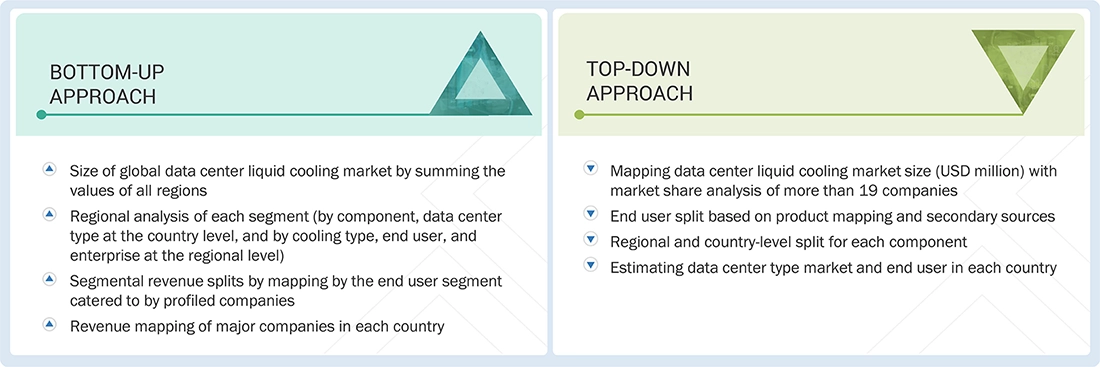
The research entailed four critical steps to assess the present size of the liquid cooling market for data centers. The initial step involved in-depth secondary research to obtain data on the market, allied markets, and the broader parent market. Primary research with industry professionals from the data center liquid cooling supply chain validated these findings and the underlying assumptions and projections. Top-down and bottom-up approaches were both used to arrive at the overall market size. The market was then analyzed, and data triangulation was used to approximate the size of different segments and subsegments.
Secondary Research
This research employed secondary sources like D&B Hoovers, Bloomberg, BusinessWeek, and Dun & Bradstreet to collect and identify the information. These sources consisted of annual reports, press releases, investor presentations, white papers, credible publications, articles by known authors, validated directories, and databases. The secondary data collected was processed to determine the total market size, which was later validated through primary research.
Primary Research
The data center liquid cooling market comprises several stakeholders, such as raw material suppliers, manufacturers, distributors, traders, data center companies, contract manufacturers, and regulatory agencies engaged in the supply chain. A variety of primary sources from both the demand and supply sides were interviewed to collect qualitative and quantitative information for this report. Supply-side information was collected from industry experts such as CEOs, vice presidents, marketing directors, and other significant executives of companies dealing in the liquid cooling industry. The demand side involved interviews with directors, marketing managers, and buying managers from various end-use industries.
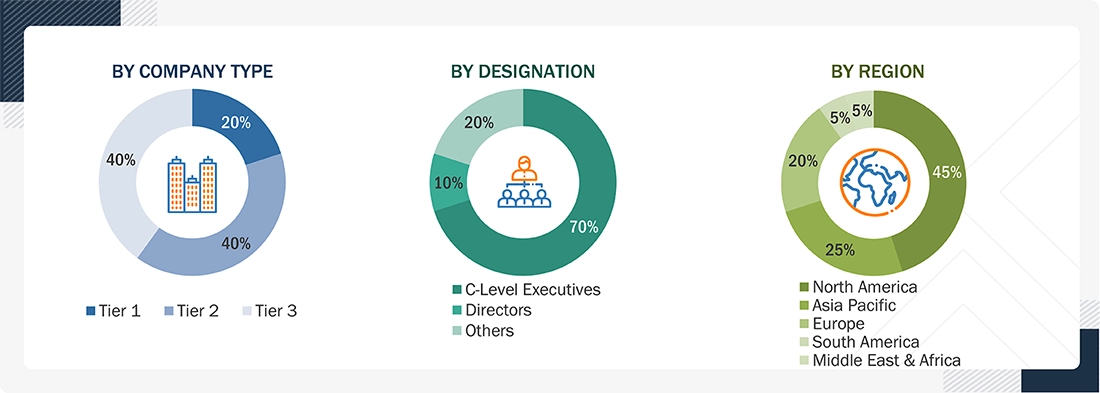
To know about the assumptions considered for the study, download the pdf brochure
Market Size Estimation
The estimation and validation of the overall size of the data center liquid cooling market utilized both top-down and bottom-up methodologies. These approaches were also applied to assess various subsegments within the market. The research process for determining market size involved several steps:
- Key industry players were identified through thorough primary and secondary research.
- The market size and value chain for data center liquid cooling were evaluated using primary and secondary sources.
- All percentage shares, distributions, and breakdowns were derived from secondary data and confirmed through primary research.
- The study accounted for all relevant factors influencing the market, which were examined in detail, validated through primary sources, and analyzed to produce comprehensive quantitative and qualitative insights.
- The research also involved reviewing reports, newsletters, and analyses from leading market participants, supplemented by in-depth interviews with influential figures such as CEOs, directors, and marketing executives.
Data Triangulation
The market was divided into multiple segments and subsegments after determining the total market size through the previously described estimation methods. Data triangulation and breakdown methods were utilized as needed to finalize the market analysis and obtain precise figures for each segment. This triangulation involved examining various demand and supply factors and trends. Furthermore, the market size was confirmed using both the top-down and bottom-up methodologies.
Market Definition
Liquid cooling in data centers utilizes immersion technology, which involves placing servers in tanks filled with non-conductive coolants that effectively absorb heat. This method offers superior cooling compared to traditional air-cooling techniques and addresses the thermal challenges posed by high-density equipment. Various technologies are available in the market, including direct liquid cooling, indirect cooling, immersion cooling, and cold plate cooling, catering to enterprise, colocation, and hyperscale data centers. The growth in power density, the need for enhanced energy efficiency, and the rise of high-performance and edge computing applications are significant drivers of this market, encompassing all hardware and services associated with liquid cooling solutions.
Key Stakeholders
- Data center liquid cooling solution providers
- Government and research organizations
- Organizations and industry consortia like the Swedish Data Center Industry Association, China Communications Standards Association, Dutch Data Center Association, European Data Center Association, and Africa Data Centers Association are examples of critical associations and bodies within the data center industry.
- Research and consulting firms
- R&D institutes
- National and regional agencies
- Investment banks and private equity firms
Report Objectives
- To define, characterize, and project the market size for liquid cooling in data centers, categorized by component, type of data center, cooling method, end user, enterprise, and region
- To provide in-depth insights into the primary factors that impact market growth, such as drivers, restraints, opportunities, and challenges
- To forecast the size of different segments within the data center liquid cooling market across five regions: North America, Asia Pacific, Europe, South America, and the Middle East & Africa, including significant countries within each region
- To identify stakeholders’ opportunities and outline a competitive landscape, highlighting market leaders
- To explore recent trends, including expansions, agreements, new product launches, partnerships, acquisitions, and collaborations in the data center liquid cooling sector
- To strategically profile the key players, thoroughly examining their core strengths and competencies
Available customizations:
MarketsandMarkets offers various customization choices for this market report, such as:
- An in-depth analysis of each company’s product offerings within the data center liquid cooling sector.
- A detailed examination of a specific region’s data center liquid cooling market focused on a particular country.
- Information and profiles of up to five additional market participants.
Get the Full Data Center Liquid Cooling Market Report
Full forecast, segment splits, and company analysis for all Data Center Liquid Cooling Market.
- Rest Of Europe Data Center Liquid Cooling Market
- Rest Of Asia Pacific Data Center Liquid Cooling Market
- Other GCC Countries Data Center Liquid Cooling Market
- Rest Of South America Data Center Liquid Cooling Market
- US Data Center Liquid Cooling Market
- Canada Data Center Liquid Cooling Market
- Mexico Data Center Liquid Cooling Market
- UK Data Center Liquid Cooling Market
- Germany Data Center Liquid Cooling Market
- France Data Center Liquid Cooling Market
- China Data Center Liquid Cooling Market
- Japan Data Center Liquid Cooling Market
- India Data Center Liquid Cooling Market
- Malaysia Data Center Liquid Cooling Market
- Singapore Data Center Liquid Cooling Market
- Australia Data Center Liquid Cooling Market
- Brazil Data Center Liquid Cooling Market
- Saudi Arabia Data Center Liquid Cooling Market
- South Africa Data Center Liquid Cooling Market
Need a Tailored Report?
Customize this report to your needs
Get 10% FREE Customization
Customize This Report
