
North America Deepfake AI Market (2025-2030)

The North America Deepfake AI Market was valued at $289.1 Million in 2025 and projected to reach to $2221.8 Million by 2030, representing a compound annual growth rate of 40.5%. North America's deepfake AI market is poised for exceptional growth through 2030, driven by increasing adoption across entertainment, cybersecurity, and enterprise sectors.


| Market Size in | USD 26.32 MN |
| Market Forecast in | |
| CAGR | |
| Forecast Period | |
| Units Considered | Value (USD MN) |
North America Deepfake AI Market Trends and Insights
- This represents a compound annual growth rate of 40.5%, driven by increasing adoption across media, entertainment, security, and enterprise sectors throughout North America.
- The region's advanced technological infrastructure, significant R&D investment, and regulatory frameworks position North America as a critical hub for deepfake AI innovation and deployment. In North America, the deepfake AI market is being shaped by rising demand for synthetic media creation, authentication technologies, and detection solutions.
- Organizations across North America are investing heavily in both offensive and defensive deepfake capabilities, from content creation to fraud prevention.
- The forecast period through 2030 reflects North America's leadership in AI development and the region's growing recognition of deepfake technology's commercial and security implications. North America's market growth is underpinned by substantial venture capital funding, corporate R&D initiatives, and emerging regulatory clarity.
- As North America continues to refine governance frameworks and industry standards, the deepfake AI market is expected to mature while maintaining strong double-digit growth momentum through 2030..
Key Market Statistics
- CAGR (2025-2030) 40.5% CAGR
- Market Size, 2025 ~USD 289.1 Million
- Forecast, 2030 ~USD 2221.8 Million
- Geography North America
North America Deepfake AI Market Overview
Dominant Market Leader :
The US commands the North American deepfake AI market with $1,785.5 million in 2030 forecast value, representing over 80% of the region's total market share and driving innovation across entertainment, security, and enterprise applications.
Rapid Growth Trajectory :
North America's deepfake AI market is expanding at 40.5% CAGR from 2025 to 2030, outpacing many global regions and reflecting strong investment in synthetic media technologies across Hollywood, financial services, and cybersecurity sectors.
Canada's Emerging Contribution :
Canada represents a significant secondary market with $436.4 million in 2030 forecast value, driven by robust tech infrastructure, government R&D initiatives, and growing adoption in media production and identity verification applications.
Advanced Tech Infrastructure :
North America's leadership in AI research, cloud computing capabilities, and venture capital funding creates an ideal ecosystem for deepfake AI development, deployment, and commercialization across multiple industry verticals.
North America Deepfake AI Market Dynamics
- The region's advanced technological infrastructure, substantial R&D investments, and early-stage regulatory frameworks create a favorable environment for innovation and market expansion.
- Major media studios, financial institutions, and security firms are rapidly integrating deepfake detection and generation technologies into their operations. The market will be shaped by evolving regulatory landscapes, particularly around synthetic media authentication and deepfake detection standards.
- Investment in responsible AI development and ethical frameworks will differentiate market leaders.
- North America's dominance is expected to continue, with the US and Canada leveraging their technological advantages to capture significant market opportunities in content creation, fraud prevention, and identity verification applications..
Market Ecosystem
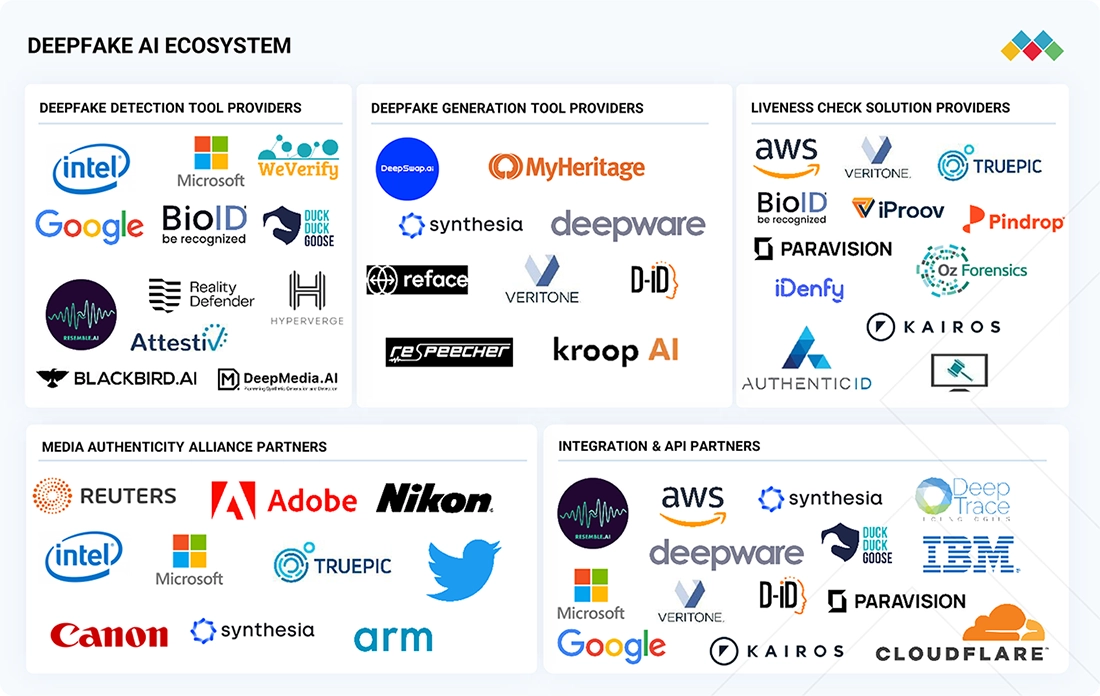
DEEPFAKE AI MARKET: COMMERCIAL USE CASES ACROSS INDUSTRIES
| COMPANY | USE CASE DESCRIPTION | BENEFITS |
|---|---|---|
 |
IPRoyal reduced time to verify new users while building custom-tailored KYC onboarding flow with iDenfy | With iDenfy, IPRoyal successfully onboarded more than 1,200 applicants a month. iDenfy streamlined customer verification for IPRoyal, reducing time by 70% and minimizing fraud. AI-powered biometric verification boosted conversions and customer base growth. |
 |
Insight Global upskilled nurses with Synthesia AI video | 100+ videos generated in 6 months Increased speed in curriculum development Extensive training content |
 |
Safe and cost-effective liveness detection with OZ Forensics for Evocabank | Evocabank attracted more than 40,000 clients from all regions of Armenia in 1 year. The rate of biometric fraud cases last year was 0.5%. No biometric attacks passed the system |
 |
D-ID revolutionized media engagement for Radio Formula | Month-on-month increase in viewership was significant among the younger audience segment, which has stopped consuming news content. Realized that the overall increase in content led to higher demand for employees in supporting positions. |
 |
SentinelOne and NetApp: AI-driven Real-time Malware & Ransomware Detection | Real-time detection and blocking of malware and ransomware threats Autonomous threat containment and recovery Reduced operational overhead and response time Enhanced data resilience and customer trust |
Logos and trademarks shown above are the property of their respective owners. Their use here is for informational and illustrative purposes only.
Related Ecosystem
Analytics
- Natural Language Processing (NLP)
- Machine Learning
- Supply Chain Management
- Predictive Analytics
- Image Sensors
- International Business Machines Corporation
- MICROSOFT CORPORATION
- Oracle Corporation
- SAP SE
Cloud Computing
- Software as A Service (SaaS)
- Natural Language Processing (NLP)
- Platform as A Service (PaaS)
- Machine Learning
- Supply Chain Management
- International Business Machines Corporation
- MICROSOFT CORPORATION
- Oracle Corporation
- Amazon.com, Inc.
Software And Services
- Natural Language Processing (NLP)
- Machine Learning
- Supply Chain Management
- Predictive Analytics
- Image Sensors
- International Business Machines Corporation
- MICROSOFT CORPORATION
- Oracle Corporation
- SAP SE
- Amazon.com, Inc.
Key Takeaways
- North America's deepfake AI market will expand from $289.1M (2025) to $2,221.8M (2030), representing a 40.5% CAGR.
- North America leads global deepfake AI innovation through concentrated venture capital, enterprise adoption, and regulatory development.
- North America's market growth is driven by demand for synthetic media, detection solutions, and authentication technologies across multiple sectors.
- North America's advanced tech infrastructure and R&D ecosystem position the region as the primary driver of deepfake AI commercialization through 2030.
Deepfake AI Market Report Scope
| Report Metric | Details |
|---|---|
| Base Year | 2025 |
| Fastest Growing Segment | SYSTEM INTEGRATION AND IMPLEMENTATION (Professional Service) |
| Forecast Period | 2025-2030 |
| Growth Rate | CAGR of 42.8% from 2025 to 2030 |
| Largest Segment | LARGE ENTERPRISES (Organization Size) |
| Market Size Base Year (Billions) | ~USD 0.86 (2025) |
| Revenue Forecast (Billions) | ~USD 5.09 (2030) |
| Segments Covered | Offering, Software Type, Type, Deployment Mode, Service, Professional Service, Technology, Vertical, Application, Deepfake Generation Software, Deepfake Detection & Authentication Software, Liveness Check Software, Software Deployment Mode, Organization Size, Target User |
North America Deepfake AI Market Report Segmentation
15 segment dimensions are covered across the global market.
By Offering
- Hardware
- Services
- Software
- Software Solutions
- Solutions
By Software Type
- Deepfake Detection & Authentication Software
- Deepfake Generation Software
- Liveness Check Software
By Type
- Biometrics Spoof Detection Tools
- Deepfake Audio & Voice Software
- Deepfake Detection Algorithms
- Deepfake Image & Face Swap Software
- Deepfake Video Editing Software
- Digital Forensics Software
- Liveness Detection Tools
- Media Authentication Tools
By Deployment Mode
- Cloud
- On-Premises
By Service
- Managed Services
- Professional Services
By Professional Service
- Support And Maintenance
- System Integration And Implementation
- Training And Consulting
By Technology
- Autoencoders
- Diffusion Models
- Generative Adversarial Networks (Gans)
- Image Forensics
- Machine And Deep Learning
- Natural Language Processing (Nlp)
- Other Technologies
- Recurrent Neural Networks (Rnns)
- Transformer Models
By Vertical
- Bfsi
- Education
- Government
- Government & Defense
- Government And Defense
- Healthcare
- Healthcare & Life Sciences
- Legal
- Manufacturing
- Media & Entertainment
- Media And Entertainment
- Other Verticals
- Real Estate
- Retail & E-Commerce
- Retail & Ecommerce
- Retail And E-Commerce
- Telecommunications
- Transportation & Utilities
By Application
- Aml & Fraud Detection
- Call Center Security
- Celebrity & Influencer Marketing
- Cgi Character Creation
- Customer Service & Personalization
- Customer Verification & Authentication
- De-Aging Actors
- Digital Content Creation
- Digital Evidence Authentication
- Digital Forensics
- Election Campaigns
- Ethical Hacking & Digital Security
- Finance & Payments
- Fraud Detection
- Government Communications
- Healthcare And Medical Imaging
- Intellectual Property Protection
- Law Enforcement Agencies
- Legal & Ethical Consultation
- Medical Training
- National Security
- News Agencies
- Other Bfsi Applications
- Other Healthcare & Life Sciences Applications
- Other Legal Applications
- Other Retail & E-Commerce Applications
- Other Telecom Applications
- Patient Case Simulations
- Recruitment
- Retail & Marketing
- Security & Access Control
- Security & Fraud Prevention
- Social Media
- Social Media And Content Moderation
- Special Effects & Visual Enhancements
- Telemedicine & Virtual Healthcare
- Visual Merchandising
By Deepfake Generation Software
- Deepfake Audio & Voice Software
- Deepfake Image & Face Swap Software
- Deepfake Video Editing Software
By Deepfake Detection & Authentication Software
- Deepfake Detection Algorithms
- Digital Forensics Software
- Media Authentication Tools
By Liveness Check Software
- Biometric Spoof Detection Tools
- Liveness Detection Tools
By Software Deployment Mode
- Cloud
- On-Premises
By Organization Size
- Large Enterprises
- Smes
By Target User
- Enterprise Grade
- Individual
- Professional
Target Audience
- Entertainment & Media Studios : Major production companies and streaming platforms in North America need market intelligence on deepfake technology adoption, synthetic content creation capabilities, and competitive positioning to enhance content production and protect intellectual property.
- Financial Services & Banking : North American financial institutions require detailed market analysis on deepfake detection solutions, fraud prevention technologies, and regulatory compliance frameworks to protect against identity fraud and synthetic media attacks.
- Cybersecurity & Enterprise Software Vendors : Security solution providers targeting North American enterprises need market sizing, growth forecasts, and sector-specific demand drivers to develop deepfake detection and authentication products for corporate deployments.
- Government & Regulatory Bodies : US and Canadian government agencies, law enforcement, and regulatory bodies need market intelligence on deepfake technology proliferation, emerging threats, and industry trends to inform policy development and enforcement strategies.
- Venture Capital & Private Equity Firms : North American investors and PE firms evaluating deepfake AI startups and technology companies require comprehensive market data, growth projections, and competitive analysis to assess investment opportunities and portfolio company valuations.
Countries within North America - compare and drill down
| Country | 2025 size (native) |
|---|---|
| US | USD 1785.5 Million |
| Canada | USD 436.4 Million |
Country market size visualization
Reasons to Buy this Report
- Country-Level Market Breakdown : Access detailed market sizing for US ($1,785.5M) and Canada ($436.4M) with separate forecasts, enabling precise market targeting and regional investment decisions for North American operations.
- Competitive Landscape Intelligence : Understand market dynamics specific to North America's dominant players in entertainment, cybersecurity, and enterprise sectors with insights into regional competitive positioning and market consolidation trends.
- Sector-Specific Growth Drivers : Identify high-growth applications across North American media production, financial services fraud prevention, identity verification, and security sectors with quantified opportunity assessments.
- Regulatory & Compliance Insights : Navigate North America's evolving regulatory environment with analysis of US federal guidelines, state-level regulations, and Canadian frameworks governing deepfake technology development and deployment.
- Investment & Expansion Strategy : Leverage 40.5% CAGR projections and $2,221.8M 2030 forecast to validate business cases, secure funding, and plan market entry or expansion strategies across the North American deepfake AI ecosystem.
Frequently asked questions
What is the projected size of North America's deepfake AI market by 2030?
North America's deepfake AI market is projected to reach $2,221.8 million by 2030, growing from $289.1 million in 2025.
What is the CAGR for North America's deepfake AI market?
North America's deepfake AI market is expected to grow at a compound annual growth rate of 40.5% between 2025 and 2030.
Which sectors are driving deepfake AI adoption in North America?
North America's deepfake AI adoption is driven by media and entertainment, cybersecurity, financial services, and enterprise authentication sectors.
Why is North America a leader in the deepfake AI market?
North America leads due to its advanced technological infrastructure, substantial venture capital investment, established AI research ecosystem, and emerging regulatory frameworks.
What factors will influence North America's deepfake AI market growth through 2030?
North America's growth will be influenced by regulatory developments, enterprise security investments, synthetic media demand, detection technology advancement, and ethical AI governance initiatives.
RESEARCH METHODOLOGY
The research methodology for the global deepfake AI market report involved the use of extensive secondary sources and directories, as well as various reputed open-source databases, to identify and collect useful information for this technical and market-oriented study. In-depth interviews were conducted with various primary respondents, including deepfake AI software providers, deepfake AI service providers, iPaaS providers, data virtualization tool vendors, and enterprise end users; high-level executives of multiple companies offering deepfake AI solutions; and industry consultants to obtain and verify critical qualitative and quantitative information and assess the market prospects and industry trends.
Secondary Research
In the secondary research process, various secondary sources were referred to for identifying and collecting information for the study. The secondary sources included annual reports; press releases and investor presentations of companies; white papers, certified publications such as Elsevier Journal of Information Security and Applications, ACM Transactions on Multimedia Computing, Communications, and Applications, Springer Artificial Intelligence Review, Nature Machine Intelligence, Pattern Recognition Letters (Elsevier), Neural Networks (Elsevier), Computer Vision and Image Understanding (Elsevier), Journal of Visual Communication and Image Representation (Elsevier), Multimedia Tools and Applications (Springer); and articles from recognized associations and government publishing sources including but not limited to National Institute of Standards and Technology (NIST), European Commission Joint Research Centre (JRC), US Department of Homeland Security (DHS), Federal Trade Commission (FTC), OECD Directorate for Science, Technology and Innovation, MITRE Corporation, Interpol Innovation Centre, United Nations Interregional Crime and Justice Research Institute (UNICRI), World Economic Forum (WEF), UK Department for Science, Innovation and Technology (DSIT), and the Cybersecurity and Infrastructure Security Agency (CISA).
The secondary research was used to obtain key information about the industry’s value chain, the market’s monetary chain, the overall pool of key players, market classification and segmentation according to industry trends to the bottom-most level, regional markets, and key developments from the market and technology-oriented perspectives.
Primary Research
In the primary research process, a diverse range of stakeholders from both the supply and demand sides of the deepfake AI ecosystem were interviewed to gather qualitative and quantitative insights specific to this market. From the supply side, key industry experts, such as chief executive officers (CEOs), vice presidents (VPs), marketing directors, technology & innovation directors, as well as technical leads from vendors offering deepfake AI software & services, were consulted. Additionally, system integrators, service providers, and IT service firms that implement and support deepfake AI were included in the study. On the demand side, input from IT decision-makers, infrastructure managers, and business heads of prominent enterprise end users was collected to understand the user perspectives and adoption challenges within targeted industries.
The primary research ensured that all crucial parameters affecting the deepfake AI market—from technological advancements and evolving use cases (election campaign management, AML & fraud detection, government communications, IP protection etc.) to regulatory and compliance needs (EU Digital Services Act, EU AI Act, US DEEPFAKES Accountability Act, California AB 730 and AB 602, China’s Deep Synthesis Provisions, etc.) were considered. Each factor was thoroughly analyzed, verified through primary research, and evaluated to obtain precise quantitative and qualitative data for this market.
Once the initial phase of market engineering was completed, including detailed calculations for market statistics, segment-specific growth forecasts, and data triangulation, an additional round of primary research was undertaken. This step was crucial for refining and validating critical data points, such as deepfake AI offerings (software & services), industry adoption trends, the competitive landscape, and key market dynamics like demand drivers (adoption of multi-modal detection combining audiovisual and metadata signals, cloud-based deepfake generation APIs democratizing access for small studios, integration of deepfake pipelines in real-time content production workflows, collaboration between social platforms and detection vendors for automated moderation), challenges (incentivizing platforms to adopt uniform deepfake moderation standards, continuous adversarial evolution making detection perpetually reactive), and opportunities (federated deepfake detection networks for multi-platform content policing, joint ventures between insurers and detection firms for synthetic risk products, IP clearinghouses for automated licensing and royalty management of digital likeness).
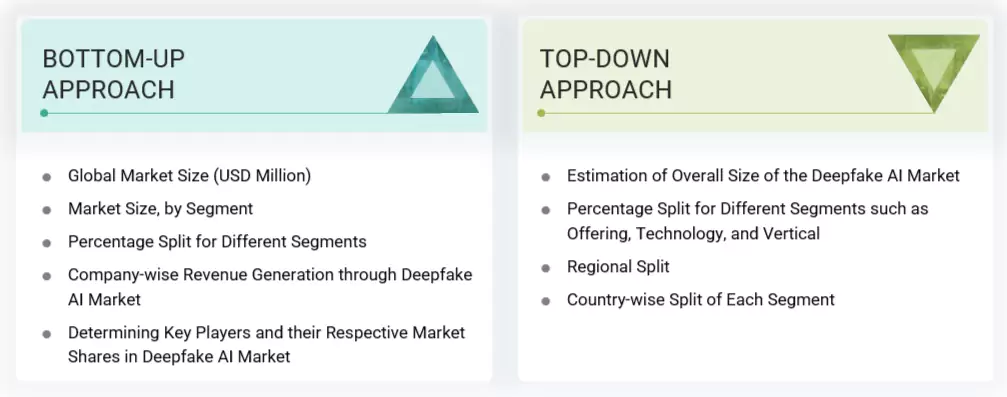
In the complete market engineering process, the top-down and bottom-up approaches and several data triangulation methods were extensively used to perform the market estimation and market forecast for the overall market segments and subsegments listed in this report. Extensive qualitative and quantitative analysis was performed on the complete market engineering process to record the critical information/insights throughout the report.
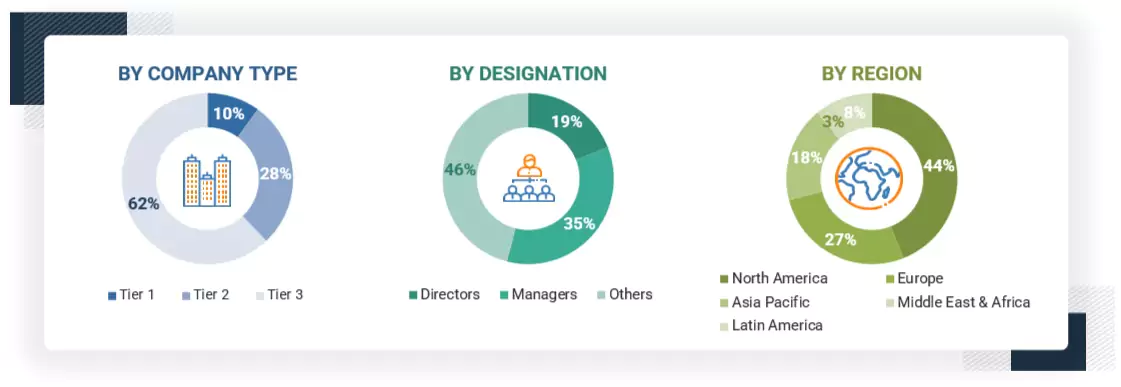
Note: Three tiers of companies are defined based on their total revenue as of 2024; tier 1 = revenue more
than USD 500 million, tier 2 = revenue between USD 500 million and 100 million, tier 3 = revenue less than USD 100 million
Source: MarketsandMarkets Analysis
To know about the assumptions considered for the study, download the pdf brochure
Market Size Estimation
To estimate and forecast the deepfake AI market and its dependent submarkets, both top-down and bottom-up approaches were employed. This multi-layered analysis was further reinforced through data triangulation, incorporating both primary and secondary research inputs. The market figures were also validated against the existing MarketsandMarkets repository for accuracy. The following research methodology has been used to estimate the market size:
Deepfake AI Market : Top-Down and Bottom-Up Approach
Data Triangulation
After arriving at the overall market size using the market size estimation processes as explained above, the market was split into several segments and subsegments. To complete the overall market engineering process and arrive at the exact statistics of each market segment and subsegment, data triangulation and market breakup procedures were employed, wherever applicable. The overall market size was then used in the top-down procedure to estimate the size of other individual markets via percentage splits of the market segmentation.
Market Definition
Deepfake AI refers to the application of artificial intelligence techniques to the creation, identification, and validation of synthetic media that closely imitates human appearance, voice, or behavior across audio, video, and image formats. It encompasses three core capabilities:
- First, deepfake AI involves the use of generative models such as GANs, diffusion models, and autoencoders to produce highly realistic fake content, including face swaps, voice clones, and text-to-video avatars.
- Second, it includes detection technologies that analyze media for signs of manipulation, using forensic, biometric, and multimodal algorithms to assess authenticity and flag inauthentic or altered content.
- Third, deepfake AI supports liveness detection and identity verification. Models are trained to confirm whether a real human is present during a biometric interaction and to detect spoofing attempts involving synthetic or replayed media.
Collectively, these technologies serve a range of applications in media integrity, digital identity, fraud prevention, and content moderation, and are increasingly relevant across both enterprise and regulatory contexts.
Stakeholders
- Deepfake AI detection software developers
- Deepfake AI generation software developers
- Liveness check providers
- Business analysts
- Cloud service providers
- Consulting service providers
- Enterprise end users
- Distributors and Value-added Resellers (VARs)
- Government agencies
- Independent Software Vendors (ISVs)
- Managed service providers
- Market research and consulting firms
- Support & maintenance service providers
- System Integrators (SIs)/Migration service providers
- Technology providers
- Academia & research institutions
- Investors & venture capital firms
Report Objectives
- To define, describe, and forecast the deepfake AI market, by offering (software and services), technology, and vertical
- To provide detailed information related to major factors (drivers, restraints, opportunities, and industry-specific challenges) influencing the market growth
- To analyze the micro markets with respect to individual growth trends, prospects, and their contribution to the total market
- To analyze the opportunities in the market for stakeholders by identifying the high-growth segments of the deepfake AI market
- To analyze the opportunities in the market and provide details of the competitive landscape for stakeholders and market leaders
- To forecast the market size of segments for five main regions: North America, Europe, Asia Pacific, the Middle East & Africa, and Latin America
- To profile the key players and comprehensively analyze their market ranking and core competencies
- To analyze competitive developments, such as partnerships, product launches, mergers, and acquisitions, in the deepfake AI market
Available Customizations
With the given market data, MarketsandMarkets offers customizations as per the company’s specific needs. The following customization options are available for the report:
Product Analysis
- Product matrix provides a detailed comparison of the product portfolio of each company
Geographic Analysis as per Feasibility
- Further breakup of the North American market for deepfake AI
- Further breakup of the European market for deepfake AI
- Further breakup of the Asia Pacific market for deepfake AI
- Further breakup of the Middle East & African market for deepfake AI
- Further breakup of the Latin American market for deepfake AI
Company Information
- Detailed analysis and profiling of additional market players (up to five)
Get the Full Deepfake AI Market Report
Full forecast, segment splits, and company analysis for all Deepfake AI Market.
- US Deepfake AI Market
- Canada Deepfake AI Market
- UK Deepfake AI Market
- Germany Deepfake AI Market
- France Deepfake AI Market
- Italy Deepfake AI Market
- Spain Deepfake AI Market
- Netherlands Deepfake AI Market
- China Deepfake AI Market
- India Deepfake AI Market
- Japan Deepfake AI Market
- South Korea Deepfake AI Market
- Singapore Deepfake AI Market
- Saudi Arabia Deepfake AI Market
- UAE Deepfake AI Market
- Turkey Deepfake AI Market
- Brazil Deepfake AI Market
- Mexico Deepfake AI Market
- Argentina Deepfake AI Market
- Rest Of Europe Deepfake AI Market
- Anz Deepfake AI Market
- Rest Of Asia Pacific Deepfake AI Market
- Rest Of Latin America Deepfake AI Market
Need a Tailored Report?
Customize this report to your needs
Get 10% FREE Customization
Customize This Report
