
US Defense Electronics Obsolescence Market (2023-2028)

The US Defense Electronics Obsolescence Market was valued at $1257.7 Million in 2023 and projected to reach to $1964.3 Million by 2028, representing a compound annual growth rate of 9.3%. The US Defense Electronics Obsolescence Market is positioned for robust growth through 2028, with a 9.3% CAGR reflecting the Pentagon's commitment to maintaining aging defense platforms while managing supply chain vulnerabilities.


| Market Size in | USD 26.32 MN |
| Market Forecast in | |
| CAGR | |
| Forecast Period | |
| Units Considered | Value (USD MN) |
US Defense Electronics Obsolescence Market Trends and Insights
- The US market is driven by aging defense platforms, supply chain vulnerabilities, and the critical need for lifecycle management of legacy military systems.
- As the US Department of Defense continues to modernize its fleet while maintaining operational readiness of existing platforms, obsolescence management has become a strategic priority for defense contractors and government agencies alike. The US defense sector faces mounting pressure to address component unavailability and technological obsolescence across aircraft, naval vessels, and ground systems.
- The US market growth outpaces the global average, reflecting heightened investment in obsolescence mitigation strategies, predictive maintenance technologies, and authorized supplier networks.
- Between 2023 and 2028, the US is expected to see accelerated adoption of obsolescence management solutions as defense budgets prioritize sustainment and modernization initiatives. The US market landscape is characterized by increasing collaboration between original equipment manufacturers, defense primes, and specialized obsolescence management firms.
- The US government's emphasis on supply chain resilience and the rising costs of system downtime continue to fuel demand for comprehensive obsolescence solutions across the defense industrial base..
Key Market Statistics
- CAGR (2023-2028) 9.3% CAGR
- Market Size, 2023 ~USD 1257.7 Million
- Forecast, 2028 ~USD 1964.3 Million
- Country US
US Defense Electronics Obsolescence Market Overview
Market Valuation Growth :
The US Defense Electronics Obsolescence Market reached $1,257.7 million in 2023 and is forecast to grow to $1,964.3 million by 2028, driven by sustained defense spending and modernization initiatives.
Aging Military Infrastructure :
US defense platforms are increasingly aging, with legacy systems requiring continuous obsolescence management solutions to maintain operational readiness and extend platform lifecycles.
Supply Chain Resilience :
Recent supply chain disruptions have elevated the priority of obsolescence management within the US Department of Defense, making lifecycle management of military electronics critical to national security.
DoD Modernization Initiatives :
The US Department of Defense's focus on sustaining legacy systems while transitioning to next-generation platforms creates sustained demand for specialized obsolescence solutions and lifecycle support services.
US Defense Electronics Obsolescence Market Dynamics
- The market expansion is underpinned by increased defense budgets, heightened focus on supply chain resilience, and the complexity of managing electronics across multiple legacy military systems.
- As the DoD prioritizes lifecycle management and sustainment of existing platforms, demand for obsolescence solutions, component sourcing, and technical support services will continue to accelerate.
- Strategic investments in domestic manufacturing and supply chain diversification further support market growth in the US..
Market Ecosystem
Related Ecosystem
Key Takeaways
- The US Defense Electronics Obsolescence Market is projected to grow from $1,257.7M in 2023 to $1,964.3M by 2028 at a 9.3% CAGR, outpacing global growth rates.
- The US market is driven by aging defense platforms, supply chain vulnerabilities, and the Department of Defense's focus on lifecycle management and operational readiness.
- The US government's emphasis on supply chain resilience and authorized supplier networks is accelerating adoption of obsolescence management solutions across the defense industrial base.
- The US market landscape features increasing collaboration between OEMs, defense primes, and specialized obsolescence management firms to address component unavailability and technological obsolescence.
Defense Electronics Obsolescence Market Report Scope
| Report Metric | Details |
|---|---|
| Base Year | 2023 |
| Fastest Growing Segment | COMMUNICATIONS (System) |
| Forecast Period | 2023-2028 |
| Growth Rate | CAGR of 8.2% from 2023 to 2028 |
| Largest Segment | AIRBORNE (Platform) |
| Market Size Base Year (Billions) | ~USD 2.49 (2023) |
| Revenue Forecast (Billions) | ~USD 3.7 (2028) |
| Segments Covered | System, Platform |
US Defense Electronics Obsolescence Market Report Segmentation
2 segment dimensions are covered across the global market.
By System
- Communications
- Electronic Warfare
- Flight Control
- Human Machine Interface
- Navigation
- Sensor
- Targeting
By Platform
- Airborne
- Land
- Naval
Target Audience
- Defense Contractors & OEMs : Need detailed US market insights to develop obsolescence management solutions, plan product portfolios, and align offerings with DoD modernization and sustainment requirements.
- Supply Chain & Logistics Providers : Require market data to identify opportunities in component sourcing, inventory management, and supply chain resilience services for US military electronics platforms.
- Government & DoD Procurement Officials : Use market intelligence to inform budget planning, procurement strategies, and lifecycle management policies for aging defense platforms and electronics systems.
- Investment & Private Equity Firms : Seek comprehensive US market analysis to evaluate investment opportunities, assess growth potential, and identify acquisition targets in the defense electronics obsolescence sector.
- Technology & Engineering Consultants : Need market-specific data to advise clients on obsolescence solutions, platform sustainment strategies, and technology roadmaps aligned with US defense sector requirements.
Reasons to Buy this Report
- Strategic Market Sizing : Obtain precise valuation data for the US market ($1,257.7M in 2023) with detailed forecasts through 2028, enabling accurate budget allocation and investment planning for defense electronics solutions.
- DoD Procurement Insights : Understand the specific drivers behind US Department of Defense spending on obsolescence management, including aging platform requirements and supply chain priorities that influence procurement decisions.
- Competitive Landscape Analysis : Identify market opportunities and competitive positioning within the US defense electronics sector, where 9.3% CAGR growth indicates expanding demand for specialized obsolescence solutions.
- Supply Chain Strategy Development : Leverage market intelligence on US supply chain vulnerabilities and resilience initiatives to develop targeted strategies for component sourcing, manufacturing partnerships, and logistics optimization.
- Investment Decision Support : Make informed investment and M&A decisions based on comprehensive US market data, growth trajectories, and emerging opportunities in defense electronics lifecycle management and sustainment services.
Frequently asked questions
What is the current size of the US Defense Electronics Obsolescence Market?
The US Defense Electronics Obsolescence Market was valued at $1,257.7 million in 2023 and is expected to reach $1,964.3 million by 2028.
What is the projected growth rate for the US market through 2028?
The US Defense Electronics Obsolescence Market is projected to grow at a compound annual growth rate of 9.3% from 2023 to 2028.
What are the primary drivers of growth in the US Defense Electronics Obsolescence Market?
Key drivers include aging defense platforms, supply chain vulnerabilities, Department of Defense modernization initiatives, and the critical need for lifecycle management of legacy military systems.
How does the US market compare to global growth trends?
The US market is growing at 9.3% CAGR, which outpaces the global average of 8.2%, reflecting heightened investment in obsolescence mitigation strategies and supply chain resilience.
Which sectors within US defense are most affected by electronics obsolescence?
Aircraft, naval vessels, and ground systems represent the primary sectors where the US defense industrial base faces component unavailability and technological obsolescence challenges.
RESEARCH METHODOLOGY
This research study on the defense electronics obsolescence involves the extensive use of secondary sources, directories, and databases, such as Hoovers, Bloomberg, Crunchbase, BusinessWeek, and Factiva, to identify and collect information relevant to the market. The primary sources considered include industry experts, as well as manufacturers, system providers, technology developers, alliances, and organizations related to all segments of the value chain of this defense electronics industry. In-depth interviews with various primary respondents, including key industry participants, subject-matter experts (SME), industry consultants, and C-level executives, have been conducted to obtain and verify critical qualitative and quantitative information pertaining to the market, as well as to assess its growth prospects.
Secondary Research
The ranking analysis of companies in the defense electronics obsolescence has been determined using secondary data from paid and unpaid sources and analyzing the product/services/solutions portfolios of major companies operating in the market. These companies have been rated based on the performance and diversification of their products. Primary sources further validate these data points.
Secondary sources referred for this research study include financial statements of companies offering defense electronics obsolescence for all respective systems stages, such as human machine interface, targeting systems, electronic warfare system, communications systems, navigation systems, flight control systems and sensors, along with various trade, business, and professional associations. The secondary data has been collected and analysed to arrive at the overall size of the market, which has been validated by primary respondents.
Primary Research
Extensive primary research has been conducted after obtaining information about the current scenario of the defense electronics obsolescence through secondary research. Several primary interviews have been conducted with market experts from the demand and supply sides across five regions, namely, North America, Europe, Asia Pacific, the Middle East. This primary data has been collected through questionnaires, emails, and telephonic interviews.
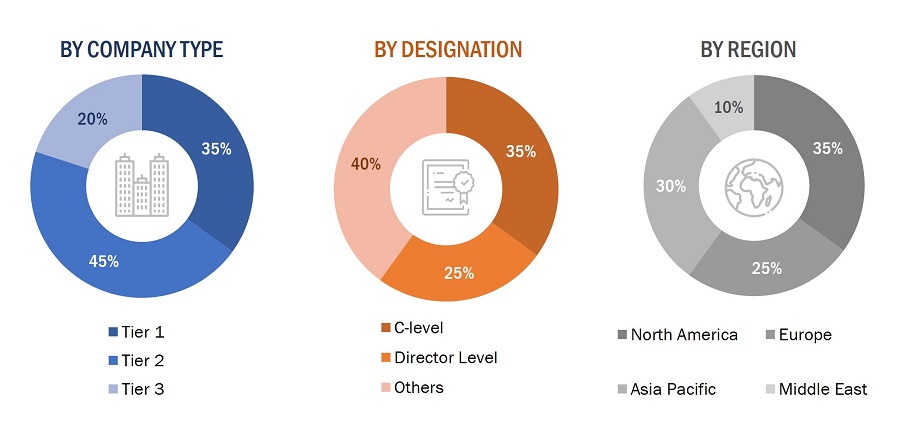
To know about the assumptions considered for the study, download the pdf brochure
Market Size Estimation
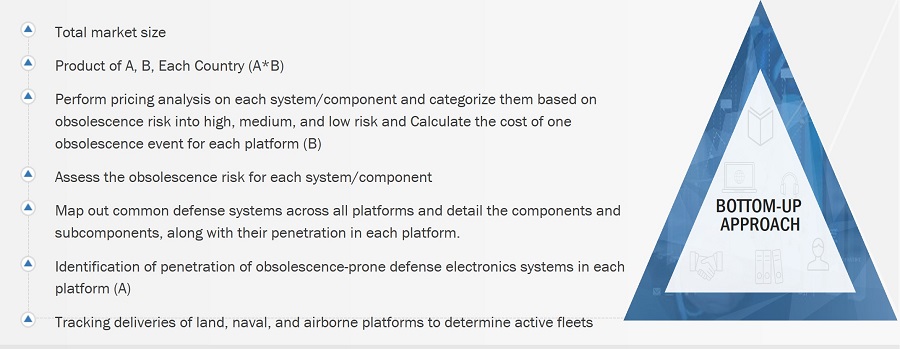
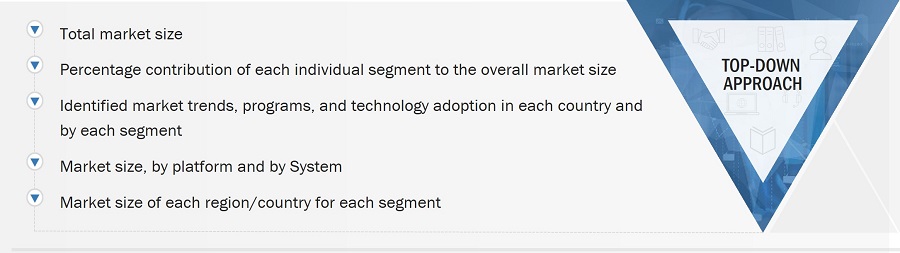
Both the top-down and bottom-up approaches have been used to estimate and validate the size of the market. The research methodology used to estimate the market size also includes the following details:
- Key players have been identified through secondary research, and their market ranking has been determined through primary and secondary research. This includes a study of annual and financial reports of the top market players and extensive interviews of leaders, including CEOs, directors, and marketing executives.
- All percentage splits and trends have been determined using secondary sources and verified through primary sources. All possible parameters that affect the market covered in this research study have been accounted for, viewed in extensive detail, verified through primary research, and analyzed to obtain the final quantitative and qualitative data. This data has been consolidated, enhanced with detailed inputs, analyzed by MarketsandMarkets, and presented in this report.
Market Size Estimation Methodology: Bottom-Up Approach
Market Size Estimation Methodology: Top-Down Approach
Data Triangulation
After arriving at the overall market size, the total market has been split into several segments and subsegments. The data triangulation and market breakdown procedures explained below have been implemented, wherever applicable, to complete the overall market engineering process and arrive at the exact statistics for various market segments and subsegments. The data has been triangulated by studying various factors and trends from both the demand and supply sides. Along with this, the market size has been validated using both the top-down and bottom-up approaches.
Market Definition
?The defense electronics obsolescence market scope includes replacement demand for obsolete electronic components across marine, airborne, and land platforms arising from the long operational life of defense programs but a shorter life span of electronic components. The defense electronics obsolescence market encompasses a wide range of activities, including reverse engineering and retrofitting existing systems with modern components. It also involves collaboration between defense contractors, electronics manufacturers, and research institutions to address the unique challenges faced by the defense sector. Obsolescence in this context pertains to the state where electronic components, technologies, or systems are no longer available, supported, or sustainable due to technological advancements, manufacturing discontinuations, or the unavailability of replacement parts.
STAKEHOLDERS
- Government Authorities
- Regulatory Bodies
- R&D Companies
- Subsystem Manufacturers
- Electronic Component Manufacturers
- Electronic System Providers
- Platform Manufacturers
- Re-engineering Component and Sub-component Providers
- Armed Forces.
Report Objectives
- To define, describe, and forecast the defense electronics obsolescence market based on system, platform, and type from 2023 to 2028
- To forecast the size of various segments of the market with respect to major regions: North America, Europe, Asia Pacific, the Middle East.
- To identify and analyze key drivers, restraints, opportunities, and challenges influencing the growth of the market
- To strategically analyze micromarkets1 with respect to individual growth trends, prospects, and their contribution to the market
- To analyze opportunities for stakeholders in the market by identifying key market trends
- To analyze competitive developments such as contracts, acquisitions, agreements, and product launches in the market
- To provide a detailed competitive landscape of the market, in addition to an analysis of business and corporate strategies adopted by leading market players
- To strategically profile key market players and comprehensively analyze their core competencies.
Available customizations
Along with the market data, MarketsandMarkets offers customizations as per the specific needs of companies. The following customization options are available for the report:
Product Analysis
- Product matrix, which gives a detailed comparison of the product portfolio of each company
Regional Analysis
- Further breakdown of the market segments at country-level
Company Information
- Detailed analysis and profiling of additional market players (up to 5)
Get the Full Defense Electronics Obsolescence Market Report
Full forecast, segment splits, and company analysis for all Defense Electronics Obsolescence Market.
- Canada Defense Electronics Obsolescence Market
- France Defense Electronics Obsolescence Market
- UK Defense Electronics Obsolescence Market
- India Defense Electronics Obsolescence Market
- Australia Defense Electronics Obsolescence Market
- Saudi Arabia Defense Electronics Obsolescence Market
- UAE Defense Electronics Obsolescence Market
Need a Tailored Report?
Customize this report to your needs
Get 10% FREE Customization
Customize This Report
