
US Delivery Robots Market (2025-2030)

The US Delivery Robots Market was valued at $68.8 Million in 2025 and projected to reach to $241.07 Million by 2030, representing a compound annual growth rate of 28.5%. The US delivery robots market is positioned for substantial growth through 2030, fueled by the continued expansion of e-commerce and the urgent need to address logistics workforce challenges.


| Market Size in | USD 26.32 MN |
| Market Forecast in | |
| CAGR | |
| Forecast Period | |
| Units Considered | Value (USD MN) |
US Delivery Robots Market Trends and Insights
- The US market is driven by increasing e-commerce demand, labor shortages in logistics, and technological advancements in autonomous navigation systems.
- The US is witnessing significant adoption across urban and suburban environments, with major retailers and logistics providers deploying autonomous delivery solutions to enhance last-mile efficiency. In the US, regulatory frameworks are evolving to support autonomous delivery operations, creating favorable conditions for market growth through 2030.
- The US market benefits from substantial venture capital investment and partnerships between technology companies and established logistics providers.
- By 2030, the US is expected to capture a significant share of the global delivery robots market, driven by consumer acceptance and infrastructure development supporting autonomous operations..
Key Market Statistics
- CAGR (2025-2030) 28.5% CAGR
- Market Size, 2025 ~USD 68.8 Million
- Forecast, 2030 ~USD 241.07 Million
- Country US
US Delivery Robots Market Overview
Rapid US Market Growth :
The US delivery robots market is expanding at 28.5% CAGR, growing from $68.8 million in 2025 to $241.07 million by 2030, driven by e-commerce acceleration and last-mile logistics transformation.
Urban Adoption Surge :
Major US cities are witnessing accelerated deployment of autonomous delivery robots in urban and suburban environments, with significant adoption from leading retailers and food delivery platforms.
Labor Shortage Solutions :
US logistics companies are increasingly turning to delivery robots to address critical labor shortages in the delivery sector, improving operational efficiency and reducing dependency on human couriers.
Technology Advancement :
Innovations in autonomous navigation systems, AI-powered route optimization, and safety protocols are enabling US companies to deploy delivery robots at scale with improved reliability and compliance.
US Delivery Robots Market Dynamics
- Retailers and delivery platforms are investing heavily in autonomous solutions to enhance last-mile delivery efficiency and reduce operational costs.
- Regulatory frameworks are gradually becoming more favorable, with cities establishing clear guidelines for robot operations in public spaces. Technological improvements in autonomous navigation, battery efficiency, and AI integration will drive wider adoption across diverse geographic regions and use cases.
- The competitive landscape will intensify as both established logistics companies and innovative startups scale their operations.
- By 2030, delivery robots are expected to become a standard component of the US logistics infrastructure, particularly in densely populated urban centers and suburban areas..
Market Ecosystem
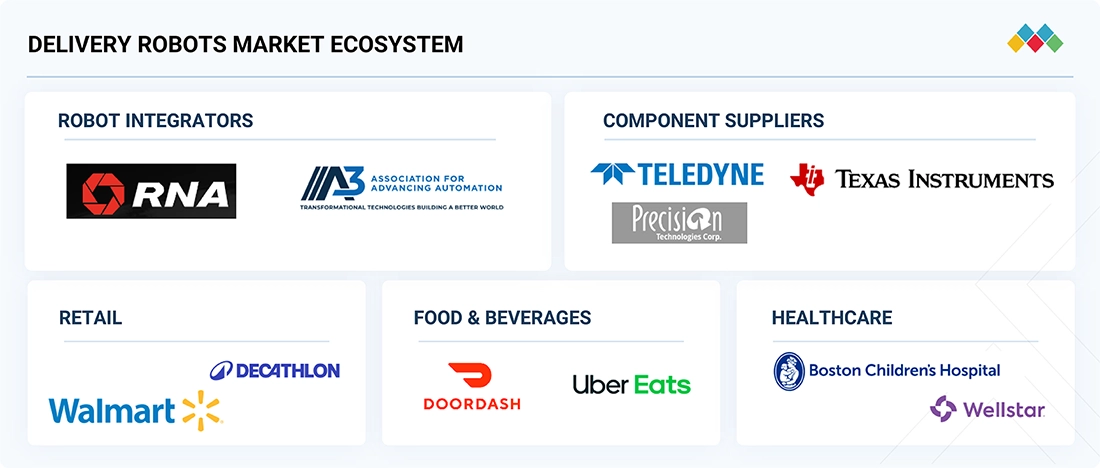
DELIVERY ROBOTS MARKET SIZE, SHARE & GROWTH, 2030: COMMERCIAL USE CASES ACROSS INDUSTRIES
| COMPANY | USE CASE DESCRIPTION | BENEFITS |
|---|---|---|
 |
Autonomous sidewalk delivery in urban and campus environments | Reduces last-mile delivery costs, enables contactless service, operates 24/7 with high safety |
 |
Autonomous local grocery and food delivery using small, driverless vehicles | Expands delivery range, lowers labor dependence, improves delivery speed and customer reach |
 |
Industrial AMRs for warehouse and factory transport of goods | Enhances operational efficiency, reduces labor strain, and supports high load capacity logistics |
Logos and trademarks shown above are the property of their respective owners. Their use here is for informational and illustrative purposes only.
Related Ecosystem
Airport Systems
- Antennas
- Sensors
- Aeronautical Information Management (AIM)
- Digital Signage
- Face Recognition
- SYSTRA LTD.
- Thales group
- HONEYWELL INTERNATIONAL INC.
- Idaho Strategic Resources, Inc.
- Leidos Holdings, Inc.
On Highway Off Highway Vehicles
- Internal Combustion Engine (ICE)
- Agricultural Tractors
- Crawler Excavator
- Battery Electric Vehicle (BEV)
- Excavators
- Visteon Corporation
- Deere & Company
- Honda Motor Co., Ltd.
- AB VOLVO PENTA
- LIEBHERR-INTERNATIONAL AG
Drones And Robotics
- Sensors
- Articulated Robots
- Cartesian Robots
- Scara Robots
- Actuators
- ABB India Limited
- KUKA AG
- MOMENTIVE PERFORMANCE MATERIALS INC.
- Fanuc Corporation
- STAUBLI INTERNATIONAL AG
Key Takeaways
- The US delivery robots market will grow from $68.8M (2025) to $241.07M (2030) at a 28.5% CAGR.
- The US market is driven by e-commerce growth, labor shortages, and autonomous technology advancement.
- The US regulatory environment is increasingly supportive of autonomous delivery operations.
- The US attracts significant investment from venture capital and major logistics partnerships.
Delivery Robots Market Report Scope
| Report Metric | Details |
|---|---|
| Base Year | 2025 |
| Fastest Growing Segment | 6 WHEELS (Number Of Wheels) |
| Forecast Period | 2025–2030 |
| Growth Rate | CAGR of 32.4% from 2025 to 2030 |
| Largest Segment | OUTDOOR (Type) |
| Market Size Base Year (Billions) | ~USD 0.8 (2025) |
| Revenue Forecast (Billions) | ~USD 3.24 (2030) |
| Segments Covered | Number Of Wheels, Load Carrying Capacity, End-Use Industry, Type, Speed Limit |
US Delivery Robots Market Report Segmentation
5 segment dimensions are covered across the global market.
By Number Of Wheels
- 3 Wheels
- 4 Wheels
- 6 Wheels
By Load Carrying Capacity
- More Than 10 Kg Up To 50 Kg
- More Than 50 Kg
- Up To 10 Kg
By End-Use Industry
- Food & Beverage
- Healthcare
- Postal
- Retail
By Type
- Indoor
- Outdoor
By Speed Limit
- 3 Kph
- Higher Than 3 Kph Up To 6 Kph
- Higher Than 6 Kph
US: DELIVERY ROBOTS MARKET, BY END-USE INDUSTRY, 2025–2030
| Segment | 2025 | 2026 | 2027 | 2028 | 2029 | 2030 | CAGR (%) |
|---|---|---|---|---|---|---|---|
| FOOD & BEVERAGE | 68.8 | 89.3 | 115.4 | 148.2 | 189.5 | 241.1 | 28.5 |
| HEALTHCARE | 8.4 | 11 | 14.2 | 18.3 | 23.4 | 29.9 | 28.8 |
| OTHERS | 5.7 | 7.4 | 9.5 | 12.2 | 15.5 | 19.6 | 28 |
| POSTAL | 5.1 | 6.6 | 8.5 | 10.8 | 13.7 | 17.3 | 27.5 |
| RETAIL | 205.2 | 273.4 | 362.6 | 478.7 | 629.1 | 823 | 32 |
| TOTAL | 293.3 | 387.7 | 510.1 | 668.2 | 871.3 | 1130.9 | 31 |
Target Audience
- Logistics & Delivery Companies : US-based logistics providers need market data to evaluate delivery robot investments, assess competitive threats, and plan fleet modernization strategies to address labor shortages.
- E-commerce & Retail Enterprises : Major US retailers require insights into autonomous delivery adoption trends and ROI metrics to make informed decisions about last-mile delivery automation and customer experience enhancement.
- Robotics & Technology Manufacturers : Hardware and software companies need US market intelligence to identify growth opportunities, understand customer requirements, and develop products aligned with regional demand.
- Investment & Private Equity Firms : Investors evaluating opportunities in US logistics technology need comprehensive market sizing, growth projections, and competitive analysis to assess portfolio companies and funding decisions.
- Government & Policy Makers : US municipal and federal agencies require market data to develop informed regulatory frameworks, urban planning policies, and infrastructure investments supporting autonomous delivery integration.
Key Companies in the US Delivery Robots Market
| Company | HQ | Ownership | Strongest segments |
|---|---|---|---|
| VOITH | Germany | Private Company | Voith Hydro (turbines, generators, hydro services),Voith Paper (papermaking components and systems),Voith Turbo (drives, couplings, braking systems), |
| STARSHIP TECHNOLOGIES | United States | Private Company | Campus delivery services (universities, corporate parks),Residential and neighborhood grocery delivery,Technology licensing, data, and ancillary services, |
| JD.COM, INC. | China | Public Company | Home appliances and 3C electronics,General merchandise and FMCG,Apparel, luxury, and lifestyle, |
| PANASONIC HOLDINGS CORPORATION | Japan | Public Company | Energy (cylindrical in-vehicle batteries and storage systems),HVAC & Cold Chain,Electric Works (lighting, wiring, solar, fuel cells, housing solutions), |
| NURO, INC. | United States | Private Company | Quell devices (hardware),Consumables and accessories,Software, data, and app-linked services, |
| ELIPORT | Core platform / flagship solution,Implementation & integration services,Support, maintenance & subscriptions, | ||
| ALIBABA GROUP HOLDING LIMITED | China | Public Company | Cross-border B2C marketplaces (AliExpress, Lazada, Trendyol exports),International B2B wholesale (Alibaba.com, 1688 export),Cloud Intelligence Group (international), |
| PIAGGIO & C. SPA | Italy | Public Company | Scooters and mopeds (Vespa, Piaggio, Scarabeo, others),Motorbikes (Aprilia, Moto Guzzi, Gilera, Derbi),Light commercial vehicles (Ape, Porter NP6), |
VOITH
Voith is a German private company founded in 1867 that employs 23,224 people. The company operates as a global industrial manufacturer and service provider.
STARSHIP TECHNOLOGIES
Starship Technologies is a United States-based private company founded in 2014 that specializes in autonomous delivery robotics and logistics solutions.
JD.COM, INC.
JD.com, Inc. is a Chinese public company founded in 2006 with 900,000 employees, operating as a major e-commerce and logistics platform.
PANASONIC HOLDINGS CORPORATION
Panasonic Holdings Corporation is a Japanese public company founded in 1918 with 183,685 employees, engaged in electronics manufacturing and industrial solutions.
NURO, INC.
Nuro, Inc. is a United States-based private company founded in 1996 with 13 employees, specializing in autonomous vehicle technology.
ELIPORT
Insufficient data provided for company description.
ALIBABA GROUP HOLDING LIMITED
Alibaba Group Holding Limited is a Chinese public company founded in 1999 with 131,462 employees, operating as a major e-commerce and technology conglomerate.
PIAGGIO & C. SPA
Piaggio & C. S.p.A. is an Italian public company founded in 1884 with 5,417 employees, specializing in the manufacture of motorcycles, scooters, and commercial vehicles.
Reasons to Buy this Report
- Market Size & Growth Data : Access precise US market valuations ($68.8M in 2025, $241.07M in 2030) and 28.5% CAGR projections to inform investment decisions and competitive positioning strategies.
- Regional Adoption Insights : Understand urban and suburban deployment patterns specific to the US market, identifying high-opportunity geographic zones and early-adopter regions for targeted expansion.
- Competitive Landscape Analysis : Gain intelligence on major US retailers and logistics players driving adoption, their deployment strategies, and market share dynamics to benchmark against competitors.
- Technology & Regulatory Trends : Stay informed on autonomous navigation advancements, safety protocols, and evolving US regulatory frameworks that impact market entry, compliance, and operational viability.
- Strategic Planning & Forecasting : Leverage detailed 5-year forecasts and market drivers to develop informed go-to-market strategies, product roadmaps, and investment allocation for the US delivery robotics sector.
Frequently asked questions
What is the current size of the US delivery robots market?
The US delivery robots market is valued at $68.8 million in 2025 and is expected to grow significantly through 2030.
What is the projected growth rate for the US delivery robots market?
The US delivery robots market is projected to grow at a compound annual growth rate (CAGR) of 28.5% from 2025 to 2030.
What factors are driving growth in the US delivery robots market?
Key drivers in the US include rising e-commerce demand, labor shortages in logistics, technological advancements in autonomous systems, and supportive regulatory frameworks.
What will the US delivery robots market be worth by 2030?
The US delivery robots market is forecasted to reach $241.07 million by 2030.
Which sectors are adopting delivery robots most rapidly in the US?
The US is seeing rapid adoption among major retailers, e-commerce platforms, and third-party logistics providers seeking to optimize last-mile delivery operations.
RESEARCH METHODOLOGY
The research process for this study included systematic gathering, recording, and analysis of data about customers and companies operating in the delivery robots market. This research study involved the extensive use of secondary sources, directories, and databases (Factiva, Oanda, and OneSource) for identifying and collecting valuable information for this extensive technical, market-oriented, and commercial study of the delivery robots market. In-depth interviews have been conducted with various primary respondents, including experts from core and related industries and preferred manufacturers, to obtain and verify critical qualitative and quantitative information, as well as to assess growth prospects. Key players in the delivery robots market have been identified through secondary research, and their market rankings have been determined through primary and secondary research. This research included studying annual reports of top players and interviewing key industry experts, such as CEOs, directors, and marketing executives.
Secondary Research
In the secondary research process, various secondary sources have been referred to for identifying and collecting information pertinent to this study. The secondary sources include annual reports, press releases, and investor presentations of companies; white papers, certified publications, and articles by recognized authors; directories; and databases. Secondary research has been mainly carried out to obtain key information about the supply chain of the delivery robots industry, the value chain of the market, the total pool of the key players, market classification and segmentation according to the industry trends to the bottom-most level, geographic markets, and key developments from both market- and technology-oriented perspectives.
Primary Research
In the primary research process, various primary sources from the supply and demand sides have been interviewed to obtain qualitative and quantitative information for this report. Primary sources from the supply side included industry experts such as CEOs, VPs, marketing directors, technology and innovation directors, and key executives from major companies and organizations operating in the delivery robots market.
After going through the entire market engineering (which includes calculations for market statistics, market breakdown, market size estimations, market forecasting, and data triangulation), extensive primary research has been conducted to gather information and verify and validate the obtained critical numbers. Primary research has been conducted to identify segmentation types, industry trends, key players, competitive landscape, and key market dynamics such as drivers, restraints, opportunities, and challenges, along with the key strategies adopted by players operating in the market.
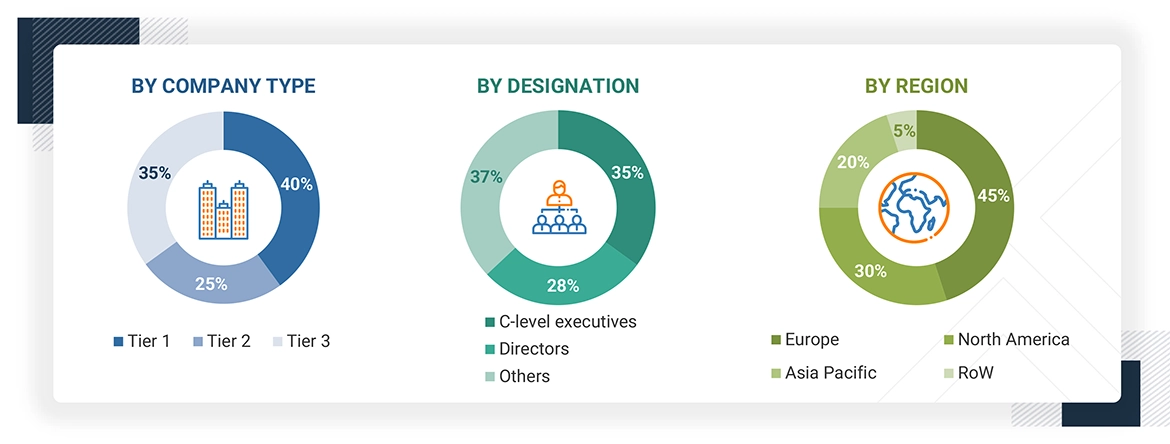
Note: Other designations include sales managers, marketing managers, and production managers. Three tiers of companies have been defined based on their total/segmental revenue as of 2024; tier 1: revenue greater than or equal to USD 1 billion; tier 2: revenue between USD 100 million and USD 1 billion; and tier 3: revenue lesser than or equal to USD 100 million.
To know about the assumptions considered for the study, download the pdf brochure
Market Size Estimation
In the complete market engineering process, both top-down and bottom-up approaches have been used, along with several data triangulation methods, to estimate and forecast the size of the market and its segments and subsegments listed in the report. Extensive qualitative and quantitative analyses have been carried out on the complete market engineering process to list the key information/insights pertaining to the delivery robots market.
The key players in the market have been identified through secondary research, and their rankings in the respective regions have been determined through primary and secondary research. This entire procedure involved the study of the annual and financial reports of top players, as well as interviews with industry experts such as chief executive officers, vice presidents, directors, and marketing executives for both quantitative and qualitative key insights. All percentage shares, splits, and breakdowns have been determined using secondary sources and verified through primary sources. All parameters that affect the markets covered in this research study have been accounted for, viewed in extensive detail, verified through primary research, and analyzed to obtain the final quantitative and qualitative data. This data has been consolidated and enhanced with detailed inputs and analysis from MarketsandMarkets and presented in this report.
Delivery Robots Market : Top-Down and Bottom-Up Approach

Data Triangulation
After arriving at the overall market size from the estimation process explained above, the total market has been split into several segments and subsegments. To complete the overall market engineering process and arrive at the exact statistics for all the segments and subsegments, data triangulation and market breakdown procedures have been employed, wherever applicable. The data has been triangulated by studying various factors and trends from both the demand and supply sides. The market has also been validated using both top-down and bottom-up approaches.
Market Definition
Autonomous guided vehicles (AGVs) or autonomous mobile robots (AMRS) used by retailers for delivering food, grocery items, or any parcel to customers at their doorstep are called delivery robots, also known as last-mile delivery robots. Autonomous last-mile delivery is a term used for the quick and cost-effective transportation of merchandise from fulfillment centers to their destinations using autonomous ground delivery vehicles for applications, including business-to-consumer or business-to-business.
Key Stakeholders
- Original equipment manufacturers (OEMs)
- OEM technology solution providers
- Research institutes
- Market research and consulting firms
- Forums, alliances, and associations
- Technology investors
- Governments and financial institutions
- Analysts and strategic business planners
- End users that want to know more about the technology and the latest technological developments in the industry
Report Objectives
- To describe and forecast the delivery robots market in terms of value, segmented based on load carrying capacity, offering, end-use industry, number of wheels, speed limit, and region
-
To describe and forecast the delivery robots market in terms of volume based on
load carrying capacity, end-use industry, number of wheels, and speed limit - To describe important safety components of delivery robots
- To describe and forecast the market size, in terms of value, for various segments about the 4 main regions: North America, Europe, Asia Pacific, and RoW
- To provide detailed information regarding drivers, restraints, opportunities, and challenges influencing the growth of the market
- To provide a detailed overview of the value chain of the delivery robots ecosystem, along with the supply chain, key industry trends, technology, patent, trade, Porter’s Five Forces, and average price analyses and tariffs & regulations
- To strategically analyze micromarkets for individual growth trends, prospects, and contributions to the total market
- To analyze opportunities in the market for various stakeholders by identifying high-growth segments of the delivery robots market
- To strategically profile key players and comprehensively analyze their market position in terms of ranking and core competencies, along with detailing the competitive landscape for market leaders
- To provide a detailed impact of the recession on the delivery robots market, its segments, and market players
- To analyze the competitive developments, such as joint ventures, collaborations, agreements, contracts, partnerships, mergers & acquisitions, new product developments, and research & development (R&D), in the delivery robots market
Get the Full Delivery Robots Market Report
Full forecast, segment splits, and company analysis for all Delivery Robots Market.
- Canada Delivery Robots Market
- Mexico Delivery Robots Market
- UK Delivery Robots Market
- Germany Delivery Robots Market
- Switzerland Delivery Robots Market
- France Delivery Robots Market
- Italy Delivery Robots Market
- Spain Delivery Robots Market
- Poland Delivery Robots Market
- China Delivery Robots Market
- Japan Delivery Robots Market
- South Korea Delivery Robots Market
- India Delivery Robots Market
- Australia Delivery Robots Market
- Indonesia Delivery Robots Market
- Malaysia Delivery Robots Market
- Vietnam Delivery Robots Market
- Thailand Delivery Robots Market
- Nordics Delivery Robots Market
- Rest Of Europe Delivery Robots Market
- Rest Of Asia Pacific Delivery Robots Market
- Bahrain Delivery Robots Market
- Kuwait Delivery Robots Market
- Oman Delivery Robots Market
- Qatar Delivery Robots Market
- Rest Of Middle East Delivery Robots Market
- Saudi Arabia Delivery Robots Market
- UAE Delivery Robots Market
- Other African Countries Delivery Robots Market
- South Africa Delivery Robots Market
Need a Tailored Report?
Customize this report to your needs
Get 10% FREE Customization
Customize This Report
