
China Dental Imaging Market (2025-2030)

The China Dental Imaging Market was valued at $221.9 Million in 2025 and projected to reach to $351.2 Million by 2030, representing a compound annual growth rate of 9.6%. China's dental imaging market is positioned for sustained growth as healthcare reforms continue to expand access to advanced diagnostic technologies.


| Market Size in | USD 26.32 MN |
| Market Forecast in | |
| CAGR | |
| Forecast Period | |
| Units Considered | Value (USD MN) |
China Dental Imaging Market Trends and Insights
- This growth trajectory reflects China's increasing investment in dental healthcare infrastructure and rising consumer awareness of oral health.
- China's market is outpacing global averages, driven by urbanization, growing middle-class populations, and modernization of dental clinics across major cities. The dental imaging sector in China benefits from technological adoption and government healthcare initiatives aimed at improving preventive care.
- China's expanding network of dental practices and cosmetic dentistry demand are accelerating the adoption of advanced imaging solutions.
- By 2030, China is expected to consolidate its position as a key regional market, with digital radiography and cone-beam computed tomography (CBCT) systems gaining significant traction among dental professionals..
Key Market Statistics
- CAGR (2025-2030) 9.6% CAGR
- Market Size, 2025 ~USD 221.9 Million
- Forecast, 2030 ~USD 351.2 Million
- Country China
China Dental Imaging Market Overview
Rapid Market Expansion :
China's dental imaging market is growing at 9.6% CAGR, significantly outpacing the global average of 7.5%, driven by increased healthcare spending and modernization of dental facilities across urban centers.
Urbanization & Middle-Class Growth :
Rapid urbanization and expansion of China's middle-class population are fueling demand for advanced dental imaging technologies, with consumers increasingly prioritizing preventive oral healthcare.
Infrastructure Investment :
China's substantial investment in dental healthcare infrastructure, including private dental clinics and hospital modernization, is accelerating adoption of digital imaging systems and CBCT technology.
Market Valuation Trajectory :
The market is valued at USD 221.9 million in 2025 and is projected to reach USD 351.2 million by 2030, representing a 58% increase over the five-year forecast period.
China Dental Imaging Market Dynamics
- The convergence of rising disposable incomes, government support for dental healthcare initiatives, and increasing awareness of oral health among younger demographics creates a favorable environment for market expansion.
- Digital transformation in dental practices and the shift toward preventive care models are accelerating technology adoption across both urban and emerging secondary cities. Looking ahead to 2030, China's market will likely benefit from technological innovations in AI-integrated imaging systems and portable diagnostic devices tailored to the Chinese market.
- Strategic partnerships between international manufacturers and local distributors, combined with regulatory improvements and reimbursement policies, will further strengthen market penetration.
- The competitive landscape will intensify as both established global players and emerging Chinese manufacturers vie for market share in this high-growth segment..
Market Ecosystem
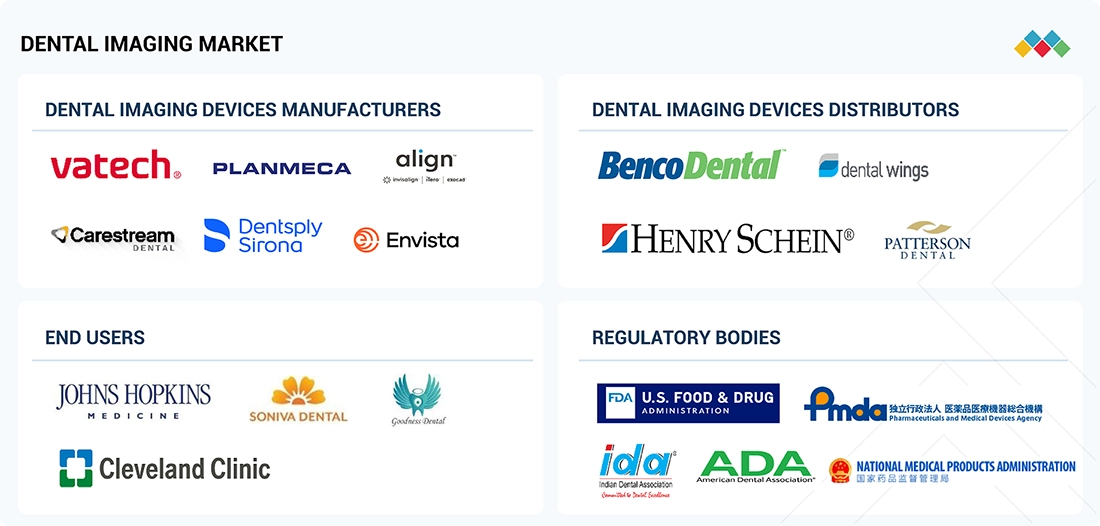
Dental Imaging Market: COMMERCIAL USE CASES ACROSS INDUSTRIES
| COMPANY | USE CASE DESCRIPTION | BENEFITS |
|---|---|---|
 |
Advanced CBCT systems and panoramic X-ray solutions for extraoral imaging | High-resolution 3D imaging, accurate diagnostics, reduced radiation dose, broad clinical utility |
 |
Intraoral scanners for orthodontic and restorative workflows | Precise digital impressions, seamless integration with clear aligners, enhances treatment accuracy |
 |
Dental CBCT, panoramic, and intraoral imaging systems | Comprehensive imaging portfolio, clear visualization, supports implantology and endodontics |
 |
CBCT systems, intraoral scanners | Efficient diagnostics, detailed 3D visualization, faster workflows, enhances clinical confidence |
 |
Wide range of CBCT units, panoramic imaging, and intraoral scanners | Ultra-low dose imaging, seamless software integration, ergonomic design, advanced diagnostics |
Logos and trademarks shown above are the property of their respective owners. Their use here is for informational and illustrative purposes only.
Related Ecosystem
Key Takeaways
- China's dental imaging market is valued at USD 221.9 million in 2025 and will grow to USD 351.2 million by 2030, representing a 9.6% CAGR.
- China's market growth rate significantly exceeds the global CAGR of 7.5%, indicating accelerated regional demand and adoption.
- Urbanization and rising disposable incomes in China are driving increased investment in modern dental imaging technologies.
- China's government healthcare policies and expansion of dental clinics are key catalysts for market growth through 2030.
Dental Imaging Market Report Scope
| Report Metric | Details |
|---|---|
| Base Year | 2025 |
| Fastest Growing Segment | INTRAORAL IMAGING (Product) |
| Forecast Period | 2025-2030 |
| Growth Rate | CAGR of 7.5% from 2025 to 2030 |
| Largest Segment | DENTAL HOSPITALS & CLINICS (End User) |
| Market Size Base Year (Billions) | ~USD 3.27 (2025) |
| Revenue Forecast (Billions) | ~USD 4.69 (2030) |
| Segments Covered | Product, Type, Application, End User |
China Dental Imaging Market Report Segmentation
4 segment dimensions are covered across the global market.
By Product
- Extraoral Imaging
- Imaging Software
- Intraoral Imaging
By Type
- 3D Cbct Systems
- Intraoral Cameras
- Intraoral Photostimulable Phosphor Systems
- Intraoral Scanners
- Intraoral Sensors
- Intraoral X-Ray Systems
- Panoramic & Cephalometric Systems
- Panoramic Systems
By Application
- Endodontics
- Implantology
- Oral And Maxillofacial Surgery
- Orthodontics
- Other Applications
By End User
- Dental Academic & Research Institutes
- Dental Diagnostic Centers
- Dental Hospitals & Clinics
CHINA: DENTAL IMAGING MARKET, BY END USER, 2023–2030
| Segment | 2023 | 2024 | 2025 | 2026 | 2028 | 2029 | 2030 | CAGR (%) |
|---|---|---|---|---|---|---|---|---|
| DENTAL ACADEMIC & RESEARCH INSTITUTES | 17.3 | 18.1 | 19.1 | 20.3 | 23 | 24.8 | 26.8 | 7 |
| DENTAL DIAGNOSTIC CENTERS | 39.3 | 41.7 | 44.8 | 48.3 | 56.6 | 61.8 | 67.9 | 8.7 |
| DENTAL HOSPITALS & CLINICS | 134.8 | 145.2 | 158 | 172.8 | 207.9 | 230.1 | 256.5 | 10.2 |
| TOTAL | 191.3 | 205 | 221.9 | 241.4 | 287.4 | 316.6 | 351.2 | 9.6 |
Target Audience
- Dental Equipment Manufacturers : Manufacturers need China-specific market data to develop localized product strategies, identify distribution partnerships, and capitalize on the 9.6% CAGR growth opportunity in this high-potential market.
- Healthcare Investment Firms : Investment professionals require detailed market sizing and growth forecasts for China to evaluate portfolio opportunities, assess ROI potential, and make informed capital allocation decisions in dental healthcare.
- Dental Practice Operators : Dental clinic owners and hospital administrators need insights into technology adoption trends and market dynamics to make informed purchasing decisions for imaging equipment and stay competitive.
- Market Entry Strategists : Companies planning market entry into China require comprehensive analysis of urbanization trends, regulatory frameworks, and competitive landscapes to develop effective go-to-market strategies.
- Healthcare Consultants & Analysts : Consultants advising healthcare clients need China-specific market intelligence to provide strategic recommendations on market opportunities, competitive positioning, and growth potential in dental imaging.
Reasons to Buy this Report
- Market-Specific Growth Intelligence : Gain detailed insights into China's 9.6% CAGR trajectory and understand the unique drivers differentiating this market from global averages, enabling targeted investment and expansion strategies.
- Urbanization & Consumer Behavior Data : Access comprehensive analysis of how China's urbanization and middle-class expansion directly impact dental imaging demand, with actionable insights for market positioning and product development.
- Infrastructure & Regulatory Landscape : Understand China's healthcare infrastructure investments, reimbursement policies, and regulatory environment to navigate market entry and partnership opportunities effectively.
- Competitive Positioning Framework : Identify competitive dynamics between international manufacturers and local players, with strategic recommendations for differentiation and market share capture in this high-growth segment.
- Forecast-Driven Business Planning : Leverage precise market projections (USD 221.9M to USD 351.2M by 2030) to inform 5-year business plans, resource allocation, and revenue forecasting specific to the China market.
Frequently asked questions
What is the current size of China's dental imaging market?
China's dental imaging market is valued at USD 221.9 million in 2025 and is projected to reach USD 351.2 million by 2030.
What is the growth rate of China's dental imaging market?
China's dental imaging market is growing at a compound annual growth rate (CAGR) of 9.6% from 2025 to 2030.
How does China's market growth compare to global trends?
China's dental imaging market CAGR of 9.6% outpaces the global CAGR of 7.5%, reflecting stronger regional demand and faster technology adoption.
What factors are driving growth in China's dental imaging market?
Key drivers include urbanization, rising disposable incomes, government healthcare initiatives, expansion of dental clinics, and increasing consumer awareness of oral health.
Which imaging technologies are gaining traction in China?
Digital radiography and cone-beam computed tomography (CBCT) systems are experiencing significant adoption among dental professionals in China.
RESEARCH METHODOLOGY
The study focused on estimating the current size of the dental imaging market. Extensive secondary research was conducted to gather information about the dental imaging industry. The findings, assumptions, and estimations were then validated through primary research with industry experts across the value chain. Various methods were utilized to estimate the total market size, including top-down and bottom-up approaches. Following this, market segmentation and data triangulation procedures were applied to determine the sizes of the different segments and subsegments within the dental imaging market.
Secondary Research
In the secondary research process, various sources were utilized, including annual reports, press releases, and investor presentations from companies, as well as white papers, certified publications, and articles by recognized authors. We also referenced reputable websites, regulatory bodies, and databases such as D&B Hoovers, Bloomberg Business, and Factiva. These sources were instrumental in identifying and collecting information for the study of the dental imaging market.
The research aimed to gather important insights about key industry players, market classification, and segmentation based on current industry trends. It also looked into geographic markets and significant developments related to the field. Additionally, a database of the leading industry players was compiled through this secondary research.
Primary Research
After gathering information about the dental imaging market through secondary research, extensive primary research was conducted. Several interviews were held with market experts from both the demand and supply sides across major regions, including North America, Europe, Asia Pacific, Latin America, and the Middle East & Africa. Data was collected through questionnaires, emails, and telephone interviews.
The primary sources from the supply side included various industry experts, such as chief executive officers (CEOs), vice presidents (VPs), directors of business development, marketing, product development/innovation teams, and other key executives from manufacturers and distributors operating in the dental imaging market.
These primary interviews aimed to gather insights on market statistics, revenue data from products and services, market breakdowns, size estimations, forecasting, and data triangulation. The research also provided an understanding of trends related to technologies, applications, end users, and regions.
Stakeholders from the demand side, including customers and end users of dental imaging products, were interviewed to gain insights into their perspectives on suppliers, products, their current usage, and future outlooks on their business. This information is valuable as it influences the overall market dynamics.
The following is a breakdown of the primary respondents:
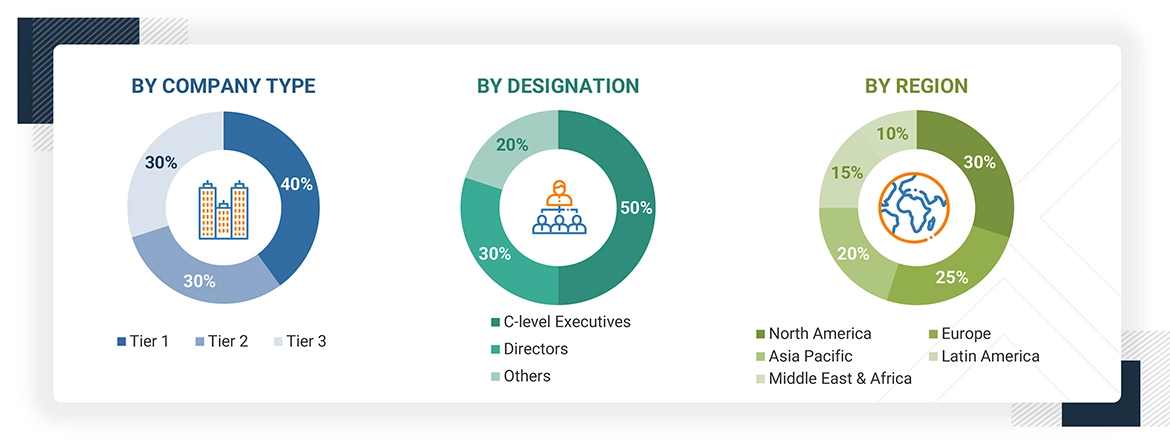
Note 1: Others include sales, marketing, and product managers.
Note 2: C-level executives include CEOs, COOs, CTOs, and VPs.
Note 3: Companies are classified into tiers based on their total revenue. As of 2024, Tier 1 = >USD 1 billion, Tier 2 = USD 500 million to USD 1 billion, and Tier 3 = < USD 500 million.
To know about the assumptions considered for the study, download the pdf brochure
Market Size Estimation
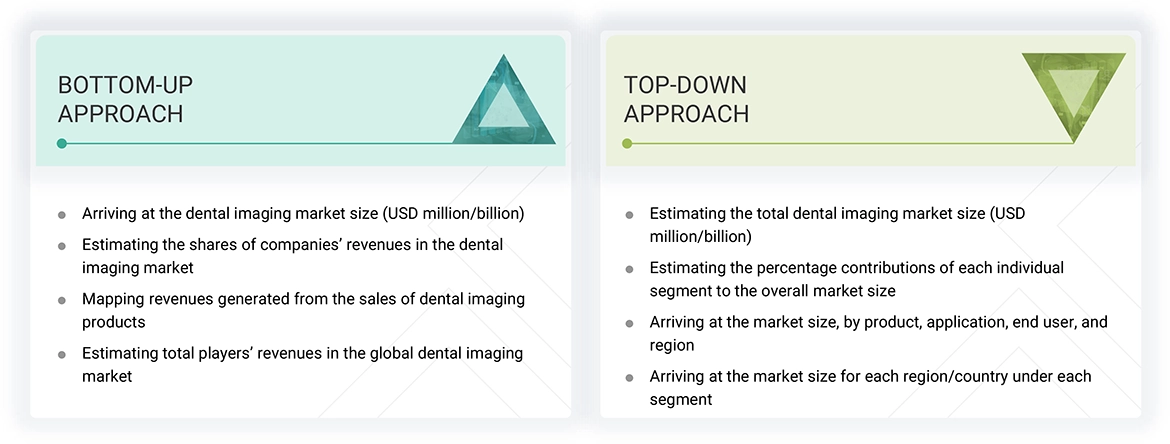
The research methodology used to estimate the size of the dental imaging market includes the following details.
The market sizing was undertaken from a global perspective.
Country-level Analysis: The size of the dental imaging market was obtained from the annual presentations of leading players and secondary data available in the public domain. The share of products in the overall dental imaging market was obtained from secondary data and validated by primary participants to arrive at the total dental imaging market. Primary participants further validated the numbers.
Geographic market assessment (by region & country): The geographic assessment was done using the following approaches:
Approach 1: Geographic revenue contributions/splits of leading players in the market (wherever available) and respective growth trends
Approach 2: Geographic adoption trends for individual devices & consumables segments by end users and growth prospects for each of the segments (assumptions and indicative estimates validated from primary interviews)
At each point, the assumptions and approaches were validated by industry experts who were contacted during primary research. Considering the limitations of data available from secondary research, revenue estimates for individual companies (for the overall dental imaging market and geographic market assessment) were ascertained based on a detailed analysis of their respective product offerings, geographic reach/strength (direct or through distributors or suppliers), and the shares of the leading players in a particular region or country.
Global Dental Imaging Market Size: Bottom-up Approach & Top-down Approach
Data Triangulation
After arriving at the overall market size using the market size estimation processes, the market was split into several segments and subsegments. Data triangulation and market breakdown procedures were employed to complete the overall market engineering process and arrive at the exact statistics of each market segment and subsegment. The data was triangulated by studying various factors and trends from both the demand and supply sides of the dental imaging market.
Market Definition
Dental imaging systems are advanced technologies that capture detailed images of a patient's teeth and surrounding structures, which are crucial for dentists to accurately assess oral health. These systems utilize sophisticated imaging techniques, such as digital radiography, to deliver high-resolution images quickly, significantly reducing the time patients spend in the dental chair. Additionally, these modern methods are designed to minimize patients' exposure to radiation compared to traditional imaging techniques, ensuring a safer experience while still providing essential diagnostic information. By enhancing the visualization of dental issues such as cavities, bone loss, and other anomalies, these imaging systems play a vital role in effective treatment planning and maintaining overall oral health.
Stakeholders
- Dental imaging product manufacturers and distributors
- Dental imaging research and development (R&D) companies
- Dental diagnostic centers
- Government associations
- Market research and consulting firms
- Venture capitalists and investors
- Research and consulting firms
- Market research and consulting firms
- Dental hospitals and clinics
- Dental academic and research institutes
- Government dental research organizations
Report Objectives
- To define, describe, and forecast the global dental imaging market by product, application, end user, and region
- To provide detailed information about the factors influencing market growth (such as drivers, opportunities, restraints, and challenges)
- To analyze micromarkets with respect to individual growth trends, prospects, and contributions to the overall dental imaging market
- To analyze market opportunities for stakeholders and provide details of the competitive landscape for key players
- To forecast the revenue of the market segments concerning five main regions: North America (the US and Canada), Europe (Germany, France, the UK, Italy, Spain, and the Rest of Europe), the Asia Pacific (China, Japan, India, South Korea, Australia, and the Rest of Asia Pacific), Latin America (Mexico, Brazil, and the Rest of Latin America), and the Middle East & Africa (GCC Countries and the Rest of Middle East & Africa)
- To profile key players in the global dental imaging market and comprehensively analyze their core competencies and market shares
- To track and analyze competitive developments such as mergers & acquisitions, new product/technology launches, expansions, collaborations and agreements, and R&D activities of the leading players in the global dental imaging market
Get the Full Dental Imaging Market Report
Full forecast, segment splits, and company analysis for all Dental Imaging Market.
- Canada Dental Imaging Market
- US Dental Imaging Market
- France Dental Imaging Market
- Germany Dental Imaging Market
- Italy Dental Imaging Market
- Spain Dental Imaging Market
- UK Dental Imaging Market
- India Dental Imaging Market
- Japan Dental Imaging Market
- South Korea Dental Imaging Market
- Australia Dental Imaging Market
- Brazil Dental Imaging Market
- Mexico Dental Imaging Market
- Rest Of Europe Dental Imaging Market
- Rest Of Asia Pacific Dental Imaging Market
- Rest Of Latin America Dental Imaging Market
Need a Tailored Report?
Customize this report to your needs
Get 10% FREE Customization
Customize This Report
