
Germany Dietary Supplements Testing Market (2025-2030)

The Germany Dietary Supplements Testing Market was valued at $172.3 Million in 2025 and projected to reach to $273 Million by 2030, representing a compound annual growth rate of 9.6%. Germany's dietary supplements testing market is positioned for sustained expansion through 2030, driven by increasingly stringent EU and national regulatory requirements.


| Market Size in | USD 26.32 MN |
| Market Forecast in | |
| CAGR | |
| Forecast Period | |
| Units Considered | Value (USD MN) |
Germany Dietary Supplements Testing Market Trends and Insights
- This 9.6% compound annual growth rate reflects Germany's stringent regulatory environment and rising consumer demand for product safety and quality assurance.
- Germany's position as a leading European hub for supplement manufacturing and distribution drives significant investment in testing infrastructure and compliance services. The German market benefits from strong regulatory frameworks, including EU directives and national food safety standards that mandate comprehensive testing protocols.
- Germany's health-conscious consumer base and premium positioning in the global supplements sector create sustained demand for advanced testing capabilities.
- By 2030, Germany is expected to solidify its role as a key testing and certification center within Europe, supported by technological innovation and increasing cross-border supplement trade..
Key Market Statistics
- CAGR (2025-2030) 9.6% CAGR
- Market Size, 2025 ~USD 172.3 Million
- Forecast, 2030 ~USD 273 Million
- Country Germany
Germany Dietary Supplements Testing Market Overview
Market Valuation & Growth :
Germany's dietary supplements testing market is valued at $172.3 million in 2025, with a robust 9.6% CAGR projected through 2030, reaching $273.0 million. This growth rate exceeds the global average of 8.8%, reflecting Germany's premium positioning in European supplement testing.
Regulatory Stringency Driver :
Germany's strict regulatory framework under the German Food and Feed Code (LFGB) and EU regulations mandates comprehensive testing for safety, purity, and efficacy. This compliance requirement drives consistent demand for specialized testing services across manufacturers and distributors.
Manufacturing & Distribution Hub :
Germany serves as a leading European center for supplement manufacturing and distribution, with major pharmaceutical and nutraceutical companies headquartered in regions like North Rhine-Westphalia and Baden-Württemberg. This concentration creates sustained demand for local testing infrastructure.
Consumer Quality Consciousness :
German consumers demonstrate exceptionally high demand for product transparency and quality assurance. This consumer preference, combined with strong purchasing power, incentivizes manufacturers to invest in premium testing services to differentiate products and build brand trust.
Germany Dietary Supplements Testing Market Dynamics
- The country's reputation for quality and safety standards creates competitive advantages for manufacturers who invest in comprehensive testing protocols, positioning Germany as a quality benchmark for European supplement producers. The market will benefit from rising health consciousness among German consumers, growing e-commerce distribution channels, and expanding product portfolios in functional foods and personalized nutrition.
- Investment in advanced testing technologies, including microbiological analysis and contaminant screening, will remain critical for market participants seeking to capture growth opportunities in this quality-focused market..
Market Ecosystem
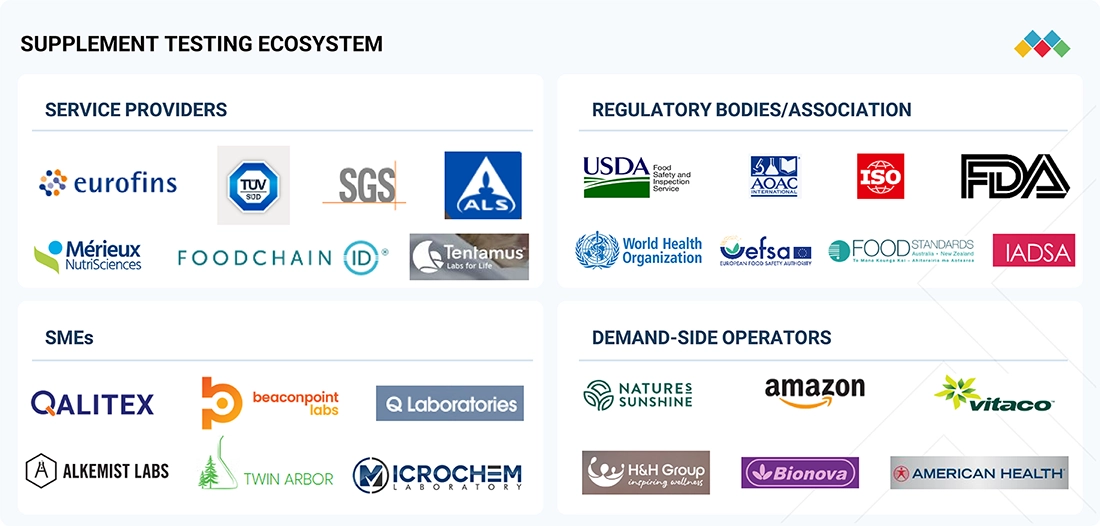
Dietary Supplements Testing Market: COMMERCIAL USE CASES ACROSS INDUSTRIES
| COMPANY | USE CASE DESCRIPTION | BENEFITS |
|---|---|---|
 |
In early 2023, SGS S.A. acquired a 60% majority stake in Nutrasource Pharmaceutical and Nutraceutical Services Inc., a Canada-based CRO with a US subsidiary. | By integrating Nutrasource’s specialized expertise, SGS S.A. strengthened its position as a comprehensive solutions provider in the supplement testing market. |
 |
In July 2025, Mérieux NutriSciences finalized the acquisition of Bureau Veritas’ (France) food testing operations in Ecuador, integrating a 750 m² laboratory and more than 80 employees into its global network. | The acquisition strengthened Mérieux’s regional leadership, enabling it to better serve Ecuador’s export-driven food and dietary supplement industries with faster turnaround, enhanced compliance services, and broader analytical capabilities. |
Logos and trademarks shown above are the property of their respective owners. Their use here is for informational and illustrative purposes only.
Related Ecosystem
Food Safety And Tic
- Dairy Products
- Polymerase Chain Reaction (PCR)
- Campylobacter
- Enzyme-Linked Immunosorbent Assay (ELISA)
- Safety Testing
- Sgs s.a.
- Intertek Group plc
- EUROFINS SCIENTIFIC SE
- Als limited
- PROMEGA CORPORATION
Key Takeaways
- Germany's dietary supplements testing market grows at 9.6% CAGR from 2025 to 2030, outpacing global growth of 8.8%.
- Germany's market size expands from $172.3 million (2025) to $273.0 million (2030), driven by regulatory compliance and quality assurance demands.
- Germany's stringent EU and national food safety regulations create sustained demand for comprehensive testing and certification services.
- Germany's role as a European manufacturing and distribution hub positions it as a critical testing and compliance center through 2030.
Dietary Supplements Testing Market Report Scope
| Report Metric | Details |
|---|---|
| Base Year | 2025 |
| Fastest Growing Segment | FUNCTIONAL CLAIMS (Test Type) |
| Forecast Period | 2025-2030 |
| Growth Rate | CAGR of 8.8% from 2025 to 2030 |
| Largest Segment | CAPSULES (Mode Of Application) |
| Market Size Base Year (Billions) | ~USD 2.4 (2025) |
| Revenue Forecast (Billions) | ~USD 3.65 (2030) |
| Segments Covered | Test Type, Product Tested, Technology, Mode Of Application |
Germany Dietary Supplements Testing Market Report Segmentation
4 segment dimensions are covered across the global market.
By Test Type
- Adulteration
- Allergen & Gmo
- Contaminants
- Functional Claims
- Identity/Authentication
- Label Claim Verification
- Microbiological
- Other Test Types
- Other Testing Type
- Other Testing Types
- Potency
- Stability & Shelf Life
By Product Tested
- Finished Product Testing
- Ingredient-Level Testing
- -Amino Acids & Proteins
- -Botanicals
- -Other Ingredients
- -Phytochemicals
- -Specialty Supplements
- -Vitamins & Minerals
By Technology
- Rapid
- Traditional
By Mode Of Application
- Capsules
- Gummies/Chewables
- Liquid
- Powder
- Tablets
Target Audience
- Testing Laboratory Operators : German and European testing labs need market data to assess competitive positioning, identify service expansion opportunities, and plan capacity investments aligned with the 9.6% growth trajectory and evolving regulatory requirements.
- Supplement Manufacturers & Distributors : German and international supplement companies require insights into local testing requirements, compliance costs, and quality assurance best practices to optimize product development, ensure regulatory approval, and maintain market competitiveness.
- Regulatory & Quality Assurance Professionals : Compliance officers and quality managers need comprehensive data on German regulatory frameworks, testing standards, and industry practices to develop robust quality management systems and ensure consistent regulatory adherence.
- Investment & Private Equity Firms : Investors evaluating opportunities in German testing infrastructure, supplement manufacturing, or nutraceutical distribution require market sizing, growth forecasts, and competitive landscape analysis to support investment decisions and valuation models.
- Market Research & Consulting Firms : Research organizations and consultants serving the supplement industry need detailed Germany-specific market data, regulatory insights, and trend analysis to support client advisory services and strategic planning engagements.
Reasons to Buy this Report
- Regulatory Compliance Intelligence : Gain detailed insights into Germany's LFGB and EU regulatory requirements specific to dietary supplements testing. Understand compliance pathways, certification standards, and evolving regulations that impact market entry and product approval timelines.
- Competitive Market Positioning : Identify key testing laboratories, service providers, and market consolidation trends in Germany. Benchmark your testing capabilities against competitors and understand market share distribution among established and emerging players.
- Growth Opportunity Assessment : Evaluate high-growth segments within German supplement testing, including functional foods, personalized nutrition, and emerging contaminant screening. Identify underserved niches and expansion opportunities aligned with the 9.6% CAGR trajectory.
- Consumer & Manufacturer Insights : Understand German consumer preferences for product safety and transparency, and how manufacturers are responding with premium testing investments. Leverage this intelligence to develop targeted service offerings and marketing strategies.
- Strategic Investment Planning : Make informed decisions on market entry, facility expansion, or service diversification in Germany. Access forecasts through 2030 to align capital investments with long-term market growth and regulatory evolution.
Frequently asked questions
What is the current size of Germany's dietary supplements testing market?
Germany's dietary supplements testing market is valued at $172.3 million in 2025 and is projected to grow to $273.0 million by 2030.
What is the growth rate for Germany's dietary supplements testing market?
Germany's dietary supplements testing market is growing at a compound annual growth rate (CAGR) of 9.6% between 2025 and 2030.
Why is Germany's testing market growing faster than the global average?
Germany's market grows at 9.6% CAGR compared to the global 8.8% due to stringent EU regulations, strong manufacturing presence, and high consumer demand for quality assurance.
What regulatory factors drive Germany's dietary supplements testing demand?
Germany's strict EU food safety directives, national regulations, and premium market positioning create mandatory testing requirements for manufacturers and distributors.
How much will Germany's dietary supplements testing market grow by 2030?
Germany's market is expected to grow by $100.7 million from 2025 to 2030, representing a 58.4% increase over the five-year forecast period.
RESEARCH METHODOLOGY
This study involved two major approaches in estimating the current size of the dietary supplements testing market. Exhaustive secondary research was carried out to collect information on the market, test type, product tested, technology, end-use (qualitative), and service provider (qualitative) segments. The next step was to validate these findings, assumptions, and sizing with industry experts across the value chain through primary research. Both top-down and bottom-up approaches were employed to estimate the complete market size. Thereafter, data triangulation was used to estimate the market size of segments and subsegments.
Secondary Research
This research study involved extensive secondary sources—directories and databases such as Bloomberg Businessweek and Factiva—to identify and collect information useful for a technical, market-oriented, and commercial market study. In the secondary research process, sources such as annual reports, press releases & investor presentations of companies, white papers, food testing journals, certified publications, articles from recognized authors, directories, and databases were referred to to identify and collect information. Secondary research was mainly used to obtain key information about the industry’s supply chain, the pool of key players, and market classification and segmentation as per the industry trends to the bottom-most level, regional markets, and key developments from market- and technology-oriented perspectives.
Primary Research
Extensive primary research was conducted after obtaining information regarding the dietary supplements testing market scenario through secondary research. Several primary interviews were conducted with market experts from the demand and supply sides across major countries of North America, Europe, Asia Pacific, South America, and the Rest of the World. Primary data was collected through questionnaires, emails, and telephonic interviews. The primary sources from the supply side included various industry experts, such as chief experience officers (CXOs), vice presidents (VPs), directors from business development, marketing, research, and development teams, and related key executives from safety testing service providers and key opinion leaders. Primary interviews were conducted to gather insights such as market statistics, data on revenue collected from the services, market breakdowns, market size estimations, market forecasting, and data triangulation. Primary research also helped understand the various trends related to test type, product tested, technology, and region. Stakeholders from the demand side, such as dietary supplement manufacturers and food health supplement product manufacturers, were interviewed to understand the buyers’ perspective on the suppliers, products, and the outlook of their business, which will affect the overall market.
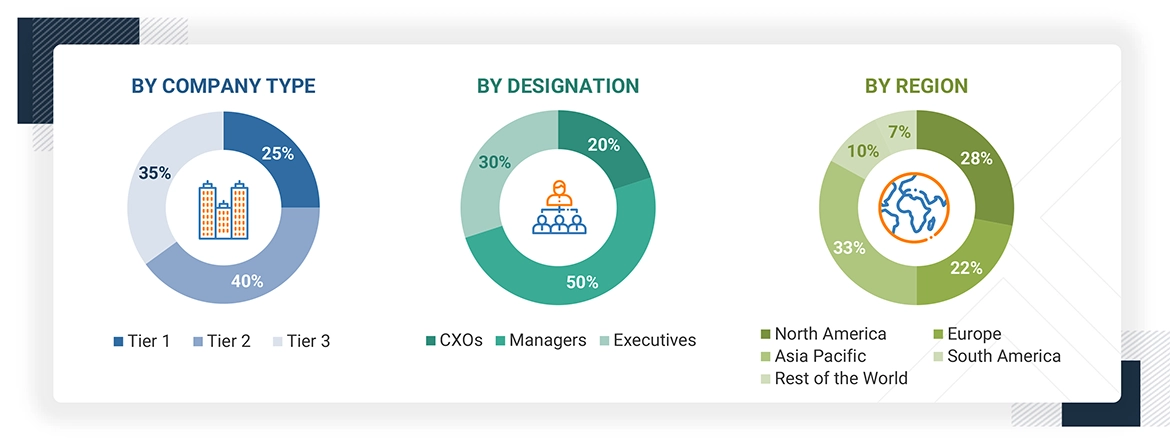
Note: The three tiers of the companies are defined based on their total revenues in 2023 or 2024, as per the
availability of financial data: Tier 1: Revenue >USD 1 billion; Tier 2: USD 100 million = revenue = USD 1 billion; Tier 3:
Revenue
To know about the assumptions considered for the study, download the pdf brochure
|
COMPANY |
DESIGNATION |
|
Mérieux NutriSciences (US) |
Quality Analyst Microbiologist |
|
TÜV SÜD (Germany) |
Key Accounts Manager |
|
Eurofins Scientific (Luxembourg) |
Sales Head |
|
Certified Laboratories (US) |
Lab Research Head |
|
ALS (Australia) |
Lab Research Manager |
|
Gravity Diagnostics (US) |
Business Development Manager |
Market Size Estimation
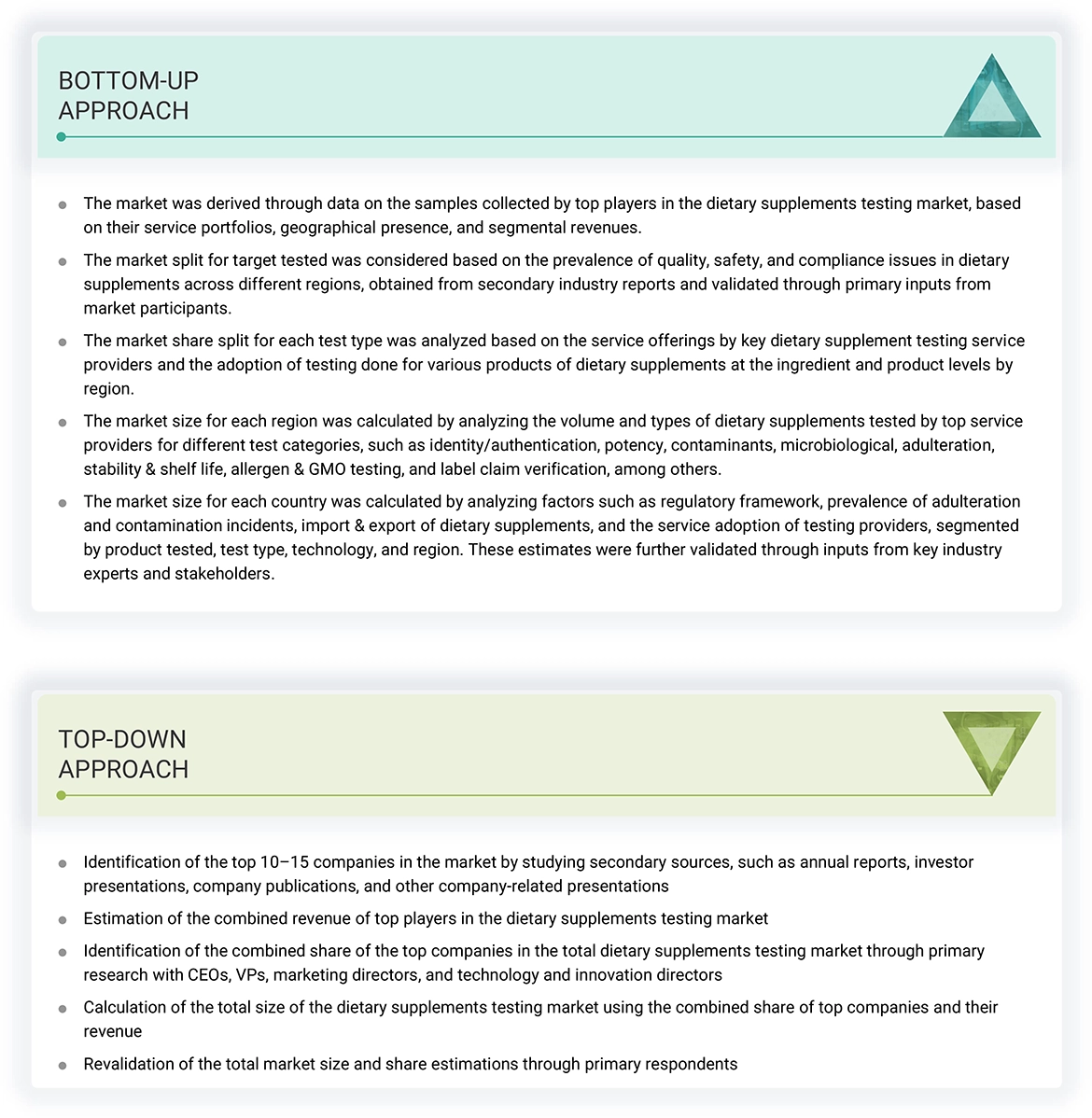
The top-down and bottom-up approaches were used to estimate and validate the total size of the dietary supplements testing market. These approaches were also used extensively to determine the size of various subsegments in the market. The research methodology used to estimate the market size includes the following details:
- The key players in the industry and the overall markets were identified through extensive secondary research.
- All shares, splits, and breakdowns were determined using secondary sources and verified through primary sources.
- All possible parameters that affect the market covered in this research study were accounted for, viewed in extensive detail, verified through primary research, and analyzed to obtain final quantitative and qualitative data.
- The research included the study of reports, reviews, and newsletters of top market players, along with extensive interviews for opinions from leaders, such as CEOs, directors, and marketing executives.
Dietary Supplements Testing Market : Top-Down and Bottom-Up Approach
Data Triangulation
After determining the overall market size from the estimation process explained above, the total market was split into several segments and subsegments. The data triangulation procedure was employed, wherever applicable, to estimate the overall dietary supplements testing market and arrive at the exact statistics for all segments and subsegments. The data was triangulated by studying various factors and trends from the demand and supply sides. The market size was also validated using both the top-down and bottom-up approaches.
Market Definition
Dietary supplement testing involves evaluating ingredients and products to ensure they meet quality and safety standards, specifically that the ingredients listed on the label are present in the correct amounts and that the product is free from harmful contaminants. This process includes a wide array of analytical and operational offerings such as identity/authentication, potency testing, contaminants testing, microbiological testing, adulteration testing, stability & shelf life, allergen & GMO testing, and label claim verification, among others.
Stakeholders
- Dietary supplement testing laboratories and service providers
- Dietary supplement ingredient suppliers, intermediates, and end-product manufacturers and processors
- Contract research organizations (CRO)
-
Government organizations, institutes, and research organizations
- US Food and Drug Administration (FDA)
- National Institutes of Health (NIH)
- Center for Drug Evaluation Research (CDER)
- World Health Organization (WHO)
-
Associations and Regulatory Bodies:
- Food and Agriculture Organization (FAO)
- European Food Safety Authority (EFSA)
- Food Safety and Standards Authority of India (FSSAI)
- Consumer Healthcare Products Association (CHPA)
- Natural Products Association (NPA)
- European Federation of Associations of Health Product Manufacturers (EHPM)
- Food Supplements Europe (FSE)
- International Organization for Standardization (ISO)
Report Objectives
- To determine and project the size of the dietary supplements testing market based on test type, product tested, technology, end-use (qualitative), service provider (qualitative), and region, over five years, i.e., from 2025 to 2030
- To identify the attractive opportunities in the market by determining the largest and fastest-growing segments across regions
- To provide detailed information about the key factors influencing market growth (drivers, restraints, opportunities, and challenges)
- To analyze the opportunities in the market for stakeholders and provide details of the competitive landscape for market leaders
- To analyze the micromarkets with respect to individual growth trends, prospects, and their contribution to the total market
- To identify and profile the key players in the dietary supplements testing market
- To understand the competitive landscape and identify the major growth strategies adopted by market players across the key regions
Available Customizations
With the given market data, MarketsandMarkets offers customizations according to company-specific scientific needs.
The following customization options are available for the report:
Product Analysis
- Product matrix, which gives a detailed comparison of the product portfolio of each company.
Geographic Analysis as per Feasibility
With the given market data, MarketsandMarkets offers customizations according to company-specific scientific needs.
- Further breakdown of the Rest of Europe dietary supplements testing market into key countries
- Further breakdown of the Rest of Asia Pacific dietary supplements testing market into key countries
- Further breakdown of the South American dietary supplements testing market into key countries
Company Information
- Detailed analyses and profiling of additional market players (up to five)
Get the Full Dietary Supplements Testing Market Report
Full forecast, segment splits, and company analysis for all Dietary Supplements Testing Market.
- US Dietary Supplements Testing Market
- Canada Dietary Supplements Testing Market
- Mexico Dietary Supplements Testing Market
- UK Dietary Supplements Testing Market
- France Dietary Supplements Testing Market
- Italy Dietary Supplements Testing Market
- Spain Dietary Supplements Testing Market
- China Dietary Supplements Testing Market
- Japan Dietary Supplements Testing Market
- India Dietary Supplements Testing Market
- Vietnam Dietary Supplements Testing Market
- Brazil Dietary Supplements Testing Market
- Argentina Dietary Supplements Testing Market
- Rest Of Europe Dietary Supplements Testing Market
- Rest Of Asia Pacific Dietary Supplements Testing Market
- Rest Of South America Dietary Supplements Testing Market
- Africa Dietary Supplements Testing Market
- Middle East Dietary Supplements Testing Market
Need a Tailored Report?
Customize this report to your needs
Get 10% FREE Customization
Customize This Report
