
Rest Of Asia Pacific Digital Agriculture Market (2023-2028)

The Rest Of Asia Pacific Digital Agriculture Market was valued at $639.2 Million in 2023 and projected to reach to $1142.6 Million by 2028, representing a compound annual growth rate of 12.3%. Rest Of Asia Pacific is experiencing accelerated digital transformation in agriculture, driven by rising labor costs, climate variability, and government initiatives promoting smart farming.


| Market Size in | USD 26.32 MN |
| Market Forecast in | |
| CAGR | |
| Forecast Period | |
| Units Considered | Value (USD MN) |
Rest Of Asia Pacific Digital Agriculture Market Trends and Insights
- In 2023, Rest Of Asia Pacific's digital agriculture market was valued at $639.2 million, reflecting strong adoption of precision farming technologies, IoT solutions, and data analytics platforms across emerging agricultural economies.
- Rest Of Asia Pacific is projected to expand significantly, reaching $1,142.6 million by 2028, driven by increasing farm mechanization, government digitalization initiatives, and rising demand for sustainable farming practices. The 12.3% compound annual growth rate (CAGR) for Rest Of Asia Pacific substantially outpaces global trends, underscoring the region's accelerating digital transformation in agriculture.
- Rest Of Asia Pacific's growth trajectory is supported by improving rural connectivity, declining technology costs, and heightened awareness among smallholder and commercial farmers regarding productivity gains.
- Rest Of Asia Pacific's market expansion reflects both technological innovation and policy support aimed at modernizing agricultural operations across diverse farming scales and geographies..
Key Market Statistics
- CAGR (2023-2028) 12.3% CAGR
- Market Size, 2023 ~USD 639.2 Million
- Forecast, 2028 ~USD 1142.6 Million
- Country Rest Of Asia Pacific
Rest Of Asia Pacific Digital Agriculture Market Overview
Strong Market Valuation :
Rest Of Asia Pacific's digital agriculture market reached $639.2 million in 2023, demonstrating robust adoption of advanced farming technologies across emerging economies in the region.
Accelerated Growth Trajectory :
With a CAGR of 12.3% through 2028, Rest Of Asia Pacific is outpacing the global digital agriculture growth rate of 10.3%, indicating faster technology penetration in these markets.
Technology Adoption Drivers :
Precision farming technologies, IoT solutions, and data analytics platforms are rapidly gaining traction across Rest Of Asia Pacific's agricultural sector, driven by increasing farm productivity demands.
Projected Market Expansion :
The market is forecasted to reach $1,142.6 million by 2028, representing an 78.7% increase from 2023 and reflecting sustained investment in digital agricultural infrastructure.
Rest Of Asia Pacific Digital Agriculture Market Dynamics
- Emerging economies in the region are increasingly adopting precision agriculture technologies, IoT sensors, and cloud-based farm management platforms to enhance crop yields and optimize resource utilization.
- The 12.3% CAGR significantly outpaces global growth, reflecting the region's untapped potential and rapid digitalization of traditional farming practices. Key growth catalysts include expanding smartphone penetration, improving rural connectivity infrastructure, and growing awareness among smallholder farmers about technology benefits.
- Investment in agricultural startups and partnerships between technology providers and local farming communities are accelerating market expansion.
- By 2028, Rest Of Asia Pacific is expected to become a critical hub for digital agriculture innovation, with increasing adoption of AI-driven crop monitoring, automated irrigation systems, and blockchain-based supply chain solutions..
Market Ecosystem
Related Ecosystem
Feed And Animal Nutrition
- Animal-Based Sealants
- Camera Systems
- Lactic Acid
- Tricalcium Phosphate
- Citric Acid
- AZELIS HOLDINGS SA
- NOVUS INTERNATIONAL, INC.
- Feedone Co., Ltd.
- NOSAN CORPORATION
- Mitsui & Co., Ltd.
Key Takeaways
- Rest Of Asia Pacific's digital agriculture market is valued at $639.2 million in 2023 and is forecast to reach $1,142.6 million by 2028, representing a 12.3% CAGR.
- Rest Of Asia Pacific's growth rate significantly exceeds global averages, driven by rapid digitalization adoption and government support for agricultural modernization.
- Rest Of Asia Pacific benefits from improving rural infrastructure, declining technology costs, and increasing farmer awareness of digital solutions' productivity benefits.
- Rest Of Asia Pacific's market expansion is fueled by precision farming technologies, IoT platforms, and data analytics solutions tailored to diverse farm sizes and regional needs.
Digital Agriculture Market Report Scope
| Report Metric | Details |
|---|---|
| Base Year | 2023 |
| Fastest Growing Segment | ADVISORY SERVICES (Offering) |
| Forecast Period | 2023-2028 |
| Growth Rate | CAGR of 10.3% from 2023 to 2028 |
| Largest Segment | FARMING & FEEDING (Operation) |
| Market Size Base Year (Billions) | ~USD 22.05 (2023) |
| Revenue Forecast (Billions) | ~USD 36 (2028) |
| Segments Covered | Offering, Technology, Type, Operation |
Rest Of Asia Pacific Digital Agriculture Market Report Segmentation
4 segment dimensions are covered across the global market.
By Offering
- Advisory Services
- Agri Ecommerce
- Digital Procurement
- Financial Services
- Precision Agriculture & Farm Management
- Quality Management & Traceability
By Technology
- Core
- Peripheral
By Type
- AI & Data Analytics
- AI/ML
- Apps
- Assistant Professional Services
- Automation
- Automation & Control Systems
- Camera Systems
- Climate Sensors
- Connectivity Services
- Control Systems
- Data Collection & Analytical Services
- Displays
- Drones
- Drones/Uavs
- Ec Sensors
- Flow & Application Control Devices
- Gps/Gnss
- Guidance & Steering
- Handheld Mobile Devices/Handheld Computers
- Hardware
- Harvesters & Forwarders
- Hvac Systems
- Irrigation Controllers
- Led Grow Lights
- Maintenance & Support Services
- On-Cloud
- On-Premises
- Other Automation & Control Systems
- Other Sensing & Monitoring Devices
- Ph & Dissolved Oxygen Sensors
- Platforms
- Precision Agriculture
- Precision Animal Rearing & Feeding
- Precision Aquaculture
- Precision Forestry
- Readers For Livestock Monitoring
- Rfid & Sensors For Precision Forestry
- Rfid Tags & Readers For Livestock Monitoring
- Rfid Tags (Active & Passive) For Livestock Monitoring
- Robotics
- Robotics Hardware
- Sensing & Monitoring Devices
- Sensors For Livestock Monitoring
- Sensors For Smart Greenhouses
- Services
- Smart Greenhouse
- Software
- Soil Sensors
- System Integration & Consulting
- Temperature & Environmental Monitoring Sensors
- Variable Rate Controllers
- Water Sensors
- Yield Monitors
By Operation
- Farming & Feeding
- Marketing & Demand Generation
- Monitoring & Scouting
Target Audience
- Agricultural Technology Vendors : Need regional market insights to develop localized solutions, identify distribution channels, and prioritize product development for Rest Of Asia Pacific's emerging digital agriculture segment.
- Investment & Private Equity Firms : Require detailed market analysis and growth forecasts to evaluate investment opportunities in agritech startups and digital agriculture platforms operating across Rest Of Asia Pacific.
- Government & Policy Makers : Seek market intelligence to design agricultural digitalization policies, allocate funding for rural connectivity, and support technology adoption initiatives in Rest Of Asia Pacific.
- Agricultural Input Suppliers : Need to understand digital agriculture adoption rates and technology integration trends to align product offerings and develop digital-first distribution strategies in the region.
- Strategic Consultants & Analysts : Require comprehensive regional data and forecasts to advise clients on market entry strategies, competitive positioning, and growth opportunities in Rest Of Asia Pacific's digital agriculture sector.
Reasons to Buy this Report
- Regional Growth Opportunity : Capture insights into the fastest-growing digital agriculture segment in Asia Pacific with 12.3% CAGR, outpacing global averages and indicating superior market expansion potential.
- Emerging Market Dynamics : Understand unique adoption patterns, technology preferences, and barriers specific to Rest Of Asia Pacific's diverse agricultural economies and smallholder farmer segments.
- Investment Decision Support : Access comprehensive market sizing and forecasts through 2028 to inform strategic investments, product launches, and partnership decisions in high-growth emerging markets.
- Competitive Intelligence : Identify key technology trends, vendor strategies, and market gaps specific to Rest Of Asia Pacific to develop targeted go-to-market approaches and competitive positioning.
- Future-Ready Strategy : Leverage detailed market projections showing 78.7% growth potential to align long-term business strategies with emerging opportunities in precision farming and agricultural digitalization.
Frequently asked questions
What is the current market size of digital agriculture in Rest Of Asia Pacific?
Rest Of Asia Pacific's digital agriculture market was valued at $639.2 million in 2023 and is projected to grow to $1,142.6 million by 2028.
What is the expected growth rate for Rest Of Asia Pacific's digital agriculture market?
Rest Of Asia Pacific is expected to grow at a compound annual growth rate (CAGR) of 12.3% from 2023 to 2028.
What factors are driving growth in Rest Of Asia Pacific's digital agriculture sector?
Rest Of Asia Pacific's growth is driven by improving rural connectivity, declining technology costs, government digitalization initiatives, and increasing farmer adoption of precision farming and IoT solutions.
How does Rest Of Asia Pacific's growth compare to global digital agriculture trends?
Rest Of Asia Pacific's 12.3% CAGR significantly outpaces the global average of 10.3%, reflecting accelerated digital transformation in the region's agricultural sector.
Which technologies are most prevalent in Rest Of Asia Pacific's digital agriculture market?
Rest Of Asia Pacific's market is characterized by adoption of precision farming technologies, IoT platforms, data analytics solutions, and farm management software tailored to regional agricultural needs.
RESEARCH METHODOLOGY
The study involved four major activities in estimating the current size of the digital agriculture market. Exhaustive secondary research was done to collect information on the market, peer, and parent markets. The next step was to validate these findings, assumptions, and sizing with industry experts across the value chain through primary research. Both top-down and bottom-up approaches were employed to estimate the complete market size. After that, market breakdown and data triangulation were used to estimate the market size of segments and subsegments.
Secondary Research
This research study involved the extensive use of secondary sources—directories and databases such as Bloomberg Businessweek and Factiva—to identify and collect information useful for a technical, market-oriented, and commercial study of the digital agriculture market.
In the secondary research process, various sources such as annual reports, press releases & investor presentations of companies, white papers, food journals, certified publications, articles from recognized authors, gold & silver standard websites, directories, and databases, were referred to identify and collect information. This research study involved the extensive use of secondary sources—directories and databases such as Bloomberg Businessweek and Factiva—to identify and collect information useful for a technical, market-oriented, and commercial study of the digital agriculture market.
Secondary research was mainly used to obtain key information about the industry’s supply chain, the total pool of key players, and market classification and segmentation as per the industry trends to the bottom-most level, regional markets, and key developments from both market- and technology-oriented perspectives.
Primary Research
Extensive primary research was conducted after obtaining information regarding the digital agriculture market scenario through secondary research. Several primary interviews were conducted with market experts from both the demand and supply sides across major countries of North America, Europe, Asia Pacific, South America, and the Rest of the World. Primary data was collected through questionnaires, emails, and telephonic interviews. The primary sources from the supply side included various industry experts, such as Chief X Officers (CXOs), Vice Presidents (VPs), Directors, from business development, marketing, research, and development teams, and related key executives from distributors, and key opinion leaders. Primary interviews were conducted to gather insights such as market statistics, data on revenue collected from the products and services, market breakdowns, market size estimations, market forecasting, and data triangulation. Primary research also helped in understanding the various trends related to additives of digital agriculture, offering, technology, operation, type, and region. Stakeholders from the demand side, such as companies who are using digital agriculture were interviewed to understand the buyer’s perspective on the suppliers, products, and their current usage of digital agriculture and the outlook of their business which will affect the overall market.
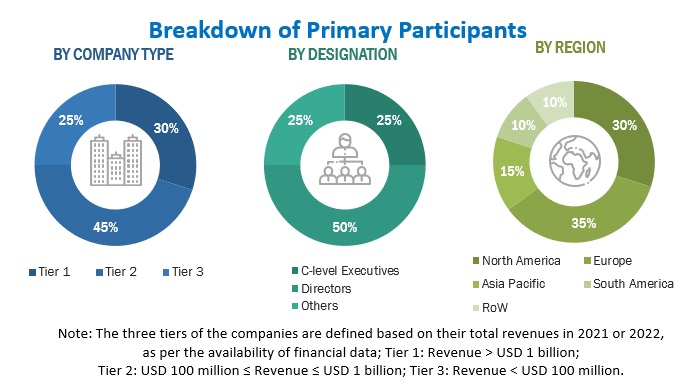
To know about the assumptions considered for the study, download the pdf brochure
|
COMPANY NAME |
designation |
|
Cisco Systems, Inc. (US) |
Sales Manager |
|
Trimble Inc. (US) |
General Manager |
|
Bayer AG (Germany) |
Manager |
|
Deere & Company (US) |
Head of digital agriculture solutions |
|
Accenture (Ireland) |
Marketing Manager |
|
IBM Corporation (US) |
Sales Executive |
|
AKVA Group (Norway) |
Head - Research & Development |
|
Hexagon AB (Sweden) |
Manager |
|
Epicor Software Corporation (US) |
R&D, QC, and production Expert |
|
AGCO Corporation (US) |
Senior Engineering Manager |
Market Size Estimation
Both the top-down and bottom-up approaches were used to estimate and validate the total size of the digital agriculture market. These approaches were also used extensively to determine the size of various subsegments in the market. The research methodology used to estimate the market size includes the following details:
- The key players in the industry and the overall markets were identified through extensive secondary research.
- All shares, splits, and breakdowns were determined using secondary sources and verified through primary sources.
- All possible parameters that affect the market covered in this research study were accounted for, viewed in extensive detail, verified through primary research, and analyzed to obtain final quantitative and qualitative data.
- The research included the study of reports, reviews, and newsletters of top market players, along with extensive interviews for opinions from leaders, such as CEOs, directors, and marketing executives.
Global Digital Agriculture Market: Bottom-Up Approach
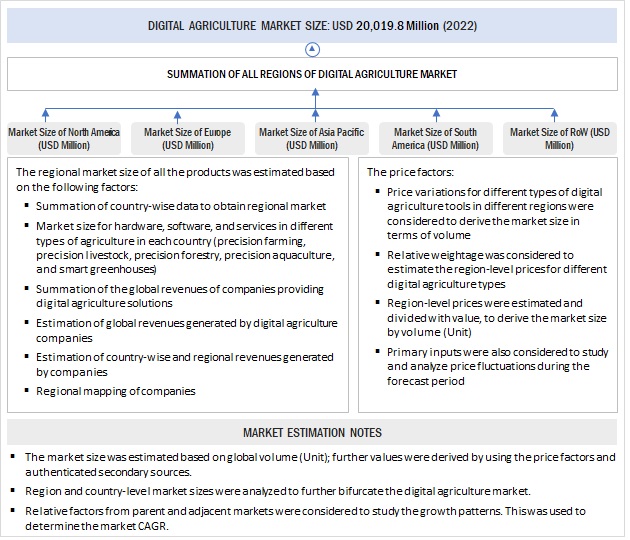
To know about the assumptions considered for the study, Request for Free Sample Report
Global Digital Agriculture Market: Top-Down Approach
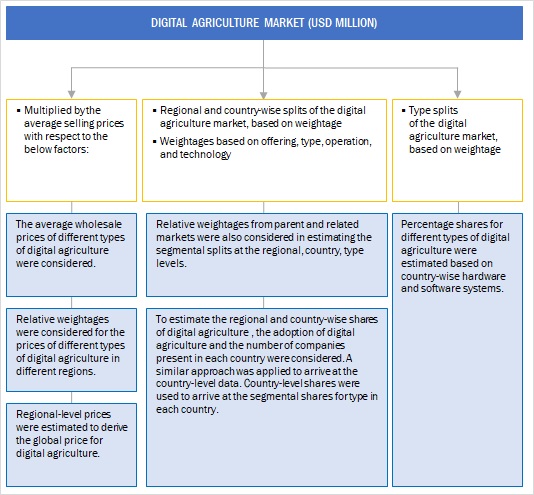
Data Triangulation
After arriving at the overall market size from the estimation process explained above, the total market was split into several segments and subsegments. Data triangulation and market breakdown procedures were employed to estimate the digital agriculture market and arrive at the exact statistics for all segments and subsegments. The data was triangulated by studying numerous factors and trends from the demand and supply sides. The market size was also validated using both the top-down and bottom-up approaches.
Market Definition
According to the International Crops Research Institute for the Semi-Arid Tropics (ICRISAT), digital agriculture is ICT and data ecosystems to support the development and delivery of timely, targeted information and services to make farming profitable and sustainable while delivering safe, nutritious, and affordable food for all.
Digital agriculture is the use of new and advanced technologies integrated into one system to enable farmers and other stakeholders within the agriculture value chain to improve food production. In contrast, a digital agriculture system gathers data more frequently and accurately, often combined with external sources (such as weather information). The resulting combined data is analyzed and interpreted so farmers can make more informed and appropriate decisions. These decisions can then be quickly implemented with greater accuracy through robotics and advanced machinery, and farmers can get real-time feedback on the impact of their actions.
Moreover, digital agriculture advances agricultural outcomes by driving more precise agriculture, better data collection and analytics, and more effective information dissemination. Digital agriculture includes precision forestry, precision aquaculture, precision livestock, and smart greenhouses.
Key Stakeholders
- Digital agriculture Raw Material Suppliers and Manufacturers
- Digital agriculture Material Importers and Exporters
- Digital agriculture Material Traders and Distributors
- Government and Research Organizations
- Digital agriculture Manufacturing Companies
- Associations and Industrial Bodies
- Agricultural Institutes and Universities
- Manufacturers and suppliers related to the digital agriculture industry.
- Concerned government authorities, commercial R&D institutions, and other regulatory bodies.
-
Regulatory bodies such as
- European GNSS Agency (GSA)
- United States Department of Agriculture (USDA)
- International Society for Precision Agriculture (ISPA)
- Government agencies and NGOs
- Commercial research & development (R&D) institutions and financial institutions
- Food and Agriculture Organization (FAO)
- Society of Precision Agriculture Australia
- National Remote Sensing Center (NRSC)
- Agricultural Research Service (ARS)
- Organization for Economic Co-operation and Development (OECD)
Report Objectives
- To determine and project the size of the digital agriculture market with respect to the type, operation, offering, technology, and region in terms of value and volume over five years, ranging from 2023 to 2028.
- To identify the attractive opportunities in the market by determining the largest and fastest-growing segments across regions.
- To provide detailed information about the key factors influencing market growth (drivers, restraints, opportunities, and challenges).
- To analyze the opportunities in the market for stakeholders and provide details of the competitive landscape for market leaders.
- To analyze the micro-markets with respect to individual growth trends, prospects, and their contribution to the total market.
- To identify and profile the key players in the digital agriculture market.
- To understand the competitive landscape and identify the major growth strategies adopted by players across the key regions.
- To provide insights on key product innovations and investments in the digital agriculture market.
Available Customizations:
With the given market data, MarketsandMarkets offers customizations according to company-specific scientific needs.
The following customization options are available for the report:
Product Analysis
- Product Matrix, which gives a detailed comparison of the product portfolio of each company.
Geographic Analysis
With the given market data, MarketsandMarkets offers customizations according to company-specific scientific needs.
- Further breakdown of the Rest of Europe’s market for digital agriculture into Denmark, Spain, Finland, and Norway.
- Further breakdown of the Rest of Asia Pacific market for digital agriculture into Thailand, Vietnam, the Philippines, and Bangladesh.
- Further breakdown of the Rest of South America market for digital agriculture into Peru, Bolivia, Paraguay, Chile, Ecuador, Colombia, and Venezuela.
- Further breakdown of the Rest of the World market for digital agriculture into Africa (South Africa, Nigeria, Zimbabwe, Namibia, Angola, and Sudan) and the Middle East (Israel, Egypt, and Turkey).
Company Information
- Detailed analyses and profiling of additional market players (up to five)
Get the Full Digital Agriculture Market Report
Full forecast, segment splits, and company analysis for all Digital Agriculture Market.
- US Digital Agriculture Market
- Canada Digital Agriculture Market
- Mexico Digital Agriculture Market
- Germany Digital Agriculture Market
- France Digital Agriculture Market
- Italy Digital Agriculture Market
- UK Digital Agriculture Market
- Sweden Digital Agriculture Market
- Netherlands Digital Agriculture Market
- Russia Digital Agriculture Market
- China Digital Agriculture Market
- Japan Digital Agriculture Market
- India Digital Agriculture Market
- Brazil Digital Agriculture Market
- Argentina Digital Agriculture Market
- Rest Of Europe Digital Agriculture Market
- Rest Of South America Digital Agriculture Market
Need a Tailored Report?
Customize this report to your needs
Get 10% FREE Customization
Customize This Report
