
Rest Of Africa Digital Substation Market (2025-2030)

The Rest Of Africa Digital Substation Market was valued at $127.9 Million in 2025 and projected to reach to $142 Million by 2030, representing a compound annual growth rate of CAGR 2.1%. Rest Of Africa's digital substation market is positioned for steady growth as regional governments accelerate electrification programs and invest in grid modernization.


| Market Size in | USD 26.32 MN |
| Market Forecast in | |
| CAGR | |
| Forecast Period | |
| Units Considered | Value (USD MN) |
Rest Of Africa Digital Substation Market Trends and Insights
- Rest Of Africa faces unique infrastructure challenges that influence the adoption of digital substation technologies, with growth driven by increasing electrification initiatives and grid modernization efforts across the region.
- Rest Of Africa's market expansion is constrained by limited capital investment and technical expertise, yet emerging opportunities exist as governments prioritize renewable energy integration and smart grid development. Rest Of Africa's digital substation sector reflects the broader energy transition occurring across the continent, with utilities gradually transitioning from legacy systems to digitalized infrastructure.
- Rest Of Africa's modest growth trajectory through 2030 underscores the region's gradual pace of technological adoption compared to global benchmarks.
- Rest Of Africa's market participants are increasingly focusing on cost-effective solutions tailored to local grid requirements and regulatory frameworks..
Key Market Statistics
- CAGR (2025-2030) CAGR 2.1%
- Market Size, 2025 ~USD 127.9 Million
- Forecast, 2030 ~USD 142 Million
- Country Rest Of Africa
Rest Of Africa Digital Substation Market Overview
Modest Growth Trajectory :
Rest Of Africa's digital substation market is estimated at USD 127.9 million in 2025, growing to USD 142.0 million by 2030 at a CAGR of 2.1%, reflecting gradual infrastructure modernization across the region.
Electrification-Driven Expansion :
Increasing electrification initiatives across Rest Of Africa are catalyzing digital substation adoption, as governments prioritize grid expansion to underserved rural and urban areas.
Infrastructure Modernization Focus :
Grid modernization projects in Rest Of Africa are driving demand for digital substation technologies to improve reliability, reduce losses, and enhance operational efficiency across aging power networks.
Regional Challenges Impact Growth :
Unique infrastructure challenges including limited capital availability, technical expertise gaps, and fragmented regulatory frameworks constrain the pace of digital substation technology adoption in Rest Of Africa.
Rest Of Africa Digital Substation Market Dynamics
- The market's 2.1% CAGR reflects the region's gradual transition toward smart grid technologies, driven by increasing energy demand and the need to improve power distribution efficiency.
- However, growth remains constrained by infrastructure limitations and capital constraints. Looking ahead to 2030, Rest Of Africa will see incremental adoption of digital substation solutions, particularly in major urban centers and industrial zones.
- Investment in renewable energy integration and grid stability will create opportunities for digital substation deployment.
- Strategic partnerships with international technology providers and regional development initiatives will be critical to accelerating market penetration and overcoming existing infrastructure barriers..
Market Ecosystem
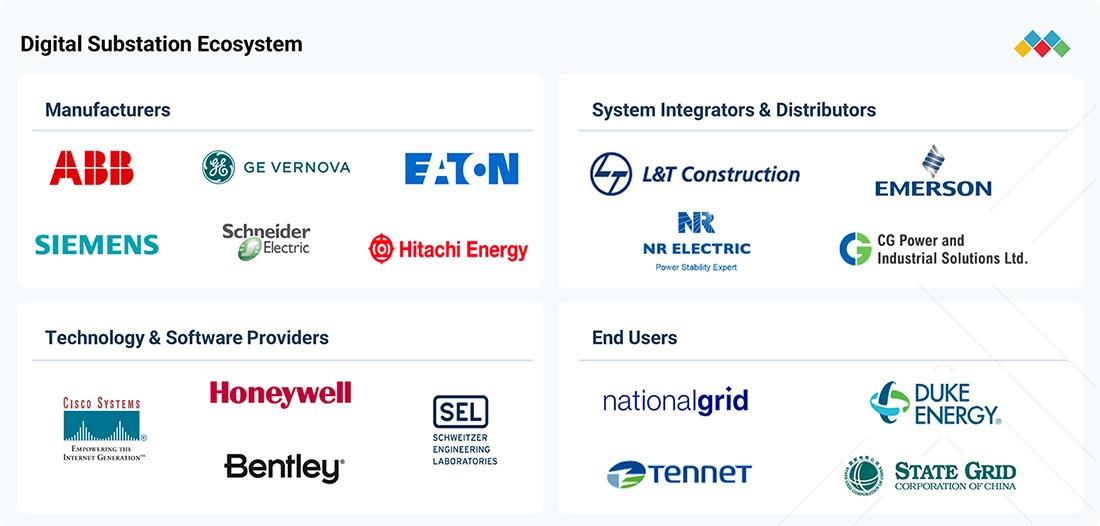
DIGITAL SUBSTATION MARKET: COMMERCIAL USE CASES ACROSS INDUSTRIES
| COMPANY | USE CASE DESCRIPTION | BENEFITS |
|---|---|---|
 |
TEPCO Power Grid uses sensing and digital technologies across substations and grid infrastructure to monitor equipment condition, operating status, and abnormal conditions. Its advanced substation initiatives combine sensors, remote monitoring, AI, and other digital technologies to assess equipment status and support automated and remote maintenance. | Enables real-time equipment monitoring | Supports remote and predictive maintenance | Reduces inspection requirements and downtime | Improves grid reliability and operational efficiency |
 |
KEPCO integrates sensor-based monitoring, digital substations, and predictive diagnostics across transmission and distribution infrastructure. Its systems use real-time sensor data to monitor transformers, GIS, underground cables, and other power assets, while smart distribution systems enable real-time monitoring and control of grid equipment. | Enables early fault detection | Supports predictive maintenance | Improves equipment reliability and grid stability | Enables automated and remote grid operations |
 |
National Grid deploys sensor-based grid monitoring technologies, including dynamic line rating sensors and AI-enabled infrastructure monitoring. Its DLR deployment uses non-contact sensors and analytics to identify available capacity on overhead lines, while digital monitoring supports asset inspection and network management. | Enables real-time line and asset monitoring | Increases utilization of existing grid infrastructure | Supports integration of renewable power | Improves network reliability and maintenance planning |
 |
Statnett uses sensors across its transmission network to monitor asset condition and operating parameters. Its sensor deployments include transformer and substation monitoring as well as Dynamic Line Rating sensors on transmission lines, enabling more accurate assessment of line capacity and asset health. | Enables accurate asset-condition monitoring | Supports predictive maintenance | Increases transmission-line capacity | Improves grid utilization and reliability |
 |
Duke Energy uses electronic sensors, switches, smart grid devices, and monitoring systems to track grid conditions and equipment status. Its smart-grid initiatives include instrumented distribution equipment such as reclosers, smart meters, sensors, and PMUs, enabling remote monitoring and control of grid assets. | Enables real-time grid monitoring | Supports automated fault detection and control | Improves outage response and grid reliability | Enables efficient management of distributed energy resources |
Logos and trademarks shown above are the property of their respective owners. Their use here is for informational and illustrative purposes only.
Related Ecosystem
Smart Grid
- Meter Data Management (MDM)
- Sensors
- Workforce Management
- Cellular Network
- Customer Analytics
- SCHNEIDER ELECTRIC SE
- Siemens ag
- ABB India Limited
- Eaton Corporation plc
- Hitachi Energy India Limited
Electronics System And Components
- Sensors
- Temperature Sensors
- Pressure Sensors
- Actuators
- Image Sensors
- Lenovo
- Samsung
- Texas Instruments Incorporated
- HONEYWELL INTERNATIONAL INC.
- Teledyne Technologies Incorporated
Industrial Iot
- Sensors
- Pressure Sensors
- Flow Sensors
- Gas Sensors
- Image Sensors
- Siemens ag
- ABB India Limited
- HONEYWELL INTERNATIONAL INC.
- Emerson Electric Co.
- SCHNEIDER ELECTRIC SE
Key Takeaways
- Rest Of Africa's digital substation market will grow from USD 127.9 million (2025) to USD 142.0 million (2030) at a 2.1% CAGR.
- Rest Of Africa's market growth is driven by electrification initiatives and renewable energy integration across the region.
- Rest Of Africa faces infrastructure and capital constraints that limit faster adoption of digital substation technologies.
- Rest Of Africa's utilities are increasingly adopting cost-effective, localized digital solutions to modernize aging grid infrastructure.
Digital Substation Market Report Scope
| Report Metric | Details |
|---|---|
| Base Year | 2025 |
| Fastest Growing Segment | SCADA SYSTEMS (Module) |
| Forecast Period | 2025–2030 |
| Growth Rate | CAGR of 6.5% from 2025 to 2030 |
| Largest Segment | HARDWARE (Module) |
| Market Size Base Year (Billions) | ~USD 14.44 (2025) |
| Revenue Forecast (Billions) | ~USD 19.78 (2030) |
| Segments Covered | Type, Installation Type, Industry, Module, Voltage, Hardware Type, Utility Type, Protection Devices Type |
Rest Of Africa Digital Substation Market Report Segmentation
8 segment dimensions are covered across the global market.
By Type
- Bus Bars
- Circuit Breakers
- Distribution
- Distribution Substations
- Interfacing Units
- Other Hardware Types
- Protection Devices
- Protection Relays
- Switch Gears
- Transformers
- Transmission
- Transmission Substations
By Installation Type
- New Installations
- Retrofit
By Industry
- Heavy Industries
- Other Industries
- Transportation
- Utilities
By Module
- Fiber-Optic Communication Networks
- Hardware
- Scada Systems
By Voltage
- 220–550 Kv
- 220–550Kv
- Above 550 Kv
- Above 550Kv
- Up To 220 Kv
- Up To 220Kv
By Hardware Type
- Bus Bars
- Interfacing Units
- Other Hardware Type
- Other Hardware Types
- Protection Devices
- Transformers
By Utility Type
- Non-Renewable
- Non-Renewables
- Renewable
- Renewables
By Protection Devices Type
- Circuit Breakers
- Protection Relays
- Switch Gears
Target Audience
- Utility Companies & Grid Operators : Rest Of Africa utility operators need market intelligence to plan digital substation investments, optimize grid modernization budgets, and align infrastructure upgrades with regional electrification timelines.
- Technology & Equipment Manufacturers : Substation equipment and digital technology providers require Rest Of Africa-specific market data to develop localized product strategies, identify customer segments, and establish regional distribution partnerships.
- Infrastructure Investment Firms : Private equity and infrastructure investors need detailed Rest Of Africa market analysis to evaluate investment opportunities in grid modernization projects and digital substation deployments across the region.
- Government & Regulatory Bodies : African government agencies and regulators require market insights to inform electrification policies, grid modernization standards, and technology adoption frameworks specific to Rest Of Africa's infrastructure needs.
- Consulting & Engineering Firms : Engineering consultants and project developers need Rest Of Africa market data to advise clients on digital substation feasibility, cost-benefit analysis, and implementation strategies for regional grid projects.
Key Companies in the Rest Of Africa Digital Substation Market
| Company | HQ | Ownership | Strongest segments |
|---|---|---|---|
| KONGSBERG GRUPPEN | Norway | Public Company | Air defence, combat systems, and C2,Missiles (naval strike and air-to-surface),Remote weapon stations and land systems, |
| AT&S | Canada | Public Company | Turnkey automated manufacturing and assembly systems,Lifecycle and post-automation services,Software and digital solutions, |
| TECH MAHINDRA LIMITED | India | Public Company | Application services and digital enterprise platforms (SAP, Oracle, Salesforce, ServiceNow, digital process solutions),Engineering, network, and testing services,Cloud and infrastructure services (CLOUDNXT.NOW, data center, FLEX digital workplace, enterprise mainframe), |
| KEC INTERNATIONAL LIMITED | India | Public Company | Transmission & Distribution EPC (including GIS and substations),Railway EPC and Urban Transport,Civil Infrastructure (transport, industrial, residential/defense, data centers, water), |
| ABB | Switzerland | Public Company | Electrification,Motion,Automation, |
| GE VERNOVA | United States | Public Company | Power (gas, nuclear, hydro, steam),Wind (onshore and offshore),Electrification (grid, power conversion, software, solar and storage), |
| MITSUBISHI ELECTRIC CORPORATION | Japan | Public Company | Infrastructure, Energy, Defense & Space Systems,Factory Automation & Industrial Systems,Automotive Equipment, |
| EATON | Ireland | Public Company | Electrical Americas (power distribution, power quality, residential, utility),Electrical Global (hazardous duty, emergency lighting, structural support),Aerospace (hydraulics, fuel systems, thermal management, filtration), |
| HONEYWELL INTERNATIONAL INC. | United States | Public Company | Industrial Automation,Building Automation,Energy and Sustainability Solutions (UOP and related), |
| TOSHIBA CORPORATION | Japan | Private Company | Energy Systems & Solutions,Infrastructure Systems & Solutions,Building Solutions, |
| CISCO | United States | Public Company | Data Center and Campus Switching/Routing,Network Security and SASE,Collaboration and Webex Suite, |
| LANNER ELECTRONICS | Taiwan | Public Company | x86 Network Appliances (rackmount & desktop, SD-WAN/security),Rugged & Industrial Edge Computers (DIN-rail, vehicle, rail, IEC61850-3),Edge AI Appliances & NVIDIA GPU-based Systems, |
| WELOTEC GMBH | Germany | Private Company | Industrial networking & routers,Industrial PCs & edge computing,Remote access & security solutions, |
KONGSBERG GRUPPEN
Kongsberg Gruppen is a Norwegian public company founded in 1814 with 7,586 employees. It operates as a diversified industrial group with operations across multiple sectors.
AT&S
AT&S is a Canadian public company founded in 1978 with 7,000 employees. It operates in the technology and industrial sectors.
TECH MAHINDRA LIMITED
Tech Mahindra Limited is an Indian public company founded in 1986 with 119,337 employees. It is a major information technology and business process management services provider.
KEC INTERNATIONAL LIMITED
KEC International Limited is an Indian public company founded in 1945 with 6,709 employees. It operates in the engineering and construction sectors.
ABB
ABB is a Swiss public company founded in 1883 with 111,900 employees. It is a leading provider of electrification, robotics, and industrial automation solutions.
GE VERNOVA
GE Vernova is a United States-based public company founded in 2023 with 78,000 employees. It operates in the energy and power generation sector.
MITSUBISHI ELECTRIC CORPORATION
Mitsubishi Electric Corporation is a Japanese public company founded in 1921 with 150,386 employees. It manufactures electrical and electronic equipment across industrial, consumer, and infrastructure sectors.
EATON
Eaton is an Ireland-based public company founded in 1911 with 97,303 employees. It provides power management solutions and diversified industrial products.
HONEYWELL INTERNATIONAL INC.
Honeywell International Inc. is a United States-based public company founded in 1885 with 101,000 employees. It operates in aerospace, building technologies, performance materials, and safety solutions.
TOSHIBA CORPORATION
Toshiba Corporation is a Japanese private company founded in 1875 with 106,648 employees. It operates across electronics, energy, infrastructure, and digital solutions sectors.
CISCO
Cisco is a United States-based public company founded in 1984 with 86,200 employees. It is a leading provider of networking and cybersecurity solutions.
LANNER ELECTRONICS
Lanner Electronics is a Taiwan-based public company founded in 1986. It operates in the electronics and computing sector.
WELOTEC GMBH
Welotec GmbH is a German private company founded in 1991. It operates in the industrial technology sector.
Reasons to Buy this Report
- Regional Market Sizing & Forecasts : Obtain precise market valuations for Rest Of Africa's digital substation sector with detailed 2025-2030 projections, enabling accurate investment planning and resource allocation decisions specific to the region.
- Growth Driver Analysis : Understand the specific electrification and grid modernization factors propelling Rest Of Africa's market, allowing you to identify high-potential segments and timing for market entry or expansion.
- Infrastructure Challenge Insights : Gain detailed intelligence on unique regional barriers including capital constraints and technical gaps, enabling you to develop tailored solutions and competitive strategies for Rest Of Africa's market conditions.
- Competitive Positioning Strategy : Benchmark your offerings against regional market dynamics and identify white-space opportunities in Rest Of Africa's emerging digital substation landscape with lower competition than global markets.
- Investment & Partnership Opportunities : Identify strategic investment targets and partnership prospects aligned with Rest Of Africa's electrification priorities and grid modernization roadmaps for sustainable market growth.
Frequently asked questions
What is the market size of digital substations in Rest Of Africa in 2025?
Rest Of Africa's digital substation market is valued at USD 127.9 million in 2025.
What is the projected market size for Rest Of Africa by 2030?
Rest Of Africa's digital substation market is forecast to reach USD 142.0 million by 2030.
What is the CAGR for Rest Of Africa's digital substation market?
Rest Of Africa's digital substation market is expected to grow at a CAGR of 2.1% from 2025 to 2030.
What factors are driving growth in Rest Of Africa's digital substation market?
Rest Of Africa's market growth is primarily driven by electrification initiatives, grid modernization efforts, and increasing renewable energy integration across the region.
What challenges does Rest Of Africa face in digital substation adoption?
Rest Of Africa faces significant challenges including limited capital investment, technical expertise gaps, and aging infrastructure that slow the pace of digital substation technology deployment.
RESEARCH METHODOLOGY
The study involved four major activities in estimating the current size of the global digital substation market. Extensive secondary research was conducted to gather information on the digital substation ecosystem, including substation automation providers, protection and control equipment manufacturers, IED suppliers, communication technology providers, SCADA and software providers, system integrators, utilities, transmission and distribution operators, renewable energy companies, and industrial end users. This was followed by primary research with industry stakeholders across the value chain, including digital substation manufacturers, technology developers, protection and automation providers, communication equipment suppliers, system integrators, utilities, renewable energy developers, industrial companies, and end users, to validate assumptions and market sizing.
Both top-down and bottom-up approaches were used to estimate the overall market size. Market breakdowns and data triangulation techniques were then applied to determine the size of individual segments and subsegments by component, module, voltage level, installation, technology, application, end user, and region. Secondary and primary sources were jointly used to support a comprehensive technical, commercial, and competitive analysis of the global market. Digital-substation technologies considered include IEC 61850-based automation, protection and control, IEDs, process-bus systems, SCADA, communication networks, monitoring and diagnostics, and digital substation software.
Secondary Research
Various secondary sources were referred to during the secondary research process to identify and collect information relevant to the digital substation market. These sources included annual reports, company presentations, press releases, product catalogs, technical datasheets, patents, technical journals, industry publications, company websites, trade directories, utility publications, standards organizations, and government databases. Secondary research was conducted to obtain key insights into the market’s supply chain, value chain, competitive landscape, technology ecosystem, and segmentation by component, module, voltage level, installation, technology, application, end user, and region. It also helped assess industry trends, adoption of digital substations across transmission and distribution networks, renewable energy projects, industrial facilities, and smart-grid applications, as well as advancements in IEC 61850, digital protection and control, IEDs, process-bus communication, SCADA, cybersecurity, digital monitoring, and automation technologies. Company-level research included assessment of portfolios from leading providers such as Hitachi Energy, Siemens Energy, ABB, GE Vernova, and Schneider Electric. The collected information was further analyzed to estimate the overall market size and validate market assumptions, which were subsequently refined through primary research with industry experts and key stakeholders.
Primary Research
Extensive primary research was conducted after gaining knowledge about the current scenario of the digital substation market through secondary research. Several primary interviews were conducted with experts from the demand and supply sides across four major regions: North America, Europe, Asia Pacific, and RoW. This primary data was collected through questionnaires, emails, and telephonic interviews.
Breakdown of Primary Interviews
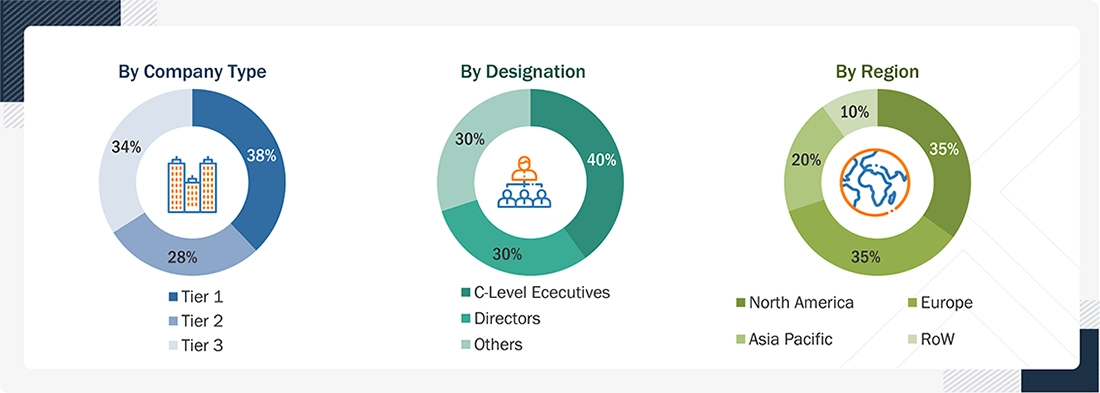
Note: The three tiers of the companies are defined based on their total revenue in 2025: Tier 1 - revenue greater than or equal to USD 1 billion; Tier 2 - revenue between USD 100 million and USD 1 billion; and Tier 3 revenue less than or equal to USD 100 million. Other designations include sales managers, marketing managers, and product managers.
To know about the assumptions considered for the study, download the pdf brochure
Market Size Estimation
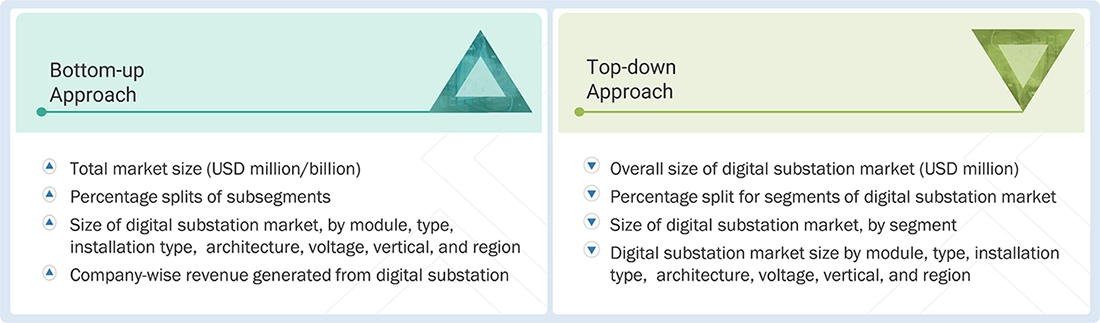
Both top-down and bottom-up approaches were used to estimate and validate the total size of the digital substation market. These methods have also been used extensively to estimate the size of various subsegments in the market. The following research methodology was used to estimate the market size:
- Major players in the digital substation market and related markets were identified through extensive secondary research.
- The industry’s value chain and market size in terms of value and volume were determined through primary and secondary research processes.
- All percentage shares, splits, and segment-level breakdowns were determined using secondary sources and verified through primary research and data triangulation.
Digital Substation Market: Top-Down and Bottom-Up Approach
Data Triangulation
After arriving at the overall size of the digital substation market through the market size estimation process, the total market was divided into relevant segments and subsegments. Data triangulation and market breakdown procedures were employed, where applicable, to complete the market engineering process and derive statistics for each segment and subsegment. The data were triangulated by evaluating factors and trends from the demand and supply sides, including grid modernization investments, digitalization of transmission and distribution networks, renewable energy integration, substation automation adoption, product deployments, technology developments, utility requirements, and regional trends. The analysis considered key digital substation technologies such as IEC 61850-based communication, intelligent electronic devices (IEDs), protection and control systems, process-bus technology, merging units, SCADA, digital monitoring, automation systems, and cybersecurity solutions. Digital substation applications across transmission, distribution, renewable energy, industrial, and infrastructure sectors were also considered. The market size was validated using top-down and bottom-up approaches to ensure consistency across the overall market and individual segments.
Market Definition
Digital substations refer to electrical substations that use digital communication, intelligent electronic devices, automated protection and control systems, and advanced monitoring technologies to acquire, transmit, process, and exchange electrical and operational data. Unlike conventional substations that rely extensively on point-to-point copper wiring, digital substations use Ethernet-based communication and IEC 61850 process-bus architectures to transmit measurements, status information, and control signals between field equipment and protection and control systems.
Digital substations play an important role in grid modernization, renewable-energy integration, distributed energy resources, and improving power-system reliability and operational efficiency. Process-bus architectures can replace extensive copper connections with standardized digital communication, while merging units convert current and voltage measurements into digital signals for use by protection and control IEDs. These capabilities support improved interoperability, reduced wiring requirements, remote diagnostics, condition-based maintenance, and more flexible substation configurations.
Key Stakeholders
- Primary equipment manufacturers (transformers, switchgear, circuit breakers, etc.)
- Intelligent electronic device (IED) manufacturers
- Supervisory control and data acquisition (SCADA) solution providers
- Communication network providers
- Engineering, procurement & construction (EPC) firms/system integrators
- Power utility companies
- Turnkey contractors
- Distributors and traders
- Research organizations
- Regulatory bodies & government energy agencies
- Forums, alliances, and associations
Report Objectives
- To define, analyze, and forecast the digital substation market size by module, type, installation type, voltage, architecture type, industry, and region, in terms of value
- To define, analyze, and forecast the market size, by hardware, in terms of volume
- To forecast the market size for various segments with respect to four main regions, namely North America, Europe, Asia Pacific, and RoW, in terms of value
- To provide detailed information regarding the major drivers, restraints, opportunities, and challenges influencing the market growth
- To study the complete supply chain and related industry segments for the market
- To strategically study the micro markets with respect to individual growth trends, prospects, and contributions to the total market
- To analyze the supply chain, market ecosystem, trends/disruptions impacting customers’ business, technology analysis, pricing analysis, Porter’s five forces model, key stakeholders & buying criteria, case study analysis, trade analysis, patent analysis, key conferences & events, regulations, and investment and funding scenario
- To understand opportunities in the market for various stakeholders by identifying the high-growth segments of the market
- To strategically profile the key players and comprehensively analyze their market position in terms of ranking, core competencies, company valuation and financial metrics, and product/brand comparison, along with detailing the competitive landscape for the market leaders
- To analyze competitive developments such as product launches, agreements, partnerships, collaborations, contracts, acquisitions, expansions, and research and development (R&D) activities carried out by players in the market
Available customizations:
With the given market data, MarketsandMarkets offers customizations according to the company’s specific needs. The following customization options are available for the report:
Company Information
-
Detailed analysis and profiling of additional market players (up to 5)
Get the Full Digital Substation Market Report
Full forecast, segment splits, and company analysis for all Digital Substation Market.
- Canada Digital Substation Market
- Mexico Digital Substation Market
- US Digital Substation Market
- UK Digital Substation Market
- Germany Digital Substation Market
- France Digital Substation Market
- Italy Digital Substation Market
- Spain Digital Substation Market
- Poland Digital Substation Market
- China Digital Substation Market
- Japan Digital Substation Market
- South Korea Digital Substation Market
- India Digital Substation Market
- Australia Digital Substation Market
- Indonesia Digital Substation Market
- Malaysia Digital Substation Market
- Thailand Digital Substation Market
- Vietnam Digital Substation Market
- Nordics Digital Substation Market
- Rest Of Europe Digital Substation Market
- Rest Of Asia Pacific Digital Substation Market
- Bahrain Digital Substation Market
- Kuwait Digital Substation Market
- Oman Digital Substation Market
- Qatar Digital Substation Market
- Rest Of Middle East Digital Substation Market
- Saudi Arabia Digital Substation Market
- UAE Digital Substation Market
- South Africa Digital Substation Market
Need a Tailored Report?
Customize this report to your needs
Get 10% FREE Customization
Customize This Report
