
Canada Display Module Market (2026-2031)

The Canada Display Module Market was valued at $148.8 Million in 2026 and projected to reach to $553.2 Million by 2031, representing a compound annual growth rate of 24.5%. Canada's display module market is poised for exceptional expansion over the next five years, driven by robust demand across multiple sectors including consumer electronics, automotive, and industrial applications.


| Market Size in | USD 26.32 MN |
| Market Forecast in | |
| CAGR | |
| Forecast Period | |
| Units Considered | Value (USD MN) |
Canada Display Module Market Trends and Insights
- This represents a compound annual growth rate of 24.5%, significantly outpacing global trends.
- Canada's market expansion is driven by increasing demand for advanced display technologies across consumer electronics, automotive, and industrial applications, supported by the country's robust technology infrastructure and manufacturing capabilities. The Canadian display module sector benefits from strong regional demand and strategic positioning within North America's semiconductor ecosystem.
- Between 2026 and 2031, Canada is expected to capture substantial market share through innovation in LCD, OLED, and emerging display technologies.
- Canada's growth trajectory reflects both domestic consumption patterns and its role as a key hub for electronics manufacturing and distribution in North America..
Key Market Statistics
- CAGR (2026-2031) 24.5% CAGR
- Market Size, 2026 ~USD 148.8 Million
- Forecast, 2031 ~USD 553.2 Million
- Country Canada
Canada Display Module Market Overview
Exceptional Growth Trajectory :
Canada's display module market is projected to grow from $148.8 million in 2026 to $553.2 million by 2031, representing a robust 24.5% CAGR that significantly exceeds the global average of 2.6%.
Key Application Drivers :
Growth is fueled by increasing adoption of advanced display technologies across consumer electronics, automotive infotainment systems, and industrial automation applications throughout Canada.
Regional Market Leadership :
Canada's display module market demonstrates stronger growth momentum compared to global trends, positioning the country as a high-potential market for display technology investments and expansion.
Technology Adoption Acceleration :
Rising demand for high-resolution displays, touchscreen interfaces, and smart display solutions in Canadian consumer and industrial sectors is accelerating market penetration and revenue growth.
Canada Display Module Market Dynamics
- The 24.5% CAGR reflects strong technology adoption rates and increasing consumer preference for advanced display solutions.
- Key growth catalysts include the expansion of electric vehicle production in Canada, rising smart home adoption, and increased industrial automation investments.
- The market's outperformance relative to global trends indicates Canada's strategic importance as a technology hub and growing consumer base for display innovations..
Market Ecosystem
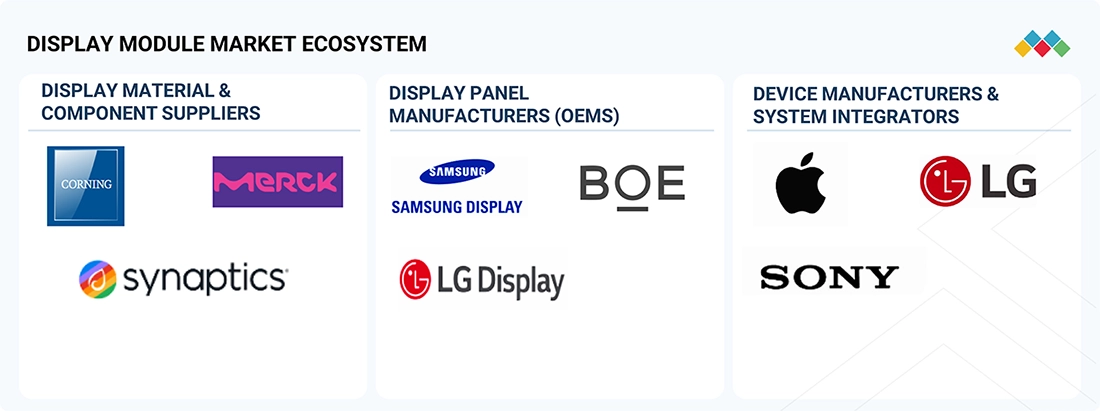
DISPLAY MODULE MARKET: COMMERCIAL USE CASES ACROSS INDUSTRIES
| COMPANY | USE CASE DESCRIPTION | BENEFITS |
|---|---|---|
 |
Expanding OLED, AMOLED, and foldable display modules for smartphones, automotive displays, IT devices, and XR applications, with a focus on thinner, energy-efficient, and high-performance modules | Enhanced display quality and power efficiency | Advanced flexible display solutions | Stronger premium product positioning |
 |
Increasing production of OLED, Mini-LED, and flexible display modules while expanding manufacturing capacity for consumer electronics, automotive, and industrial applications | Higher production scalability | Improved display module performance | Expanded customer reach |
 |
Developing OLED and large-format display modules for TVs, automotive, gaming, and commercial applications with enhanced brightness, durability, and energy efficiency | Superior visual performance | Improved energy efficiency | Broader adoption in premium and automotive applications |
Logos and trademarks shown above are the property of their respective owners. Their use here is for informational and illustrative purposes only.
Related Ecosystem
Display Technology
- Augmented Reality
- Liquid Crystal Display (LCD)
- Sensors
- Virtual Reality Devices
- Liquid Crystal on Silicon (LCOS)
- VIVITEK CORPORATION
- Samsung
- Lenovo
- Panasonic Holdings Corporation
- Lg corp
Key Takeaways
- Canada's display module market will grow from $148.8M (2026) to $553.2M (2031), a 24.5% CAGR.
- Canada significantly outperforms the global market growth rate of 2.6%, indicating strong regional demand.
- Canada's strategic position in North America supports manufacturing and distribution of advanced display technologies.
- Canada's market expansion is fueled by automotive, consumer electronics, and industrial display applications.
Display Module Market Report Scope
| Report Metric | Details |
|---|---|
| Base Year | 2026 |
| Fastest Growing Segment | MICROLED (Display Technology) |
| Forecast Period | 2026-2031 |
| Growth Rate | CAGR of 2.6% from 2026 to 2031 |
| Largest Segment | ELECTRONIC (NON-OPTICAL) (Type) |
| Market Size Base Year (Billions) | ~USD 137 (2026) |
| Revenue Forecast (Billions) | ~USD 155.76 (2031) |
| Segments Covered | Type, Display Technology, Display Type, Product Type, Technology, Electronic Type, End Use, Display Size |
Canada Display Module Market Report Segmentation
8 segment dimensions are covered across the global market.
By Type
- Electronic (Non-Optical)
- Optical
- Other Non-Optical Module-Based Products
- Smartphones
- Tablets, Monitors & Laptops
By Display Technology
- Dlp
- E-Paper
- Laser Beam Scanning
- Laser-Beam Scanning
- Lcd
- Lcos
- Led
- Microled
- Oled
- Oledos
- Other Optical Display Technologies
- Tft Lcd
By Display Type
- Ar
- Vr & Mr
By Product Type
- Hmds
- Huds
- Other Non-Optical Module-Based Products
- Smartphones
- Tablets, Monitors & Laptops
By Technology
- Dlp
- Laser Beam Scanning
- Oled
By Electronic Type
- Other Non-Optical Module-Based Products
- Smartphones
- Tablets, Monitors & Laptops
- Tablets, Monitors, & Laptops
By End Use
- Aerospace & Defense
- Automotive
- Consumer Electronics
- Education
- Healthcare
- Industrial
- Other End Uses
- Retail, Hospitality & Bfsi
- Sports & Entertainment
- Transportation
By Display Size
- 0.5-1 Inch
- Less Than 0.5 Inch
- Microdisplays
- More Than 1 Inch
- More Than 9 Inches
- Up To 9 Inches
Target Audience
- Display Module Manufacturers : Manufacturers need Canada-specific market data to identify growth opportunities, assess competitive positioning, and develop targeted expansion strategies in this high-growth regional market.
- Electronics & Automotive OEMs : Original equipment manufacturers require detailed demand forecasts and application insights to optimize supply chain planning and product development for the Canadian market.
- Investment & Private Equity Firms : Investors need comprehensive market analysis and growth projections to evaluate investment opportunities and assess the strategic value of display technology companies in Canada.
- Technology Distributors & Resellers : Distribution partners require market sizing, growth forecasts, and sector-specific demand data to optimize inventory, sales strategies, and channel partnerships in Canada.
- Strategic Business Consultants : Consultants advising clients on market entry, expansion, or M&A activities in Canada's display sector need detailed market intelligence and competitive landscape analysis.
Reasons to Buy this Report
- Market-Specific Growth Intelligence : Gain detailed insights into Canada's 24.5% CAGR growth trajectory, enabling strategic planning and investment decisions tailored to this high-growth regional market.
- Competitive Positioning Data : Understand Canada's market dynamics relative to global trends, identifying competitive advantages and market gaps specific to Canadian manufacturers and distributors.
- Sector-Specific Application Insights : Access detailed analysis of display module demand across Canadian consumer electronics, automotive, and industrial sectors to target high-opportunity segments.
- Investment & Expansion Strategy : Leverage comprehensive market forecasts through 2031 to make informed decisions about market entry, capacity expansion, or partnership development in Canada.
- Regulatory & Market Context : Understand Canada-specific market conditions, supply chain dynamics, and technology adoption patterns essential for successful market penetration and growth.
Frequently asked questions
What is the current size of Canada's display module market?
Canada's display module market is estimated at $148.8 million in 2026, with projections to reach $553.2 million by 2031.
What is Canada's display module market CAGR?
Canada's display module market is growing at a compound annual growth rate of 24.5% from 2026 to 2031.
How does Canada's growth compare to global trends?
Canada's 24.5% CAGR significantly exceeds the global display module market CAGR of 2.6%, demonstrating exceptional regional momentum.
What applications drive Canada's display module demand?
Canada's display module market is driven by consumer electronics, automotive displays, industrial applications, and emerging technologies like OLED and advanced LCD solutions.
What is Canada's market size forecast for 2031?
Canada's display module market is forecasted to reach $553.2 million by 2031, representing a 272% increase from 2026 levels.
RESEARCH METHODOLOGY
The study involved four major activities in estimating the current size of the display module market. Exhaustive secondary research was conducted to gather information on the market, adjacent markets, and the overall high-end refractometer landscape. These findings, along with assumptions and projections, were validated through primary research involving interviews with industry experts and key stakeholders across the value chain. Both top-down and bottom-up approaches were utilized to estimate the overall market size. Subsequently, market breakdown and data triangulation techniques were applied to determine the sizes of various segments and subsegments. Two key sources, secondary and primary, were leveraged to conduct a comprehensive technical and commercial assessment of the display module market.
Secondary Research
The secondary research process referred to various secondary sources to identify and collect necessary information for this study. The secondary sources included annual reports, press releases, and investor presentations of companies; white papers; journals and certified publications; and articles from recognized authors, websites, directories, and databases. Secondary research was conducted to obtain key information about the industry’s supply chain, the market’s value chain, the total pool of key players, market segmentation according to the industry trends (to the bottom-most level), regional markets, and key developments from market- and technology-oriented perspectives. The secondary data was collected and analyzed to determine the overall market size, which is further validated through primary research.
Primary Research
Extensive primary research was conducted after gaining knowledge about the current scenario of the display module market through secondary research. Several primary interviews were conducted with experts from the demand and supply sides across five major regions—North America, Europe, Asia Pacific, and the RoW. This primary data was collected through questionnaires, emails, and telephonic interviews.
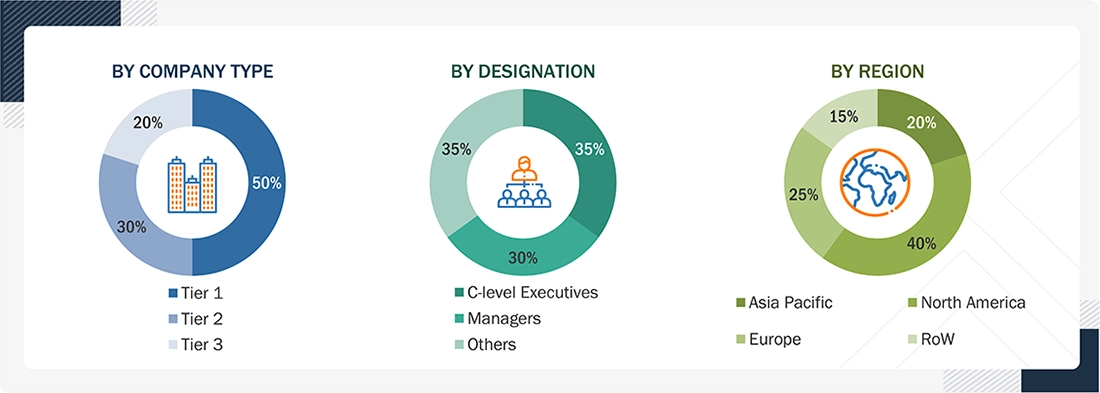
Notes: The three tiers of companies have been defined based on their total revenue as of 2025. The categorization given below has been applied:
To know about the assumptions considered for the study, download the pdf brochure
Market Size Estimation
In the complete market engineering process, top-down and bottom-up approaches and several data triangulation methods were used to estimate and forecast the overall market segments and subsegments listed in this report. Key players in the market were identified through secondary research, and their market shares in the respective regions were determined through primary and secondary research. This entire procedure included the study of annual and financial reports of the top market players and extensive interviews for key insights (quantitative and qualitative) with industry experts (CEOs, VPs, directors, and marketing executives).
All percentage shares, splits, and breakdowns were determined using secondary sources and verified through primary sources. All the parameters affecting the markets covered in this research study were accounted for, viewed in detail, verified through primary research, and analyzed to obtain the final quantitative and qualitative data. This data was consolidated and supplemented with detailed inputs and analysis from MarketsandMarkets and presented in this report.
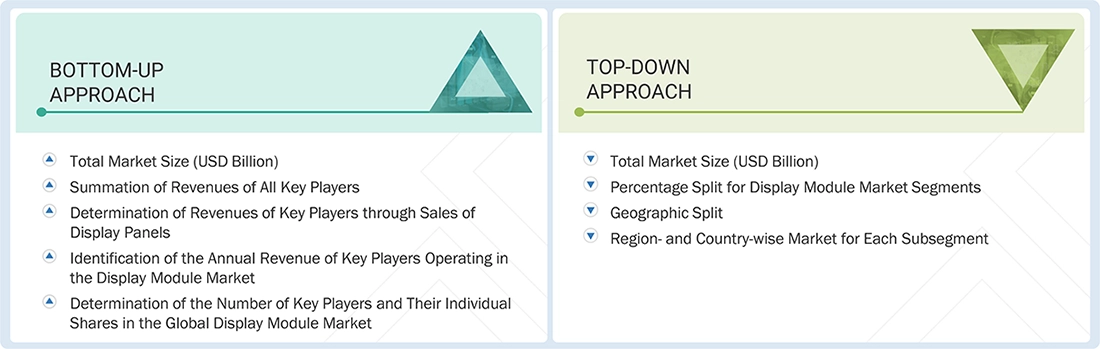
- Approach to arrive at market size using bottom-up analysis (demand side)
- Companies offering display panels were identified, and their offerings were mapped based on technology and panel size footprint.
- The global display module market size was derived through the data sanity method. The revenues of display panel providers were analyzed through annual reports and press releases and summed up to derive the overall market size.
- For each company, a percentage was assigned to the overall revenue to derive the revenues from display panels.
- Each company’s percentage was assigned after analyzing various factors, including its product offerings, geographic presence, R&D expenditures and initiatives, and recent developments/strategies adopted for growth in the display module market.
- For the CAGR, the market trend analysis of display panels was carried out by understanding the industry penetration rate and the demand and supply of display panels to different verticals.
- Estimates at every level were verified and cross-checked by discussing them with key opinion leaders, including sales heads, directors, operations managers, and market domain experts of MarketsandMarkets.
- Various paid and unpaid information sources, such as annual reports, press releases, white papers, and databases, were studied.
The top-down approach was used to estimate and validate the total size of the display module market.
- Focusing initially on the top-line investments and expenditures being made in the ecosystem of displays, further splitting into display technology, product type, display size, end-use industry, and display resolution, and listing key developments in key market areas
- Identifying all major players in the display module market and their product portfolio for various verticals through secondary research, as well as verifying with a brief discussion with industry experts
- Analyzing revenues, product mix, geographic presence, and key verticals for which all identified players serve, display products/technologies to estimate and arrive at the percentage splits for all key segments
- Discussing these splits with the industry experts to validate the information and identify key growth pockets across all key segments
- Breaking down the total market based on verified splits and key growth pockets across all segments
The market size was arrived at using the following approaches:
Data Triangulation
After estimating the overall market size, the label identification market was classified into subsegments. The overall market engineering process was finalized through data triangulation and market segmentation, yielding accurate statistics for all segments and subsegments. This triangulation involved analyzing various trends and factors on both the demand and supply sides. Furthermore, label identification market data were verified and validated using both top-down and bottom-up approaches.
Market Definition
The label identification market comprises technologies, instruments, software, and consumables used to accurately identify, authenticate, and track biological, chemical, and material samples in laboratory environments. These technologies include barcode and RFID systems, laboratory information management systems (LIMS), sample labeling and tracking solutions, molecular identification technologies, microbial identification systems, and automated data management platforms. Label identification is widely used across pharmaceutical and biotechnology companies, clinical and diagnostic laboratories, academic and research institutes, food and beverage testing, environmental testing, and forensic laboratories to improve sample traceability, workflow efficiency, regulatory compliance, data integrity, and the accuracy of analytical and diagnostic results.
Key Stakeholders
- Research & Development Directors
- Analytical Laboratory Managers
- Scientists
- Quality Control (QC) Managers
- Quality Assurance (QA) Directors
- Procurement Managers
- Supply Chain Managers
- Bioprocessing Managers
- Manufacturing Operations Directors
- Clinical Research Managers
- Product Development Scientists
- Regulatory Affairs Managers
- Laboratory Directors
- Sales & Marketing Directors
- CRO/CDMO Operations Managers
Report Objectives
- To define, describe, and forecast the size of the label identification market based on product type, technology, application, and region
- To provide detailed information regarding the factors influencing the growth potential of the global label identification market (drivers, restraints, opportunities, challenges, and trends)
- To analyze micromarkets with respect to individual growth trends, prospects, and contributions to the global label identification market
- To analyze key growth opportunities in the global label identification market for key stakeholders and provide details of the competitive landscape for market leaders
- To forecast the size of market segments and/or subsegments concerning five regions, namely, North America (US and Canada), Europe (Germany, France, the UK, Spain, Italy, and the Rest of Europe), Asia Pacific (Japan, China, India, Australia, South Korea, and the Rest of Asia Pacific), Latin America (Brazil, Mexico, and the Rest of Latin America), and the Middle East & Africa (GCC Countries and the Rest of Middle East & Africa)
- To profile the key players in the label identification market and comprehensively analyze their market shares and core competencies
- To track and analyze the competitive developments undertaken in the global label identification market, such as product launches/approvals, agreements, expansions, collaborations, and acquisitions.
Available customizations:
With the market data given, MarketsandMarkets offers customizations according to the company’s specific needs. The following customization options are available for the report:
Company Information:
- Detailed analysis and profiling of additional market players (up to five)
Get the Full Display Module Market Report
Full forecast, segment splits, and company analysis for all Display Module Market.
- US Display Module Market
- Mexico Display Module Market
- Germany Display Module Market
- UK Display Module Market
- France Display Module Market
- Italy Display Module Market
- China Display Module Market
- Japan Display Module Market
- South Korea Display Module Market
- Taiwan Display Module Market
- India Display Module Market
- Rest Of Europe Display Module Market
- Rest Of Asia Pacific Display Module Market
- GCC Countries Display Module Market
Need a Tailored Report?
Customize this report to your needs
Get 10% FREE Customization
Customize This Report
