
Australia Disposable Endoscopes Market (2025-2030)

The Australia Disposable Endoscopes Market was valued at $6.1 Million in 2025 and projected to reach to $17.2 Million by 2030, representing a compound annual growth rate of 23.0%. Australia's disposable endoscopes market is positioned for significant expansion through 2030, supported by increasing healthcare expenditure and growing awareness of infection control benefits.


| Market Size in | USD 26.32 MN |
| Market Forecast in | |
| CAGR | |
| Forecast Period | |
| Units Considered | Value (USD MN) |
Australia Disposable Endoscopes Market Trends and Insights
- This represents a compound annual growth rate of 23.0%, reflecting strong demand across Australian healthcare facilities for single-use endoscopic devices.
- Australia's advanced healthcare infrastructure and emphasis on infection control standards are driving adoption of disposable endoscopes in diagnostic and therapeutic procedures. The Australian market benefits from increasing procedural volumes in gastroenterology, pulmonology, and otolaryngology specialties.
- Australia's regulatory environment and reimbursement frameworks support the transition from reusable to disposable endoscopes, particularly in response to sterilization challenges and cross-contamination concerns.
- By 2030, Australia is expected to solidify its position as a key market for disposable endoscope manufacturers in the Asia Pacific region..
Key Market Statistics
- CAGR (2025-2030) 23.0% CAGR
- Market Size, 2025 ~USD 6.1 Million
- Forecast, 2030 ~USD 17.2 Million
- Country Australia
Australia Disposable Endoscopes Market Overview
Market Valuation Growth :
Australia's disposable endoscopes market is valued at $6.1 million in 2025, with projections reaching $17.2 million by 2030, demonstrating a robust 23% CAGR driven by increasing adoption of single-use devices across Australian healthcare facilities.
Infection Control Compliance :
Australian healthcare providers are prioritizing infection prevention protocols, making disposable endoscopes essential for meeting stringent regulatory standards and reducing cross-contamination risks in clinical settings.
Advanced Healthcare Infrastructure :
Australia's well-developed healthcare system and high healthcare spending per capita create favorable conditions for adoption of premium disposable endoscopic technologies across hospitals and surgical centers.
Regulatory Environment :
Strict Australian medical device regulations and TGA approval requirements ensure quality standards, driving demand for certified disposable endoscopes from reputable manufacturers in the domestic market.
Australia Disposable Endoscopes Market Dynamics
- The shift from reusable to single-use endoscopic devices reflects broader trends in Australian healthcare toward enhanced patient safety and operational efficiency.
- Major hospitals and surgical centers are investing in disposable technologies to streamline sterilization processes and reduce procedure-related infections.
- Government healthcare initiatives and private sector investments will further accelerate market penetration across metropolitan and regional Australian healthcare facilities..
Market Ecosystem
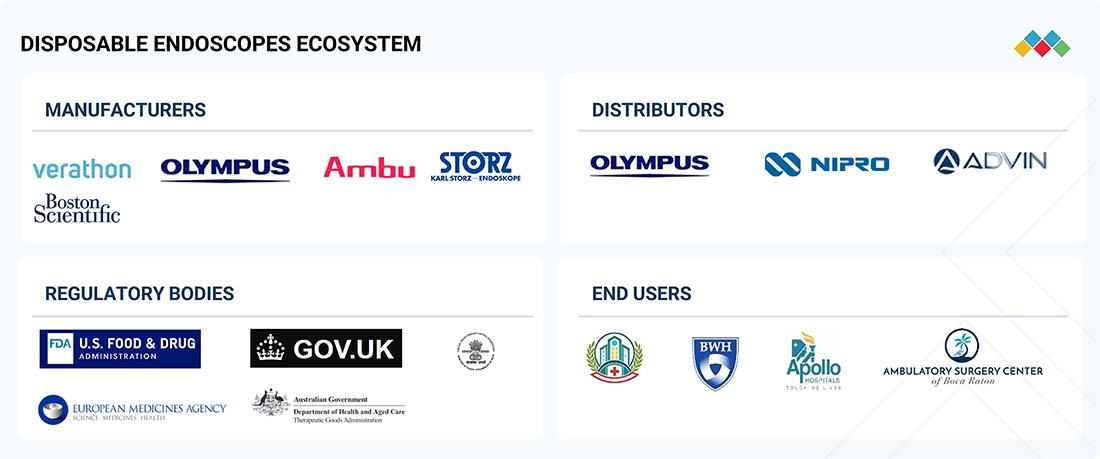
Disposable Endoscopes Market: COMMERCIAL USE CASES ACROSS INDUSTRIES
| COMPANY | USE CASE DESCRIPTION | BENEFITS |
|---|---|---|
 |
RenaFlex single-use flexible ureteroscope used to access and visualize the urinary tract (urethra, bladder, ureter, calyces, renal papillae) for diagnostic and therapeutic ureteroscopy and stone management | Consistent high-quality visualization via distal chip with 120° field of view and auto white balance, plus 270° articulation for navigation; 9.5 Fr outer diameter with 3.6 Fr working channel and a lightweight ergonomic handle support simple OR setup |
 |
aScope 4 Cysto sterile single-use flexible cystoscope intended for endoscopic access to and examination of the lower urinary tract, used with an Ambu display unit in hospital or office settings. | Clear, sharp imaging and smooth maneuverability for every case because a new scope is used each time; high bending angles (about 210°/120°) and portable, always-available setup reduce reprocessing delays |
 |
C-MAC S single-use video laryngoscopes and FIVE S single-use flexible intubation video endoscope for airway management and flexible endoscopic procedures such as bronchoscopy and laryngoscopy, integrating with C-MAC monitors. | Slim, break-resistant single-use blades and scopes provide clear images and maneuverability while minimizing cross-contamination; connects seamlessly to C-MAC HD and Pocket Monitor platforms and is offered in multiple sizes for varied patients |
 |
LithoVue Elite single-use digital flexible ureteroscope system for access, visualization, and treatment of stones throughout the urinary tract; used with the StoneSmart/Connect console. | Real-time intrarenal pressure monitoring at the ureteroscope tip with enhanced image quality supports clinical decisions; 120° field of view, 270° deflection, 9.5 Fr outer diameter, and 3.6 Fr working channel enable navigation and instrument passage. |
 |
BFlex single-use bronchoscopes for routine and emergent airway and bronchoscopy procedures across ICU, OR, and ED settings, with adult and pediatric sizes and GlideScope platform integration. | Bright, crisp imaging with Dynamic Light Control and anti-fog plus improved suction and increased articulation in BFlex 2 enhance efficiency, while single-use design reduces cross-contamination risk and eliminates reprocessing burdens |
Logos and trademarks shown above are the property of their respective owners. Their use here is for informational and illustrative purposes only.
Related Ecosystem
Diagnostic Imaging
- Magnetic Resonance Imaging (MRI)
- Computed Tomography (CT)
- CT Scanners
- Nuclear Imaging
- Positron Emission Tomography
- Siemens healthineers
- PHILIPS HEALTHCARE
- CANON INC.
- FUJIFILM Holdings Corporation
- UNITED IMAGING HEALTHCARE CO., LTD.
Medical Devices
- Polymerase Chain Reaction (PCR)
- Magnetic Resonance Imaging (MRI)
- Disposable Autoinjectors
- Pulse Oximeters
- Blood Pressure Monitors
- Medtronic plc
- Abbott Laboratories
- Stryker Corporation
- Becton, Dickinson and Company
- CONMED Corporation
Key Takeaways
- Australia's disposable endoscopes market is valued at $6.1 million in 2025 and will reach $17.2 million by 2030, representing 23.0% CAGR growth.
- Australia's advanced healthcare infrastructure and strict infection control protocols are primary drivers of disposable endoscope adoption.
- Australia's regulatory environment and reimbursement policies increasingly favor single-use endoscopes over reusable alternatives.
- Australia is positioned as a significant growth market within Asia Pacific for disposable endoscope manufacturers through 2030.
Disposable Endoscopes Market Report Scope
| Report Metric | Details |
|---|---|
| Base Year | 2025 |
| Fastest Growing Segment | GI ENDOSCOPES (Type) |
| Forecast Period | 2025–2030 |
| Growth Rate | CAGR of 22.9% from 2025 to 2030 |
| Largest Segment | UROLOGY ENDOSCOPES (Type) |
| Market Size Base Year (Billions) | ~USD 0.95 (2025) |
| Revenue Forecast (Billions) | ~USD 2.67 (2030) |
| Segments Covered | Type |
Australia Disposable Endoscopes Market Report Segmentation
1 segment dimensions are covered across the global market.
By Type
- Arthroscopes
- Bronchoscopes
- Cystoscopes
- Gi Endoscopes
- Laryngoscopes
- Other Disposable Endoscopes
- Urology Endoscopes
AUSTRALIA: DISPOSABLE ENDOSCOPES MARKET, BY END USER, 2023–2030
| Segment | 2023 | 2024 | 2025 | 2026 | 2027 | 2028 | 2029 | 2030 | CAGR (%) |
|---|---|---|---|---|---|---|---|---|---|
| AMBULATORY SURGERY CENTERS | 3.5 | 4.1 | 4.9 | 6 | 7.4 | 9.5 | 12.4 | 16.5 | 27.6 |
| CLINICS | 2.3 | 2.6 | 2.9 | 3.4 | 4.1 | 5 | 6.3 | 8 | 22.5 |
| HOSPITALS | 10.5 | 11.6 | 12.8 | 14.6 | 16.9 | 20.1 | 24.5 | 30.5 | 18.9 |
| OTHER END USERS | 2.8 | 3.2 | 3.6 | 4.1 | 4.8 | 5.9 | 7.3 | 9.2 | 21.1 |
| TOTAL | 19.1 | 21.5 | 24.2 | 28 | 33.2 | 40.4 | 50.5 | 64.3 | 21.6 |
Target Audience
- Medical Device Manufacturers : Manufacturers need Australia-specific market data to assess market opportunity, develop localized product strategies, and identify distribution partnerships within the growing disposable endoscopes segment.
- Healthcare Facility Administrators : Hospital and surgical center leaders require market insights to justify capital investments in disposable endoscope technologies, benchmark against industry standards, and optimize procurement decisions.
- Investment & Private Equity Firms : Investors evaluating opportunities in Australian healthcare need detailed market sizing, growth projections, and competitive analysis to assess investment viability and portfolio company potential.
- Medical Device Distributors : Distributors and suppliers need Australia market intelligence to identify growth opportunities, understand customer demand patterns, and develop effective sales and marketing strategies for disposable endoscopes.
- Healthcare Policy & Regulatory Bodies : Government agencies and regulatory organizations require market data to inform healthcare policy decisions, infection control guidelines, and medical device procurement standards for Australian facilities.
Key Companies in the Australia Disposable Endoscopes Market
| Company | HQ | Ownership | Strongest segments |
|---|---|---|---|
| AMBU A/S | Denmark | Public Company | GI Endoscopes,Urology Endoscopes,Laryngoscopes & Bronchoscopes, |
| BOSTON SCIENTIFIC CORPORATION | United States | Public Company | GI Endoscopes (SpyGlass, single-use duodenoscopes, related GI disposables),Urology Endoscopes (single-use digital flexible ureteroscopes),Laryngoscopes and ENT-related single-use scopes, |
| OLYMPUS CORPORATION | Japan | Public Company | GI Disposable Endoscopes,Urology Disposable Endoscopes,Laryngoscopes / ENT Disposable Endoscopes, |
| HOYA CORPORATION | Japan | Public Company | GI Endoscopes,Urology Endoscopes,Laryngoscopes / ENT Endoscopes, |
| THE COOPER COMPANIES, INC. | United States | Public Company | GI Endoscopes,Urology Endoscopes,Laryngoscopes, |
| OTU MEDICAL | United States | Public Company | GI Endoscopes,Urology Endoscopes,Laryngoscopes, |
AMBU A/S
AMBU A/S is a Danish medical device company founded in 1937 with 5,200 employees. Operating as a public company, it serves the global healthcare market.
BOSTON SCIENTIFIC CORPORATION
Boston Scientific Corporation is a United States-based medical device manufacturer founded in 1979 with 59,000 employees. The publicly traded company is a major player in the global medical technology industry.
OLYMPUS CORPORATION
Olympus Corporation is a Japanese multinational company founded in 1919 with 28,138 employees. As a public company, it operates across multiple sectors including medical devices and imaging technology.
HOYA CORPORATION
HOYA Corporation is a Japanese public company founded in 1941 with 37,752 employees. The company operates in healthcare, optical products, and related technology sectors.
THE COOPER COMPANIES, INC.
The Cooper Companies, Inc. is a United States-based public company founded in 1960 with 18,000 employees. The company operates in the medical device and healthcare sectors.
OTU MEDICAL
OTU Medical is a United States-based public company founded in 1984 with 13,000 employees. The company operates in the medical device and healthcare industry.
Reasons to Buy this Report
- Market Size & Growth Data : Access precise valuation figures for Australia's disposable endoscopes market with detailed 2025-2030 forecasts, enabling accurate business planning and investment decisions specific to the Australian healthcare sector.
- Competitive Landscape Intelligence : Understand market dynamics, key players, and competitive positioning within Australia's disposable endoscopes segment to identify partnership opportunities and market entry strategies.
- Regulatory & Compliance Insights : Gain comprehensive knowledge of Australian TGA requirements, infection control standards, and healthcare compliance frameworks that influence disposable endoscope adoption and procurement decisions.
- Demand Drivers & Trends : Identify specific growth catalysts in Australia including healthcare facility expansion, infection prevention initiatives, and technological advancements driving single-use endoscope adoption.
- Strategic Market Positioning : Leverage Australia-specific market insights to develop targeted marketing strategies, pricing models, and distribution channels aligned with local healthcare provider needs and purchasing behaviors.
Frequently asked questions
What is the current market size of disposable endoscopes in Australia?
Australia's disposable endoscopes market was valued at $6.1 million in 2025 and is expected to grow to $17.2 million by 2030.
What is the projected growth rate for Australia's disposable endoscopes market?
Australia's disposable endoscopes market is projected to grow at a compound annual growth rate (CAGR) of 23.0% from 2025 to 2030.
What factors are driving growth in Australia's disposable endoscopes market?
Australia's growth is driven by advanced healthcare infrastructure, strict infection control standards, increasing procedural volumes, and regulatory support for single-use devices over reusable alternatives.
Which medical specialties in Australia are adopting disposable endoscopes?
Australia's primary adopters include gastroenterology, pulmonology, and otolaryngology specialties, where disposable endoscopes are used for both diagnostic and therapeutic procedures.
How does Australia's market compare to the global disposable endoscopes market?
Australia's 23.0% CAGR slightly exceeds the global CAGR of 22.9%, indicating that Australia is a faster-growing market within the global disposable endoscopes sector.
RESEARCH METHODOLOGY
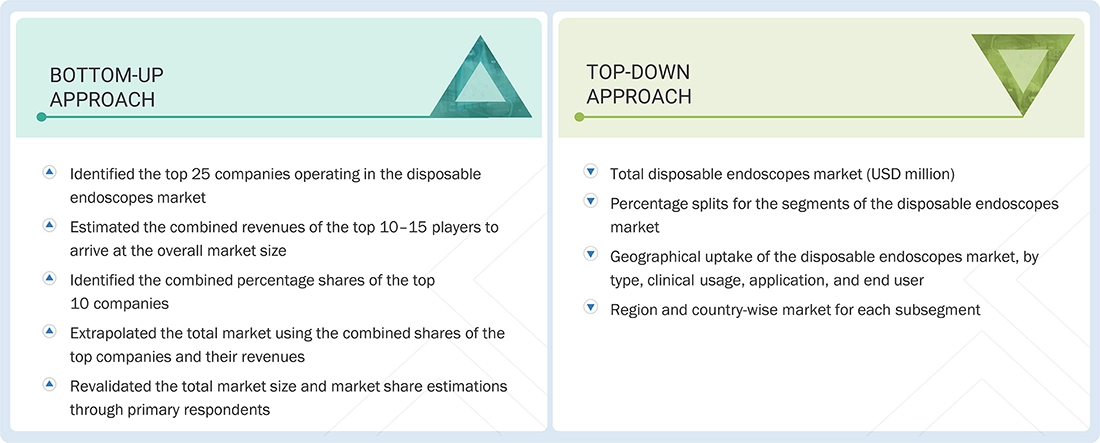
The research study involved key activities in estimating the current market size for disposable endoscopes. Extensive secondary research was conducted to collect information on the market. The next step was to validate these findings, assumptions, and estimates with industry experts across the value chain using primary research. Different methods, such as top-down and bottom-up approaches, were used to calculate the total market size. Following that, market segmentation and data triangulation procedures were employed to determine the market size of the segments and subsegments of the disposable endoscopes market.
Secondary Research
The secondary research process involved extensive use of secondary sources, including directories, databases (such as Bloomberg Businessweek, Factiva, and D&B Hoovers), white papers, annual reports, investor presentations, SEC filings of companies, and publications from government agencies like the National Institutes of Health (NIH), US Food and Drug Administration (FDA), US Census Bureau, World Health Organization (WHO), International Trade Administration (ITA), Global Burden of Disease Study, and Centers for Medicare and Medicaid Services (CMS). These sources were used to identify and gather information for the global disposable endoscopes market study. They also provided essential details about key players, market classification, and segmentation based on industry trends down to the most detailed levels, as well as key developments related to market and technology perspectives. Additionally, a database of leading industry players was created using secondary sources research.
Primary Research
During the primary research process, various sources from both the supply and demand sides were interviewed to gather qualitative and quantitative information for this report. On the supply side, primary sources include industry experts such as CEOs, vice presidents, marketing and sales directors, technology & innovation directors, and other key executives from various companies and organizations in the disposable endoscopes market. On the demand side, sources include ambulatory surgical centers, hospitals, clinics, and other end users. This primary research was conducted to validate market segmentation, identify key players, and gather insights on major industry trends and market dynamics.
A breakdown of the primary respondents is provided below:
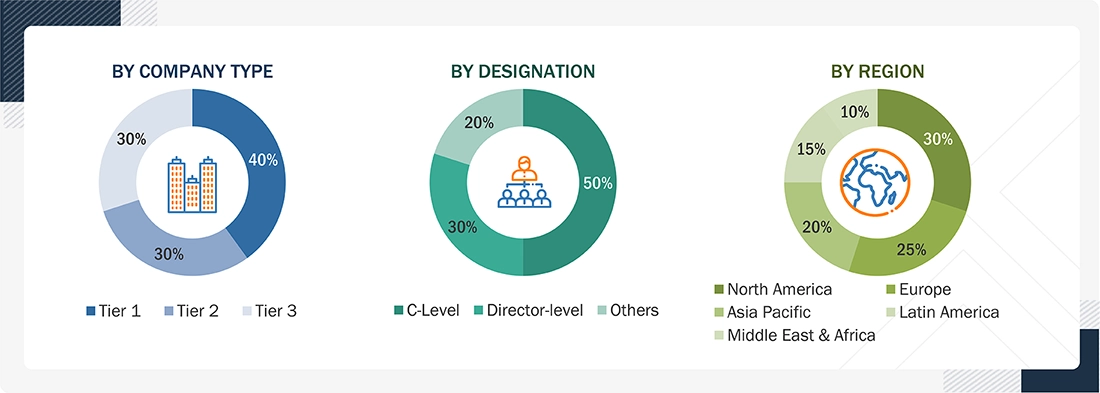
C-level primaries include CEOs, CFOs, COOs, and VPs.
*Others include Sales Managers, Marketing Managers, Business Development Managers, Product Managers, Distributors, and Suppliers.
Companies are classified into tiers based on their total revenue. The tiers are as follows:
Tier 1 = > USD 10.00 billion, Tier 2 = USD 1.00 billion to USD 10.00 billion, and Tier 3 = < USD 1.00 billion
Source: MarketsandMarkets Analysis
To know about the assumptions considered for the study, download the pdf brochure
Market Size Estimation
For the global market value, annual revenue figures were calculated based on revenue mapping of major product manufacturers and OEMs active in the worldwide disposable endoscopes market. All major product manufacturers were identified at the global and/or country or regional level. Revenue mapping for the relevant business segments or sub-segments was conducted for the key players. Additionally, the global disposable endoscopes market was divided into various segments and sub-segments based on,
- List of major players operating in the products market at the regional and/or country level
- Product mapping of various disposable endoscope manufacturers at the regional and/or country level
- Mapping of annual revenue generated by listed major players from disposable endoscopes (or the nearest reported business unit/product category)
- Extrapolation of the revenue mapping of the listed major players to derive the global market value of the respective segments/subsegments
- Summation of the market value of all segments/subsegments to arrive at the global disposable endoscopes market
The data mentioned above was consolidated and added with detailed inputs and analysis from MarketsandMarkets and presented in this report.
Market Size Estimation (Bottom-Up & Top-down Approaches)
Data Triangulation
After determining the overall size of the global disposable endoscopes market using the methodology described above, this market was divided into several segments and subsegments. Data triangulation and market segmentation techniques were used, where applicable, to complete the entire market analysis and obtain precise market value data for the key segments and subsegments. The estimated market data was validated by analyzing various macro indicators and regional trends from both demand and supply perspectives.
Market Definition
Disposable endoscopes are single-use medical devices designed for diagnostic and therapeutic procedures that provide direct visualization of internal organs. These sterile, ready-to-use instruments eliminate the need for reprocessing, reduce infection risks, and improve operational efficiency across various specialties such as gastroenterology, urology, pulmonology, and otolaryngology.
Stakeholders
- Manufacturers of endoscopes and related devices
- Suppliers and distributors of endoscopy devices
- Hospitals, diagnostic centers, and medical colleges
- Independent surgeons and private offices of physicians
- Ambulatory surgery centers
- Teaching hospitals and academic medical centers
- Government bodies/Municipal corporations
- Business research and consulting service providers
- Venture capitalists
Report Objectives
- To define, describe, segment, and forecast the disposable endoscopes market by type, clinical usage, application, end user, and region
- To provide detailed information about the factors influencing the market growth (such as drivers, restraints, opportunities, and challenges)
- To analyze micromarkets1 with respect to individual growth trends, prospects, and contributions to the overall disposable endoscopes market
- To analyze market opportunities for stakeholders and provide details of the competitive landscape for key players
- To forecast the size of the disposable endoscopes market in five main regions (along with their respective key countries), namely, North America, Europe, the Asia Pacific, Latin America, and the Middle East & Africa
- To profile the key players in the disposable endoscopes market and comprehensively analyze their core competencies2 and market shares
- To track and analyze competitive developments such as acquisitions, product launches, expansions, collaborations, agreements, partnerships, and R&D activities of the leading players in the disposable endoscopes market
- To benchmark players within the disposable endoscopes market using the Competitive Leadership Mapping framework, which analyzes market players on various parameters within the broad categories of business strategy, market share, and product offerings
Get the Full Disposable Endoscopes Market Report
Full forecast, segment splits, and company analysis for all Disposable Endoscopes Market.
- US Disposable Endoscopes Market
- Canada Disposable Endoscopes Market
- Germany Disposable Endoscopes Market
- UK Disposable Endoscopes Market
- France Disposable Endoscopes Market
- Italy Disposable Endoscopes Market
- Spain Disposable Endoscopes Market
- China Disposable Endoscopes Market
- Japan Disposable Endoscopes Market
- India Disposable Endoscopes Market
- South Korea Disposable Endoscopes Market
- Brazil Disposable Endoscopes Market
- Mexico Disposable Endoscopes Market
Need a Tailored Report?
Customize this report to your needs
Get 10% FREE Customization
Customize This Report
