
North America Disposable Medical Device Sensors Market (2021-2026)

The North America Disposable Medical Device Sensors Market was valued at $2603.5 Million in 2021 and projected to reach to $3676.6 Million by 2026, representing a compound annual growth rate of 7.1%. North America's disposable medical device sensors market is poised for sustained growth through 2026, supported by aging demographics, rising chronic disease prevalence, and healthcare providers' commitment to infection control.


| Market Size in | USD 26.32 MN |
| Market Forecast in | |
| CAGR | |
| Forecast Period | |
| Units Considered | Value (USD MN) |
North America Disposable Medical Device Sensors Market Trends and Insights
- This expansion reflects North America's advanced healthcare infrastructure, increasing adoption of point-of-care diagnostics, and rising demand for single-use sensor technologies across hospitals and clinical settings.
- North America's market growth is driven by regulatory support, technological innovation, and heightened focus on infection control and patient safety. The 7.1% compound annual growth rate (CAGR) positions North America as a key market for disposable sensor manufacturers.
- North America's healthcare providers continue to prioritize disposable sensors for continuous monitoring applications, remote patient monitoring, and wearable medical devices.
- The region's strong reimbursement landscape and established medical device supply chains further accelerate North America's market penetration and adoption rates through 2026..
Key Market Statistics
- CAGR (2021-2026) 7.1% CAGR
- Market Size, 2021 ~USD 2603.5 Million
- Forecast, 2026 ~USD 3676.6 Million
- Geography North America
North America Disposable Medical Device Sensors Market Overview
Market Expansion :
North America's disposable medical device sensors market grew from $2,603.5 million in 2021 to $3,676.6 million in 2026, representing a robust 7.1% CAGR driven by healthcare modernization and technological adoption.
Advanced Healthcare Infrastructure :
North America's well-established healthcare systems, high hospital density, and significant R&D investments create an ideal environment for rapid adoption of innovative disposable sensor technologies.
Point-of-Care Diagnostics Surge :
Increasing demand for rapid, accurate diagnostics at the point of care is accelerating the adoption of disposable sensors across North American hospitals, clinics, and outpatient facilities.
Single-Use Technology Preference :
North American healthcare providers increasingly prefer single-use sensor solutions to minimize cross-contamination risks, enhance patient safety, and comply with stringent regulatory standards.
North America Disposable Medical Device Sensors Market Dynamics
- The region's regulatory framework and reimbursement policies favor disposable sensor adoption, particularly in critical care and diagnostic applications.
- Technological advancements in miniaturization and wireless connectivity are expanding use cases across hospitals and home healthcare settings. Key growth drivers include increased healthcare spending, digital health integration, and post-pandemic emphasis on contactless diagnostics.
- North American manufacturers' focus on innovation and quality assurance positions the region as a leader in disposable sensor development.
- Strategic partnerships between device makers and healthcare systems will further accelerate market penetration and drive competitive differentiation..
Market Ecosystem
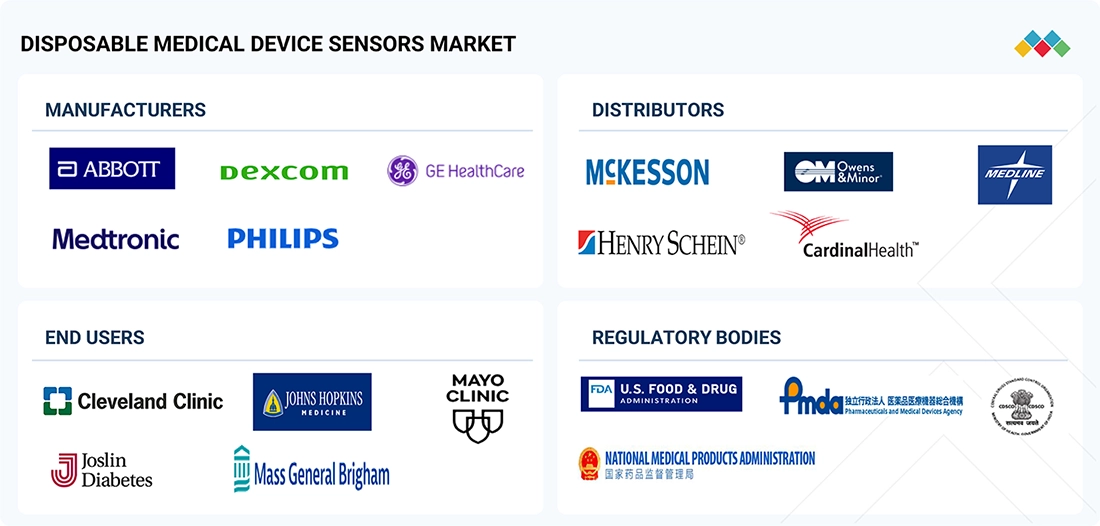
DISPOSABLE MEDICAL DEVICE SENSORS MARKET: COMMERCIAL USE CASES ACROSS INDUSTRIES
| COMPANY | USE CASE DESCRIPTION | BENEFITS |
|---|---|---|
 |
FreeStyle Libre disposable continuous glucose monitoring sensors are worn on the upper arm to continuously measure glucose in interstitial fluid and transmit readings to a compatible smartphone or reader. They support day-to-day diabetes management, glucose-trend monitoring and identification of hyperglycaemic or hypoglycaemic events. | Continuous real-time glucose information | Reduced dependence on routine finger-stick testing | Visibility of glucose direction and trends | Discreet multi-day wear and improved support for treatment | Diet and activity decisions |
 |
Accu-Chek SmartGuide CGM sensors provide continuous glucose values for adults with type 1 or type 2 diabetes receiving flexible insulin therapy. The disposable sensor works with Roche’s SmartGuide and Predict applications to monitor current glucose and forecast potential glucose excursions. | Up to 14-day continuous monitoring | Predictive alerts for low or high glucose | Earlier corrective intervention | Reduced testing burden | More informed insulin-management decisions |
 |
Simplera and Simplera Sync disposable all-in-one CGM sensors continuously measure interstitial glucose and transmit data to compatible diabetes-management applications or the MiniMed 780G insulin-delivery system. Medtronic also offers single-patient Nellcor adhesive SpO2 sensors for continuous oxygen-saturation and pulse-rate monitoring in clinical environments. | Simplified sensor insertion | Compact and discreet wear | Real-time glucose alerts | Integration with automated insulin delivery and reduced finger-stick requirements. Nellcor sensors provide continuous non-invasive SpO2 monitoring, broad patient applicability, and reduced cross-patient contamination risk through single-patient use. |
 |
TruSignal disposable SpO2 sensors are attached to adult, paediatric or neonatal patients for continuous non-invasive monitoring of blood oxygen saturation and pulse rate. Entropy EasyFit disposable sensors are used during anaesthesia to acquire frontal EEG signals and assess the patient’s level of consciousness. | Reliable oxygenation and pulse-rate measurements | Support for timely clinical intervention | Compatibility with GE patient monitors and improved infection-control workflows. Entropy sensors support individualized anaesthetic dosing, assessment of anaesthetic depth and reduced risk of excessive or insufficient anaesthesia. |
 |
EnviteC disposable pulse-oximetry sensors are applied to adults, children, infants and neonates for continuous measurement of SpO2 and pulse rate in hospitals, emergency care, intensive care and extended monitoring. Honeywell also supplies medical oxygen-sensing components used in ventilators, anaesthesia machines, incubators and oxygen concentrators. | Reduced cross-contamination through single-patient use | Flexible and biocompatible materials | Improved comfort during prolonged monitoring | Size-specific designs for different patient groups | Dependable oxygen monitoring across critical-care applications |
Logos and trademarks shown above are the property of their respective owners. Their use here is for informational and illustrative purposes only.
Related Ecosystem
Medical Devices
- Polymerase Chain Reaction (PCR)
- Magnetic Resonance Imaging (MRI)
- Disposable Autoinjectors
- Pulse Oximeters
- Blood Pressure Monitors
- Medtronic plc
- Abbott Laboratories
- Stryker Corporation
- Becton, Dickinson and Company
- CONMED Corporation
Key Takeaways
- North America's disposable medical device sensors market grew from $2,603.5M (2021) to $3,676.6M (2026) at a 7.1% CAGR.
- North America's advanced healthcare infrastructure and regulatory environment support rapid adoption of disposable sensor technologies.
- North America's focus on infection control and patient safety drives demand for single-use sensor solutions across clinical settings.
- North America's strong reimbursement landscape and established supply chains position the region as a leading market for sensor manufacturers.
Disposable Medical Device Sensors Market Report Scope
| Report Metric | Details |
|---|---|
| Base Year | 2021 |
| Fastest Growing Segment | DRUG AND ALCOHOL TEST STRIP SENSORS (Device Type) |
| Forecast Period | 2021-2026 |
| Growth Rate | CAGR of 7.7% from 2021 to 2026 |
| Largest Segment | BIOSENSORS (Product) |
| Market Size Base Year (Billions) | ~USD 6.49 (2021) |
| Revenue Forecast (Billions) | ~USD 9.4 (2026) |
| Segments Covered | Product, Type, Application, Device Type |
North America Disposable Medical Device Sensors Market Report Segmentation
4 segment dimensions are covered across the global market.
By Product
- Accelerometers
- Biosensors
- Image Sensors
- Other Sensors
- Pressure Sensors
- Temperature Sensors
By Type
- Ingestible Sensors
- Invasive Sensors
- Strip Sensors
- Wearable Sensors
By Application
- Diagnostic Testing
- Imaging
- Patient Monitoring
- Therapeutics
By Device Type
- Blood Glucose Test Strip Sensors
- Capsule Endoscope Sensors
- Cardiac Catheter Sensors
- Cardiac Monitors
- Continuous Blood Pressure Monitors
- Continuous Glucose Monitoring (Cgm) Devices
- Dialysis Device Sensors
- Disposable Endoscope Sensors
- Drug And Alcohol Test Strip Sensors
- Infectious Disease Test Strip Sensors
- Insulin Pump Sensors
- Other Patient Monitoring Devices
- Pregnancy Test Strip Sensors
- Pulse Oximeters
- Smart Pills
Target Audience
- Medical Device Manufacturers : Manufacturers need North America-specific market data to develop region-tailored product strategies, identify distribution opportunities, and benchmark against competitors in this high-value market.
- Healthcare Providers & Hospital Systems : Hospital administrators and procurement teams require market insights to evaluate sensor technology options, optimize purchasing decisions, and improve patient care outcomes.
- Investment & Private Equity Firms : Investors need detailed North American market analysis to identify acquisition targets, assess portfolio company growth potential, and evaluate sector investment opportunities.
- Regulatory & Compliance Consultants : Consultants require region-specific market intelligence to advise clients on North American regulatory requirements, market entry strategies, and compliance frameworks.
- Market Research & Strategy Teams : Corporate strategists need comprehensive North America data to support business planning, competitive analysis, and long-term market positioning decisions.
Countries within North America - compare and drill down
| Country | 2025 size (native) |
|---|---|
| US | USD 3264.2 Million |
| Canada | USD 412.4 Million |
Country market size visualization
Reasons to Buy this Report
- Regional Market Sizing : Obtain precise market valuations for North America ($2,603.5M in 2021, $3,676.6M in 2026) with country-level breakdowns for US and Canada to inform regional expansion strategies.
- Competitive Landscape Intelligence : Understand North American market dynamics, key players, and competitive positioning specific to the region's advanced healthcare infrastructure and regulatory environment.
- Growth Opportunity Identification : Identify high-potential segments within North America's point-of-care diagnostics and single-use sensor markets to prioritize product development and commercialization efforts.
- Strategic Investment Decisions : Make data-driven investment and partnership decisions based on North America's 7.1% CAGR and market expansion trajectory through 2026.
- Regulatory & Reimbursement Insights : Access North America-specific regulatory trends and reimbursement policies that influence disposable sensor adoption across hospitals and clinical settings.
Frequently asked questions
What was North America's disposable medical device sensors market size in 2021?
North America's disposable medical device sensors market was valued at $2,603.5 million in 2021.
What is the projected market size for North America by 2026?
North America's disposable medical device sensors market is projected to reach $3,676.6 million by 2026.
What is the CAGR for North America's disposable medical device sensors market?
North America's disposable medical device sensors market is expected to grow at a compound annual growth rate (CAGR) of 7.1% from 2021 to 2026.
What factors drive growth in North America's disposable sensor market?
North America's market growth is driven by advanced healthcare infrastructure, regulatory support, technological innovation, infection control priorities, and strong reimbursement landscapes.
Which applications are most prominent in North America's disposable sensor market?
North America's disposable sensors are widely used in continuous monitoring, point-of-care diagnostics, remote patient monitoring, and wearable medical device applications.
RESEARCH METHODOLOGY
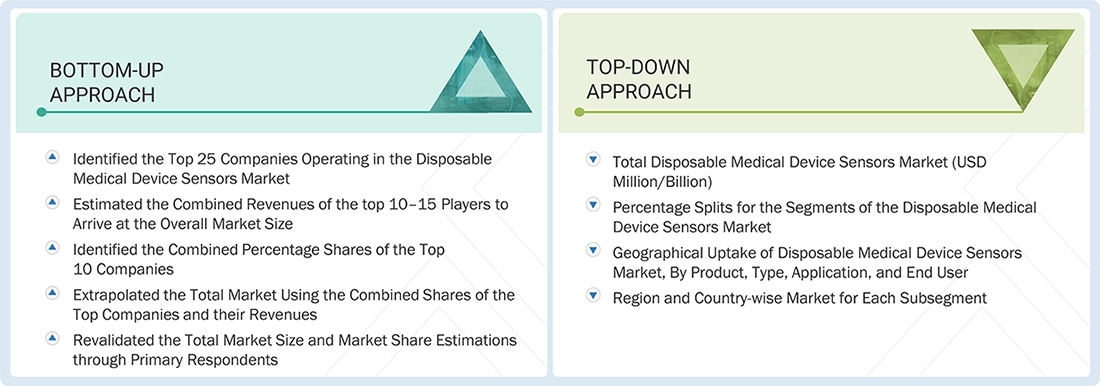
The study involved four major activities in estimating the current size of the disposable medical device sensors market. Exhaustive secondary research was done to collect information on the market and its different subsegments. The next step was to validate these findings, assumptions, and sizing with industry experts across the value chain through primary research. Both top-down and bottom-up approaches were employed to estimate the complete market size. After that, market breakdown and data triangulation procedures were used to estimate the market size of the segments and subsegments.
Secondary Research
The secondary research process involved the widespread use of secondary sources, directories, databases (such as Bloomberg Businessweek, Factiva, and D&B Hoovers), white papers, annual reports, company house documents, investor presentations, and company SEC filings. Secondary research was used to identify and collect information useful for the extensive, technical, market-oriented, and commercial study of the disposable medical device sensors market. It was also used to obtain important information on key players, market classification, and segmentation aligned with industry trends to the bottom-most level, and key developments from market and technology perspectives. A database of the key industry leaders was also prepared using secondary research.
Primary Research
The secondary research process involved the widespread use of secondary sources, directories, databases (such as Bloomberg Businessweek, Factiva, and D&B Hoovers), white papers, annual reports, company house documents, investor presentations, and company SEC filings. Secondary research was used to identify and collect information useful for the extensive, technical, market-oriented, and commercial study of the disposable medical device sensors market. It was also used to obtain important information on key players, market classification, and segmentation aligned with industry trends to the bottom-most level, and key developments from market and technology perspectives. A database of the key industry leaders was also prepared using secondary research.
BREAKDOWN OF PRIMARIES
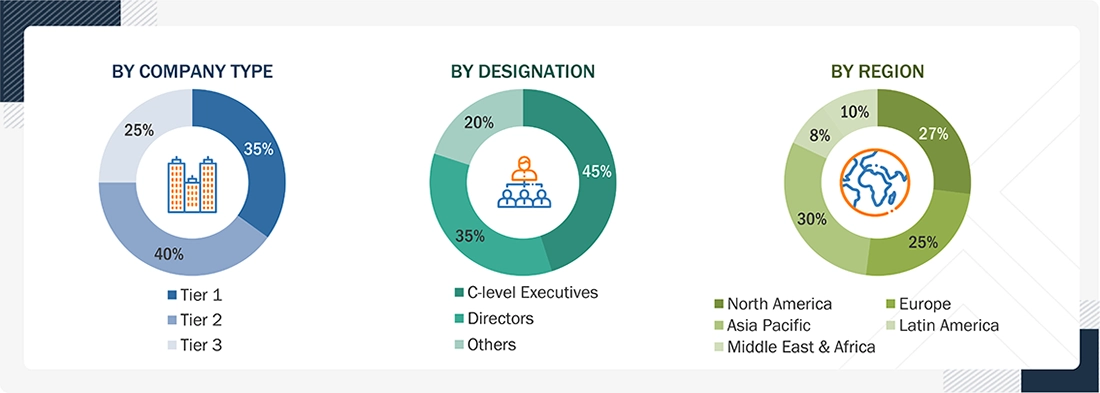
*Others include sales managers, marketing managers, and product managers.
Note 1: C-level executives include CEOs, CFOs, COOs, and VPs.
Note 2: Others include sales managers, marketing managers, business development managers, product managers, distributors, and suppliers.
Note 3: Companies are classified into tiers based on their total revenue. As of 2024, Tier 1 = >USD 10.00 billion, Tier 2 = USD 1.00 billion to USD 10.00 billion, and Tier 3 = <USD 1.00 billion.
To know about the assumptions considered for the study, download the pdf brochure
Market Size Estimation
For the global market value, annual revenues were calculated based on the revenue mapping of major product manufacturers and OEMs active in the global disposable medical device sensors market. All the major product manufacturers were identified at the global and/or country/regional level. Revenue mapping for the respective business segments/subsegments was done for the major players. Also, the global disposable medical device sensors market was split into various segments and subsegments based on the:
- List of major players operating in the products market at the regional and/or country level
- Product mapping of various dental bone graft substitute manufacturers at the regional and/or country level
- Mapping of annual revenue generated by listed major players from disposable medical device sensors (or the nearest reported business unit/product category)
- Revenue mapping of major players to be covered
- Extrapolation of the revenue mapping of the listed major players to derive the global market value of the respective segments/subsegments
- Summation of the market value of all segments/subsegments to arrive at the global disposable medical device sensors market
The above-mentioned data was consolidated and added with detailed inputs and analysis from MarketsandMarkets and presented in this report.
Disposable Medical Device Sensors Market : Top-Down and Bottom-Up Approach
Data Triangulation
After arriving at the overall size of the global disposable medical device sensors market through the above-mentioned methodology, this market was split into several segments and subsegments. The data triangulation and market breakdown procedures were employed, wherever applicable, to complete the overall market engineering process and arrive at the exact market value data for the key segments and subsegments. The extrapolated market data was triangulated by studying various macroindicators and regional trends from both demand- and supply-side participants.
Market Definition
Disposable medical device sensors are easy-to-use sensing devices used for short-term (a few months) or rapid single-point measurements. They convert physical (temperature, blood pressure, humidity, or speed), chemical, or biological changes in the human body to an analytical signal. These are used for sensing parameters such as temperature, pressure, blood glucose levels, and other vital parameters. These devices are extensively used for monitoring, diagnostic, therapeutic, and surgical applications.
Key Stakeholders
- Manufacturers and suppliers of sensor components, biosensing materials, electrodes, and electronic components
- Disposable medical device sensor companies
- Medical device and healthcare technology companies
- Point-of-care (POC) diagnostic providers
- Healthcare institutes
- Diagnostic laboratories
- Hospitals and healthcare facilities
- Academic institutes
- Research institutes
- Government associations
- Market research and consulting firms
- Venture capitalists and investors
Report Objectives
-
To define, describe, and forecast the global disposable medical device sensors market on the basis of product, type, application, end user, and region
-
To provide detailed information regarding the major factors influencing the growth of the market (drivers, opportunities, and challenges)
-
To strategically analyze micromarkets with respect to individual growth trends, future prospects, and contributions to the overall market
-
To analyze opportunities in the market for stakeholders and provide details of the competitive landscape for market leaders
-
To forecast the size of the disposable medical device sensors market with respect to four main regions (along with countries), namely, North America, Europe, Asia Pacific, and the Rest of the World
-
To strategically profile the key players in the global disposable medical device sensors market and comprehensively analyze their core competencies and market shares
-
To track and analyze competitive developments such as partnerships, mergers & acquisitions; new product launches of the leading players in the global disposable medical device sensors market
Available customizations:
With the given market data, MarketsandMarkets offers customizations as per the company’s specific needs. The following customization options are available for the report:
Geographic Analysis
- Further breakdown of the Rest of Europe disposable medical device sensors market into Russia, Switzerland, Denmark, Austria, and others
- Further breakdown of the Rest of Asia Pacific disposable medical device sensors market into South Korea, Taiwan, and others
- Further breakdown of the Rest of Latin America disposable medical device sensors market into Argentina, Colombia, Chile, Ecuador, and others
- Further breakdown of the Southeast Asia disposable medical device sensors market into Malaysia, Singapore, New Zealand, and others
Competitive Landscape Assessment
- Market share analysis, by region (North America, Europe, Asia Pacific, Latin America, and the Middle East & Africa), which provides market shares of the top 3–5 key players in the disposable medical device sensors market
- Competitive leadership mapping for established players in the US
Get the Full Disposable Medical Device Sensors Market Report
Full forecast, segment splits, and company analysis for all Disposable Medical Device Sensors Market.
- Canada Disposable Medical Device Sensors Market
- US Disposable Medical Device Sensors Market
- Germany Disposable Medical Device Sensors Market
- France Disposable Medical Device Sensors Market
- UK Disposable Medical Device Sensors Market
- Italy Disposable Medical Device Sensors Market
- Spain Disposable Medical Device Sensors Market
- China Disposable Medical Device Sensors Market
- Japan Disposable Medical Device Sensors Market
- India Disposable Medical Device Sensors Market
- Rest Of Europe Disposable Medical Device Sensors Market
- Roapac Disposable Medical Device Sensors Market
Need a Tailored Report?
Customize this report to your needs
Get 10% FREE Customization
Customize This Report
