
Argentina Distributed Control System Market (2025-2030)

The Argentina Distributed Control System Market was valued at $390.3 Million in 2025 and projected to reach to $518.1 Million by 2030, representing a compound annual growth rate of 5.8%. Argentina's Distributed Control System market is experiencing steady expansion as the country prioritizes modernization of its energy infrastructure and industrial operations.


| Market Size in | USD 26.32 MN |
| Market Forecast in | |
| CAGR | |
| Forecast Period | |
| Units Considered | Value (USD MN) |
Argentina Distributed Control System Market Trends and Insights
- Argentina's energy and power sector is increasingly adopting advanced automation and control technologies to enhance operational efficiency and meet regulatory compliance standards.
- The growth trajectory reflects Argentina's ongoing investments in modernizing its industrial infrastructure and power generation capabilities. The DCS market in Argentina is driven by the country's focus on optimizing energy production and reducing operational costs across thermal, hydroelectric, and renewable energy facilities.
- Argentina's commitment to expanding renewable energy capacity, particularly wind and solar projects, is creating substantial demand for sophisticated control systems.
- Between 2025 and 2030, Argentina is expected to see accelerated adoption of DCS solutions as industries prioritize digital transformation and grid stability improvements. Argentina's market growth is supported by government initiatives promoting industrial automation and energy efficiency.
- The country's strategic position in South America and its developing manufacturing base present significant opportunities for DCS vendors targeting the region.
- As Argentina continues to strengthen its energy infrastructure, the DCS market is poised for sustained expansion through 2030..
Key Market Statistics
- CAGR (2025-2030) 5.8% CAGR
- Market Size, 2025 ~USD 390.3 Million
- Forecast, 2030 ~USD 518.1 Million
- Country Argentina
Argentina Distributed Control System Market Overview
Market Valuation :
Argentina's DCS market is valued at USD 390.3 million in 2025, with strong growth trajectory driven by modernization of power generation and industrial facilities across the country.
Steady Growth Momentum :
The market is projected to reach USD 518.1 million by 2030, representing a CAGR of 5.8%, outpacing many regional markets due to increased investment in automation infrastructure.
Regulatory Compliance Driver :
Argentina's energy sector is increasingly adopting DCS technologies to meet stringent regulatory compliance standards and improve operational efficiency in power generation and distribution networks.
Industrial Modernization :
Growing demand for advanced automation and control systems in Argentina's manufacturing and energy sectors is accelerating DCS adoption to enhance productivity and reduce operational costs.
Argentina Distributed Control System Market Dynamics
- The shift toward digital transformation in the power sector, coupled with government initiatives to improve grid reliability and efficiency, is creating sustained demand for advanced DCS solutions.
- Investment in renewable energy projects and upgrades to existing thermal and hydroelectric facilities are key growth catalysts. Looking ahead to 2030, Argentina's DCS market will benefit from increasing automation requirements, cybersecurity enhancements, and the integration of IoT technologies in control systems.
- The market's 5.8% CAGR reflects a balanced growth environment supported by both public sector infrastructure projects and private industrial investments.
- Regional economic stabilization and foreign direct investment in energy projects will further strengthen market expansion opportunities..
Market Ecosystem
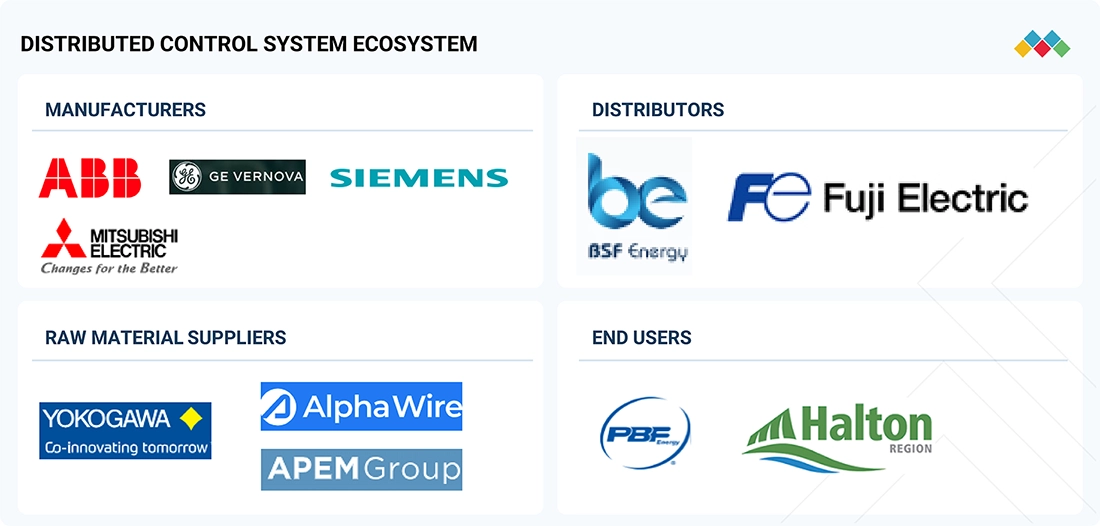
Distributed Control System: COMMERCIAL USE CASES ACROSS INDUSTRIES
| COMPANY | USE CASE DESCRIPTION | BENEFITS |
|---|---|---|
 |
Colombian oil and gas company adopts ABB’s modern freelance DCS platform to reduce downtime and boost cybersecurity | The company transitioned to ABB’s modern Freelance DCS platform, which delivered enhanced cyber protection, reduced downtime, and simplified maintenance procedures. The system supported remote diagnostics, lifecycle management, and seamless integration with existing infrastructure. The upgrade helped cut operational costs while aligning the facility with current security and regulatory standards and gave the flexibility to scale and integrate future digital tools with minimal disruption. |
 |
Food and beverage plant uses Rockwell Automation’s integrated control solutions to reduce waste and enhance production visibility | The plant implemented Rockwell Automation’s FactoryTalk Analytics and other integrated control solutions. This enabled real-time data collection, visualization, and actionable insights. As a result, the facility reduced waste by over USD 500,000, improved process efficiency, and enhanced production visibility. |
Logos and trademarks shown above are the property of their respective owners. Their use here is for informational and illustrative purposes only.
Related Ecosystem
Smart Energy And Digital Solutions
- Cellular Network
- Analytics Software
- Geographical Information System (GIS)
- Meter Data Management (MDM)
- Smart Meters
- Siemens ag
- SCHNEIDER ELECTRIC SE
- ABB India Limited
- General Electric Company
- Eaton Corporation plc
Industrial Iot
- Sensors
- Pressure Sensors
- Flow Sensors
- Gas Sensors
- Image Sensors
- Siemens ag
- ABB India Limited
- HONEYWELL INTERNATIONAL INC.
- Emerson Electric Co.
- SCHNEIDER ELECTRIC SE
Key Takeaways
- Argentina's DCS market is valued at USD 390.3 million in 2025 and will reach USD 518.1 million by 2030, growing at 5.8% CAGR.
- Argentina's renewable energy expansion, particularly in wind and solar, is driving significant demand for advanced control systems.
- Industrial automation and energy efficiency initiatives in Argentina are accelerating DCS adoption across the power sector.
- Argentina's strategic focus on grid modernization and operational optimization creates sustained growth opportunities for DCS vendors through 2030.
Distributed Control System Market Report Scope
| Report Metric | Details |
|---|---|
| Base Year | 2025 |
| Fastest Growing Segment | CHEMICALS (End-Use Industry) |
| Forecast Period | 2025–2030 |
| Growth Rate | CAGR of 6.3% from 2025 to 2030 |
| Largest Segment | CONTINUOUS PROCESS (Application) |
| Market Size Base Year (Billions) | ~USD 21.6 (2025) |
| Revenue Forecast (Billions) | ~USD 29.32 (2030) |
| Segments Covered | Component, Application, End-Use Industry |
Argentina Distributed Control System Market Report Segmentation
3 segment dimensions are covered across the global market.
By Component
- Hardware
- Services
- Software
By Application
- Batch-Oriented Process
- Continuous Process
By End-Use Industry
- Chemicals
- Food & Beverages
- Metals & Mining
- Oil & Gas
- Other Industries
- Pharmaceutical
- Pharmaceuticals
- Power Generation
- Pulp & Paper
- Water & Wastewater Treatment
ARGENTINA: DISTRIBUTED CONTROL SYSTEM MARKET, BY END-USE INDUSTRY, 2025–2030
| Segment | 2025 | 2026 | 2027 | 2028 | 2029 | 2030 | CAGR (%) |
|---|---|---|---|---|---|---|---|
| CHEMICALS | 46.8 | 49.1 | 51.8 | 54.7 | 58 | 61.7 | 5.7 |
| FOOD & BEVERAGES | 33.8 | 35.5 | 37.3 | 39.4 | 41.7 | 44.3 | 5.5 |
| METALS & MINING | 16.6 | 17.2 | 17.8 | 18.5 | 19.3 | 20.2 | 3.9 |
| OIL & GAS | 99 | 104.2 | 110.1 | 116.6 | 123.9 | 132.1 | 5.9 |
| OTHER INDUSTRIES | 55.9 | 58.9 | 62.3 | 66.1 | 70.3 | 75 | 6.1 |
| PHARMACEUTICALS | 26.8 | 28.1 | 29.5 | 31.1 | 32.9 | 34.9 | 5.4 |
| POWER GENERATION | 83.8 | 88.4 | 93.6 | 99.3 | 105.8 | 113 | 6.2 |
| PULP & PAPER | 15.4 | 16.2 | 17.1 | 18.1 | 19.2 | 20.4 | 5.8 |
| WATER & WASTEWATER TREATMENT | 12.2 | 12.9 | 13.7 | 14.5 | 15.5 | 16.6 | 6.4 |
| TOTAL | 390.3 | 410.5 | 433.2 | 458.3 | 486.4 | 518.1 | 5.8 |
Target Audience
- Energy & Power Companies : Argentine utilities and power generators need market intelligence to plan DCS investments, upgrade aging infrastructure, and comply with regulatory standards while optimizing operational efficiency.
- Industrial Manufacturers : Manufacturing facilities in Argentina require insights into DCS adoption trends and automation solutions to enhance production efficiency, reduce downtime, and maintain competitive advantage.
- Technology Solution Providers : DCS vendors and system integrators need Argentina-specific market data to identify growth opportunities, understand customer requirements, and develop localized solutions for the regional market.
- Investment & Financial Analysts : Investors and financial institutions evaluating opportunities in Argentina's energy sector need reliable market forecasts and growth projections to assess investment viability and returns.
- Government & Policy Makers : Argentine government agencies and regulatory bodies require market analysis to inform energy modernization policies, infrastructure investment decisions, and technology adoption incentives.
Key Companies in the Argentina Distributed Control System Market
| Company | HQ | Ownership | Strongest segments |
|---|---|---|---|
| FLSMIDTH | United States | Public Company | Hardware,Software,Services, |
| ENI SPA | Italy | Public Company | Hardware,Software,Services, |
| GALP GROUP | Portugal | InvalidIdentifier | Hardware,Software,Services, |
| SIEMENS | Germany | Public Company | Hardware,Software,Services, |
| SCHNEIDER ELECTRIC | Canada | Public Company | Hardware,Software,Services, |
| HONEYWELL INTERNATIONAL INC. | United States | Public Company | Hardware,Software,Services, |
| HITACHI, LTD. | Japan | Public Company | Hardware,Software,Services, |
| GE VERNOVA | United States | Public Company | Hardware,Software,Services, |
| ABB | India | Public Company | Hardware,Software,Services, |
| EMERSON ELECTRIC CO. | United States | Public Company | Hardware,Software,Services, |
| YOKOGAWA ELECTRIC CORPORATION | Japan | Public Company | Hardware,Software,Services, |
| ROCKWELL AUTOMATION | United States | Public Company | Hardware,Software,Services, |
| VALMET | Finland | Public Company | Hardware,Software,Services, |
| TOSHIBA CORPORATION | Japan | Private Company | Hardware,Software,Services, |
| MITSUBISHI ELECTRIC CORPORATION | Japan | Public Company | Hardware,Software,Services, |
| AZBIL CORPORATION | Japan | Public Company | Hardware (controllers, I/O, sensors, valves, actuators),Software (control, HMI, engineering, analytics),Services (engineering, commissioning, maintenance, lifecycle), |
| ANDRITZ | Austria | Public Company | Hardware,Software,Services, |
| OMRON CORPORATION | Japan | Public Company | Hardware,Software,Services, |
FLSMIDTH
FLS Smith is a publicly traded Danish-American engineering company founded in 1882 with 5,340 employees, specializing in industrial equipment and solutions.
ENI SPA
ENI SpA is an Italian multinational public company founded in 1953 with 32,349 employees, operating in oil, gas, and renewable energy sectors.
GALP GROUP
Galp Group information is incomplete and cannot be accurately described with the provided data.
SIEMENS
Siemens is a German multinational public company founded in 1847 with 310,312 employees, providing industrial automation, digitalization, and infrastructure solutions.
SCHNEIDER ELECTRIC
Schneider Electric is a Canadian-based publicly traded company founded in 1836 with 158,122 employees, specializing in energy management and industrial automation.
HONEYWELL INTERNATIONAL INC.
Honeywell International Inc. is a U.S. public company founded in 1885 with 101,000 employees, operating in aerospace, building technologies, and industrial automation.
HITACHI, LTD.
Hitachi, Ltd. is a Japanese multinational public company founded in 1910 with 287,901 employees, providing industrial equipment, infrastructure, and digital solutions.
GE VERNOVA
GE Vernova is a U.S. public company founded in 2023 with 78,000 employees, focused on energy transition and renewable power solutions.
ABB
ABB is a publicly traded company founded in 1883 with 111,900 employees, operating in India and providing robotics, power, and automation technologies.
EMERSON ELECTRIC CO.
Emerson Electric Co. is a U.S. public company founded in 1890 with 71,000 employees, specializing in process management and automation solutions.
YOKOGAWA ELECTRIC CORPORATION
Yokogawa Electric Corporation is a Japanese public company founded in 1915 with 18,313 employees, providing industrial automation and control systems.
ROCKWELL AUTOMATION
Rockwell Automation is a U.S. public company founded in 1903 with 26,000 employees, specializing in industrial automation and information technology.
VALMET
Valmet is a Finnish public company founded in 1750 with 18,370 employees, serving the pulp, paper, and energy industries with process technologies.
TOSHIBA CORPORATION
Toshiba Corporation is a Japanese private company founded in 1875 with 106,648 employees, operating in electronics, infrastructure, and industrial systems.
MITSUBISHI ELECTRIC CORPORATION
Mitsubishi Electric Corporation is a Japanese public company founded in 1921 with 150,386 employees, providing industrial automation, power systems, and electronics.
AZBIL CORPORATION
Azbil Corporation is a Japanese public company founded in 1906 with 9,170 employees, specializing in building automation and control systems.
ANDRITZ
Andritz is an Austrian public company founded in 1852 with 30,487 employees, providing equipment and services for hydropower, pulp, and paper industries.
OMRON CORPORATION
Omron Corporation is a Japanese public company founded in 1933 with 26,050 employees, specializing in industrial automation and healthcare technologies.
Reasons to Buy this Report
- Country-Specific Market Sizing : Obtain precise valuation data for Argentina's DCS market with verified 2025 baseline (USD 390.3M) and 2030 forecast (USD 518.1M), enabling accurate budget allocation and investment planning.
- Competitive Landscape Intelligence : Understand Argentina-specific market dynamics, key players, and competitive positioning within the country's energy and industrial sectors to identify partnership and expansion opportunities.
- Regulatory & Compliance Insights : Access detailed analysis of Argentina's regulatory environment, compliance requirements, and government initiatives driving DCS adoption in power generation and distribution networks.
- Growth Driver Analysis : Identify Argentina-specific growth catalysts including renewable energy projects, grid modernization initiatives, and industrial automation trends shaping market demand through 2030.
- Strategic Market Entry Planning : Leverage Argentina market data to develop targeted go-to-market strategies, assess market entry barriers, and prioritize customer segments within the country's energy and industrial sectors.
Frequently asked questions
What is the current market size of DCS in Argentina?
Argentina's Distributed Control System market is valued at USD 390.3 million in 2025.
What is the projected market size for Argentina's DCS market by 2030?
Argentina's DCS market is projected to reach USD 518.1 million by 2030.
What is the CAGR for Argentina's DCS market?
Argentina's DCS market is expected to grow at a compound annual growth rate (CAGR) of 5.8% from 2025 to 2030.
What are the primary drivers of DCS market growth in Argentina?
Argentina's DCS market growth is driven by renewable energy expansion, industrial automation initiatives, grid modernization efforts, and government policies promoting energy efficiency.
Which sectors in Argentina are adopting DCS solutions most rapidly?
Argentina's power generation sector, including thermal, hydroelectric, and renewable energy facilities, is adopting DCS solutions most rapidly to optimize operations and ensure grid stability.
RESEARCH METHODOLOGY
The study involved major activities in estimating the current size of the distributed control system market. Exhaustive secondary research was done to collect information on the peer and parent markets. The next step was to validate these findings, assumptions, and sizing with industry experts across the value chain through primary research. Both top-down and bottom-up approaches were employed to estimate the complete market size. Thereafter, market breakdown and data triangulation were used to estimate the market size of the segments and subsegments.
Secondary Research
This research study on the distributed control system market involved the use of extensive secondary sources, directories, and databases, such as Hoovers, Bloomberg, Businessweek, Factiva, International Energy Agency, and BP Statistical Review of World Energy, to identify and collect information useful for a technical, market-oriented, and commercial study of the global distributed control system market. The other secondary sources included annual reports, press releases, investor presentations of companies, white papers, certified publications, articles by recognized authors, manufacturer associations, trade directories, and databases.
Primary Research
The distributed control system market comprises stakeholders such as distributed control system manufacturers, technology providers, and support providers in the supply chain. The demand side of this market is characterized by the rising demand for enhanced automation, real-time monitoring, and improved operational efficiency across process industries, including power, chemicals, and oil & gas. The supply side is characterized by the rising demand for integrated systems supporting sustainability goals, energy efficiency, advanced control infrastructure, and mergers & acquisitions among big players. Various primary sources from the supply and demand sides of the market were interviewed to obtain qualitative and quantitative information. The following is the breakdown of primary respondents:
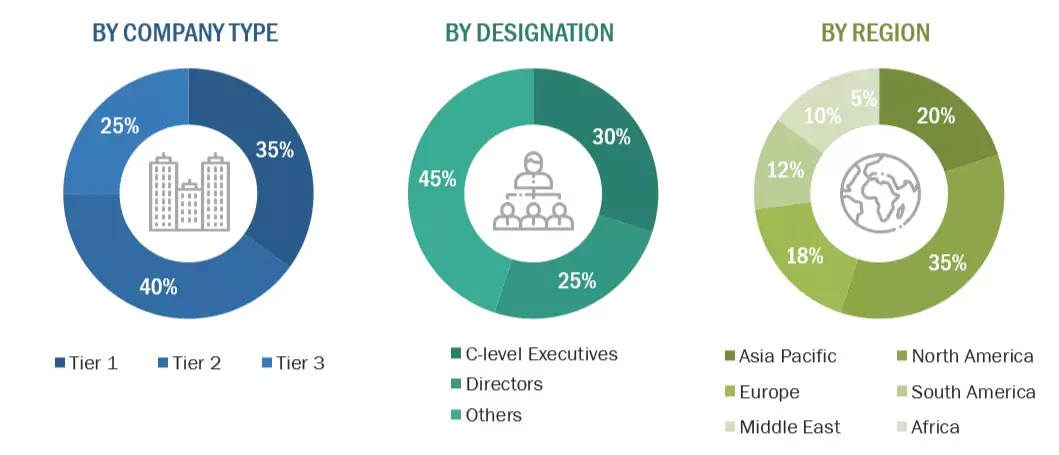
Note: “Others” include sales managers, engineers, and regional managers
The tiers of the companies are defined based on their total revenue as of 2024: Tier 1: >USD 1 billion, Tier 2: USD 500 million–1 billion, and Tier 3:
To know about the assumptions considered for the study, download the pdf brochure
Market Size Estimation
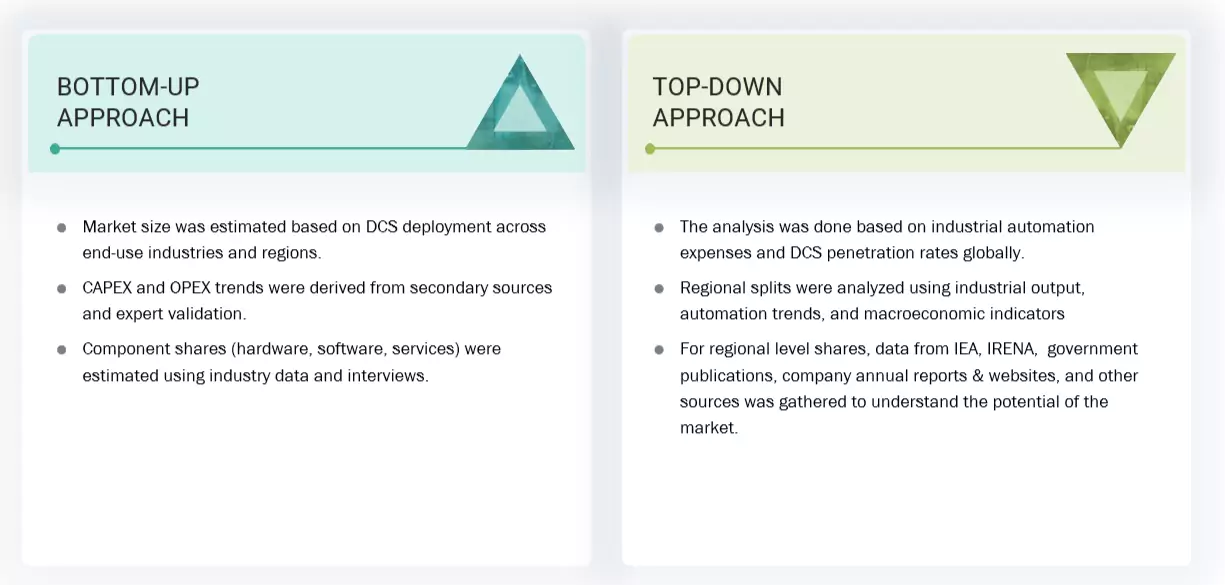
Both the top-down and bottom-up approaches were used to estimate and validate the size of the distributed control system market. These methods were also used extensively to estimate the size of various subsegments in the market. The research methodology used to estimate the market size includes the following.
Distributed Control System Market : Top-Down and Bottom-Up Approach
Data Triangulation
The total market was split into several segments and subsegments after arriving at the overall market size from the above estimation process. Data triangulation and market breakdown processes were employed to complete the overall market engineering process and arrive at the exact statistics for all the segments and subsegments, wherever applicable. The data was triangulated by studying various factors and trends from the demand and supply sides. In addition, the market size was validated using the top-down and bottom-up approaches.
Market Definition
A distributed control system (DCS) is an industrial automation solution widely utilized in process industries to enable plant-wide control via a decentralized network of supervisory and control units. It is commonly applied in sectors such as food & beverages, pharmaceuticals, and petrochemicals, where production involves continuous or complex batch-based processes. The market for distributed control systems is defined as the sum of revenues that the global companies generate through the sales of their distributed control systems. The scope of the current study includes the bifurcation of the distributed control system market by component, application, end-use industry, and region.
Stakeholders
- DCS manufacturers and suppliers
- Solution vendors
- Original equipment manufacturers (OEMs)
- Government agencies
- Managed service providers (MSPs)
- System integrators
- Consultancy firms/advisory firms
- Investors and venture capitalists
- Independent software vendors
- Existing and prospective end-use industries
- Government and research organizations
Report Objectives
- To define, describe, segment, and forecast the distributed control system market, by component, application, end-use industry, and region, in terms of value
- To forecast the market sizes for six major regions, namely North America, Europe, Asia Pacific, South America, the Middle East, and Africa, along with their key countries, in terms of value
- To provide detailed information regarding key drivers, restraints, opportunities, and challenges influencing the growth of the distributed control system market
- To provide the supply chain analysis, trends/disruptions impacting customer business, ecosystem analysis, regulatory landscape, patent analysis, case study analysis, technology analysis, key conferences & events, the impact of AI/Gen AI, macroeconomic outlook, pricing analysis, porter’s five forces analysis, and regulatory analysis, the impact of 2025 US tariff on the market
- To analyze opportunities for stakeholders in the distributed control system market and draw a competitive landscape of the market
- To benchmark market players using the company evaluation matrix, which analyzes market players on broad categories of business and product strategies adopted by them
- To compare key market players for the market share, product specifications, and applications
- To strategically profile key players and comprehensively analyze their market ranking and core competencies.
- To analyze competitive developments, such as contracts, agreements, partnerships, and product launches, in the distributed control system market
Available Customizations
MarketsandMarkets offers customizations according to the specific needs of the companies using the given market data.
The following customization options are available for the report:
Product Analysis
- Product matrix, which gives a detailed comparison of the product portfolio of each company
Geographic Analysis as per Feasibility
- Further breakdown of the distributed control system, by country
Company Information
- Detailed analysis and profiling of additional market players (up to five)
Get the Full Distributed Control System Market Report
Full forecast, segment splits, and company analysis for all Distributed Control System Market.
- China Distributed Control System Market
- India Distributed Control System Market
- South Korea Distributed Control System Market
- Japan Distributed Control System Market
- US Distributed Control System Market
- Canada Distributed Control System Market
- Mexico Distributed Control System Market
- Germany Distributed Control System Market
- UK Distributed Control System Market
- France Distributed Control System Market
- Italy Distributed Control System Market
- Russia Distributed Control System Market
- Saudi Arabia Distributed Control System Market
- UAE Distributed Control System Market
- Qatar Distributed Control System Market
- Brazil Distributed Control System Market
- Venezuela Distributed Control System Market
- South Africa Distributed Control System Market
- Nigeria Distributed Control System Market
- Rest Of Europe Distributed Control System Market
- Rest Of Asia Pacific Distributed Control System Market
- GCC Countries Distributed Control System Market
- Rest Of Middle East Distributed Control System Market
- Rest Of GCC Distributed Control System Market
- Rest Of South America Distributed Control System Market
- Algeria Distributed Control System Market
- Rest Of Africa Distributed Control System Market
Need a Tailored Report?
Customize this report to your needs
Get 10% FREE Customization
Customize This Report
