
Russia Distributed Fiber Optic Sensor Market (2024-2029)

The Russia Distributed Fiber Optic Sensor Market was valued at $328.8 Million in 2024 and projected to reach to $600.6 Million by 2029, representing a compound annual growth rate of 10.6%. Russia's distributed fiber optic sensor market is poised for sustained expansion driven by the nation's strategic focus on infrastructure resilience and energy sector optimization.


| Market Size in | USD 26.32 MN |
| Market Forecast in | |
| CAGR | |
| Forecast Period | |
| Units Considered | Value (USD MN) |
Russia Distributed Fiber Optic Sensor Market Trends and Insights
- This expansion reflects Russia's increasing investment in infrastructure monitoring, oil and gas applications, and industrial automation across critical sectors.
- Russia's market growth trajectory aligns with broader adoption of advanced sensing technologies for real-time structural health monitoring and environmental surveillance. The Russian market benefits from significant demand in energy infrastructure, where distributed fiber optic sensors enable precise temperature and strain monitoring across pipelines and power transmission networks.
- Russia's strategic focus on domestic technological development and modernization of legacy infrastructure drives sustained investment in sensor deployment.
- Between 2024 and 2029, Russia is expected to see accelerated adoption driven by regulatory requirements for safety monitoring and the need for cost-effective, long-distance sensing solutions across vast geographical territories. Russia's competitive landscape features both established industrial players and emerging technology providers capitalizing on the country's unique infrastructure challenges.
- The market's 10.6% compound annual growth rate underscores Russia's commitment to modernizing critical infrastructure and enhancing operational efficiency through advanced fiber optic sensing technologies..
Key Market Statistics
- CAGR (2024-2029) 10.6% CAGR
- Market Size, 2024 ~USD 328.8 Million
- Forecast, 2029 ~USD 600.6 Million
- Country Russia
Russia Distributed Fiber Optic Sensor Market Overview
Market Valuation Growth :
Russia's distributed fiber optic sensor market is valued at USD 328.8 million in 2024, with projections reaching USD 600.6 million by 2029, representing an 82.7% total growth over the forecast period.
Oil & Gas Dominance :
Russia's extensive oil and gas infrastructure drives significant demand for distributed fiber optic sensors in pipeline monitoring, wellbore surveillance, and subsurface temperature and strain measurements across Siberian and Far Eastern operations.
Infrastructure Modernization :
Increasing government investment in critical infrastructure monitoring, including power grids, railways, and telecommunications networks, accelerates adoption of advanced sensing technologies across Russia's vast geographic expanse.
Industrial Automation Expansion :
Growing industrial automation initiatives in manufacturing, mining, and energy sectors position Russia as a key market for real-time monitoring solutions that enhance operational efficiency and safety compliance.
Russia Distributed Fiber Optic Sensor Market Dynamics
- The 10.6% CAGR reflects strong demand from oil and gas operators seeking advanced monitoring capabilities across remote and challenging environments.
- Government initiatives supporting digital transformation in critical infrastructure, combined with increasing industrial automation investments, create favorable conditions for market penetration. The forecast period through 2029 will likely see accelerated adoption as Russian enterprises prioritize real-time monitoring solutions for operational safety and efficiency.
- Domestic technological advancement and localized manufacturing capabilities are expected to enhance market accessibility, while integration with IoT and AI-driven analytics platforms will unlock new applications in predictive maintenance and asset management across Russia's industrial landscape..
Market Ecosystem
Related Ecosystem
Sensors And Control
- Sensors
- Temperature Sensors
- Image Sensors
- Pressure Sensors
- Flow Sensors
- BAUMER ELECTRIC AG
- HONEYWELL INTERNATIONAL INC.
- Stmicroelectronics
- Lenovo
- Texas Instruments Incorporated
Industrial Iot
- Sensors
- Pressure Sensors
- Flow Sensors
- Gas Sensors
- Image Sensors
- Siemens ag
- ABB India Limited
- HONEYWELL INTERNATIONAL INC.
- Emerson Electric Co.
- SCHNEIDER ELECTRIC SE
Key Takeaways
- Russia's distributed fiber optic sensor market will nearly double from USD 328.8 million in 2024 to USD 600.6 million by 2029, driven by infrastructure modernization.
- Russia's 10.6% CAGR reflects strong demand from oil, gas, and power transmission sectors requiring long-distance, real-time monitoring capabilities.
- Russia's vast geographical expanse creates unique demand for distributed sensing solutions that can monitor critical infrastructure across extended distances cost-effectively.
- Russia's market growth is supported by regulatory mandates for safety monitoring and domestic technological development initiatives through 2029.
Distributed Fiber Optic Sensor Market Report Scope
| Report Metric | Details |
|---|---|
| Base Year | 2024 |
| Fastest Growing Segment | STRAIN SENSING (Application) |
| Forecast Period | 2024-2029 |
| Growth Rate | CAGR of 10.9% from 2024 to 2029 |
| Largest Segment | OPTICAL TIME DOMAIN REFLECTOMETRY (Operating Principle) |
| Market Size Base Year (Billions) | ~USD 1.41 (2024) |
| Revenue Forecast (Billions) | ~USD 2.37 (2029) |
| Segments Covered | Fiber Type, Operating Principle, Scattering Method, Application, Vertical |
Russia Distributed Fiber Optic Sensor Market Report Segmentation
5 segment dimensions are covered across the global market.
By Fiber Type
- Multi-Mode
- Single-Mode
By Operating Principle
- Optical Frequency Domain Reflectometry
- Optical Time Domain Reflectometry
By Scattering Method
- Brillouin Scattering Method
- Raman Scattering Method
- Rayleigh Scattering & Bragg Grating Method
By Application
- Acoustic Sensing
- Strain Sensing
- Temperature Sensing
By Vertical
- Industrial
- Infrastructure
- Oil & Gas
- Power & Utility
- Safety & Security
- Telecommunications
RUSSIA: DISTRIBUTED FIBER OPTIC SENSOR MARKET, BY APPLICATION, 2024–2030
| Segment | 2024 | 2025 | 2026 | 2027 | 2028 | 2029 | 2030 | CAGR (%) |
|---|---|---|---|---|---|---|---|---|
| ACOUSTIC SENSING | 89.3 | 101.7 | 115.4 | 130 | 145.7 | 162.8 | 181.7 | 12.6 |
| STRAIN SENSING | 20.7 | 24.8 | 29.5 | 34.8 | 40.8 | 47.6 | 55.4 | 17.8 |
| TEMPERATURE SENSING | 218.8 | 240.6 | 263.6 | 287.1 | 311.2 | 336.5 | 363.4 | 8.8 |
| TOTAL | 328.8 | 367.1 | 408.4 | 451.9 | 497.7 | 547 | 600.6 | 10.6 |
Target Audience
- Oil & Gas Operators : Russian and international energy companies operating in Russia require detailed market intelligence on distributed fiber optic sensor adoption for pipeline integrity, wellbore monitoring, and subsurface asset management.
- Infrastructure & Utilities Managers : Government agencies and utility operators responsible for power grids, railways, and telecommunications need market data to evaluate sensor technology investments for critical infrastructure resilience and real-time monitoring.
- Technology & Equipment Manufacturers : Sensor manufacturers, system integrators, and technology providers targeting Russia require market sizing, growth forecasts, and sector-specific demand drivers to guide product development and market expansion strategies.
- Industrial & Mining Enterprises : Russian manufacturing, mining, and industrial automation companies need market insights to assess distributed fiber optic sensor viability for operational efficiency, safety compliance, and predictive maintenance applications.
- Investment & Strategy Consultants : Private equity firms, venture capital investors, and management consultants evaluating Russia market opportunities require comprehensive market data, growth projections, and competitive landscape analysis for investment decisions.
Reasons to Buy this Report
- Strategic Market Sizing : Obtain precise valuation data for Russia's distributed fiber optic sensor market with verified 2024 baseline (USD 328.8M) and 2029 forecasts, enabling accurate budget allocation and investment planning for market entry or expansion.
- Sector-Specific Insights : Understand Russia's dominant oil and gas applications, infrastructure modernization drivers, and industrial automation trends to identify high-potential customer segments and tailor product-market fit strategies.
- Competitive Positioning : Benchmark your organization against Russia's 10.6% CAGR growth trajectory and identify market gaps, emerging opportunities, and competitive advantages in a market experiencing robust expansion through 2029.
- Risk & Opportunity Assessment : Evaluate Russia-specific market dynamics, regulatory environment, and geopolitical factors affecting distributed fiber optic sensor adoption to inform go/no-go decisions and risk mitigation strategies.
- Growth Trajectory Planning : Leverage detailed market forecasts to develop multi-year business strategies, sales projections, and resource allocation plans aligned with Russia's anticipated 82.7% market value growth through 2029.
Frequently asked questions
What is the current size of Russia's distributed fiber optic sensor market?
Russia's distributed fiber optic sensor market was valued at USD 328.8 million in 2024 and is expected to grow to USD 600.6 million by 2029.
What is the projected growth rate for Russia's distributed fiber optic sensor market?
Russia's distributed fiber optic sensor market is projected to grow at a compound annual growth rate (CAGR) of 10.6% from 2024 to 2029.
Which industries drive demand for distributed fiber optic sensors in Russia?
Russia's primary demand drivers include oil and gas infrastructure, power transmission networks, industrial automation, and structural health monitoring applications requiring long-distance sensing.
Why is Russia's market particularly suited for distributed fiber optic sensor adoption?
Russia's vast geographical territory and extensive pipeline and power transmission networks create significant demand for cost-effective, long-distance monitoring solutions that distributed fiber optic sensors provide.
What factors will support Russia's market growth through 2029?
Russia's market growth will be supported by infrastructure modernization initiatives, regulatory safety requirements, domestic technology development programs, and the need for real-time monitoring across critical infrastructure.
RESEARCH METHODOLOGY
This is a technical, market-oriented, and commercial study of the distributed fiber optic sensor (DFOS) market, which was carried out through the structured collection, documentation, and analysis of data on companies operating in the market. Significant use of secondary sources, directories, and databases - Factiva, Oanda, and OneSource, was made to identify and collect the needed information. In-depth interviews were conducted with various primary respondents, mostly experts from the core and related industries and preferred manufacturers, in order to acquire and verify critical qualitative and quantitative information. The growth prospects of the market were measured. Using secondary research, the key players involved in the DFOS market were ascertained, and market rankings were identified through both primary and secondary research. This included research about the annual reports of the top players, interviews with senior industry experts such as CEOs, directors, and marketing executives.
Secondary Research
In the secondary research process, various secondary sources were used to identify and collect information for this study. These include annual reports, press releases, and investor presentations of companies, whitepapers, certified publications, and articles from recognized associations and government publishing sources. Research reports from a few consortiums and councils were also consulted to structure qualitative content. Secondary sources included corporate filings (such as annual reports, investor presentations, and financial statements); trade, business, and professional associations; white papers; Journals and certified publications; articles by recognized authors; gold-standard and silver-standard websites; directories; and databases. Data was also collected from secondary sources, such as the International Trade Centre (ITC) (Switzerland), and the International Monetary Fund (IMF).
Primary Research
Extensive primary research was accomplished after understanding and analyzing the distributed fiber optic sensor (DFOS) market scenario through secondary research. Several primary interviews were conducted with key opinion leaders from both demand- and supply-side vendors across four major regions-North America, Europe, Asia Pacific, and RoW. The primary interviews were conducted with the demand side to the extent of 40% and with the supply side to the extent of 60%. Primary data collected through questionnaires, emails, telephonic interviews, through the contact of various departments in organizations, sales, operations, and administration are considered to provide a holistic viewpoint in the report.
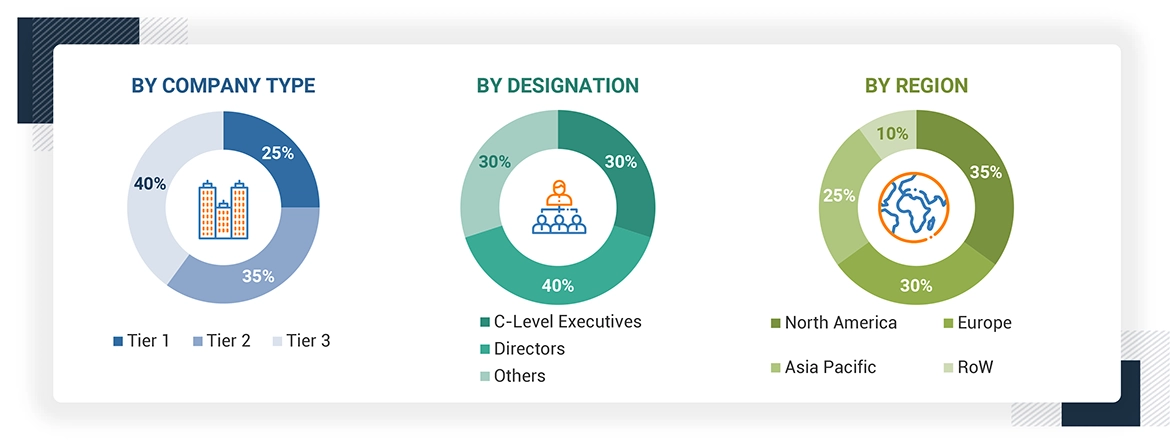
Note: The three tiers of companies are based on their total revenue as of 2023: Tier 1 - equal to or more than USD 1,000 million; Tier 2 - between USD 500 million and USD 1,000 million; and Tier 3 - less than or equal to USD 500 million. Other designations include managers and academicians.
To know about the assumptions considered for the study, download the pdf brochure
Market Size Estimation
In the complete market engineering process, both top-down and bottom-up approaches were used, along with several data triangulation methods, to estimate and forecast the size of the market and its segments and subsegments listed in the report. Extensive qualitative and quantitative analyses were carried out on the complete market engineering process to list the key information/insights pertaining to distributed fiber optic sensor (DFOS) market.
The key players in the market were identified through secondary research, and their rankings in the respective regions determined through primary and secondary research. This entire procedure involved the study of the annual and financial reports of top players, and interviews with industry experts such as chief executive officers, vice presidents, directors, and marketing executives for quantitative and qualitative key insights. All percentage shares, splits, and breakdowns were determined using secondary sources and verified through primary sources. All parameters that affect the markets covered in this research study were accounted for, viewed in extensive detail, verified through primary research, and analyzed to obtain the final quantitative and qualitative data. This data was consolidated, supplemented with detailed inputs and analysis from MarketsandMarkets, and presented in this report.
Distributed Fiber Optic Sensor Market : Top-Down and Bottom-Up Approach
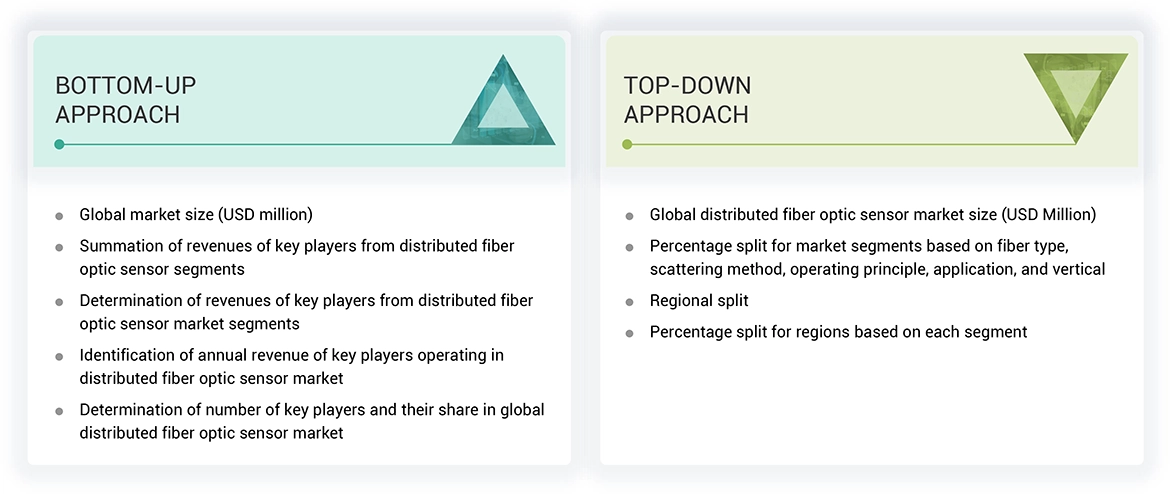
The bottom-up procedure was employed to arrive at the overall size of the distributed fiber optic sensor (DFOS) market from revenues of the key players and their share in the market. The overall market size was calculated on the basis of the revenues of the key companies identified in the market.
In the top-down approach, the overall market size has been used to estimate the size of the individual markets (mentioned in the market segmentation) through percentage splits obtained from secondary and primary research. For the calculation of the distributed fiber optic sensor market segments, the market size obtained by implementing the bottom-up approach was used to implement the top-down approach, which was later confirmed with the primary respondents across different regions. The bottom-up approach has also been implemented for the data extracted from secondary research to validate the market size of various segments.
The approximate market share of each company has been estimated to verify revenue shares used earlier in the bottom-up approach. With the help of the data triangulation procedure and the validation of data through primary interviews, the overall market size and each market size have been determined and confirmed in this study. The data triangulation procedure used for this study has been explained in the next section.
Data Triangulation
After arriving at the overall market size through the above process, the market has been split into several segments. To complete the overall market engineering process and arrive at the exact statistics for all the segments, market breakdown and data triangulation procedures have been employed, wherever applicable. The data has been triangulated by studying various factors and trends from both the demand and supply sides. The market has also been validated using both the top-down and bottom-up approaches.
Market Definition
Distributed fiber optic sensors use a fiber optic cable to measure temperature, acoustics, pressure, and strain along the length of the fiber. The benefit of using a distributed fiber optic sensor is that it provides the real-time measurement of physical parameters such as temperature, vibration, or strain, which are recorded along the length of the optical sensor cable and are reliable for operating in harsh environments. Industries such as oil & gas, power & utility, safety & security, and civil engineering require distributed fiber optic sensors for monitoring as they can operate reliably in harsh working environments and are immune to electromagnetic interference.
Key Stakeholders
- Raw Material Vendors
- Component and Hardware Providers
- Sensor Providers
- System Integrators
- Original Equipment Manufacturers (OEMs)/Device Manufacturers
- Technology Standard Organizations, Forums, Alliances, and Associations
- Governments, Financial Institutions, and Investment Communities
- Research Organizations
- Analysts and Strategic Business Planners
- Venture Capitalists, Private Equity Firms, and Start-up Companies
Report Objectives
- To define, describe, and forecast the size of the distributed fiber optic sensor market, by fiber type, operating principle, scattering method, application, and vertical, in terms of value
- To forecast the size of market segments with respect to four regions, namely North America, Europe, Asia Pacific, and the Rest of the World (RoW), in terms of value
- To define, describe, and forecast the size of the distributed fiber optic sensor market, by application, in terms of volume
- To identify and analyze key drivers, restraints, opportunities, and challenges influencing the growth of the distributed fiber optic sensor market
- To offer an ecosystem analysis, value chain analysis, case study analysis, patent analysis, technology analysis, pricing analysis, Porter’s five forces analysis, and regulations pertaining to the market
- To strategically analyze micromarkets with respect to individual growth trends, prospects, and contributions to the total market
- To strategically profile key players and comprehensively analyze their market shares and core competencies
- To analyze the opportunities in the market for stakeholders and describe the competitive landscape of the market
- To study competitive developments, such as collaborations, partnerships, product developments, and acquisitions, in the market
- To understand the impact of Gen AI/AI on the distributed fiber optic sensor market
- To understand the Macroeconomic outlook on the fiber optic sensor market
Available Customizations
With the given market data, MarketsandMarkets offers customizations according to the company’s specific needs. The following customization options are available for the report:
Company Information:
- Detailed analysis and profiling of additional market players (up to 7)
Get the Full Distributed Fiber Optic Sensor Market Report
Full forecast, segment splits, and company analysis for all Distributed Fiber Optic Sensor Market.
- US Distributed Fiber Optic Sensor Market
- Canada Distributed Fiber Optic Sensor Market
- Mexico Distributed Fiber Optic Sensor Market
- Germany Distributed Fiber Optic Sensor Market
- UK Distributed Fiber Optic Sensor Market
- China Distributed Fiber Optic Sensor Market
- Japan Distributed Fiber Optic Sensor Market
- India Distributed Fiber Optic Sensor Market
- Indonesia Distributed Fiber Optic Sensor Market
- Saudi Arabia Distributed Fiber Optic Sensor Market
- Iran Distributed Fiber Optic Sensor Market
- Iraq Distributed Fiber Optic Sensor Market
- Brazil Distributed Fiber Optic Sensor Market
- Rest Of Europe Distributed Fiber Optic Sensor Market
- Scandinavia Distributed Fiber Optic Sensor Market
- Rest Of Asia Pacific Distributed Fiber Optic Sensor Market
- Rest Of Middle East Distributed Fiber Optic Sensor Market
- Argentina Distributed Fiber Optic Sensor Market
- Venezuela Distributed Fiber Optic Sensor Market
Need a Tailored Report?
Customize this report to your needs
Get 10% FREE Customization
Customize This Report
