
Sweden Drone Battery Market (2025-2030)

The Sweden Drone Battery Market was valued at $13.7 Million in 2025 and projected to reach to $20.7 Million by 2030, representing a compound annual growth rate of 8.6%. Sweden's drone battery market is experiencing accelerated growth fueled by escalating defence modernization initiatives and the Nordic region's commitment to advanced unmanned systems.


| Market Size in | USD 26.32 MN |
| Market Forecast in | |
| CAGR | |
| Forecast Period | |
| Units Considered | Value (USD MN) |
Sweden Drone Battery Market Trends and Insights
- Valued at USD 13.7 million in 2025, Sweden's market is projected to expand to USD 20.7 million by 2030, reflecting a compound annual growth rate of 8.6%.
- This growth trajectory underscores Sweden's increasing investment in unmanned aerial systems and advanced battery technologies for both commercial and defence applications. The Swedish drone battery market benefits from the country's strong engineering heritage, robust defence procurement initiatives, and growing adoption of drone technology across surveying, logistics, and public safety sectors.
- Sweden's commitment to innovation and sustainability drives demand for high-performance, long-duration battery solutions.
- The market expansion from 2025 to 2030 demonstrates Sweden's strategic importance in the Nordic and broader European drone ecosystem, supported by favourable regulatory frameworks and technological advancement. Sweden's competitive positioning within Europe is reinforced by its focus on next-generation battery chemistries and integration with autonomous systems.
- The forecasted growth to 2030 reflects both domestic demand and Sweden's role as a technology hub for regional drone battery development and deployment..
Key Market Statistics
- CAGR (2025-2030) 8.6% CAGR
- Market Size, 2025 ~USD 13.7 Million
- Forecast, 2030 ~USD 20.7 Million
- Country Sweden
Sweden Drone Battery Market Overview
Market Valuation :
Sweden's drone battery market is valued at USD 13.7 million in 2025, with strong growth momentum driven by increased defence spending and commercial drone adoption across Nordic regions.
Robust Growth Trajectory :
The Swedish market is projected to reach USD 20.7 million by 2030, representing an 8.6% CAGR, closely aligned with the global growth rate of 8.7%, indicating Sweden's competitive positioning in advanced battery technologies.
Defence & Aerospace Integration :
Sweden's strategic focus on unmanned aerial systems for defence applications, coupled with investments in autonomous technologies, positions the country as a key hub for drone battery innovation within European aerospace and defence sectors.
Technology Advancement :
Swedish manufacturers are increasingly developing high-performance battery solutions tailored for military and commercial UAV applications, supporting the nation's leadership in advanced defence technologies and sustainable energy systems.
Sweden Drone Battery Market Dynamics
- The country's strong industrial base in aerospace and defence, combined with significant R&D investments, positions Sweden as a critical player in developing next-generation battery technologies for UAV applications.
- Government support for autonomous systems and increasing procurement budgets for defence equipment are expected to sustain market expansion through 2030. The Swedish market benefits from proximity to NATO partnerships and regional security concerns, driving demand for sophisticated drone capabilities.
- Local manufacturers and technology providers are capitalizing on opportunities in both military and commercial segments, including surveillance, logistics, and emergency response applications.
- Continued innovation in battery chemistry, energy density, and charging infrastructure will further accelerate market penetration across Swedish defence agencies and commercial operators..
Market Ecosystem
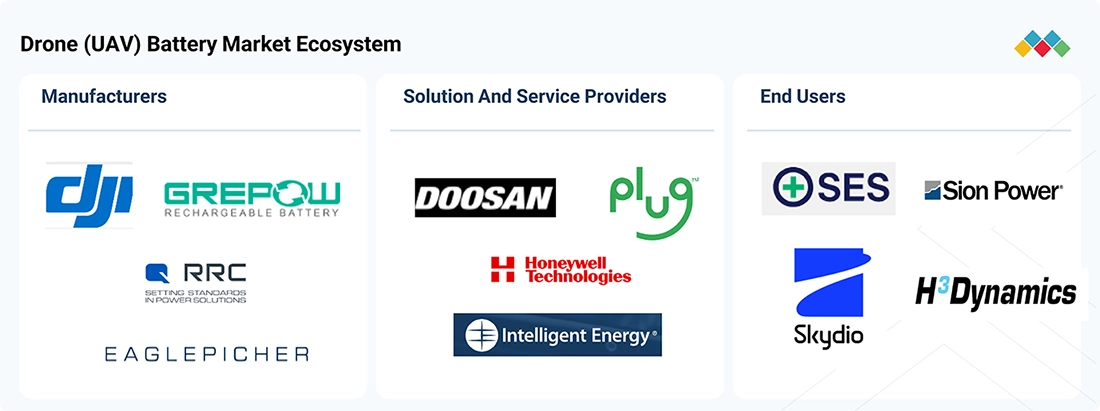
DRONE (UAV) BATTERY MARKET: COMMERCIAL USE CASES ACROSS INDUSTRIES
| COMPANY | USE CASE DESCRIPTION | BENEFITS |
|---|---|---|
 |
Development of intelligent flight batteries for consumer, commercial, and enterprise drones. DJI batteries integrate battery management functions and are designed to support different UAV platforms with varying capacity, voltage, and flight requirements. | Supports longer flight operations, provides battery status monitoring, and improves charging and power management. Intelligent battery functions also help maintain battery condition during storage and operation. |
 |
Development of customized lithium-ion and lithium-polymer batteries for drones and other unmanned systems. The company provides integrated solutions covering battery cells, Battery Management Systems (BMS), and battery structures. | Enables customized battery designs based on UAV size and power requirements. Supports lightweight designs, improved energy performance, and integration with different drone platforms. |
 |
Development of rechargeable and primary battery systems for military and aerospace UAV applications. EaglePicher has supplied lithium-ion battery systems for UAV platforms including the RQ-4 Global Hawk, Aurora Excalibur and X-47B. | Provides high power and extended operating time for demanding UAV missions. Lightweight primary batteries can also support expendable UAV applications where long runtime and low weight are important. |
 |
Development of standard and customized lithium-ion and lithium-polymer battery packs for transportation drones, inspection drones and other professional UAV applications. The company also supplies chargers, power management modules and connectors. | Supports fast charging and high-power loads while providing reliable operation under demanding conditions. Customized battery solutions allow UAV manufacturers to match power systems with specific drone requirements. |
 |
Development of main propulsion batteries for Mini and Small Tactical Unmanned Aerial Systems (UAS) as well as backup batteries for Medium-Altitude Long-Endurance (MALE) UAS. Its batteries are designed for operations in desert, arctic and marine environments. | Provides high energy and power density while maintaining low weight. Smart Battery Management Systems (BMS) support battery monitoring, balancing, safety and mission endurance under demanding operating conditions. |
Logos and trademarks shown above are the property of their respective owners. Their use here is for informational and illustrative purposes only.
Related Ecosystem
Unmanned Systems
- Rotary Wing Aircraft
- Fixed-Wing Drones
- Sensors
- Fuel Cell
- Fixed Wing Aircraft
- LOCKHEED MARTIN CORPORATION
- Northrop Grumman Corporation
- ISRAEL AEROSPACE INDUSTRIES LTD
- Elbit Systems Ltd.
- Thales group
Battery And Wireless Charging
- Nickel-Cadmium Battery
- Battery Electric Vehicle (BEV)
- Energy Harvesting
- Hybrid Electric Vehicle (HEV)
- Smart Cards
- Panasonic Holdings Corporation
- MOMENTIVE PERFORMANCE MATERIALS INC.
- Lg corp
- FDK Corporation
- Samsung
Drones And Robotics
- Sensors
- Articulated Robots
- Cartesian Robots
- Scara Robots
- Actuators
- ABB India Limited
- KUKA AG
- MOMENTIVE PERFORMANCE MATERIALS INC.
- Fanuc Corporation
- STAUBLI INTERNATIONAL AG
Key Takeaways
- Sweden's drone battery market is valued at USD 13.7 million in 2025 and is forecast to reach USD 20.7 million by 2030.
- Sweden's market exhibits a steady 8.6% CAGR, driven by defence modernisation and commercial drone adoption.
- Sweden's strong engineering capabilities and sustainability focus position it as a regional innovation leader in battery technology.
- Sweden's growth is supported by favourable regulatory frameworks and increasing investment in autonomous systems across multiple sectors.
Drone Battery Market Report Scope
| Report Metric | Details |
|---|---|
| Base Year | 2025 |
| Fastest Growing Segment | COMMERCIAL (Platform) |
| Forecast Period | 2025-2030 |
| Growth Rate | CAGR of 8.7% from 2025 to 2030 |
| Largest Segment | LITHIUM-BASED (Technology) |
| Market Size Base Year (Billions) | ~USD 1.59 (2025) |
| Revenue Forecast (Billions) | ~USD 2.41 (2030) |
| Segments Covered | Technology, Type, Component, Point Of Sale, Platform, Weight, Size, Range, Capacity |
Sweden Drone Battery Market Report Segmentation
9 segment dimensions are covered across the global market.
By Technology
- Fuel Cell
- Lithium-Based
- Nickel-Based
- Sodium-Ion
By Type
- Hale
- Lithium-Ion
- Lithium-Metal
- Lithium-Polymer
- Lithium-Sulfur
- Male
- Micro
- Mini
- Nano
- Nickel-Cadmium
- Nickel-Metal Hydride
- Product Integration
- Small
- Spare Parts
- Strategic
- Tactical
- Upgrade
By Component
- Battery Management System
- Battery Management Systems
- Cell
- Cells
- Connector
- Connectors
- Enclosure
- Enclosures
By Point Of Sale
- Aftermarket
- OEM
By Platform
- Commercial
- Consumer
- Government & Law Enforcement
- Military
By Weight
- <250 G
- >250 G
By Size
- Large
- Medium
- Small
By Range
- Close Range
- Long Range Medium Endurance
- Medium Range Medium Endurance
- Short Range
By Capacity
- 20-50 Ah
- 5-20 Ah
- <5 Ah
- >50 Ah
Target Audience
- Swedish Defence Contractors : Manufacturers and suppliers need market data to optimize product portfolios, identify growth segments, and align battery technology development with Swedish military modernization programs and NATO requirements.
- International Battery Manufacturers : Global battery producers require Sweden-specific market insights to assess entry opportunities, competitive positioning, and localization strategies for the Nordic aerospace and defence sectors.
- Investment & Private Equity Firms : Investors evaluating Swedish drone technology companies need detailed market forecasts, growth drivers, and competitive dynamics to make informed acquisition, funding, and portfolio decisions.
- Government & Policy Makers : Swedish government agencies and defence procurement officials require market intelligence to inform defence budgets, technology roadmaps, and strategic investments in autonomous systems capabilities.
- Commercial Drone Operators : Swedish commercial UAV service providers need market insights on battery technology trends, cost structures, and performance specifications to optimize fleet operations and service offerings.
Reasons to Buy this Report
- Localized Market Intelligence : Gain Sweden-specific insights into market dynamics, competitive landscape, and growth drivers that differ from broader European trends, enabling targeted business strategies for Nordic operations.
- Defence Procurement Opportunities : Understand Swedish military and government procurement patterns for drone battery systems, including budget allocations, tender timelines, and strategic defence priorities shaping market demand.
- Technology & Innovation Tracking : Access detailed analysis of Swedish manufacturers' R&D initiatives, battery chemistry advancements, and proprietary technologies driving competitive differentiation in the Nordic and European markets.
- Investment & Partnership Guidance : Identify key Swedish stakeholders, potential acquisition targets, and partnership opportunities within the drone battery ecosystem, supported by market sizing and growth forecasts through 2030.
- Regulatory & Policy Framework : Understand Sweden-specific regulations, NATO alignment requirements, export controls, and government incentives influencing drone battery development, manufacturing, and commercialization strategies.
Frequently asked questions
What is the current size of Sweden's drone battery market?
Sweden's drone battery market is valued at USD 13.7 million in 2025, with expectations to grow to USD 20.7 million by 2030.
What is the projected growth rate for Sweden's drone battery market?
Sweden's drone battery market is projected to grow at a compound annual growth rate (CAGR) of 8.6% from 2025 to 2030.
What factors are driving growth in Sweden's drone battery market?
Sweden's market growth is driven by defence procurement initiatives, commercial drone adoption, sustainability commitments, and strong engineering innovation capabilities.
How does Sweden's drone battery market compare to Europe?
Sweden represents a significant segment within the European drone battery market, leveraging its technological expertise and strategic defence investments to maintain competitive positioning.
What applications are driving demand in Sweden's drone battery market?
Key applications in Sweden include defence and military operations, surveying and mapping, logistics, public safety, and autonomous systems integration.
RESEARCH METHODOLOGY
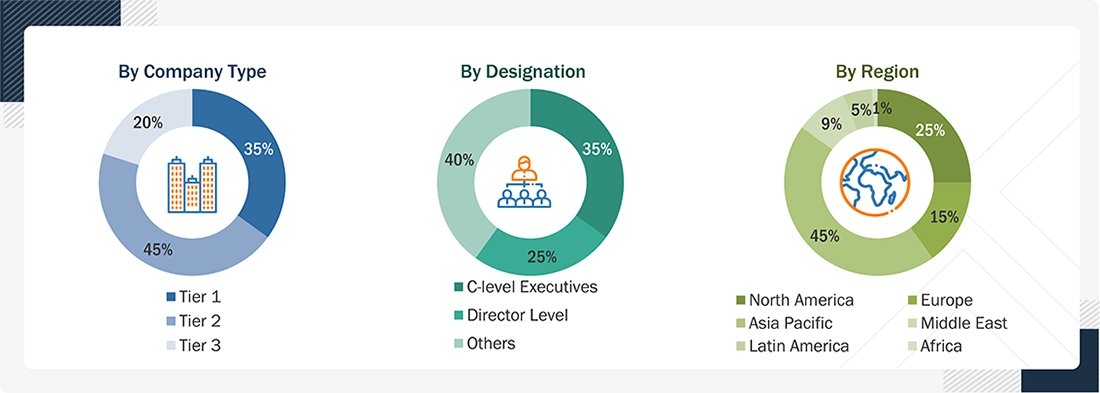
The study followed four main steps to estimate the size of the drone (UAV) battery market. Secondary research was conducted to collect data on drone battery technologies, battery capacities, component types, drone applications, production volumes, and industry developments across key markets. These findings were validated through primary interviews with drone manufacturers, battery manufacturers, suppliers, system integrators, and industry experts. The research analyzed drone adoption, battery demand, technology developments, production trends, and application requirements to assess market demand. Market estimates were then segmented by platform, capacity, technology, point of sale, component, and region. Data triangulation was applied to validate the final figures for each segment and subsegment.
Secondary Research
Secondary research was conducted to build the foundation for the drone (UAV) battery market study. Data were collected from drone industry reports, battery manufacturers, aviation authorities, drone manufacturers, and regulatory organizations related to unmanned aerial vehicles. Company information was reviewed through annual reports, product documents, press releases, and investor presentations of drone and battery manufacturers. The study also examined industry articles, white papers, and research studies related to battery technologies, energy density, charging systems, battery management systems, and UAV applications. Additional insights were gathered from industry associations and market platforms to analyze market trends, technology developments, drone adoption, battery production, and demand across key regions.
Primary Research
Primary research was conducted after key insights from secondary analysis were identified. The study team engaged with executives from drone manufacturers, battery manufacturers, battery component suppliers, system integrators, and industry experts involved in the drone (UAV) battery market. Discussions covered battery technology providers, cell manufacturers, battery management system suppliers, drone companies, and other industry stakeholders across major markets. Interviews were conducted through calls and written correspondence to validate market size estimates, production trends, customer requirements, battery performance, and technology developments. These inputs helped refine perspectives on competition, product development, supply chain activities, and investment trends while improving overall data accuracy.
To know about the assumptions considered for the study, download the pdf brochure
Market Size Estimation
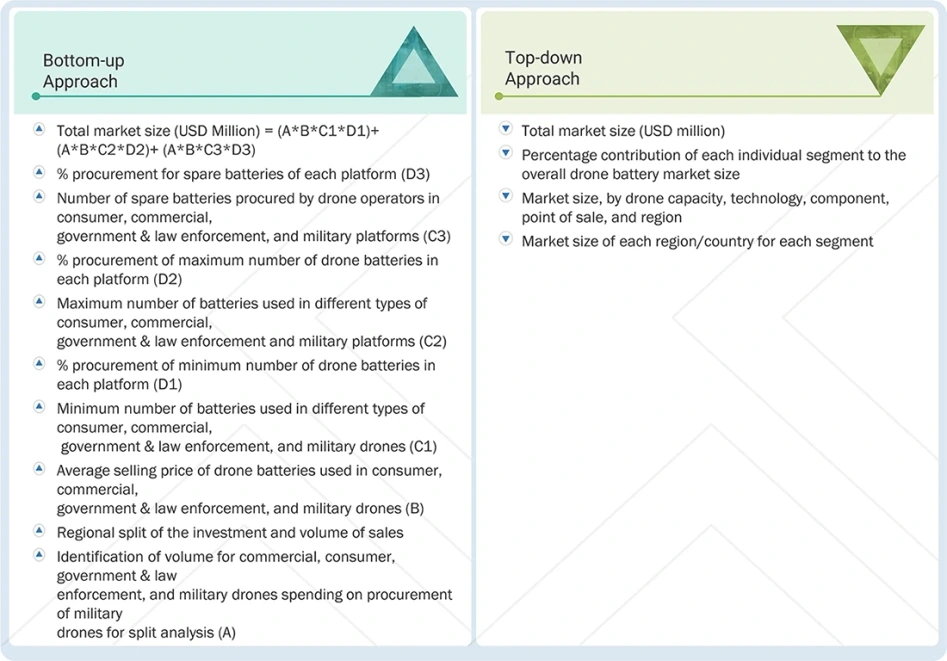
The top-down and bottom-up methods were used to estimate and validate the size of the drone battery market. The research process involved several steps to ensure accuracy.
- Key companies active in the drone battery market were identified through secondary research. Their market share was evaluated using a combination of primary inputs and published data. This included reviewing annual reports, financial disclosures, certification updates, and public filings from various organizations. Interviews were also conducted with industry participants such as company executives, program managers, operators, infrastructure providers, and aviation experts. These inputs were used to validate assumptions and refine market size estimates across regions.
- All percentage shares, segment splits, and market breakdowns were first developed using secondary information. These values were then verified through primary discussions with industry participants.
- The analysis evaluated key factors shaping the drone battery market, including
defense spending trends, drone battery procurement programs, autonomous technology developments, payload integration capabilities, and surveillance requirements. Each factor was assessed through primary research and used to develop both quantitative and qualitative market estimates for this report.
Drone (UAV) Battery Market: Top-Down and Bottom-Up Approach
Data Triangulation
After determining the overall market size, the total market was divided into multiple segments and subsegments. The data triangulation and market breakdown procedures described below were carried out, where applicable, to complete the overall market analysis and determine the estimated market figures for the segments and subsegments. The data were triangulated by examining various factors and trends from both demand and supply sides. Additionally, the market size was validated using the top-down and bottom-up approaches.
Market Definition
A drone battery is a device made up of one or more electrochemical cells with external connections to store energy and provide power to the drone’s electric motors and other onboard electronic systems. It includes integrated modules such as cells, a battery management system (BMS), connectors, and enclosures. The configuration of the battery, whether series or parallel cell arrangements, is designed to meet specific power output and energy capacity needs based on the drone’s application, weight class, and mission duration.
Drone batteries are typically manufactured using lithium-ion, lithium-polymer, lithium-metal, nickel, sodium-ion, and fuel cells. These batteries support diverse drone uses, including inspection and monitoring, surveying and mapping, agriculture, cargo transport, passenger air mobility, and military operations. They are utilized across different drone structures and serve consumer, commercial, government, and defense sectors.
Key Stakeholders
- Drone (UAV) manufacturers developing platforms for commercial, industrial, agricultural, logistics, and defense applications
- Battery manufacturers producing lithium-ion, lithium-polymer, lithium-metal, sodium-ion, and other advanced battery systems
- Battery cell manufacturers supplying high-energy-density cells for UAV battery packs
- Battery management system (BMS) suppliers providing monitoring, thermal management, protection, and battery optimization technologies
- Battery component suppliers providing connectors, enclosures, electrodes, separators, and thermal management components
- Drone operators and service providers using UAVs for inspection, mapping, surveying, agriculture, delivery, and surveillance
- Defense organizations and military forces procuring UAVs and high-performance battery systems for reconnaissance, surveillance, and tactical missions
- Charging system manufacturers developing fast-charging, portable, automated, and field-deployable charging solutions for drones
- Electric motor and propulsion system manufacturers supplying motors, electronic speed controllers, and power systems that determine UAV energy requirements
- Raw material suppliers providing lithium, nickel, cobalt, graphite, and other materials used in battery production
- Battery testing and certification organizations supporting safety, performance, reliability, and regulatory compliance of UAV batteries.
Report Objectives
- To define, describe, and forecast the size of the drone (UAV) battery market by platform, capacity, technology, component, and point of sale
- To forecast the size of market segments with respect to key countries in the following regions: North America, Europe, Asia Pacific, the Middle East, and the Rest of the World (RoW)
- To identify and analyze drivers, restraints, opportunities, and challenges influencing the growth of the market
- To identify industry trends, market trends, and technology trends currently prevailing in the market
- To provide an overview of the regulatory landscape with respect to global drone battery (UAV) market regulations
- To analyze micromarkets with respect to individual growth trends, prospects, and their contribution to the overall market
- To analyze opportunities in the market for stakeholders by identifying key market trends
- To profile key market players and comprehensively analyze their market share and core competencies
- To analyze the degree of competition in the market by identifying growth strategies, such as agreements, acquisitions, partnerships, collaborations, and product launches, adopted by leading market players
- To identify detailed financial positions, key products, and unique selling points of leading market players.
Available customizations:
MarketsandMarkets offers the following customizations for this market report:
- Additional country-level analysis of the drone (UAV) battery market
- Profiling of other market players (up to 5)
Product Analysis
- Product matrix, which provides a detailed comparison of the product portfolio of each company in the drone (UAV) battery market
Get the Full Drone Battery Market Report
Full forecast, segment splits, and company analysis for all Drone Battery Market.
- Canada Drone Battery Market
- US Drone Battery Market
- UK Drone Battery Market
- France Drone Battery Market
- Germany Drone Battery Market
- Italy Drone Battery Market
- Russia Drone Battery Market
- China Drone Battery Market
- India Drone Battery Market
- Japan Drone Battery Market
- Australia Drone Battery Market
- South Korea Drone Battery Market
- Saudi Arabia Drone Battery Market
- UAE Drone Battery Market
- Israel Drone Battery Market
- Turkey Drone Battery Market
- Rest Of Europe Drone Battery Market
- Rest Of Asia Pacific Drone Battery Market
- Rest Of Middle East Drone Battery Market
Need a Tailored Report?
Customize this report to your needs
Get 10% FREE Customization
Customize This Report
