
North America Drone Detection Market (2024-2029)

The North America Drone Detection Market was valued at $365.5 Million in 2024 and projected to reach to $1176.2 Million by 2029, representing a compound annual growth rate of 26.3%. North America's drone detection market is poised for exceptional growth through 2029, fueled by escalating security threats and regulatory mandates across federal, state, and local governments.


| Market Size in | USD 26.32 MN |
| Market Forecast in | |
| CAGR | |
| Forecast Period | |
| Units Considered | Value (USD MN) |
North America Drone Detection Market Trends and Insights
- North America's market expansion is driven by increasing regulatory pressures, critical infrastructure protection requirements, and rising security concerns across government and commercial sectors.
- The region's advanced technological capabilities and substantial defense spending position North America as a leading market for sophisticated drone detection solutions. In North America, the forecast period from 2024 to 2029 reflects accelerating adoption of counter-unmanned aircraft systems (C-UAS) technologies across airports, military installations, and urban centers.
- North America's market growth is supported by heightened awareness of airspace security threats and the deployment of integrated detection networks.
- The region's emphasis on homeland security and critical asset protection continues to fuel demand for advanced radar, RF sensing, and AI-powered detection platforms throughout the forecast period..
Key Market Statistics
- CAGR (2024-2029) 26.3% CAGR
- Market Size, 2024 ~USD 365.5 Million
- Forecast, 2029 ~USD 1176.2 Million
- Geography North America
North America Drone Detection Market Overview
Dominant Market Leader :
North America commands the largest share of the global drone detection market, with the US alone representing $1,110.1 million of the $1,176.2 million regional forecast by 2029, reflecting strong government and defense investments.
Regulatory Compliance Drivers :
Stringent FAA regulations and DHS mandates across North America are accelerating adoption of drone detection systems for airport security, border protection, and critical infrastructure safeguarding.
Rapid CAGR Expansion :
North America's 26.3% CAGR (2024-2029) demonstrates sustained market momentum, driven by increasing drone threats to commercial airspace and government facilities requiring advanced detection capabilities.
Canada's Growing Contribution :
Canada's drone detection market is projected at $66.1 million by 2029, supported by national security initiatives and cross-border infrastructure protection requirements aligned with US standards.
North America Drone Detection Market Dynamics
- The region's technological sophistication and substantial defense budgets enable rapid adoption of advanced detection systems including radar, RF sensors, and AI-powered analytics.
- Commercial sectors including airports, utilities, and critical infrastructure operators are increasingly investing in drone detection to mitigate operational risks and comply with evolving regulations. The market expansion is further supported by strategic partnerships between defense contractors and technology innovators, creating integrated solutions tailored to North American security requirements.
- Investment in R&D for next-generation detection capabilities, coupled with government procurement programs, will sustain the 26.3% CAGR through 2029.
- Both the US and Canada are prioritizing drone detection infrastructure, positioning North America as the global leader in market adoption and technological advancement..
Market Ecosystem
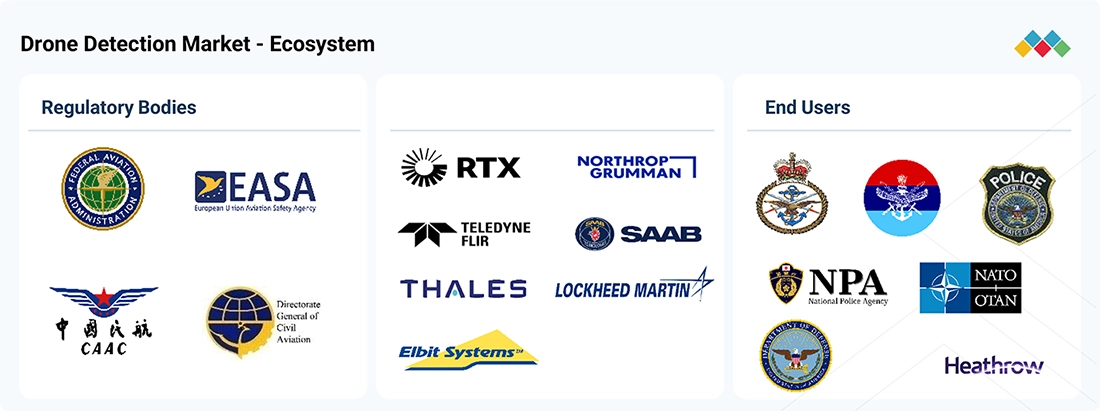
DRONE (UAV) DETECTION MARKET: COMMERCIAL USE CASES ACROSS INDUSTRIES
| COMPANY | USE CASE DESCRIPTION | BENEFITS |
|---|---|---|
 |
Radar-Based Drone Detection & Classification – The IRIS radar is designed to detect and track small drones in low-altitude airspace. It provides 360-degree coverage and uses radar information, including micro-Doppler signatures, to help classify drones and distinguish them from birds and other objects. | Continuous Small-Drone Monitoring – Provides continuous detection without depending on communication signals from the drone. Automated tracking and classification help operators monitor multiple targets and reduce incorrect alerts caused by non-drone objects. |
 |
RF-Based Drone Detection & Identification – EnforceAir monitors RF communication between drones and their controllers to detect, locate, and identify unauthorized drone activity around government facilities, military installations, and major events. The system can be deployed from fixed locations or vehicles depending on the monitoring requirement. | Passive RF Monitoring & Geolocation – Provides information on detected drones and their controllers without relying on radar emissions. Mobile deployment allows detection coverage to be moved between locations, while RF analysis supports identification and location of compatible drone activity. |
 |
Radar-Based Airspace & Drone Surveillance – Ground Master 200 Multi-Mission radars provide mobile airspace surveillance for the Brazilian Air Force, including detection and tracking of small and low-altitude aerial targets. The radar uses 4D AESA technology and can be rapidly deployed as monitoring requirements change. | Mobile Radar Detection & Tracking – Provides extended airspace monitoring and tracking of small aerial targets from a deployable radar platform. Rapid setup and extended autonomous operation allow surveillance coverage to be established at different locations according to operational requirements. |
Logos and trademarks shown above are the property of their respective owners. Their use here is for informational and illustrative purposes only.
Related Ecosystem
Airport Systems
- Antennas
- Sensors
- Aeronautical Information Management (AIM)
- Digital Signage
- Face Recognition
- SYSTRA LTD.
- Thales group
- HONEYWELL INTERNATIONAL INC.
- Idaho Strategic Resources, Inc.
- Leidos Holdings, Inc.
Defence Platforms And Systems
- Sensors
- Unmanned Ground Vehicles (UGV)
- Fighter Aircraft
- Special Mission Aircraft
- Antennas
- BAE Systems plc
- Thales group
- LOCKHEED MARTIN CORPORATION
- Northrop Grumman Corporation
- L3Harris Technologies, Inc.
Homeland Security
- Heat Pumps
- Humidifiers
- Ip Cameras
- Monitors
- Navigation Systems
- Thales group
- Northrop Grumman Corporation
- L3Harris Technologies, Inc.
- Elbit Systems Ltd.
- LOCKHEED MARTIN CORPORATION
Key Takeaways
- North America's drone detection market will grow from $365.5M (2024) to $1,176.2M (2029), representing a 26.3% CAGR.
- North America leads in adoption of advanced C-UAS technologies driven by regulatory mandates and critical infrastructure security needs.
- North America's market is supported by substantial government defense budgets and heightened airspace security awareness.
- North America's forecast growth reflects increasing deployment across airports, military bases, and urban security applications.
Drone Detection Market Report Scope
| Report Metric | Details |
|---|---|
| Base Year | 2024 |
| Fastest Growing Segment | CRITICAL INFRASTRUCTURE (Application) |
| Forecast Period | 2024–2029 |
| Growth Rate | CAGR of 28.7% from 2024 to 2029 |
| Largest Segment | GROUND-BASED (Type) |
| Market Size Base Year (Billions) | ~USD 0.66 (2024) |
| Revenue Forecast (Billions) | ~USD 2.329 (2029) |
| Segments Covered | Application, Subapplication, Technology, Range, Type, Ground-Based System |
North America Drone Detection Market Report Segmentation
6 segment dimensions are covered across the global market.
By Application
- Critical Infrastructure
- Government & Law Enforcement
- Military & Defense
By Subapplication
- Airports
- Border Security
- Corporate & Industrial Facilities
- Military Base
- Oil & Gas Fields
- Portable Isr
- Power Plants
- Prisons
- Stadiums
By Technology
- Optical System
- Radar System
- Rf Scanner
By Range
- 5–10 Km
- < 5 Km
- > 10 Km
By Type
- Fixed
- Ground-Based
- Handheld
- Mobile
By Ground-Based System
- Fixed
- Mobile
Target Audience
- Defense & Government Agencies : US Department of Defense, DHS, and Canadian Armed Forces require market intelligence to evaluate drone detection procurement strategies, budget allocation, and technology roadmaps for national security.
- Aerospace & Defense Contractors : Major defense manufacturers and systems integrators need competitive analysis and market forecasts to guide R&D investments, product development, and go-to-market strategies in North America.
- Commercial Aviation Operators : Airport authorities and airlines across North America require market insights to understand drone threat mitigation requirements, regulatory compliance costs, and technology investment priorities.
- Critical Infrastructure Operators : Utilities, telecommunications, and energy companies need market data to assess drone detection system requirements for asset protection and regulatory compliance across North American operations.
- Technology Investors & Venture Capital : Investment firms targeting aerospace, defense, and security sectors require detailed North America market analysis to identify growth opportunities, emerging technologies, and acquisition targets.
Key Companies in the North America Drone Detection Market
| Company | HQ | Ownership | Strongest segments |
|---|---|---|---|
| RTX | United States | Public Company | Radar-based drone detection,RF scanner-based drone detection,Optical and EO/IR-based detection, |
| NORTHROP GRUMMAN | United States | Public Company | Radar-based drone detection,RF scanner and electronic sensing,Optical / EO-IR detection, |
| LOCKHEED MARTIN CORPORATION | United States | Public Company | Radar-based drone detection,RF scanner / RF analytics,Optical / EO-IR detection, |
| ELBIT SYSTEMS LTD. | Israel | Public Company | Radar-based drone detection,RF scanner / electronic sensing,Optical / EO-IR detection and tracking, |
| TELEDYNE FLIR LLC | United States | Private Company | Optical / thermal imaging for drone detection,Integrated ground-based detection systems and payload bundles,Handheld and mobile detection / observation devices, |
| LEONARDO S.P.A. | Italy | Public Company | Radar-based drone detection,RF scanner / RF analytics,Optical / EO-IR detection, |
| THALES | France | Public Company | Radar-based drone detection,RF scanner-based detection,Optical / optronics-based detection, |
| ISRAEL AEROSPACE INDUSTRIES | Israel | Private Company | Radar-based drone detection,EO/IR and optical detection,RF scanner and signal intelligence-based detection, |
| SAAB AB | Sweden | Public Company | Radar-based drone detection,RF scanner and EW-based detection,Optical and multi-sensor fusion solutions, |
| DRONESHIELD LTD | Australia | Public Company | RF-based detection (DroneSentry, SentryCiv, RfPatrol Mk2, RF sensors),Handheld and wearable counter-UAS (DroneGun Mk4, DroneGun Tactical, RfPatrol-Plugin),Integrated C2 platforms (DroneSentry-C2, Enterprise, Tactical, Access Portal), |
| QINETIQ | United Kingdom | Public Company | Radar-based drone detection,RF scanner and electromagnetic spectrum-based detection,Optical and EO/IR detection, |
| BHARAT ELECTRONICS LIMITED (BEL) | India | ||
| L3HARRIS TECHNOLOGIES, INC. | United States | Public Company | Radar-based drone detection,RF scanner / spectrum-based detection,Optical / EO-IR detection, |
| RHEINMETALL AG | Germany | Public Company | Radar-based drone detection,RF scanner-based detection,Optical / EO-IR detection and tracking, |
| ASELSAN A.S. | Turkey | Public Company | Radar-based drone detection,RF scanner / electronic warfare-based detection,Optical / electro-optic detection, |
RTX
RTX is a United States-based public company founded in 1934 that employs 180,000 people. The company operates as a major aerospace and defense contractor.
NORTHROP GRUMMAN
Northrop Grumman is a United States-based public company founded in 1939 with 95,000 employees. The company is a leading aerospace and defense technology provider.
LOCKHEED MARTIN CORPORATION
Lockheed Martin Corporation is a United States-based public company founded in 1912 with 123,000 employees. The company is a global aerospace, security, and advanced technologies company.
ELBIT SYSTEMS LTD.
Elbit Systems Ltd. is an Israel-based public company founded in 1966 with 20,000 employees. The company specializes in aerospace and defense electronics.
TELEDYNE FLIR LLC
Teledyne FLIR LLC is a United States-based private company founded in 1978 with 4,179 employees. The company develops thermal imaging and sensing technologies.
LEONARDO S.P.A.
Leonardo S.p.A. is an Italy-based public company founded in 1948 with 65,455 employees. The company operates in aerospace, defense, and security sectors.
THALES
Thales is a France-based public company founded in 1893 with 82,111 employees. The company provides aerospace, defense, and security solutions globally.
ISRAEL AEROSPACE INDUSTRIES
Israel Aerospace Industries is an Israel-based private company founded in 1953 with 15,151 employees. The company develops aerospace and defense systems.
SAAB AB
SAAB AB is a Sweden-based public company founded in 1937 with 28,667 employees. The company operates in aerospace, defense, and security markets.
DRONESHIELD LTD
DroneShield Ltd is an Australia-based public company founded in 2014 with 450 employees. The company specializes in counter-drone technology and solutions.
QINETIQ
QinetiQ is a United Kingdom-based public company founded in 2001 with 7,378 employees. The company provides science and engineering services for defense and security.
BHARAT ELECTRONICS LIMITED (BEL)
Bharat Electronics Limited (BEL) is an India-based company specializing in defense electronics and related technologies.
L3HARRIS TECHNOLOGIES, INC.
L3Harris Technologies, Inc. is a United States-based public company founded in 1895 with 45,000 employees. The company provides aerospace, defense, and security solutions.
RHEINMETALL AG
Rheinmetall AG is a Germany-based public company founded in 1889 with 28,815 employees. The company operates in automotive, defense, and technology sectors.
ASELSAN A.S.
ASELSAN A.S. is a Turkey-based public company founded in 1975 with 16,243 employees. The company develops defense electronics and systems.
Countries within North America - compare and drill down
| Country | 2025 size (native) |
|---|---|
| US | USD 1110.1 Million |
| Canada | USD 66.1 Million |
Country market size visualization
Reasons to Buy this Report
- Regional Market Dominance Insights : Gain comprehensive understanding of why North America represents 40%+ of global drone detection spending, with detailed analysis of US and Canadian market dynamics, regulatory frameworks, and competitive landscapes.
- Strategic Investment Opportunities : Identify high-growth segments and emerging technologies within North America's $1.18 billion market by 2029, enabling informed capital allocation and partnership decisions for vendors and investors.
- Regulatory & Compliance Roadmap : Access detailed intelligence on FAA, DHS, and Canadian regulatory requirements driving drone detection adoption, helping organizations align products and services with evolving compliance mandates.
- Competitive Positioning Analysis : Benchmark your organization against North American market leaders through detailed competitive assessments, market share data, and technology differentiation strategies specific to the region.
- End-User Demand Forecasting : Leverage granular forecasts for government, commercial aviation, utilities, and critical infrastructure sectors across North America to optimize sales strategies and resource planning through 2029.
Frequently asked questions
What is the current size of the North America drone detection market?
The North America drone detection market was valued at $365.5 million in 2024 and is expected to reach $1,176.2 million by 2029.
What is the projected growth rate for North America's drone detection market?
North America's drone detection market is projected to grow at a compound annual growth rate (CAGR) of 26.3% from 2024 to 2029.
What factors are driving growth in North America's drone detection market?
North America's market growth is driven by regulatory pressures, critical infrastructure protection requirements, heightened security concerns, and substantial government defense spending.
Which sectors in North America are adopting drone detection technologies?
North America's drone detection adoption spans airports, military installations, government facilities, urban centers, and critical infrastructure sites requiring airspace security.
What technologies are most prevalent in North America's drone detection market?
North America's market features advanced radar systems, RF sensing technologies, AI-powered detection platforms, and integrated counter-unmanned aircraft systems (C-UAS) solutions.
RESEARCH METHODOLOGY
This research study involves the use of secondary sources, company publications, government databases, procurement records, technical papers and industry associations to collect information related to the Drone Detection Market. Primary research includes discussions with industry participants such as drone detection system providers, radar and RF sensor manufacturers, EO/IR and acoustic sensor providers, software developers, system integrators, distributors, and end users. Interviews with industry experts, company executives, and other participants are used to validate information on market size, segment trends, technology adoption, competitive activity, and future market developments. Both qualitative and quantitative inputs are considered to assess the market and its segments.
Secondary Research
In the secondary research process, various sources are referred to for identifying and collecting information related to the drone detection market. These sources include company annual reports, press releases, investor presentations, product documents, government and defense publications, procurement databases, technical papers, journals, patents, industry associations, and recognized news sources. Secondary research is used to gather information on the market supply chain, competitive landscape, market segmentation, regional presence, technology developments, contracts, partnerships, product developments, and deployment of drone detection systems. Information on radar, RF, EO/IR, acoustic, multi-sensor systems, detection software, and related technologies is also reviewed to understand changes in the market. The collected information is analyzed to estimate the overall market and individual segments using bottom-up and top-down approaches. The findings from secondary research are further checked and validated through primary research with relevant industry participants and subject matter experts.
Primary Research
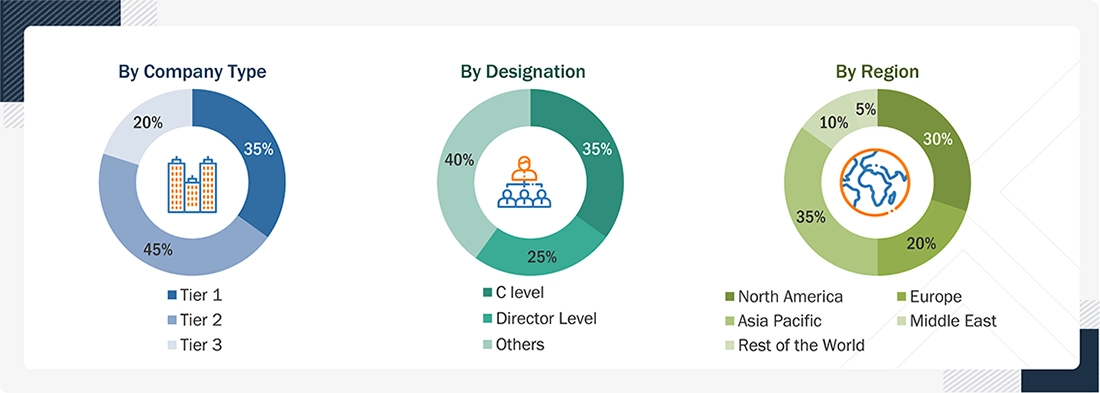
Extensive primary research was conducted after acquiring information on the drone detection market through secondary research. Several primary interviews were conducted with market experts from the demand and supply sides across major countries of North America, Europe, Asia Pacific, the Middle East, and the Rest of the World. Primary data was collected through questionnaires, emails, and telephonic interviews.
To know about the assumptions considered for the study, download the pdf brochure
Market Size Estimation
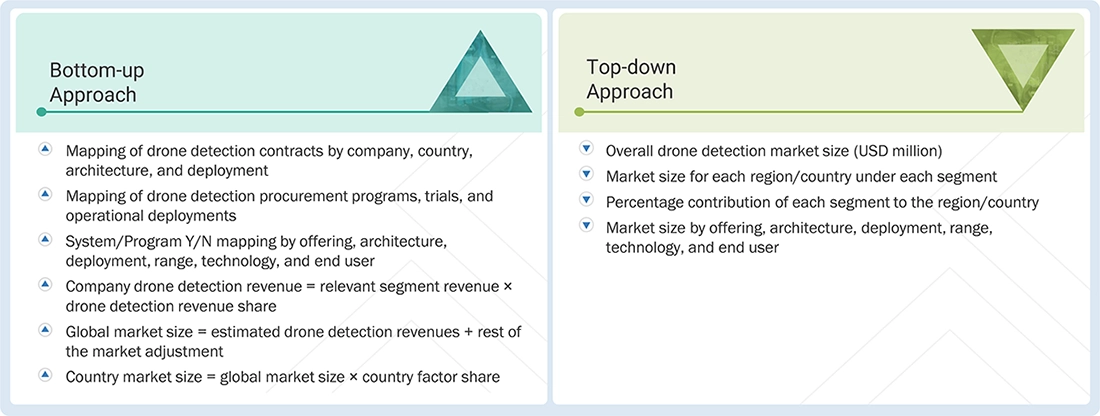
Top-down and bottom-up approaches were used to estimate and validate the size of the drone detection market. The research methodology used to estimate the size of the market included the following details:
- Key players in the drone detection market were identified through secondary research, and their market shares were determined through a combination of primary and secondary research. This included a study of the annual and financial reports of the top market players, as well as extensive interviews with leaders, including directors, engineers, marketing executives, and other key stakeholders of leading companies operating in the market.
- All percentage shares, splits, and breakdowns were determined using secondary sources and verified through primary sources.
- All possible parameters that affect the markets covered in this research study were accounted for, viewed in extensive detail, verified through primary research, and analyzed to obtain the final quantitative and qualitative data on the drone detection market. This data was consolidated, enhanced with detailed input, analyzed by MarketsandMarkets, and presented in this report.
Drone (UAV) Detection Market: Top-Down and Bottom-Up Approach
Data Triangulation
After determining the overall market size, the total market was classified into several segments and subsegments. The data triangulation and market breakdown procedures explained below were implemented, wherever applicable, to complete the overall market engineering process and arrive at the estimated market numbers for the market segments and subsegments. The data were triangulated by examining various factors and trends on both the demand and supply sides. Additionally, the market size was validated using top-down and bottom-up approaches.
Market Definition
The drone detection market focuses on technologies and systems that detect and identify unmanned aerial vehicles (UAVs) or drones. The market includes many solutions that aim to secure airspace, protect critical infrastructure, and prevent unauthorized drone activities, such as potential threats to national security, privacy violations, or smuggling operations.
Drone detection technologies often use radar systems, radio frequency (RF) sensors, and optical sensors to monitor and detect drone activities in real time. The market caters to several applications, including military & defense, government & law enforcement, and critical infrastructure.
Key Stakeholders
- Government agencies and regulators
- Military and defense organizations
- Critical infrastructure operators
- Law enforcement and security agencies
- Technology providers and system integrators
- Drone detection system manufacturers
- Service providers and maintenance companies
- Private security firms
- Research and development institutions
- End users and operators
Report Objectives
- To define, describe, segment, and forecast the size of the drone detection market based on offering, architecture, deployment, range, technology, end user, and region
- To forecast the size of various segments of the market with respect to major regions: North America, Europe, Asia Pacific, the Middle East, and the Rest of the World, along with major countries in each of these regions
- To identify and analyze the drivers, restraints, opportunities, and challenges influencing the growth of the market
- To identify industry trends, market trends, and technology trends currently prevailing in the market
- To analyze micromarkets with respect to growth trends, prospects, and their contribution to the overall market
- To analyze opportunities in the market for stakeholders by identifying key market trends
- To profile key market players and comprehensively analyze their market share and core competencies
- To evaluate the degree of competition in the market by analyzing recent developments, such as contracts, agreements, and acquisitions adopted by leading market players
- To identify detailed financial positions, key products, and unique selling points of leading companies in the market
- To provide a detailed competitive landscape of the market, along with market share analysis and revenue analysis of key players
Available customizations:
MarketsandMarkets offers the following customizations for this market report:
- Additional country-level analysis of the drone detection market
- Profiling of other market players (up to five)
Product Analysis
-
Product matrix, which provides a detailed comparison of the product portfolios of each company in the drone detection market
Get the Full Drone Detection Market Report
Full forecast, segment splits, and company analysis for all Drone Detection Market.
- US Drone Detection Market
- Canada Drone Detection Market
- UK Drone Detection Market
- France Drone Detection Market
- Germany Drone Detection Market
- Italy Drone Detection Market
- Russia Drone Detection Market
- China Drone Detection Market
- India Drone Detection Market
- Japan Drone Detection Market
- South Korea Drone Detection Market
- Australia Drone Detection Market
- Saudi Arabia Drone Detection Market
- UAE Drone Detection Market
- Israel Drone Detection Market
- Turkey Drone Detection Market
Need a Tailored Report?
Customize this report to your needs
Get 10% FREE Customization
Customize This Report
