
UAE Edge AI Hardware Market (2025-2030)

The UAE Edge AI Hardware Market was valued at $9394 Million in 2025 and projected to reach to $18114 Million by 2030, representing a compound annual growth rate of 14.0%. The UAE Edge AI Hardware Market is poised for sustained expansion driven by the nation's strategic focus on becoming a global technology leader.


| Market Size in | USD 26.32 MN |
| Market Forecast in | |
| CAGR | |
| Forecast Period | |
| Units Considered | Value (USD MN) |
UAE Edge AI Hardware Market Trends and Insights
- The UAE's strategic positioning as a technology hub in the Middle East, combined with significant investments in smart city infrastructure and digital transformation initiatives, is driving demand for edge AI hardware solutions.
- The market in UAE is benefiting from increased adoption across sectors including telecommunications, healthcare, retail, and autonomous systems, where real-time processing and low-latency AI inference are critical. The UAE's commitment to becoming a global AI leader, supported by government initiatives and private sector innovation, is accelerating the deployment of edge computing devices and specialized AI processors.
- The market in UAE is characterized by growing partnerships between local enterprises and international semiconductor manufacturers, fostering ecosystem development.
- Between 2025 and 2030, the UAE market is expected to nearly double in value, driven by expanding IoT deployments, smart infrastructure projects, and the region's focus on reducing cloud dependency through edge-based AI solutions..
Key Market Statistics
- CAGR (2025-2030) 14.0% CAGR
- Market Size, 2025 ~USD 9394 Million
- Forecast, 2030 ~USD 18114 Million
- Country UAE
UAE Edge AI Hardware Market Overview
Market Valuation Growth :
UAE's Edge AI Hardware Market is valued at $9,394 million in 2025 and is projected to reach $18,114 million by 2030, demonstrating nearly 93% growth over the forecast period with a steady 14% CAGR.
Smart City Infrastructure Expansion :
UAE's ambitious smart city initiatives, particularly in Dubai and Abu Dhabi, are driving substantial demand for edge AI hardware solutions to support intelligent urban infrastructure, IoT networks, and real-time data processing capabilities.
Digital Transformation Leadership :
The UAE government's commitment to digital transformation and Vision 2030 initiatives is accelerating adoption of edge computing technologies across healthcare, retail, manufacturing, and government sectors throughout the emirates.
Regional Technology Hub Status :
UAE's position as the Middle East's leading technology and innovation hub attracts significant foreign investment and partnerships in edge AI hardware development, creating a competitive ecosystem for advanced semiconductor solutions.
UAE Edge AI Hardware Market Dynamics
- Government initiatives supporting smart city development, coupled with increasing enterprise adoption of AI-powered edge computing solutions, will continue to fuel market growth.
- The UAE's robust digital infrastructure and high technology adoption rates position it favorably for accelerated edge AI hardware deployment across multiple sectors. Looking ahead to 2030, the market will benefit from growing investments in autonomous systems, intelligent surveillance, and industrial IoT applications.
- The convergence of 5G infrastructure rollout, increased cloud-edge integration, and rising demand for real-time data processing in critical applications will sustain the 14% CAGR trajectory, making UAE a key growth market within the broader Middle Eastern region..
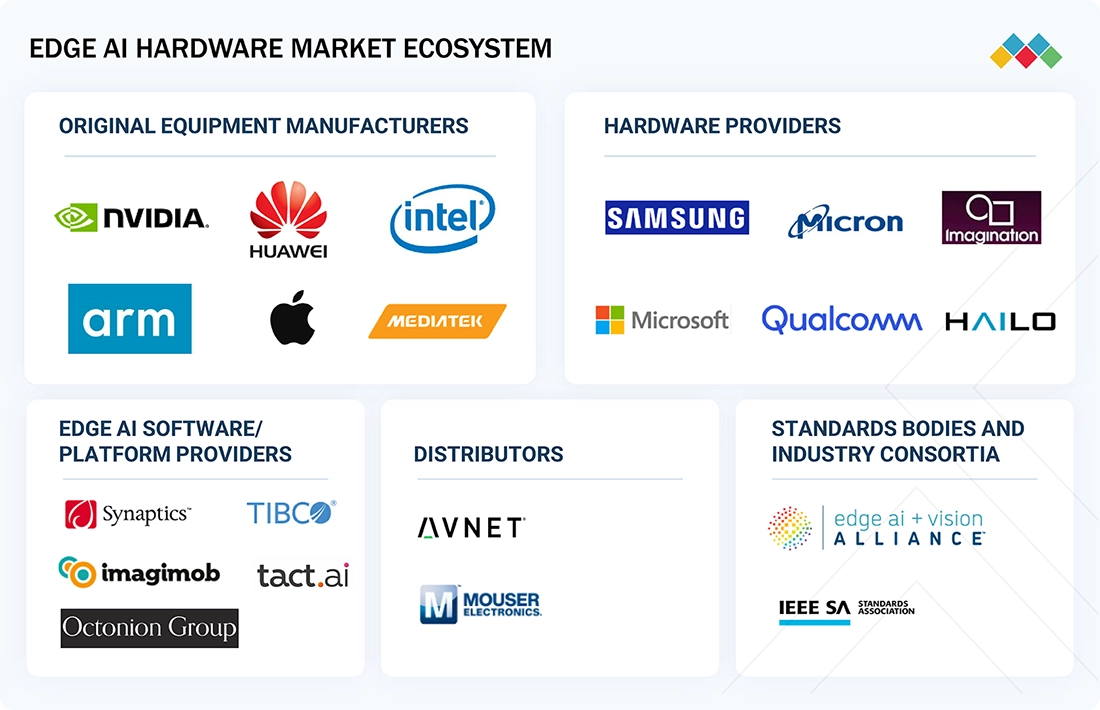
Market Ecosystem
Edge AI Hardware Market: COMMERCIAL USE CASES ACROSS INDUSTRIES
| COMPANY | USE CASE DESCRIPTION | BENEFITS |
|---|---|---|
 |
Hailo-8 AI processor in smart security cameras for anomaly detection | Real-time surveillance, reduced bandwidth usage, and energy-efficient processing |
 |
Apple Neural Engine in iPhones for on-device image recognition and AR applications | Fast on-device inference, enhanced privacy, and low power consumption |
 |
Movidius Myriad X in retail for smart cameras analyzing customer behavior | Personalized shopping experiences, reduced theft, and optimized store layouts |
 |
Snapdragon Edge AI in drones for aerial inspection of infrastructure | Low-latency processing, enhanced safety, reduced operational costs |
Logos and trademarks shown above are the property of their respective owners. Their use here is for informational and illustrative purposes only.
Related Ecosystem
Key Takeaways
- The UAE Edge AI Hardware Market will nearly double from $9,394M (2025) to $18,114M (2030) at a 14.0% CAGR.
- The UAE's smart city initiatives and digital transformation programs are primary catalysts for edge AI hardware adoption.
- The UAE market benefits from government support and strategic positioning as a regional technology and innovation hub.
- Telecommunications, healthcare, and autonomous systems sectors in UAE are driving significant demand for edge AI solutions.
Edge AI Hardware Market Report Scope
| Report Metric | Details |
|---|---|
| Base Year | 2025 |
| Fastest Growing Segment | AUTOMOTIVE SYSTEMS (Device) |
| Forecast Period | 2025-2030 |
| Growth Rate | CAGR of 17.6% from 2025 to 2030 |
| Largest Segment | INFERENCE (Function) |
| Market Size Base Year (Billions) | ~USD 26.19 (2025) |
| Revenue Forecast (Billions) | ~USD 58.9 (2030) |
| Segments Covered | Device, Application, Power Consumption, Processor, Function, Vertical |
UAE Edge AI Hardware Market Report Segmentation
6 segment dimensions are covered across the global market.
By Device
- Automotive Systems
- Domestic Robots
- Drones
- Edge Servers
- Entertainment Robots
- Industrial Robots
- Logistics Robots
- Medical Robots
- Mv Cameras
- Other Aerospace & Defense Devices
- Other Automotive & Transportation Devices
- Other Devices
- Other Healthcare Devices
- Professional Service Robots
- Robots
- Service Robots
- Smart Ip Cameras
- Smart Speakers
- Smartphones
- Surveillance Cameras
- Wearables
By Application
- Construction
- Electronic Gadgets
- Enterprise & Industrial Settings
- Government Agencies
- Healthcare Devices
- Industrial Inspection
- Other Applications
- Public Safety
- Smart Farming
- Transportation
- Utility
By Power Consumption
- 1-3 W
- >3-5 W
- >5-10 W
- Less Than 1 W
- More Than 10 W
By Processor
- Asic
- Cpu
- Gpu
- Other Processors
By Function
- Inference
- Training
By Vertical
- Aerospace & Defense
- Automotive & Transportation
- Construction
- Consumer Electronics
- Government
- Healthcare
- Industrial
- Other Verticals
- Smart Home
Target Audience
- Hardware Manufacturers & Semiconductor Companies : Need UAE-specific market data to assess market entry viability, identify growth opportunities in smart city and IoT segments, and develop localized product strategies for the region's expanding edge AI hardware demand.
- Technology Solution Providers & System Integrators : Require detailed market insights to understand UAE customer requirements, competitive positioning, and sector-specific applications driving edge AI adoption in government, healthcare, and enterprise environments.
- Investment & Private Equity Firms : Need comprehensive market valuation and growth forecasts to evaluate investment opportunities in UAE-based edge AI hardware startups, technology companies, and infrastructure projects aligned with Vision 2030.
- Government & Policy Makers : Utilize market data to inform digital transformation initiatives, smart city planning, technology procurement strategies, and regulatory frameworks supporting edge AI hardware adoption across UAE emirates.
- Enterprise & Corporate Decision Makers : Require market intelligence to benchmark edge AI hardware investments, understand technology trends, identify qualified vendors, and plan digital transformation initiatives aligned with UAE's technology ecosystem.
Reasons to Buy this Report
- Market Size & Growth Validation : Obtain precise market valuation data for UAE ($9.4B in 2025) and verified forecasts through 2030, enabling accurate business planning and investment decisions in the region's high-growth edge AI hardware sector.
- UAE-Specific Growth Drivers : Understand the unique factors propelling UAE's 14% CAGR, including smart city initiatives, government digital transformation mandates, and regional technology hub positioning that differ from global market dynamics.
- Competitive Landscape Intelligence : Gain insights into UAE's competitive ecosystem, local partnerships, and foreign investment trends to identify market entry opportunities and strategic positioning for edge AI hardware vendors and solution providers.
- Sector-Specific Demand Analysis : Access detailed breakdown of edge AI hardware adoption across UAE's key verticals—healthcare, retail, manufacturing, and government—to target high-potential customer segments and tailor product offerings.
- Strategic Investment Planning : Leverage comprehensive market data to support investment decisions, partnership evaluations, and expansion strategies specifically tailored to UAE's regulatory environment and technology adoption patterns.
Frequently asked questions
What is the current size of the UAE Edge AI Hardware Market?
The UAE Edge AI Hardware Market is valued at $9,394 million in 2025 and is projected to reach $18,114 million by 2030.
What is the growth rate of the UAE Edge AI Hardware Market?
The UAE Edge AI Hardware Market is growing at a compound annual growth rate (CAGR) of 14.0% from 2025 to 2030.
Which sectors are driving demand for edge AI hardware in the UAE?
Key sectors driving demand in the UAE include telecommunications, healthcare, retail, autonomous systems, and smart city infrastructure projects.
What factors are contributing to growth in the UAE Edge AI Hardware Market?
Growth in the UAE market is driven by government AI initiatives, smart city development, IoT expansion, reduced cloud dependency, and strategic partnerships with international semiconductor manufacturers.
How does the UAE Edge AI Hardware Market compare to the global market?
The UAE market grows at 14.0% CAGR, slightly below the global average of 17.6%, reflecting the region's developing but rapidly advancing edge AI infrastructure.
RESEARCH METHODOLOGY
The research process for this study included systematic gathering, recording, and analysis of data about customers and companies operating in the edge AI hardware market. This process involved the extensive use of secondary sources, directories, and databases (Factiva and OneSource) to identify and collect valuable information for the comprehensive, technical, market-oriented, and commercial study of the edge AI hardware market. In-depth interviews were conducted with primary respondents, including experts from core and related industries and preferred manufacturers, to obtain and verify critical qualitative and quantitative information and assess growth prospects. Key players in the edge AI hardware market were identified through secondary research, and their market rankings were determined through primary and secondary research. This research included studying annual reports of top players and interviewing key industry experts such as CEOs, directors, and marketing executives.
Secondary Research
Various secondary sources have been referred to in the secondary research process for identifying and collecting information pertinent to this study. The secondary sources include annual reports, press releases, and investor presentations of companies; white papers, certified publications, and articles by recognized authors; directories; and databases. Secondary research has been mainly carried out to obtain key information about the supply chain of the edge AI hardware industry, the value chain of the market, the total pool of the key players, market classification, and segmentation according to the industry trends to the bottom-most level, geographic markets, and key developments from both market- and technology-oriented perspectives.
Primary Research
In the primary research process, various sources from the supply and demand sides have been interviewed to obtain qualitative and quantitative information for this report. Primary sources from the supply side included industry experts such as CEOs, VPs, marketing directors, technology and innovation directors, and key executives from major companies and organizations operating in the edge AI hardware market. After going through the entire market engineering (which includes calculations for market statistics, market breakdown, market size estimations, market forecasting, and data triangulation), extensive primary research has been conducted to gather information and verify and validate the obtained critical numbers. Primary research has been conducted to identify segmentation types, industry trends, key players, competitive landscape, and key market dynamics such as drivers, restraints, opportunities, and challenges, along with the key strategies adopted by players operating in the market.
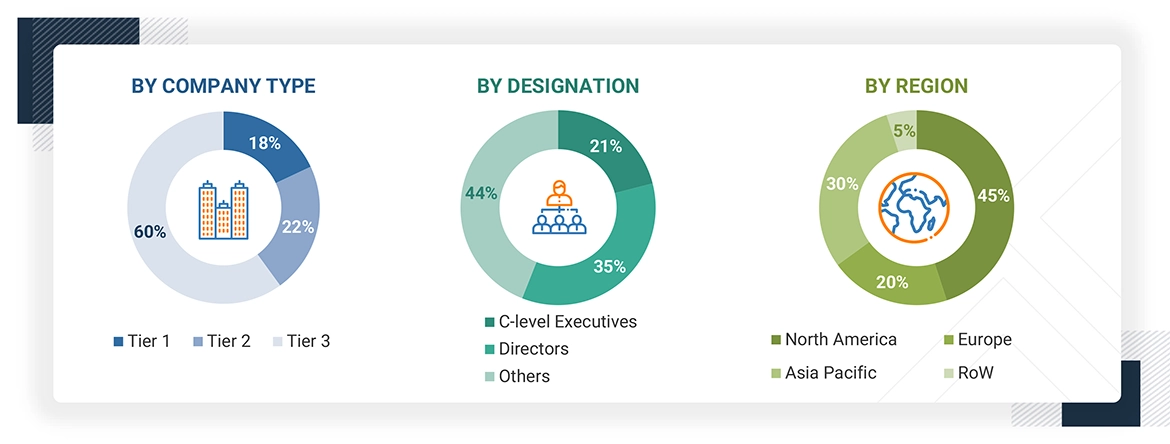
Note: The three tiers of the companies have been defined based on their total/segmental revenue as of 2024: Tier 1 = >USD 1 billion, Tier 2 = USD 1 billion–USD 500 million, and Tier 3 = USD 500 million. Others include sales, marketing, and product managers.
To know about the assumptions considered for the study, download the pdf brochure
Market Size Estimation
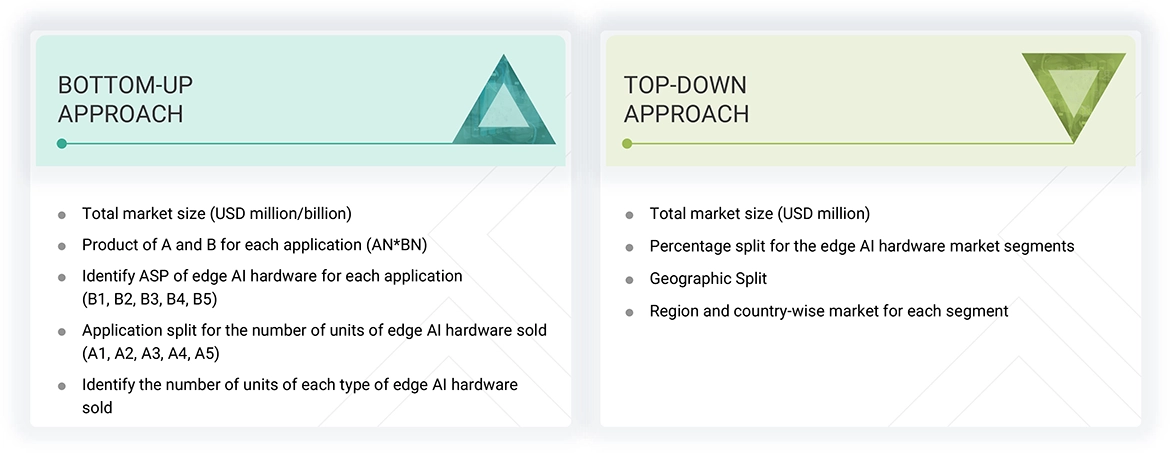
In the complete market engineering process, top-down and bottom-up approaches and several data triangulation methods have been used to estimate and forecast the size of the market and its segments and subsegments listed in the report. Extensive qualitative and quantitative analyses have been carried out on the complete market engineering process to list the key information/insights about the edge AI hardware market.
The key players in the market have been identified through secondary research, and their rankings in the respective regions have been determined through primary and secondary research. This entire procedure involved the study of the annual and financial reports of top players and interviews with industry experts such as chief executive officers, vice presidents, directors, and marketing executives for quantitative and qualitative key insights. All percentage shares, splits, and breakdowns have been determined using secondary sources and verified through primary sources. All parameters that affect the markets covered in this research study have been accounted for, viewed in extensive detail, verified through primary research, and analyzed to obtain the final quantitative and qualitative data. This data has been consolidated and enhanced with detailed inputs and analysis from MarketsandMarkets and presented in this report.
Edge AI Hardware Market : Top-Down and Bottom-Up Approach
Data Triangulation
After arriving at the overall market size from the above estimation process, the total market has been split into several segments and subsegments. Data triangulation and market breakdown procedures have been employed to complete the overall market engineering process and arrive at the exact statistics for all the segments and subsegments, wherever applicable. The data has been triangulated by studying various factors and trends from both the demand and supply sides. The market has also been validated using both top-down and bottom-up approaches.
Market Definition
Artificial intelligence (AI) technology is now implemented in smartphones, automobiles, drones, and robots. Edge AI is the combination of edge computing and artificial intelligence. Edge AI is the implementation of AI applications in devices throughout the physical world. In this technique, the computation of AI is done near the user at the edge of the network, close to where the data is located, rather than centrally in a cloud computing facility or private data centers. Edge AI offers a way to process data faster than cloud processing. The release of low-power and high-computing processors has led to integrating AI algorithms into devices. Developing dedicated AI processors for edge devices has resulted in AI inference performed on devices rather than the cloud platform.
Key Stakeholders
- Semiconductor companies
- Technology providers
- Universities and research organizations
- System integrators
- AI solution providers
- AI platform providers
- AI system providers
- Investors and venture capitalists
- Manufacturers and people implementing AI technology
- Government agencies
- IoT providers
- Consulting firms
Report Objectives
- To define, describe, and forecast the edge artificial intelligence (AI) hardware market, in terms of volume, by processor, power consumption, device, function, vertical, and region
- To describe and forecast the market, in terms of value, by region—North America, Europe, Asia Pacific, and RoW (South America, Africa, and the Middle East)
- To define, describe, and forecast the global edge AI hardware market, in terms of value
- To provide detailed information regarding factors (drivers, restraints, opportunities, and challenges) influencing market growth
- To provide a detailed overview of the process flow of the edge AI hardware market
- To analyze supply chain, market/ecosystem map, trend/disruptions impacting customer business, technology analysis, Porter's five force analysis, trade analysis, case study analysis, patent analysis, key conferences & events, and regulations related to the edge AI hardware market
- To analyze opportunities for stakeholders in the edge AI hardware market by identifying the high-growth segments
- To strategically analyze micro markets concerning individual growth trends, prospects, and contributions to the overall market
- To strategically profile the key players and comprehensively analyze their market shares and core competencies, along with detailing the competitive leadership and analyzing growth strategies, such as product launches and developments, expansions, acquisitions, and partnerships of leading players
- Analyzing opportunities in the market for stakeholders and providing a competitive landscape for the market
Get the Full Edge AI Hardware Market Report
Full forecast, segment splits, and company analysis for all Edge AI Hardware Market.
- US Edge AI Hardware Market
- Canada Edge AI Hardware Market
- Mexico Edge AI Hardware Market
- Germany Edge AI Hardware Market
- UK Edge AI Hardware Market
- France Edge AI Hardware Market
- Italy Edge AI Hardware Market
- Spain Edge AI Hardware Market
- Nordics Edge AI Hardware Market
- Poland Edge AI Hardware Market
- Rest Of Europe Edge AI Hardware Market
- China Edge AI Hardware Market
- Japan Edge AI Hardware Market
- India Edge AI Hardware Market
- South Korea Edge AI Hardware Market
- Australia Edge AI Hardware Market
- Indonesia Edge AI Hardware Market
- Thailand Edge AI Hardware Market
- Malaysia Edge AI Hardware Market
- Vietnam Edge AI Hardware Market
- Rest Of Asia Pacific Edge AI Hardware Market
- Bahrain Edge AI Hardware Market
- Kuwait Edge AI Hardware Market
- Oman Edge AI Hardware Market
- Qatar Edge AI Hardware Market
- Rest Of Middle East Edge AI Hardware Market
- Saudi Arabia Edge AI Hardware Market
- Other African Countries Edge AI Hardware Market
- South Africa Edge AI Hardware Market
Need a Tailored Report?
Customize this report to your needs
Get 10% FREE Customization
Customize This Report
