
Japan Electric Light Commercial Vehicle Market (2025-2030)

The Japan Electric Light Commercial Vehicle Market was valued at $6 Million in 2025 and projected to reach to $21 Million by 2030, representing a compound annual growth rate of 19.0%. Japan's electric light commercial vehicle market is experiencing robust expansion, driven by regulatory pressures and sustainability commitments.


| Market Size in | USD 26.32 MN |
| Market Forecast in | |
| CAGR | |
| Forecast Period | |
| Units Considered | Value (USD MN) |
Japan Electric Light Commercial Vehicle Market Trends and Insights
- Japan's adoption of electric light commercial vehicles is driven by stringent emissions regulations, urban congestion concerns, and the nation's commitment to carbon neutrality by 2050.
- In 2025, Japan's market reflects early-stage penetration, with fleet operators and last-mile delivery companies beginning to transition from traditional combustion engines to electric alternatives. By 2030, Japan is expected to see accelerated market expansion as charging infrastructure matures and vehicle costs decline.
- Japan's automotive manufacturing expertise positions domestic OEMs to capture significant market share in the electric light commercial vehicle segment.
- Government incentives, including subsidies for electric vehicle purchases and investments in charging networks, are catalyzing Japan's transition toward sustainable commercial transportation solutions..
Key Market Statistics
- CAGR (2025-2030) 19.0% CAGR
- Market Size, 2025 ~USD 6 Million
- Forecast, 2030 ~USD 21 Million
- Country Japan
Japan Electric Light Commercial Vehicle Market Overview
Regulatory Momentum :
Japan's stringent emissions regulations and carbon neutrality targets by 2050 are accelerating electric light commercial vehicle adoption across urban and suburban logistics networks.
Urban Logistics Transformation :
Tokyo, Osaka, and other major metropolitan areas are experiencing rapid fleet electrification as delivery companies seek to reduce congestion and meet local air quality standards.
Government Incentives :
Japanese government subsidies and tax benefits for electric commercial vehicles are driving fleet operators to transition from traditional combustion engines to electric alternatives.
Technology Leadership :
Japan's automotive manufacturers are leveraging advanced battery technology and vehicle efficiency innovations to establish competitive advantages in the electric light commercial segment.
Japan Electric Light Commercial Vehicle Market Dynamics
- The market's growth from $6.0 million in 2025 to $21.0 million by 2030 reflects increasing fleet electrification among logistics providers and last-mile delivery operators.
- Urban congestion challenges and strict emissions standards are compelling businesses to adopt cleaner transportation solutions.
- Japan's mature automotive infrastructure and technological expertise position the country as a key growth market in Asia-Pacific.
- Continued government support and declining battery costs will further accelerate market penetration through 2030..
Market Ecosystem
Related Ecosystem
Key Takeaways
- Japan's electric light commercial vehicle market will grow from $6.0M (2025) to $21.0M (2030) at a 19.0% CAGR.
- Japan's stringent emissions regulations and carbon neutrality targets are primary drivers of electric light commercial vehicle adoption.
- Japan's domestic automotive manufacturers are well-positioned to lead the electric light commercial vehicle market through 2030.
- Japan's government incentives and expanding charging infrastructure will accelerate market penetration in the forecast period.
Electric Light Commercial Vehicle Market Report Scope
| Report Metric | Details |
|---|---|
| Base Year | 2025 |
| Fastest Growing Segment | 100 TO 150 KWH (Battery Capacity) |
| Forecast Period | 2025-2030 |
| Growth Rate | CAGR of 25% from 2025 to 2030 |
| Largest Segment | VAN (Vehicle Type) |
| Market Size Base Year (Billions) | ~USD 24.45 (2025) |
| Revenue Forecast (Billions) | ~USD 74.62 (2030) |
| Segments Covered | Vehicle Type, Propulsion, Battery Capacity, Battery Type, End Use, Gvwr, Range |
Japan Electric Light Commercial Vehicle Market Report Segmentation
7 segment dimensions are covered across the global market.
By Vehicle Type
- Pickup Truck
- Van
By Propulsion
- Battery Electric Vehicle
- Plug-In Hybrid Electric Vehicle
By Battery Capacity
- 100 To 150 Kwh
- 50 To 100 Kwh
- Up To 50 Kwh
By Battery Type
- Lfp
- Nmc
- Solid-State
By End Use
- Distribution Services
- Field Services
- Last-Mile Delivery
By Gvwr
- 6,001-10,000 Lbs
- Below 6,000 Lbs
By Range
- 100 To 200 Miles
- Above 200 Miles
- Up To 100 Miles
Target Audience
- Fleet Operators & Logistics Companies : Japanese delivery and logistics firms need market data to evaluate electrification ROI, understand competitor adoption rates, and plan fleet transition strategies aligned with regulatory timelines.
- Automotive Manufacturers : OEMs and commercial vehicle producers require Japan-specific market insights to guide product development, assess demand forecasts, and optimize manufacturing capacity for electric light commercial vehicles.
- Government & Policy Makers : Japanese regulatory bodies and transportation agencies use market research to evaluate policy effectiveness, design incentive programs, and monitor progress toward carbon neutrality objectives.
- Investment & Private Equity Firms : Investors targeting Japan's automotive and transportation sectors need validated market sizing and growth projections to identify acquisition targets and fund allocation opportunities.
- Technology & Infrastructure Providers : Battery manufacturers, charging network developers, and software solution providers require Japan market data to prioritize expansion, forecast demand, and secure partnerships with fleet operators.
Reasons to Buy this Report
- Market Size & Growth Validation : Confirm Japan's electric light commercial vehicle market trajectory with precise valuation data, supporting strategic investment and expansion decisions in this high-growth segment.
- Regulatory Landscape Intelligence : Understand Japan's emissions standards, government incentives, and carbon neutrality policies shaping fleet electrification timelines and compliance requirements for market participants.
- Competitive Positioning Analysis : Identify key Japanese and international manufacturers gaining market share, assess technology differentiation, and benchmark competitive strategies in the light commercial EV space.
- Urban Fleet Electrification Trends : Access insights on logistics operators, delivery companies, and fleet managers transitioning to electric vehicles in major Japanese cities, revealing adoption patterns and procurement priorities.
- Investment & Partnership Opportunities : Discover emerging opportunities for technology providers, charging infrastructure developers, and supply chain partners entering Japan's rapidly expanding electric commercial vehicle ecosystem.
Frequently asked questions
What is the current size of Japan's electric light commercial vehicle market in 2025?
Japan's electric light commercial vehicle market is estimated at $6.0 million in 2025, reflecting early-stage market development and growing fleet operator interest in electrification.
What is the projected market size for Japan's electric light commercial vehicle sector by 2030?
Japan's electric light commercial vehicle market is forecast to reach $21.0 million by 2030, driven by regulatory compliance, infrastructure development, and cost reductions.
What is the expected growth rate for Japan's electric light commercial vehicle market?
Japan's electric light commercial vehicle market is projected to grow at a compound annual growth rate of 19.0% between 2025 and 2030.
Which factors are driving growth in Japan's electric light commercial vehicle market?
Japan's market growth is driven by emissions regulations, carbon neutrality commitments, government subsidies, charging infrastructure expansion, and fleet operators' sustainability initiatives.
How does Japan's electric light commercial vehicle market compare to other Asia Pacific nations?
Japan's 19.0% CAGR reflects strong domestic demand and regulatory support, positioning Japan as a key market within the Asia Pacific region for electric light commercial vehicles.
RESEARCH METHODOLOGY
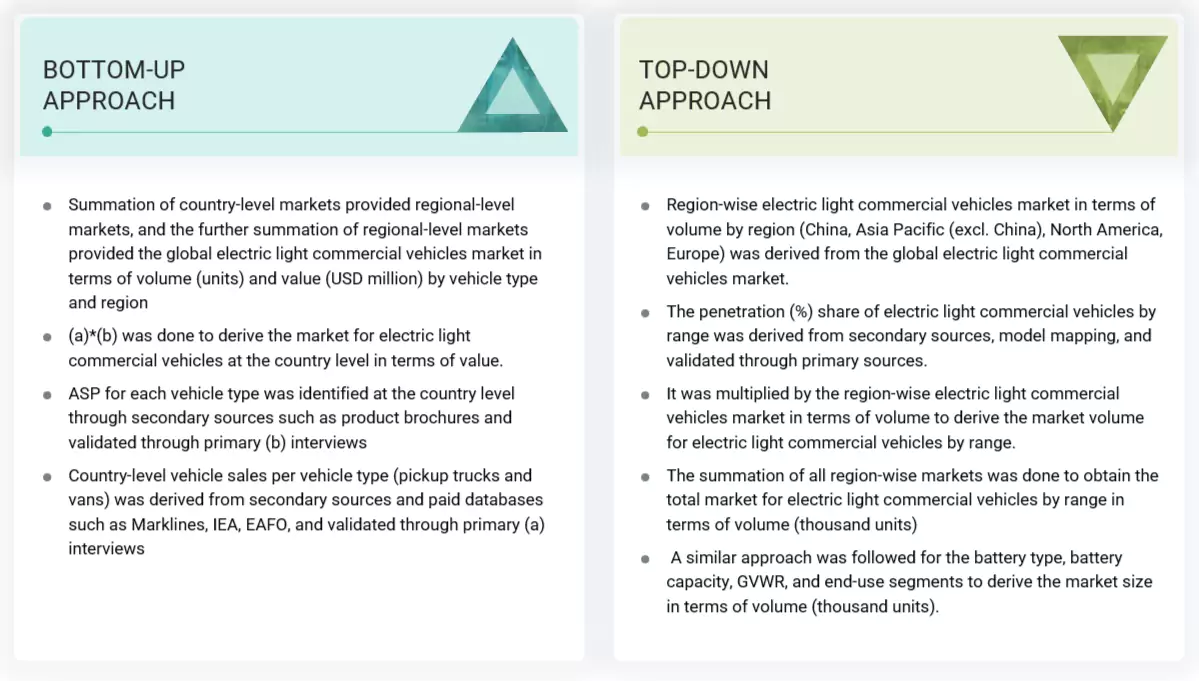
The study involved four major activities in estimating the current size of the electric light commercial vehicle market. Exhaustive secondary research was carried out to collect information on the market, the peer market, and the parent market. The next step involved validating these findings and assumptions and sizing them with industry experts across value chains through primary research. The top-down and bottom-up approaches were employed to estimate the complete market size. Thereafter, market breakdown and data triangulation processes were used to estimate the market size of segments and subsegments.
Secondary Research
In the secondary research process, various secondary sources were used to identify and collect information on the electric light commercial vehicle market for this study. Secondary sources included annual reports, press releases, and investor presentations of companies; whitepapers, certified publications, and articles from recognized authors; directories; databases; and articles from recognized associations and government publishing sources.
Primary Research
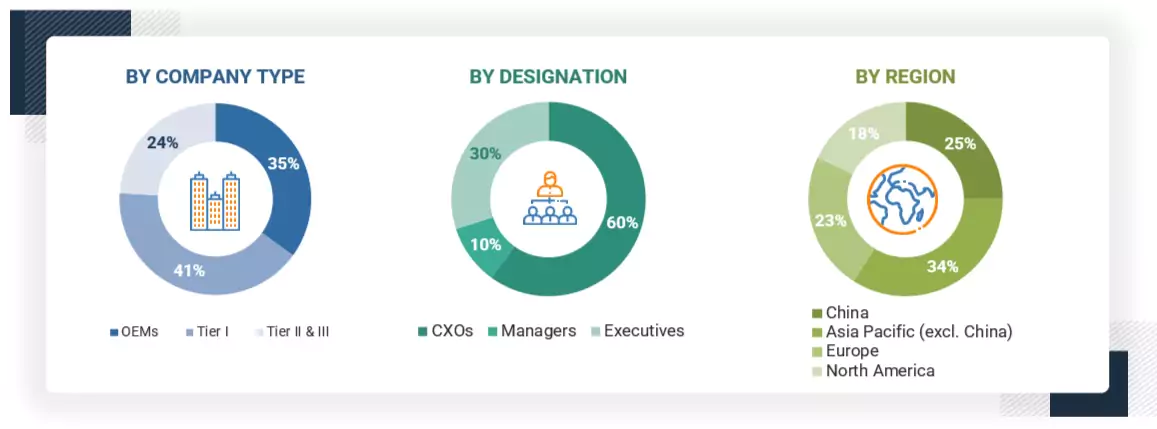
Extensive primary research was conducted after understanding the electric light commercial vehicle market scenario through secondary research. Several primary interviews were conducted with market experts from both the demand (OEMs) and supply (electric light commercial vehicle manufacturers and component manufacturers) sides across major regions, namely, North America, Europe, and Asia Pacific. Approximately 35% and 65% of primary interviews were conducted from the demand and supply sides, respectively. Primary data was collected through questionnaires, emails, and telephonic interviews.
In the canvassing of primaries, various departments within organizations, such as sales, operations, and marketing, were covered to provide a holistic viewpoint in the report. After interacting with industry experts, brief sessions were conducted with highly experienced independent consultants to reinforce the findings from primary interviews. This, along with the opinions of in-house subject matter experts, led to the findings described in the remainder of this report.
To know about the assumptions considered for the study, download the pdf brochure
Market Size Estimation
A detailed market estimation approach was followed to estimate and validate the value and volume of the electric light commercial vehicle market and other dependent submarkets, as mentioned below:
- The market size was derived by collecting sales of electric light commercial vehicles (pickup trucks and vans) through association and paid databases.
- Key players in the electric light commercial vehicle market were identified through secondary research, and their global market share was determined through primary and secondary research.
- The research methodology included the study of annual and quarterly financial reports, regulatory filings of major market players, and interviews with industry experts to gain detailed market insights.
- All major penetration rates, percentage shares, splits, and breakdowns for the electric light commercial vehicles market were determined through secondary sources and verified through primary sources.
- All key macroindicators affecting the revenue growth of the market segments and subsegments were accounted for, viewed in extensive detail, verified through primary research, and analyzed to get the validated and verified quantitative & qualitative data.
Electric Light Commercial Vehicle Market : Top-Down and Bottom-Up Approach
Data Triangulation
All percentage shares, splits, and breakdowns were determined using secondary sources and verified by primary sources. All parameters that affect the markets covered in this research study were accounted for, viewed in extensive detail, and analyzed to obtain the final quantitative and qualitative data. This data was consolidated and enhanced with detailed inputs and analysis from MarketsandMarkets and presented in the report. The following figure is an illustrative representation of the overall market size estimation process employed for this study.
Market Definition
According to the European Alternative Fuels Observatory (EAFO), an electric vehicle (EV) is any motor vehicle that can be recharged from an external source of electricity. The electricity stored in the rechargeable battery packs drives the wheels. Electric light commercial vehicles include pickup trucks and vans that use electric motors for propulsion. These vehicles are powered by electricity and used for commercial purposes, like transporting goods or services.
Stakeholders
- Associations, Forums, and Alliances related to Electric Light Commercial Vehicles
- Automobile Manufacturers
- Automotive Component Manufacturers
- Automotive Investors
- Automotive Software Manufacturers and Providers
- Battery Distributors
- Battery Manufacturers
- Charging Infrastructure Providers
- Charging Service Providers
- Companies Operating in the Autonomous Vehicle Ecosystem
- Distributors and Retailers
- Electric Pickup Truck Manufacturers
- Electric Van Manufacturers
- EV Battery Manufacturers
- EV Charging Equipment Manufacturers
- EV Charging Infrastructure Service Providers
- EV Component Manufacturers
- EV Distributors and Retailers
- Government Agencies and Policy Makers
- Original Equipment Manufacturers
- Raw Material Suppliers for Automotive Software or Components
- Technology Providers
- Transport Authorities
- Technology Providers
- Vehicle Electronics Manufacturers
Report Objectives
- To segment and forecast the electric light commercial vehicle (eLCV) market in terms of volume (thousand units) and value (USD million)
-
To define, describe, and forecast the market based on vehicle type, propulsion, battery type, battery capacity, range, GVWR, end use, and region
- To segment and forecast the market size by volume and value based on vehicle type (pickup truck and van)
- To segment and forecast the market size by volume based on propulsion (battery electric vehicle and plug-in hybrid electric vehicle)
- To segment and forecast the market size by volume based on battery type (LPF, NMC, solid-state, and others)
- To segment and forecast the market size by volume based on battery capacity (up to 50 kWh, 50 to 100 kWh, and 100 to 150 kWh)
- To segment and forecast the market size by volume based on range (up to 100 miles, 100 to 200 miles, and above 200 miles)
- To segment and forecast the market size by volume based on GVWR (Below 6,000 lbs and 6,001 to 10,000 lbs)
- To segment and forecast the market size by volume based on end use (last-mile delivery, field services, and distribution services)
- To forecast the market size with respect to key regions: China, Asia Pacific (excl. China), Europe, and North America
- To analyze technological developments impacting the market
- To provide detailed information about the major factors influencing market growth (drivers, challenges, restraints, and opportunities)
- To strategically analyze the market, considering individual growth trends, prospects, and contributions to the total market
- To study the following concerning the market
- Supply chain analysis
-
Ecosystem analysis
- Technology analysis
- HS code
- Case study analysis
- Patent analysis
- Regulatory landscape
- Key stakeholders and buying criteria
- Key conferences and events
- Impact of Generative AI
-
To estimate the following with respect to the market:
- Pricing Analysis
- Market Share Analysis
- To strategically profile key players and comprehensively analyze their market shares and core competencies
- To track and analyze competitive developments, such as deals, product developments, and expansions, carried out by key industry participants.
Available Customizations
With the given market data, MarketsandMarkets offers customizations in line with the company’s specific needs.
Company Profiles
Profiling of Additional Market Players (Up to 5)
- Electric Light Commercial Vehicle Market, By Propulsion, At Country Level
- Electric Light Commercial Vehicle Market, By GVWR, At Country Level
Get the Full Electric Light Commercial Vehicle Market Report
Full forecast, segment splits, and company analysis for all Electric Light Commercial Vehicle Market.
- China Electric Light Commercial Vehicle Market
- India Electric Light Commercial Vehicle Market
- South Korea Electric Light Commercial Vehicle Market
- France Electric Light Commercial Vehicle Market
- Germany Electric Light Commercial Vehicle Market
- Spain Electric Light Commercial Vehicle Market
- Austria Electric Light Commercial Vehicle Market
- Norway Electric Light Commercial Vehicle Market
- Sweden Electric Light Commercial Vehicle Market
- Netherlands Electric Light Commercial Vehicle Market
- UK Electric Light Commercial Vehicle Market
- Italy Electric Light Commercial Vehicle Market
- Canada Electric Light Commercial Vehicle Market
- US Electric Light Commercial Vehicle Market
- Rest Of Europe Electric Light Commercial Vehicle Market
- Asia Pacific (Excl. China) Electric Light Commercial Vehicle Market
- Europe Electric Light Commercial Vehicle Market
- North America Electric Light Commercial Vehicle Market
Need a Tailored Report?
Customize this report to your needs
Get 10% FREE Customization
Customize This Report
