
US Electric Light Commercial Vehicle Market (2025-2030)

The US Electric Light Commercial Vehicle Market was valued at $108 Million in 2025 and projected to reach to $396 Million by 2030, representing a compound annual growth rate of 20.3%. The US electric light commercial vehicle market is positioned for sustained growth through 2030, driven by accelerating fleet electrification in the logistics and delivery sectors.


| Market Size in | USD 26.32 MN |
| Market Forecast in | |
| CAGR | |
| Forecast Period | |
| Units Considered | Value (USD MN) |
US Electric Light Commercial Vehicle Market Trends and Insights
- This 20.3% compound annual growth rate reflects strong adoption of electric vans, trucks, and delivery vehicles across the US logistics and last-mile delivery sectors.
- The US market is driven by regulatory pressures, rising fuel costs, and corporate sustainability commitments that are accelerating fleet electrification among US-based enterprises. In 2025, the US represents a mature yet rapidly evolving market for electric light commercial vehicles, with established OEM presence and growing charging infrastructure.
- By 2030, the US is expected to capture significant market share as total addressable opportunities expand across urban delivery, regional distribution, and specialized commercial applications.
- The US market's growth trajectory outpaces global averages, positioning the country as a key driver of innovation and adoption in the electric light commercial vehicle segment..
Key Market Statistics
- CAGR (2025-2030) 20.3% CAGR
- Market Size, 2025 ~USD 108 Million
- Forecast, 2030 ~USD 396 Million
- Country US
US Electric Light Commercial Vehicle Market Overview
Market Valuation Growth :
The US electric light commercial vehicle market is valued at $108.0 million in 2025 and is projected to reach $396.0 million by 2030, representing a robust 20.3% CAGR over the forecast period.
Last-Mile Delivery Expansion :
US logistics and last-mile delivery sectors are rapidly adopting electric vans and trucks, driven by e-commerce growth and the need for cost-effective, sustainable delivery solutions in urban and suburban markets.
Regulatory & Cost Drivers :
Stringent emissions regulations, rising fuel costs, and federal incentives are accelerating fleet electrification among US commercial operators seeking to reduce operational expenses and meet environmental compliance standards.
Infrastructure Development :
Expanding charging infrastructure across the US, coupled with improving battery technology and vehicle range, is removing adoption barriers for commercial fleet operators in the light commercial vehicle segment.
US Electric Light Commercial Vehicle Market Dynamics
- Commercial operators are increasingly recognizing the total cost of ownership advantages of electric vehicles, particularly as charging infrastructure expands and battery costs decline.
- Federal tax credits and state-level incentives continue to support adoption, while rising diesel prices make electric alternatives more economically attractive. Key growth catalysts include the surge in e-commerce demand, last-mile delivery optimization, and corporate sustainability commitments from major logistics providers.
- Regional variations exist, with California and Northeast markets leading adoption due to stricter emissions standards.
- The market will likely see increased competition from both established automakers and emerging EV manufacturers targeting the commercial segment, further driving innovation and price competitiveness..
Market Ecosystem
Related Ecosystem
Key Takeaways
- The US electric light commercial vehicle market will grow from $108.0M (2025) to $396.0M (2030), representing a 20.3% CAGR.
- The US market is driven by last-mile delivery demand, fleet electrification mandates, and corporate ESG commitments among major US logistics operators.
- The US benefits from established charging infrastructure and supportive federal incentives that accelerate adoption of electric commercial vehicles.
- By 2030, the US is positioned as a leading market for electric light commercial vehicles, with expanding OEM competition and declining battery costs.
Electric Light Commercial Vehicle Market Report Scope
| Report Metric | Details |
|---|---|
| Base Year | 2025 |
| Fastest Growing Segment | 100 TO 150 KWH (Battery Capacity) |
| Forecast Period | 2025-2030 |
| Growth Rate | CAGR of 25% from 2025 to 2030 |
| Largest Segment | VAN (Vehicle Type) |
| Market Size Base Year (Billions) | ~USD 24.45 (2025) |
| Revenue Forecast (Billions) | ~USD 74.62 (2030) |
| Segments Covered | Vehicle Type, Propulsion, Battery Capacity, Battery Type, End Use, Gvwr, Range |
US Electric Light Commercial Vehicle Market Report Segmentation
7 segment dimensions are covered across the global market.
By Vehicle Type
- Pickup Truck
- Van
By Propulsion
- Battery Electric Vehicle
- Plug-In Hybrid Electric Vehicle
By Battery Capacity
- 100 To 150 Kwh
- 50 To 100 Kwh
- Up To 50 Kwh
By Battery Type
- Lfp
- Nmc
- Solid-State
By End Use
- Distribution Services
- Field Services
- Last-Mile Delivery
By Gvwr
- 6,001-10,000 Lbs
- Below 6,000 Lbs
By Range
- 100 To 200 Miles
- Above 200 Miles
- Up To 100 Miles
Target Audience
- Fleet Operators & Logistics Companies : US-based logistics and delivery companies need market data to evaluate electrification ROI, understand competitor adoption rates, and plan fleet transition strategies aligned with regulatory requirements.
- Automotive Manufacturers & OEMs : Vehicle manufacturers require US-specific market insights to guide product development, identify demand hotspots, assess competitive positioning, and optimize go-to-market strategies for commercial EV offerings.
- Investment & Private Equity Firms : Investors evaluating opportunities in the US EV commercial vehicle sector need validated market sizing, growth projections, and trend analysis to support due diligence and portfolio decisions.
- Government & Policy Makers : US federal and state agencies require market intelligence to assess incentive program effectiveness, forecast adoption trends, and develop evidence-based transportation and sustainability policies.
- Charging Infrastructure Providers : Charging network operators need US market data to identify high-demand regions, forecast infrastructure requirements, and plan deployment strategies aligned with commercial vehicle adoption patterns.
Reasons to Buy this Report
- Market Size & Growth Validation : Obtain precise US market valuation data ($108M in 2025) and verified growth projections through 2030, enabling accurate business planning and investment decisions in the electric commercial vehicle segment.
- Competitive Landscape Intelligence : Understand market dynamics specific to the US, including key players, adoption rates by region, and competitive positioning to identify market entry opportunities and strategic partnerships.
- Regulatory & Incentive Analysis : Access detailed insights on US federal tax credits, state-level incentives, and emissions regulations driving adoption, critical for fleet operators and manufacturers planning compliance strategies.
- Sector-Specific Demand Insights : Gain deep understanding of last-mile delivery and logistics sector adoption patterns, customer preferences, and purchasing behaviors specific to the US commercial vehicle market.
- Investment & Expansion Strategy : Leverage comprehensive US market data to support investment decisions, expansion planning, and product development strategies in the high-growth electric commercial vehicle sector.
Frequently asked questions
What is the current size of the US electric light commercial vehicle market?
The US electric light commercial vehicle market is valued at $108.0 million in 2025 and is projected to reach $396.0 million by 2030.
What is the growth rate of the US electric light commercial vehicle market?
The US market is growing at a compound annual growth rate (CAGR) of 20.3% from 2025 to 2030.
What are the primary drivers of growth in the US market?
Key drivers include last-mile delivery expansion, federal and state electrification incentives, corporate sustainability goals, and declining battery costs in the US.
Which segments are leading adoption in the US?
The US logistics, e-commerce delivery, and urban distribution sectors are leading adoption of electric light commercial vehicles.
How does the US market compare to global trends?
The US market's 20.3% CAGR outpaces the global average of 25%, reflecting mature market dynamics and established infrastructure in the US.
RESEARCH METHODOLOGY
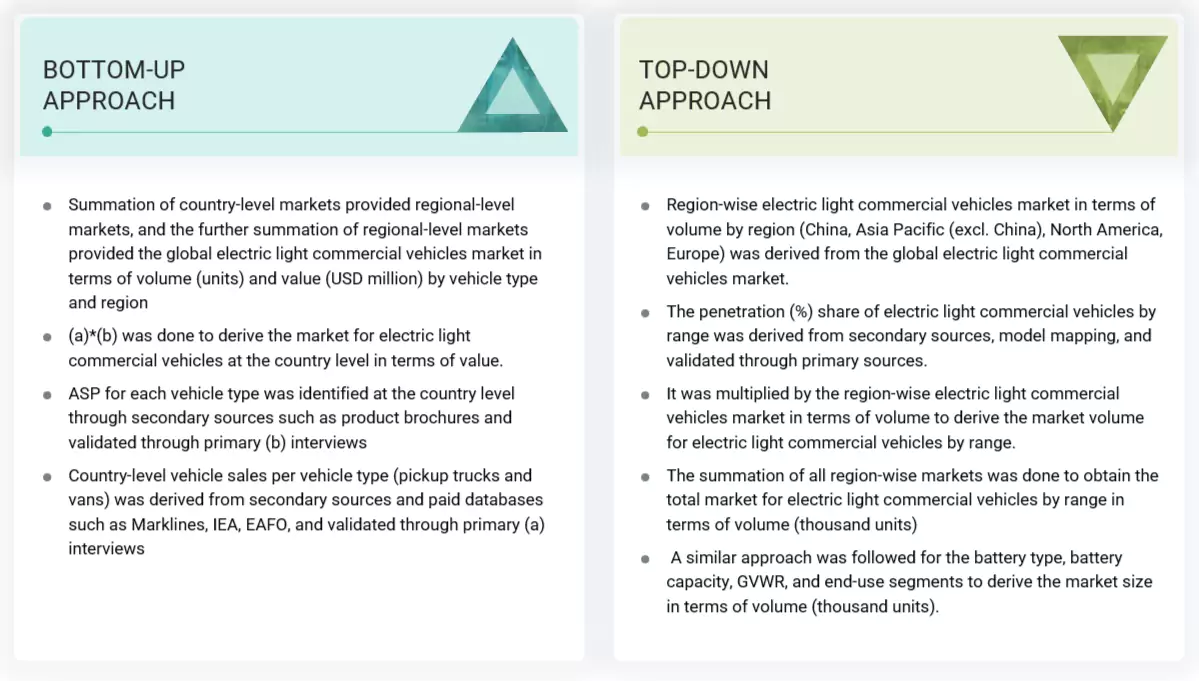
The study involved four major activities in estimating the current size of the electric light commercial vehicle market. Exhaustive secondary research was carried out to collect information on the market, the peer market, and the parent market. The next step involved validating these findings and assumptions and sizing them with industry experts across value chains through primary research. The top-down and bottom-up approaches were employed to estimate the complete market size. Thereafter, market breakdown and data triangulation processes were used to estimate the market size of segments and subsegments.
Secondary Research
In the secondary research process, various secondary sources were used to identify and collect information on the electric light commercial vehicle market for this study. Secondary sources included annual reports, press releases, and investor presentations of companies; whitepapers, certified publications, and articles from recognized authors; directories; databases; and articles from recognized associations and government publishing sources.
Primary Research
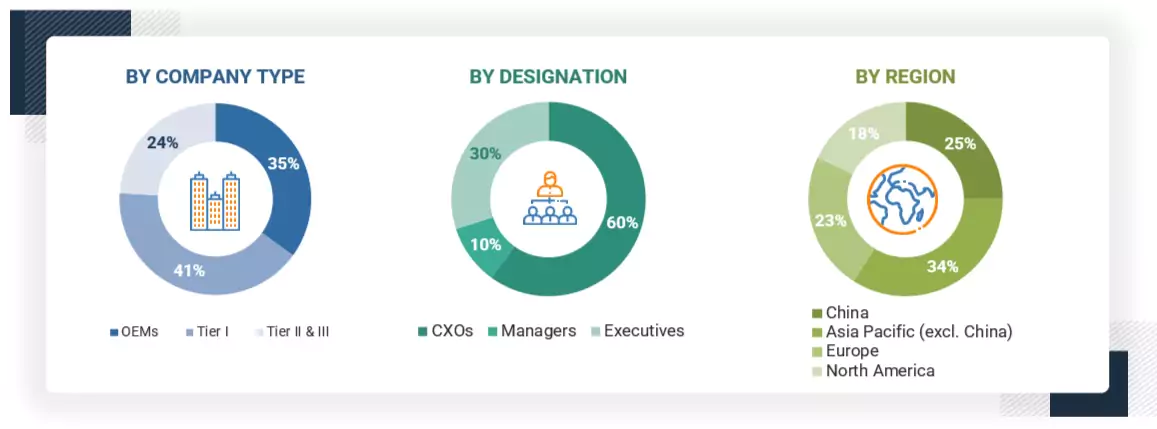
Extensive primary research was conducted after understanding the electric light commercial vehicle market scenario through secondary research. Several primary interviews were conducted with market experts from both the demand (OEMs) and supply (electric light commercial vehicle manufacturers and component manufacturers) sides across major regions, namely, North America, Europe, and Asia Pacific. Approximately 35% and 65% of primary interviews were conducted from the demand and supply sides, respectively. Primary data was collected through questionnaires, emails, and telephonic interviews.
In the canvassing of primaries, various departments within organizations, such as sales, operations, and marketing, were covered to provide a holistic viewpoint in the report. After interacting with industry experts, brief sessions were conducted with highly experienced independent consultants to reinforce the findings from primary interviews. This, along with the opinions of in-house subject matter experts, led to the findings described in the remainder of this report.
To know about the assumptions considered for the study, download the pdf brochure
Market Size Estimation
A detailed market estimation approach was followed to estimate and validate the value and volume of the electric light commercial vehicle market and other dependent submarkets, as mentioned below:
- The market size was derived by collecting sales of electric light commercial vehicles (pickup trucks and vans) through association and paid databases.
- Key players in the electric light commercial vehicle market were identified through secondary research, and their global market share was determined through primary and secondary research.
- The research methodology included the study of annual and quarterly financial reports, regulatory filings of major market players, and interviews with industry experts to gain detailed market insights.
- All major penetration rates, percentage shares, splits, and breakdowns for the electric light commercial vehicles market were determined through secondary sources and verified through primary sources.
- All key macroindicators affecting the revenue growth of the market segments and subsegments were accounted for, viewed in extensive detail, verified through primary research, and analyzed to get the validated and verified quantitative & qualitative data.
Electric Light Commercial Vehicle Market : Top-Down and Bottom-Up Approach
Data Triangulation
All percentage shares, splits, and breakdowns were determined using secondary sources and verified by primary sources. All parameters that affect the markets covered in this research study were accounted for, viewed in extensive detail, and analyzed to obtain the final quantitative and qualitative data. This data was consolidated and enhanced with detailed inputs and analysis from MarketsandMarkets and presented in the report. The following figure is an illustrative representation of the overall market size estimation process employed for this study.
Market Definition
According to the European Alternative Fuels Observatory (EAFO), an electric vehicle (EV) is any motor vehicle that can be recharged from an external source of electricity. The electricity stored in the rechargeable battery packs drives the wheels. Electric light commercial vehicles include pickup trucks and vans that use electric motors for propulsion. These vehicles are powered by electricity and used for commercial purposes, like transporting goods or services.
Stakeholders
- Associations, Forums, and Alliances related to Electric Light Commercial Vehicles
- Automobile Manufacturers
- Automotive Component Manufacturers
- Automotive Investors
- Automotive Software Manufacturers and Providers
- Battery Distributors
- Battery Manufacturers
- Charging Infrastructure Providers
- Charging Service Providers
- Companies Operating in the Autonomous Vehicle Ecosystem
- Distributors and Retailers
- Electric Pickup Truck Manufacturers
- Electric Van Manufacturers
- EV Battery Manufacturers
- EV Charging Equipment Manufacturers
- EV Charging Infrastructure Service Providers
- EV Component Manufacturers
- EV Distributors and Retailers
- Government Agencies and Policy Makers
- Original Equipment Manufacturers
- Raw Material Suppliers for Automotive Software or Components
- Technology Providers
- Transport Authorities
- Technology Providers
- Vehicle Electronics Manufacturers
Report Objectives
- To segment and forecast the electric light commercial vehicle (eLCV) market in terms of volume (thousand units) and value (USD million)
-
To define, describe, and forecast the market based on vehicle type, propulsion, battery type, battery capacity, range, GVWR, end use, and region
- To segment and forecast the market size by volume and value based on vehicle type (pickup truck and van)
- To segment and forecast the market size by volume based on propulsion (battery electric vehicle and plug-in hybrid electric vehicle)
- To segment and forecast the market size by volume based on battery type (LPF, NMC, solid-state, and others)
- To segment and forecast the market size by volume based on battery capacity (up to 50 kWh, 50 to 100 kWh, and 100 to 150 kWh)
- To segment and forecast the market size by volume based on range (up to 100 miles, 100 to 200 miles, and above 200 miles)
- To segment and forecast the market size by volume based on GVWR (Below 6,000 lbs and 6,001 to 10,000 lbs)
- To segment and forecast the market size by volume based on end use (last-mile delivery, field services, and distribution services)
- To forecast the market size with respect to key regions: China, Asia Pacific (excl. China), Europe, and North America
- To analyze technological developments impacting the market
- To provide detailed information about the major factors influencing market growth (drivers, challenges, restraints, and opportunities)
- To strategically analyze the market, considering individual growth trends, prospects, and contributions to the total market
- To study the following concerning the market
- Supply chain analysis
-
Ecosystem analysis
- Technology analysis
- HS code
- Case study analysis
- Patent analysis
- Regulatory landscape
- Key stakeholders and buying criteria
- Key conferences and events
- Impact of Generative AI
-
To estimate the following with respect to the market:
- Pricing Analysis
- Market Share Analysis
- To strategically profile key players and comprehensively analyze their market shares and core competencies
- To track and analyze competitive developments, such as deals, product developments, and expansions, carried out by key industry participants.
Available Customizations
With the given market data, MarketsandMarkets offers customizations in line with the company’s specific needs.
Company Profiles
Profiling of Additional Market Players (Up to 5)
- Electric Light Commercial Vehicle Market, By Propulsion, At Country Level
- Electric Light Commercial Vehicle Market, By GVWR, At Country Level
Get the Full Electric Light Commercial Vehicle Market Report
Full forecast, segment splits, and company analysis for all Electric Light Commercial Vehicle Market.
- China Electric Light Commercial Vehicle Market
- Japan Electric Light Commercial Vehicle Market
- India Electric Light Commercial Vehicle Market
- South Korea Electric Light Commercial Vehicle Market
- France Electric Light Commercial Vehicle Market
- Germany Electric Light Commercial Vehicle Market
- Spain Electric Light Commercial Vehicle Market
- Austria Electric Light Commercial Vehicle Market
- Norway Electric Light Commercial Vehicle Market
- Sweden Electric Light Commercial Vehicle Market
- Netherlands Electric Light Commercial Vehicle Market
- UK Electric Light Commercial Vehicle Market
- Italy Electric Light Commercial Vehicle Market
- Canada Electric Light Commercial Vehicle Market
- Rest Of Europe Electric Light Commercial Vehicle Market
- Asia Pacific (Excl. China) Electric Light Commercial Vehicle Market
- Europe Electric Light Commercial Vehicle Market
- North America Electric Light Commercial Vehicle Market
Need a Tailored Report?
Customize this report to your needs
Get 10% FREE Customization
Customize This Report
