
Canada Electric Motors Market (2024-2029)

The Canada Electric Motors Market was valued at $4234.5 Million in 2024 and projected to reach to $5454.8 Million by 2029, representing a compound annual growth rate of 5.2%. Canada's electric motors market is positioned for sustained growth through 2029, driven by stringent energy efficiency standards and industrial decarbonization initiatives.


| Market Size in | USD 26.32 MN |
| Market Forecast in | |
| CAGR | |
| Forecast Period | |
| Units Considered | Value (USD MN) |
Canada Electric Motors Market Trends and Insights
- This steady expansion reflects Canada's commitment to industrial modernization and energy efficiency standards across manufacturing, HVAC, and renewable energy sectors.
- Canada's market growth is driven by increasing adoption of high-efficiency motors in industrial applications and the country's transition toward sustainable energy infrastructure. The Canadian electric motors market benefits from strong regulatory frameworks promoting energy conservation and the nation's robust manufacturing base.
- Canada's investment in electric vehicle infrastructure and industrial automation is accelerating demand for advanced motor technologies.
- Between 2024 and 2029, Canada is positioned to capture significant market opportunities through technological innovation and alignment with North American supply chain dynamics..
Key Market Statistics
- CAGR (2024-2029) 5.2% CAGR
- Market Size, 2024 ~USD 4234.5 Million
- Forecast, 2029 ~USD 5454.8 Million
- Country Canada
Canada Electric Motors Market Overview
Market Valuation :
Canada's electric motors market is valued at $4,234.5 million in 2024, with projected growth to $5,454.8 million by 2029, driven by industrial modernization and energy efficiency mandates.
Growth Trajectory :
The Canadian market demonstrates a steady 5.2% CAGR through 2029, outpacing global growth trends and reflecting strong domestic demand for sustainable industrial solutions.
Key Application Sectors :
Manufacturing, HVAC systems, and renewable energy installations are primary growth drivers in Canada, supported by federal and provincial energy efficiency regulations and net-zero commitments.
Competitive Landscape :
Canada's electric motors market benefits from proximity to North American supply chains, established industrial infrastructure, and increasing investments in green technology adoption across provinces.
Canada Electric Motors Market Dynamics
- The country's commitment to net-zero emissions by 2050 is accelerating adoption of high-efficiency electric motors across manufacturing, commercial HVAC, and renewable energy sectors.
- Provincial regulations and federal incentive programs are encouraging businesses to upgrade legacy systems, creating consistent demand for advanced motor technologies. The market outlook remains positive as Canadian industries prioritize operational efficiency and environmental compliance.
- Investment in renewable energy infrastructure, particularly wind and hydroelectric projects, continues to expand the addressable market.
- Additionally, supply chain diversification away from traditional sources is prompting domestic manufacturers to increase production capacity, further supporting market expansion and creating opportunities for technology providers and system integrators..
Market Ecosystem
Related Ecosystem
Industrial Equipment
- HVAC System
- Fiberglass
- Actuators
- Cartridge Filters
- Electrostatic Precipitators
- Siemens ag
- GRUNDFOS GROUP
- ABB India Limited
- SCHNEIDER ELECTRIC SE
- Eaton Corporation plc
Variable Speed Drives
- Brushed DC Motors
- HVAC System
- High Power Drives
- Low Power Drives
- Medium Power Drives
- ABB India Limited
- Siemens ag
- Rockwell Automation, Inc.
- SCHNEIDER ELECTRIC SE
- Weg sa
Key Takeaways
- Canada's electric motors market is valued at $4,234.5 million in 2024 and will reach $5,454.8 million by 2029 at a 5.2% CAGR.
- Canada's energy efficiency regulations and industrial modernization initiatives are primary growth catalysts for the electric motors sector.
- Canada's manufacturing and renewable energy sectors are driving increased demand for high-efficiency electric motor solutions.
- Canada's strategic position in North American supply chains enhances market competitiveness and technology adoption rates.
Electric Motors Market Report Scope
| Report Metric | Details |
|---|---|
| Base Year | 2024 |
| Fastest Growing Segment | >1 HP MOTORS (Output Power) |
| Forecast Period | 2024-2029 |
| Growth Rate | CAGR of 6.3% from 2024 to 2029 |
| Largest Segment | INNER ROTOR (Rotor Type) |
| Market Size Base Year (Billions) | ~USD 152.07 (2024) |
| Revenue Forecast (Billions) | ~USD 206.4 (2029) |
| Segments Covered | Type, Power Rating, Voltage, Rotor Type, Output Power, End User, Industrial End User, Commercial End User, Residential End User, Agriculture End User, Transportation End User |
Canada Electric Motors Market Report Segmentation
11 segment dimensions are covered across the global market.
By Type
- Ac Motors
- Brushed Dc Motors
- Brushless Dc Motors
- Dc Motors
- Induction Ac Motors
- Synchronous Ac Motors
By Power Rating
- 1 Kw-2.2 Kw
- 1-2.2 Kw
- 1-2.2 Kw
- 2.2 Kw-375 Kw
- 2.2-375 Kw
- 2.2-375 Kw
- 375 Kw-900 Kw
- 375-900 Kw
- 375-900 Kw
- <1 Kw
- > 900 Kw
- Above 900 Kw
By Voltage
- High Voltage
- Low Voltage
- Medium Voltage
By Rotor Type
- Inner Rotor
- Outer Rotor
By Output Power
- <1 Hp Motors
- <1 Hp Motors (Fractional Horsepower Motors)
- >1 Hp Motors
- >1 Hp Motors (Integral Horsepower Motors)
By End User
- Agriculture
- Commercial
- Industrial
- Residential
- Transportation
By Industrial End User
- Aerospace & Defense
- Automation
- Cement
- Chemical & Petrochemical
- Food & Beverages
- Manufacturing
- Metal & Mining
- Oil & Gas
- Renewables
- Utilities
- Water & Wastewater
By Commercial End User
- Educational Institutions
- Hospitals
- Hotels
- Offices
By Residential End User
- Apartments
- Single Households
By Agriculture End User
- Crop Farming
- Livestock Farming
By Transportation End User
- Automotive
- Marine
- Railways
CANADA: ELECTRIC MOTORS MARKET, BY END USER, 2024–2029
| Segment | 2024 | 2025 | 2026 | 2027 | 2028 | 2029 | CAGR (%) |
|---|---|---|---|---|---|---|---|
| AGRICULTURE | 109.5 | 115 | 120.5 | 126.3 | 132.2 | 138.3 | 4.8 |
| COMMERCIAL | 810.5 | 854.6 | 900.6 | 948.5 | 998.4 | 1050.3 | 5.3 |
| INDUSTRIAL | 2063.8 | 2170.7 | 2281.9 | 2397.4 | 2517.3 | 2641.7 | 5.1 |
| RESIDENTIAL | 670.5 | 704.5 | 739.9 | 776.6 | 814.6 | 854 | 5 |
| TRANSPORTATION | 580.2 | 614.9 | 651.2 | 689.2 | 728.9 | 770.4 | 5.8 |
| TOTAL | 4234.5 | 4459.7 | 4694.1 | 4938 | 5191.5 | 5454.8 | 5.2 |
Target Audience
- Industrial Equipment Manufacturers : Need Canada-specific demand forecasts and sector trends to optimize production planning, supply chain management, and product development for the domestic market.
- Energy & Utilities Companies : Require insights on motor adoption in renewable energy projects and grid modernization initiatives to align infrastructure investments with market growth opportunities.
- HVAC & Building Systems Integrators : Depend on Canadian market data to forecast demand for high-efficiency motors driven by building code updates and commercial energy efficiency retrofits.
- Investment & Private Equity Firms : Evaluate market growth potential, competitive dynamics, and regulatory tailwinds in Canada to assess acquisition targets and portfolio company expansion strategies.
- Government & Policy Advisors : Use market intelligence to inform energy efficiency programs, industrial policy development, and net-zero transition strategies aligned with Canada's climate commitments.
Reasons to Buy this Report
- Localized Market Intelligence : Gain Canada-specific insights on market size, growth rates, and forecasts that differ from global trends, enabling precise strategic planning for the North American market.
- Regulatory & Policy Analysis : Understand federal and provincial energy efficiency standards, net-zero commitments, and incentive programs driving motor adoption across Canadian industries.
- Sector-Specific Opportunities : Identify high-growth segments including manufacturing modernization, HVAC upgrades, and renewable energy infrastructure expansion unique to Canada's economic landscape.
- Competitive Positioning : Benchmark against Canadian market players and understand supply chain dynamics, local partnerships, and distribution channels specific to the region.
- Investment & Expansion Planning : Make informed decisions on market entry, capacity expansion, or product localization with detailed Canada market forecasts and growth trajectory analysis through 2029.
Frequently asked questions
What is the current size of Canada's electric motors market?
Canada's electric motors market is valued at $4,234.5 million in 2024 and is projected to grow to $5,454.8 million by 2029.
What is the expected growth rate for Canada's electric motors market?
Canada's electric motors market is expected to grow at a compound annual growth rate (CAGR) of 5.2% from 2024 to 2029.
Which industries are driving demand for electric motors in Canada?
Canada's manufacturing, HVAC, renewable energy, and electric vehicle infrastructure sectors are primary drivers of electric motor demand.
What regulatory factors influence Canada's electric motors market?
Canada's energy efficiency standards, environmental regulations, and industrial modernization policies significantly support market growth and technology adoption.
How does Canada's market compare to North America?
Canada represents a significant portion of the North American electric motors market, with strong growth potential driven by industrial automation and renewable energy investments.
RESEARCH METHODOLOGY
This research study involves the use of extensive secondary sources, directories, and databases, such as Hoovers, Bloomberg L.P., Factiva, ICIS, and OneSource, to identify and collect information useful for this technical, market-oriented, and commercial study of the global electric motor market. Primary sources are mainly industry experts from core and related industries, preferred suppliers, manufacturers, distributors, service providers, and organizations related to all segments of the value chain of this industry. In-depth interviews were conducted with various primary respondents, including key industry participants, subject matter experts, C-level executives of key market players, and industry consultants, among other experts, to obtain and verify critical qualitative and quantitative information as well as assess growth prospects of the electric motors market.
Secondary Research
Secondary sources include annual reports, press releases, and investor presentations of companies; directories and databases, which include D&B, Bloomberg, and Factiva; white papers and articles from recognized authors, and publications and databases from associations, such as the BP Statistical Review of World Energy, Energy Information Administration, and Department of Energy. Secondary research has been used to obtain important information about the key players and market classification & segmentation according to industry trends to the bottom-most level and key developments related to market and technology perspectives. A database of the key industry leaders has also been prepared using secondary research.
Primary Research
In the primary research process, various sources from both the supply and demand sides have been interviewed to obtain and verify qualitative and quantitative information for this report and analyze prospects. Primary sources from the supply side include industry experts such as CEOs, vice presidents, marketing directors, technology and innovation directors, and related executives from various leading companies and organizations operating in the electric motor market. Primary sources from the demand side include experts and key persons from the end user segment.
After the complete market engineering process (which includes calculations of market statistics, market breakdown, electric motors market size estimations, market forecasts, and data triangulation), extensive primary research has been conducted to gather information and verify and validate the critical numbers arrived at. Primary research has also been conducted to identify the segmentation, applications, Porter’s Five Forces, key players, competitive landscape, and key market dynamics such as drivers, opportunities, challenges, industry trends, and strategies adopted by key players.
Following is the breakdown of primary respondents:
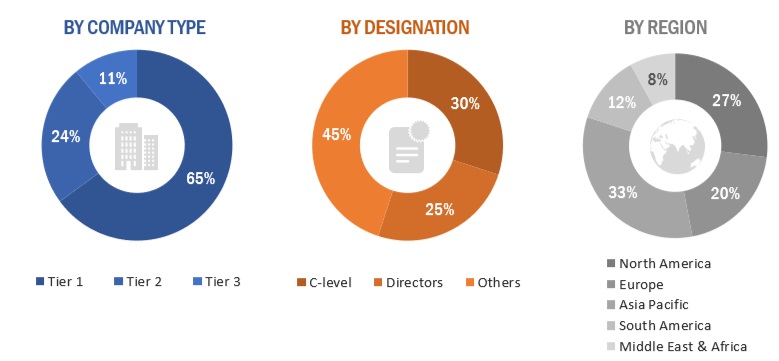
To know about the assumptions considered for the study, download the pdf brochure
Electric Motors Market Size Estimation
In the complete market engineering process, both top-down and bottom-up approaches have been extensively used along with several data triangulation methods to estimate and forecast the overall market segments listed in this report.
Top-down and bottom-up approaches have been used to estimate and validate the electric motors market size of electric motor for various applications in each region. The key players in the market have been identified through secondary research, and their market share in respective regions has been determined through primary and secondary research. This entire procedure includes the study of annual and financial reports of the key market players and extensive interviews for insights from industry leaders such as CEOs, vice presidents, directors, and marketing executives. All percentage shares, splits, and breakdowns have been determined using secondary sources and verified through primary sources.
Global Electric Motors Market Size: Bottom Up Approach
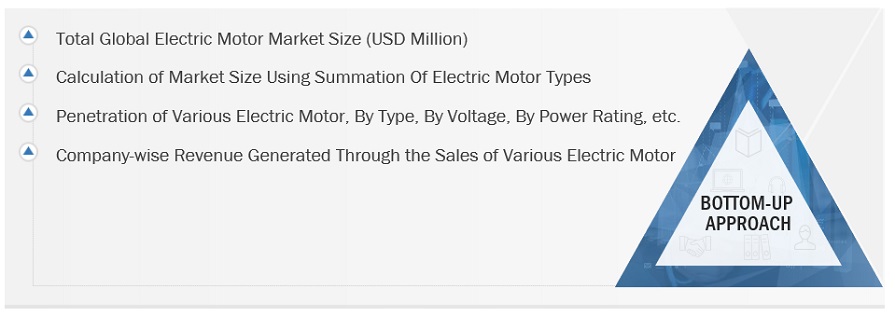
To know about the assumptions considered for the study, Request for Free Sample Report
Global Electric Motors Market Size: Top-down Approach
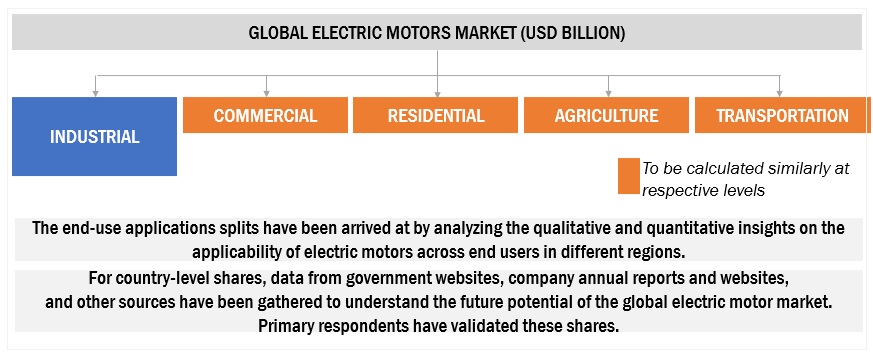
Data Triangulation
After arriving at the overall electric motors market size from the estimation process explained above, the total market has been split into several segments and sub-segments. Data triangulation and market breakdown procedures have been used wherever applicable to complete the overall market engineering process and to arrive at the exact statistics for all segments and sub-segments. The data has been triangulated by studying various factors and trends from both the demand and supply sides. The market has been validated using both the top-down and bottom-up approaches. Then, it was verified through primary interviews. Hence, for every data segment, there are three sources—the top-down approach, the bottom-up approach, and expert interviews. When the values arrived at from the three points matched, the data was assumed to be correct.
Market Definition.
An electric motor is a rotating electric machine that converts electrical energy into mechanical energy. Its major components include a stator, a rotor, bearings, windings, eye bolts, brushes, poles, and conduit boxes.
- AC Motors: These are motors driven by an alternating current (AC). AC motors are mainly of two types—synchronous AC motors and induction motors. AC motors are required where there is a need for high speed and variable torque.
- DC Motors: These are rotatory electric motors that convert direct current (DC) into mechanical energy. DC motors are also mainly of two types—brushed DC motors and brushless DC motors (BLDC).
The electric motors market is defined as the sum of revenues generated by global companies from the sale of electric motors. These electric motors are of two types, AC and DC; they cater to various end users, such as industrial, commercial, residential, transportation, and agriculture. The regions considered for the electric motor market study include Asia Pacific, Europe, North America, the Middle East & Africa, and South America.
Key Stakeholders
- Associations, Forums, and Alliances related to Electric Vehicle Charging Stations
- Consulting Companies in the Energy Sector
- Electric Motor Equipment Manufacturers
- Environmental Associations
- Government and Research Organizations
- Power Companies
- Motor Manufacturing Companies
- Electric Motor Organizations, Forums, Alliances, and Associations
- State and National Regulatory Authorities
Report Objectives
- To define, describe, segment, and forecast the electric motors market on the basis of type, power rating, voltage, rotor type, output power, end user, and region
- To provide detailed information on the major factors influencing the growth of the electric motor market (drivers, restraints, opportunities, and challenges)
- To strategically analyze the electric motor market with respect to individual growth trends, future expansions, and the contribution of each segment to the market
- To analyze electric motor market opportunities for stakeholders and details of the competitive landscape for market leaders
- To forecast the growth of the electric motor market with respect to the main regions (Asia Pacific, Europe, North America, South America, and Middle East & Africa)
- To strategically profile key players and comprehensively analyze their market rankings and core competencies*
- To track and analyze competitive developments in the electric motor market, such as contracts and agreements, investments and expansions, new product developments, and mergers and acquisitions
Note: 1. Micromarkets are defined as the further segments and subsegments of the electric motor market included in the report.
2. Core competencies of companies are captured in terms of their key developments and product portfolios, as well as key strategies adopted to sustain their position in the electric motor market.
Available Customizations
MarketsandMarkets offers customizations according to the specific needs of the companies with the given market data.
The following customization options are available for the report:
Product Analysis
- Product matrix, which gives a detailed comparison of the product portfolio of each company
Regional Analysis
- Further breakdown of the electric motor market, by country
Company Information
- Detailed analysis and profiling of additional market players (up to five)
Get the Full Electric Motors Market Report
Full forecast, segment splits, and company analysis for all Electric Motors Market.
- China Electric Motors Market
- Japan Electric Motors Market
- India Electric Motors Market
- South Korea Electric Motors Market
- Australia Electric Motors Market
- Germany Electric Motors Market
- UK Electric Motors Market
- Italy Electric Motors Market
- France Electric Motors Market
- Russia Electric Motors Market
- Sweden Electric Motors Market
- Norway Electric Motors Market
- Denmark Electric Motors Market
- Mexico Electric Motors Market
- US Electric Motors Market
- Saudi Arabia Electric Motors Market
- UAE Electric Motors Market
- South Africa Electric Motors Market
- Brazil Electric Motors Market
- Argentina Electric Motors Market
- Rest Of Europe Electric Motors Market
- Rest Of Asia Pacific Electric Motors Market
- GCC Countries Electric Motors Market
- Rest Of GCC Countries Electric Motors Market
Need a Tailored Report?
Customize this report to your needs
Get 10% FREE Customization
Customize This Report
