
Costa Rica Electric Vehicle Market (2025-2030)

The Costa Rica Electric Vehicle Market was valued at $13 Million in 2025 and projected to reach to $20 Million by 2030, representing a compound annual growth rate of 4.6%. Costa Rica's electric vehicle market is experiencing steady expansion driven by the nation's commitment to carbon neutrality by 2050 and abundant renewable energy resources.


| Market Size in | USD 26.32 MN |
| Market Forecast in | |
| CAGR | |
| Forecast Period | |
| Units Considered | Value (USD MN) |
Costa Rica Electric Vehicle Market Trends and Insights
- Costa Rica's commitment to sustainability and renewable energy infrastructure creates a favorable environment for EV adoption, though the market remains relatively nascent compared to global peers.
- Costa Rica's geographic advantages and environmental policies are expected to drive incremental demand for electric vehicles throughout the forecast period. The Costa Rican EV market reflects broader Latin American trends toward electrification, supported by government incentives and improving charging infrastructure.
- Costa Rica's strong environmental credentials and high renewable energy penetration position the nation as a regional leader in sustainable transportation adoption.
- Between 2025 and 2030, Costa Rica is anticipated to experience moderate but consistent market expansion as consumer awareness and vehicle availability increase..
Key Market Statistics
- CAGR (2025-2030) 4.6% CAGR
- Market Size, 2025 ~USD 13 Million
- Forecast, 2030 ~USD 20 Million
- Country Costa Rica
Costa Rica Electric Vehicle Market Overview
Renewable Energy Advantage :
Costa Rica's 99% renewable electricity generation provides a strong foundation for EV adoption, reducing operational costs and environmental impact compared to fossil fuel-dependent markets.
Government Incentives :
Tax exemptions and import duty reductions on electric vehicles drive affordability and market penetration, with government policies actively promoting sustainable transportation adoption.
Growing Urban Infrastructure :
Expanding charging station networks in San José and major cities support EV ownership, with private and public sector investments accelerating infrastructure development.
Tourism Sector Demand :
Costa Rica's tourism industry increasingly adopts electric vehicles for rental fleets and transportation services, creating sustained demand from hospitality and travel operators.
Costa Rica Electric Vehicle Market Dynamics
- The market's 4.6% CAGR reflects growing consumer awareness of sustainability benefits and improving vehicle affordability through government incentives.
- Despite lagging the global 5.5% growth rate, Costa Rica's unique renewable energy advantage positions it favorably for long-term EV adoption. The forecast growth from $13.0 million (2025) to $20.0 million (2030) indicates increasing market maturity and consumer acceptance.
- Key growth drivers include expanding charging infrastructure, rising fuel costs, and the tourism sector's sustainability initiatives.
- However, limited model availability and higher upfront costs compared to conventional vehicles remain challenges.
- Strategic partnerships between government, private sector, and international manufacturers will be critical to accelerating market penetration..
Market Ecosystem
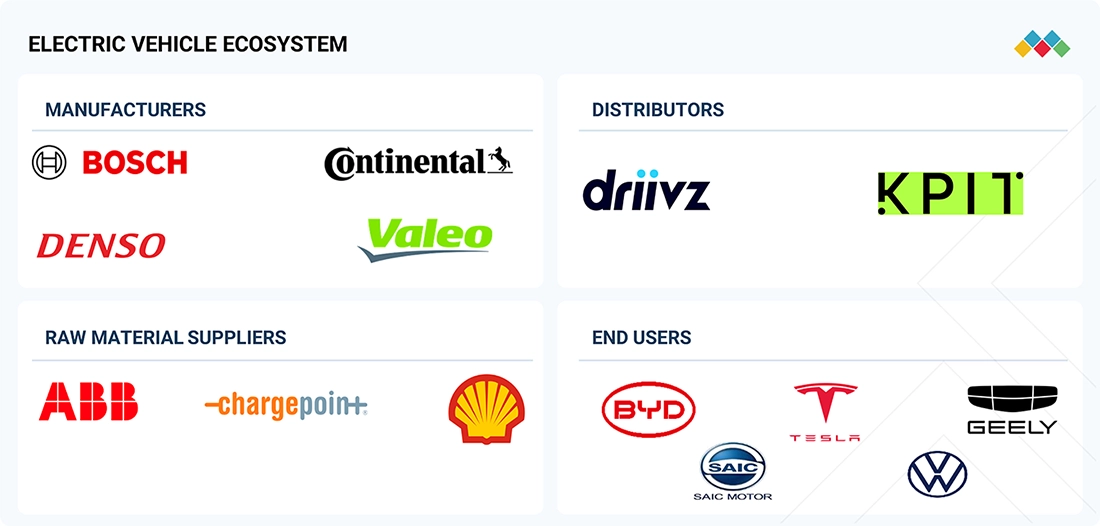
ELECTRIC VEHICLE MARKET SIZE, SHARE & ANALYSIS: COMMERCIAL USE CASES ACROSS INDUSTRIES
| COMPANY | USE CASE DESCRIPTION | BENEFITS |
|---|---|---|
 |
Blade battery technology in passenger cars and electric buses | Enhanced safety, longer battery life, improved energy density, reduced thermal management issues |
 |
Electrified pickup trucks and SUVs for fleet and consumer use | High torque for off-road performance, extended driving range, fast charging capability |
 |
Electric commercial trucks with integrated telematics and battery management systems | Optimized energy use, reduced operational costs, improved route planning and fleet efficiency |
Logos and trademarks shown above are the property of their respective owners. Their use here is for informational and illustrative purposes only.
Related Ecosystem
Electric Hybrid Vehicles
Key Takeaways
- Costa Rica's EV market is valued at $13.0 million in 2025 and is forecast to reach $20.0 million by 2030.
- Costa Rica demonstrates a 4.6% CAGR, reflecting steady but moderate growth in electric vehicle adoption.
- Costa Rica's renewable energy infrastructure and environmental policies support long-term EV market expansion.
- Costa Rica's market growth is driven by increasing consumer awareness and improving charging network availability.
Electric Vehicle Market Report Scope
| Report Metric | Details |
|---|---|
| Base Year | 2025 |
| Fastest Growing Segment | 800V (Electric Architecture) |
| Forecast Period | 2025–2030 |
| Growth Rate | CAGR of 5.5% from 2025 to 2030 |
| Largest Segment | PASSENGER CAR (Vehicle Type) |
| Market Size Base Year (Billions) | ~USD 696.42 (2025) |
| Revenue Forecast (Billions) | ~USD 910.2 (2030) |
| Segments Covered | Propulsion, Vehicle Type, Configuration Type, Electric Architecture, Vehicle Body Type, Vehicle Drive Type, Vehicle Top Speed |
Costa Rica Electric Vehicle Market Report Segmentation
7 segment dimensions are covered across the global market.
By Propulsion
- Bev
- Fcev
- Hev
- Mhev
- Phev
By Vehicle Type
- Commercial Vehicle
- Passenger Car
By Configuration Type
- Parallel
- Series
- Series-Parallel
By Electric Architecture
- 400V
- 800V
By Vehicle Body Type
- Hatchback
- Sedan
- SUV/Mpv
By Vehicle Drive Type
- Awd
- Fwd
- Rwd
By Vehicle Top Speed
- <110 Mph
- >110 Mph
Target Audience
- Automotive Manufacturers & Distributors : Need market-specific data to assess Costa Rica's EV potential, identify distribution partnerships, and develop localized product strategies for Central American expansion.
- Infrastructure & Energy Companies : Require insights on charging station demand, grid capacity requirements, and investment opportunities in Costa Rica's rapidly developing EV charging ecosystem.
- Investment & Private Equity Firms : Seek detailed market forecasts and growth metrics to evaluate investment returns in Costa Rica's EV sector, including fleet operators and charging networks.
- Government & Policy Makers : Use market analysis to refine sustainability policies, incentive programs, and infrastructure investments aligned with Costa Rica's carbon neutrality objectives.
- Tourism & Hospitality Operators : Need market data on EV availability, operating costs, and charging infrastructure to plan fleet electrification and meet sustainability commitments in Costa Rica.
Key Companies in the Costa Rica Electric Vehicle Market
| Company | HQ | Ownership | Strongest segments |
|---|---|---|---|
| EVGO | United States | Public Company | Owned DC fast-charging services (public and commercial),eXtend – white-label hardware, design, construction, and O&M,PlugShare data, research, advertising, and ancillary digital services, |
| ABB LTD | India | Public Company | Electrification,Motion,Automation, |
| EATON CORPORATION | Ireland | Public Company | Electrical Americas,Electrical Global,Aerospace, |
| ALFEN | Netherlands | Public Company | Smart grid solutions (secondary substations, microgrids, PV and fast-charging grid connections),EV charging equipment (home, workplace, retail, public),Stationary and mobile battery energy storage systems, |
| BLINK CHARGING | United States | Public Company | Commercial and public charging hardware,Network software, services, and payment processing,Residential charging hardware and services, |
| GAZ | Russia | Public Company | Gas business (exploration, production, transport, sales),Oil and refined products,Electric power and heat generation, |
| ALTEN | United States | Public Company | Engineering and R&D services,IT and digital services,Infrastructure and construction engineering, |
| ADVANCED ENERGY | United States | Public Company | Plasma power for semiconductor and thin film,High and low voltage power supplies,Sensing, controls, and instrumentation, |
| ENERSYS | United States | Public Company | Network & Infrastructure Solutions,Industrial Mobility Solutions,Precision Power Solutions, |
| ROCKWELL COLLINS INC | United States | Private Company | Commercial Systems (avionics, cabin management, sensors, training),Interior Systems (seating, galleys, cabin equipment, aftermarket services),Government Systems (mission avionics, communications, EW, training, space), |
| MAZDA MOTOR CORPORATION | Japan | Public Company | Passenger cars (hatchbacks and sedans),Crossovers and SUVs,Light commercial vehicles and pickups, |
| BYD COMPANY LTD. | China | Public Company | Automobiles and Related Products (incl. leasing, after-sales, auto components),Automobile Power Batteries and Lithium-ion Batteries,Mobile Handset Components, Assembly Service and Other Products, |
| TESLA | United States | Public Company | Battery electric vehicles (sedans & SUVs),Energy generation and storage (Powerwall, Megapack, solar),Services, maintenance, and parts, |
| ZHEJIANG GEELY HOLDING GROUP | China | Private Company | Mass-market ICE passenger vehicles (sedans, hatchbacks),SUVs and crossovers (ICE and hybrid),Battery electric and plug-in hybrid passenger vehicles, |
| GENERAL MOTORS | United States | Public Company | Trucks, pickups, and full-size SUVs,Crossovers and mid-size SUVs,Cars and small vehicles, |
| CHANGAN | China | Public Company | Passenger ICE and hybrid vehicles (CHANGAN, UNI, joint-venture brands),Battery electric and plug-in hybrid vehicles (DEEPAL, AVATR, LUMIN, CHANGAN NEVO),LCV and commercial vehicles (CHANGAN LCV, HUNTER), |
| BMW GROUP | Germany | Public Company | Automotive (BMW brand),Automotive (MINI and Rolls-Royce),Motorcycles (BMW Motorrad), |
| LI AUTO INC. | China | Public Company | Large premium SUVs,MPVs and people-movers,Mid-size and emerging BEV SUVs, |
| STELLANTIS NV | Netherlands | Public Company | Mass-market passenger cars (Fiat, Peugeot, Citroën, Opel, Vauxhall),SUVs and crossovers (Jeep, Peugeot, Opel, DS),Pickups and light commercial vehicles (Ram, Fiat Professional, Peugeot, Citroën), |
| GREAT WALL MOTOR | China | Public Company | SUVs (Haval, WEY, TANK, GWM),Pick-up trucks (GWM Pick-up),Sedans and MPVs, |
| TOYOTA MOTOR CORPORATION | Japan | Public Company | Passenger cars (subcompact, compact, mid-size, luxury, sports),SUVs, crossovers, and recreational vehicles,Pickup trucks, minivans, and light commercial vehicles, |
EVGO
EVgo is a United States-based public company founded in 2010 that operates as an electric vehicle charging infrastructure provider. With 376 employees, the company develops and manages charging networks for electric vehicles.
ABB LTD
ABB Ltd is a global public company founded in 1883 with headquarters in India, employing 112,700 people. The company operates across multiple industrial and technology sectors.
EATON CORPORATION
Eaton Corporation is a public company founded in 1911 with operations based in Ireland, employing 97,303 people. The company provides diversified industrial manufacturing and technology solutions.
ALFEN
Alfen is a Dutch public company founded in 1937 with 923 employees. The company focuses on energy infrastructure and electric vehicle charging solutions.
BLINK CHARGING
Blink Charging is a United States-based public company founded in 2009 with 320 employees. The company develops and operates electric vehicle charging networks and technology.
GAZ
GAZ is a Russian public company founded in 1993 with 468,000 employees. The company is a major manufacturer in the automotive and industrial sectors.
ALTEN
Alten is a United States-based public company founded in 1988 with 56,376 employees. The company provides engineering and IT consulting services.
ADVANCED ENERGY
Advanced Energy is a United States-based public company founded in 1981 with 13,000 employees. The company designs and manufactures power conversion and energy management solutions.
ENERSYS
EnerSys is a United States-based public company founded in 1991 with 9,682 employees. The company manufactures and distributes energy storage and power conversion solutions.
ROCKWELL COLLINS INC
Rockwell Collins Inc is a United States-based private company founded in 1933 with 31,200 employees. The company provides aerospace and defense electronics and communication systems.
MAZDA MOTOR CORPORATION
Mazda Motor Corporation is a Japanese public company founded in 1920 with 47,144 employees. The company designs, manufactures, and sells automobiles globally.
BYD COMPANY LTD.
BYD Company Ltd is a Chinese public company founded in 1994 with 869,600 employees. The company is a major manufacturer of electric vehicles, batteries, and renewable energy solutions.
TESLA
Tesla is a United States-based public company founded in 2003 with 134,785 employees. The company designs and manufactures electric vehicles, energy storage systems, and renewable energy products.
ZHEJIANG GEELY HOLDING GROUP
Zhejiang Geely Holding Group is a Chinese private company founded in 1986 with 18,000 employees. The company is an automotive manufacturer specializing in passenger vehicles.
GENERAL MOTORS
General Motors is a United States-based public company founded in 1908 with 156,000 employees. The company designs, manufactures, and sells automobiles and automotive components worldwide.
CHANGAN
Changan is a Chinese public company founded in 1996 with 58,274 employees. The company manufactures and sells automobiles and automotive products.
BMW GROUP
BMW Group is a German public company founded in 1916 with 154,540 employees. The company designs, manufactures, and sells premium automobiles and motorcycles globally.
LI AUTO INC.
Li Auto Inc is a Chinese public company founded in 2015 with 30,728 employees. The company designs and manufactures electric and extended-range electric vehicles.
STELLANTIS NV
Stellantis NV is a Netherlands-based public company founded in 1899 with 258,668 employees. The company is a multinational automotive manufacturer producing a diverse portfolio of vehicle brands.
GREAT WALL MOTOR
Great Wall Motor is a Chinese public company founded in 1984 with 97,600 employees. The company manufactures and sells sport utility vehicles, sedans, and pickup trucks.
TOYOTA MOTOR CORPORATION
Toyota Motor Corporation is a Japanese public company founded in 1933 with 390,927 employees. The company is a global leader in automobile manufacturing, producing vehicles and automotive components worldwide.
Reasons to Buy this Report
- Market Entry Strategy : Identify optimal entry points and localization strategies for automotive manufacturers and EV distributors targeting Costa Rica's growing but nascent market with specific growth projections.
- Investment Opportunity Assessment : Evaluate investment potential in charging infrastructure, EV dealerships, and related services with detailed market sizing and CAGR data specific to Costa Rica's economic conditions.
- Competitive Landscape Analysis : Understand market dynamics, key players, and competitive positioning within Costa Rica's unique renewable energy ecosystem and government incentive framework.
- Policy & Regulatory Insights : Access comprehensive analysis of Costa Rica's sustainability goals, tax incentives, import regulations, and government initiatives shaping EV market development.
- Tourism & Fleet Operator Planning : Support fleet electrification decisions for tourism companies and transportation operators with market data on charging availability, vehicle costs, and operational economics in Costa Rica.
Frequently asked questions
What is the current size of Costa Rica's electric vehicle market?
Costa Rica's electric vehicle market is estimated at $13.0 million in 2025.
What is the projected market size for Costa Rica's EV sector by 2030?
Costa Rica's EV market is forecast to reach $20.0 million by 2030.
What is the growth rate for Costa Rica's electric vehicle market?
Costa Rica's electric vehicle market is expected to grow at a compound annual growth rate of 4.6% from 2025 to 2030.
What factors are driving EV adoption in Costa Rica?
Costa Rica's high renewable energy penetration, government sustainability policies, and improving charging infrastructure are primary drivers of EV market growth.
How does Costa Rica's EV market compare to other Latin American countries?
Costa Rica is positioned as a regional leader in sustainable transportation due to its strong environmental policies and renewable energy commitment, though absolute market size remains smaller than larger regional economies.
RESEARCH METHODOLOGY
The research study involves extensive use of secondary sources such as company annual reports/presentations, industry association publications, magazine articles, directories, technical handbooks, World Economic Outlook, trade websites, technical articles, and databases to identify and collect information on the electric vehicle market. In-depth interviews have been conducted with various primary sources, experts from related industries, auto component and service providers, to obtain and verify critical information, as well as assess the growth prospects and market estimations.
Secondary Research
Secondary sources for this research study include corporate filings, such as annual reports, investor presentations, and financial statements; trade, business, and professional associations; whitepapers and electric vehicle-related journals; certified publications; articles by recognized authors; directories; and databases. Secondary data has been collected and analyzed to determine the overall market size, further validated by primary research.
Primary Research
Extensive primary research has been conducted after understanding the electric vehicle market scenario through secondary research. Several primary interviews have been conducted with market experts from demand (fleet operators, consumers) and supply (OEMs, EV battery manufacturers, country-level government associations, and trade associations) sides. The regions considered for the research include North America, Europe, Asia Pacific, Southeast Asia, Latin America, the Middle East, and Africa. Approximately 32% and 68% of primary interviews have been conducted from the demand and supply sides, respectively. Primary data has been collected through questionnaires, emails, and telephonic interviews. In the canvassing of primaries, various departments within organizations, such as sales, operations, and marketing, have been covered to provide a holistic viewpoint in this report.
After interacting with industry experts, brief sessions have been conducted with experienced independent consultants to reinforce the findings from the primaries. This, along with the in-house subject matter experts’ opinions, has led to the findings described in this report.
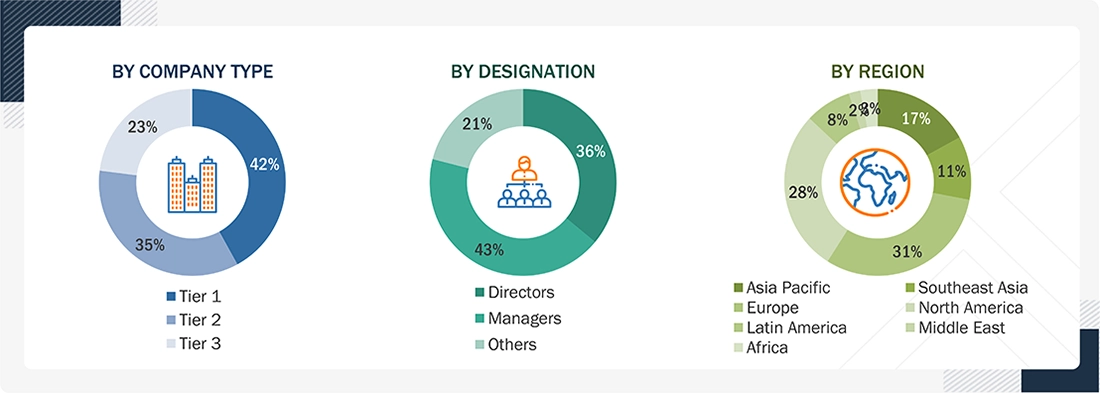
Note: Others include sales, managers, and product managers.
Company tiers are based on the value chain; the company’s revenue is not considered.
To know about the assumptions considered for the study, download the pdf brochure
Market Size Estimation
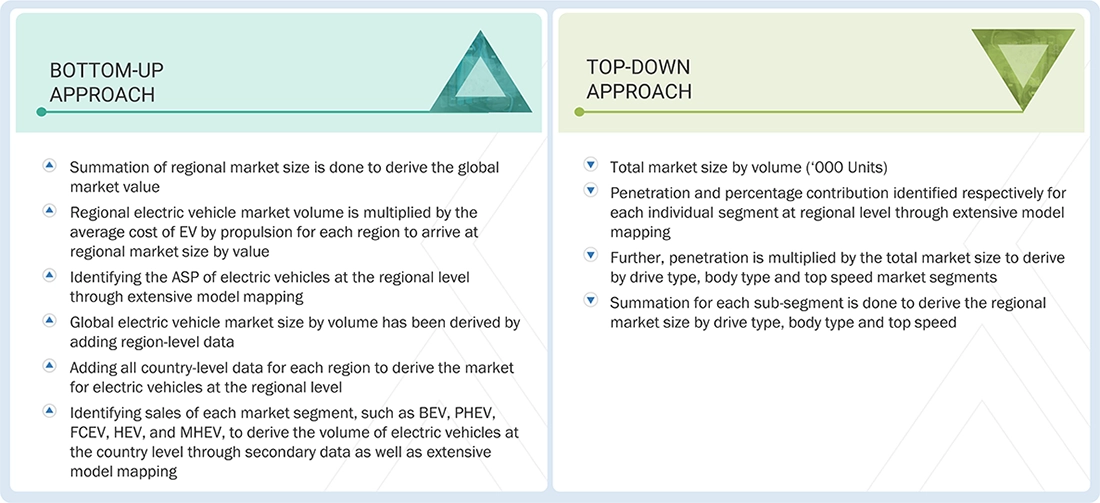
As mentioned below, a detailed market estimation approach has been followed to estimate and validate the volume and value of the electric vehicle market and other submarkets.
- The market size has been derived by using parameters such as sales of EVs.
- Segment split has been identified through primary and secondary research.
- Key players in the global electric vehicle market have been identified through secondary research, and their global market ranking has been determined through primary and secondary research.
- The research methodology includes the study of the annual and quarterly financial reports & regulatory filings of major market players, as well as interviews with industry experts for detailed market insights.
- All major penetration rates, percentage shares, splits, and breakdowns for the global market have been determined by using secondary sources and verified through primary sources.
- All key macro indicators affecting the revenue growth of the market segments and subsegments have been accounted for, viewed in extensive detail, verified through primary research, and analyzed to get the validated and verified quantitative & qualitative data.
- The gathered market data has been consolidated and added with detailed inputs, analyzed, and presented in this report.
Electric Vehicle Market : Top-Down and Bottom-Up Approach
Data Triangulation
After arriving at the overall market size through the aforementioned methodology, the electric vehicle market has been split into several segments and subsegments. The data triangulation procedure has been employed, wherever applicable, to complete the overall market engineering process and arrive at the exact market value for key segments and subsegments. The extrapolated market data has been triangulated by studying various macro indicators and regional trends from both the demand- and supply-side participants.
Market Definition
An electric vehicle (EV) is an automobile propelled by one or more electric motors. An EV uses energy stored in rechargeable batteries, which can be charged using private or public charging infrastructure. There are five major types of EVs, namely, battery electric vehicles (BEVs), plug-in hybrid electric vehicles (PHEVs), hybrid electric vehicles (HEVs), mild hybrid electric vehicles (MHEVs), and fuel cell electric vehicles (FCEVs).
Stakeholders
- Associations, forums, and alliances related to EVs
- Automobile manufacturers
- Battery distributors
- Battery manufacturers
- Charging infrastructure providers
- Charging service providers
- EV charging station service providers
- EV component manufacturers
- EV distributors and retailers
- EV manufacturers
- Government agencies and policymakers
Report Objectives
- To analyze and forecast the electric vehicle market in terms of volume (thousand units) and value (USD million) from 2025 to 2035
-
To segment the market by Vehicle Type, Propulsion, by EV Architecture, Vehicle Top Speed, Vehicle Drive Type, Vehicle Body Type, Configuration Type, Topology, Vehicle Connectivity, Propulsion & Component, End Use, and Region
- To segment and forecast the market size by vehicle type (passenger cars and commercial vehicles)
- To segment and forecast the market by propulsion (battery electric vehicle, fuel cell electric vehicle, plug-in hybrid electric vehicle, hybrid electric vehicle, and mild hybrid electric vehicle)
- To segment and forecast the market by EV architecture (400V and 800V)
- To segment and forecast the market by vehicle top speed (<125 mph and >125 mph)
- To segment and forecast the market by vehicle drive type (front-wheel drive, rear-wheel drive, and all wheel drive)
- To segment and forecast the market by vehicle body type (SUV/MPV, sedan, and hatchback)
- To segment and forecast the market by configuration type (series, parallel, and series-parallel)
- To segment and forecast the market by topology (P0, P1, P2, P3, and P4)
- To segment and forecast the market by vehicle connectivity (V2B or V2I, V2G, and V2V)
- To segment and forecast the market by propulsion & component (BEV components, PHEV components, FCEV components, HEV components, and MHEV components)
- To segment and forecast the market by end use (private and commercial fleets)
- To segment and forecast the market by Region [Asia Pacific, Southeast Asia, Europe, North America, and Rest of the World (RoW)]
- To identify and analyze key drivers, challenges, restraints, and opportunities influencing the market growth
- To strategically analyze the market, considering individual growth trends, prospects, and contributions to the total market
-
To study the following with respect to the market
- Supply chain analysis
- Ecosystem analysis
- Technology analysis
- Trade analysis
- Case study analysis
- Patent analysis
- Regulatory landscape
- Average selling price analysis
- Trends/Disruptions impacting customers’ business
- Impact of AI/Gen AI
- Key stakeholders and buying criteria
- Key conferences and events
- MNM insights on the electric vehicle market trends
- To strategically profile the key players and comprehensively analyze their market share and core competencies
- To track and analyze competitive developments such as deals (joint ventures, mergers & acquisitions, partnerships, collaborations), product developments and launches, and other activities undertaken by the key industry participants
Available Customizations
With the given market data, MarketsandMarkets offers customizations in accordance with the company’s specific needs.
- Electric vehicle market, by commercial vehicle type, at the regional level (for regions covered in the report)
- Electric vehicle market, by propulsion, for additional countries (for countries not covered in the report)
- Additional company profiles (up to five)
Get the Full Electric Vehicle Market Report
Full forecast, segment splits, and company analysis for all Electric Vehicle Market.
- China Electric Vehicle Market
- India Electric Vehicle Market
- Japan Electric Vehicle Market
- South Korea Electric Vehicle Market
- Thailand Electric Vehicle Market
- Indonesia Electric Vehicle Market
- Malaysia Electric Vehicle Market
- Vietnam Electric Vehicle Market
- Singapore Electric Vehicle Market
- Philippines Electric Vehicle Market
- Australia Electric Vehicle Market
- Canada Electric Vehicle Market
- Mexico Electric Vehicle Market
- Germany Electric Vehicle Market
- France Electric Vehicle Market
- Netherlands Electric Vehicle Market
- Norway Electric Vehicle Market
- Sweden Electric Vehicle Market
- UK Electric Vehicle Market
- Denmark Electric Vehicle Market
- Austria Electric Vehicle Market
- Switzerland Electric Vehicle Market
- Spain Electric Vehicle Market
- Russia Electric Vehicle Market
- Italy Electric Vehicle Market
- UAE Electric Vehicle Market
- Saudi Arabia Electric Vehicle Market
- Israel Electric Vehicle Market
- Brazil Electric Vehicle Market
- Colombia Electric Vehicle Market
- Chile Electric Vehicle Market
- Egypt Electric Vehicle Market
- South Africa Electric Vehicle Market
- US Electric Vehicle Market
- Uruguay Electric Vehicle Market
- Morocco Electric Vehicle Market
Need a Tailored Report?
Customize this report to your needs
Get 10% FREE Customization
Customize This Report
