
North America Global Range Extended Electric Vehicle (2025-2030)

The North America Global Range Extended Electric Vehicle was valued at $29 Million in 2025 and projected to reach to $29 Million by 2030, representing a compound annual growth rate of 7.48%. North America's Range Extended Electric Vehicle market is positioned for steady, incremental growth as consumers seek practical solutions to range limitations.


| Market Size in | USD 26.32 MN |
| Market Forecast in | |
| CAGR | |
| Forecast Period | |
| Units Considered | Value (USD MN) |
North America Global Range Extended Electric Vehicle Trends and Insights
- In North America, the adoption of range-extended electric vehicles reflects a balanced approach to electrification, combining battery-electric powertrains with onboard combustion engines to address consumer range anxiety.
- North America's market dynamics are shaped by regulatory pressures, infrastructure development, and consumer preferences for vehicles offering extended driving range without full dependency on charging networks. The North America market landscape demonstrates resilience as original equipment manufacturers invest in range-extended technologies to meet evolving emissions standards and consumer demand.
- North America's forecast through 2030 indicates sustained market activity, with the region maintaining its $29.0 million valuation as manufacturers refine product offerings and charging infrastructure matures.
- North America's competitive environment features both established automotive players and emerging EV specialists positioning range-extended vehicles as a transitional solution in the broader shift toward full electrification..
Key Market Statistics
- CAGR (2025-2030) 7.48% CAGR
- Market Size, 2025 ~USD 29 Million
- Forecast, 2030 ~USD 29 Million
- Geography North America
North America Global Range Extended Electric Vehicle Overview
Steady Market Valuation :
North America's Range Extended Electric Vehicle market is valued at $29.0 million in 2025, reflecting a niche but established segment within the broader EV market focused on extended-range solutions.
Moderate Growth Trajectory :
With a CAGR of 7.48% through 2030, North America demonstrates consistent but measured expansion, significantly slower than the global rate of 17.1%, indicating market maturity and selective adoption patterns.
Balanced Electrification Strategy :
North American consumers and manufacturers favor range-extended electric vehicles that combine battery-electric powertrains with onboard combustion engines, addressing range anxiety while maintaining environmental benefits.
Regional Market Positioning :
North America represents a smaller segment of the global REEV market, with growth constrained by strong preference for pure battery-electric vehicles and traditional combustion engines in the region.
North America Global Range Extended Electric Vehicle Dynamics
- The 7.48% CAGR reflects a maturing market where REEVs serve as a transitional technology for early adopters concerned about charging infrastructure gaps.
- Manufacturers are increasingly integrating advanced battery technologies and efficient combustion engines to enhance vehicle performance and reduce emissions. Looking ahead to 2030, North America's REEV market will benefit from expanding charging networks, improved battery technology, and regulatory incentives promoting electrification.
- However, growth will remain moderate compared to global trends, as the region's strong EV infrastructure development and consumer preference for fully electric vehicles limit REEV market expansion.
- Strategic positioning in premium and commercial segments will drive market development..
Market Ecosystem
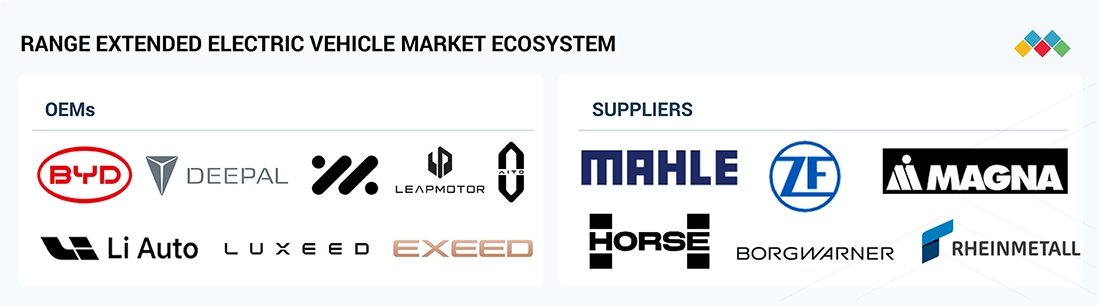
Related Ecosystem
Key Takeaways
- North America's Range Extended EV market is valued at $29.0 million in 2025 with a 7.48% CAGR through 2030.
- North America's market reflects consumer preference for extended-range solutions that mitigate charging infrastructure gaps.
- North America's regulatory environment drives OEM investment in range-extended technologies as a compliance pathway.
- North America's forecast stability through 2030 indicates range-extended vehicles serve as a transitional powertrain segment.
Global Range Extended Electric Vehicle Report Scope
| Report Metric | Details |
|---|---|
| Base Year | 2025 |
| Fastest Growing Segment | FUEL CELL RANGE EXTENDER (Type) |
| Forecast Period | 2025–2030 |
| Growth Rate | CAGR of 17.1% from 2025 to 2030 |
| Largest Segment | PC (Vehicle Type) |
| Segments Covered | Type, Component, Vehicle Type |
North America Global Range Extended Electric Vehicle Report Segmentation
3 segment dimensions are covered across the global market.
By Type
- Fuel Cell Range Extender
- ICE Range Extender
By Component
- Battery Pack
- Electric Motor
- Generator
- Power Converter
By Vehicle Type
- Cv
- Pc
Target Audience
- Automotive Manufacturers : OEMs and tier-1 suppliers need North America-specific market data to develop REEV product strategies, assess regional demand, and optimize manufacturing and distribution investments.
- Investment & Financial Firms : Investors, private equity, and financial analysts require detailed North American market valuations and forecasts to evaluate investment opportunities and portfolio positioning in the EV sector.
- Government & Policy Makers : Regulatory bodies and government agencies use regional market intelligence to inform electrification policies, incentive programs, and infrastructure development initiatives specific to North America.
- Energy & Infrastructure Companies : Charging network operators and energy providers need North America market insights to plan charging infrastructure expansion and align services with regional REEV adoption trends.
- Market Research & Consulting Firms : Research organizations and consultants require granular North American data to support client advisory services, competitive analysis, and strategic recommendations in the automotive sector.
Key Companies in the North America Global Range Extended Electric Vehicle
| Company | HQ | Ownership | Strongest segments |
|---|---|---|---|
| NOVELIS, INC | United States | Private Company | Beverage packaging sheet,Automotive sheet,Aerospace and transportation, |
| TOYODA GOSEI CO., LTD | Japan | Public Company | Weatherstrips,Functional Components (fuel tank, battery, engine, chassis & drive train parts),Interior & Exterior Plastic Parts (radiator grilles, ducts, fuel filler pipes), |
| ALTRAN | France | Private Company | Engineering and R&D services,Organization and IT systems consulting, |
| NITTO DENKO CORPORATION | Japan | Public Company | Industrial & double-sided adhesive tapes,Surface protective films & packaging tapes,Electronics & semiconductor process materials, |
| VOLKSWAGEN AG | Germany | Public Company | Passenger Cars & Light Commercial Vehicles,Commercial Vehicles (Trucks & Buses),Financial Services, |
| SIMPLO TECHNOLOGY CO., LTD. | Taiwan | Public Company | Lithium battery modules for mobile devices,Lithium battery modules for household appliances,LEV and EV battery modules, |
| ROBERT BOSCH GMBH | India | Private Company | Mobility (automotive systems and aftermarket),Industrial Technology (automation, drive and control, packaging),Consumer Goods (power tools and home appliances), |
| VOLEX GROUP | United Kingdom | Public Company | Power cords and consumer power products,Complex cable assemblies and harnesses (industrial, medical, off-highway),Data center power cables and copper interconnect/data cables, |
NOVELIS, INC
Novelis, Inc. is a private company founded in 2004 and headquartered in the United States. With 13,250 employees, the company operates as a significant player in its industry sector.
TOYODA GOSEI CO., LTD
Toyoda Gosei Co., Ltd. is a Japanese public company established in 1949. The company employs 41,304 people and maintains a substantial presence in the global market.
ALTRAN
Altran is a French private company founded in 1970 with a workforce of 50,124 employees. The organization operates as a major enterprise in its field of business.
NITTO DENKO CORPORATION
Nitto Denko Corporation is a Japanese public company with roots dating back to 1918. The company employs 26,477 people and maintains a long-established market presence.
VOLKSWAGEN AG
Volkswagen AG is a German public company founded in 1937 and one of the world's largest automotive manufacturers. With 598,592 employees, the company operates globally across multiple vehicle segments and markets.
SIMPLO TECHNOLOGY CO., LTD.
Simplo Technology Co., Ltd. is a Taiwanese public company established in 1981. The company operates with a workforce of 449 employees in its specialized industry sector.
ROBERT BOSCH GMBH
Robert Bosch GmbH is a private company founded in 1886 with operations in India. The company employs 412,774 people, making it one of the largest private enterprises globally.
VOLEX GROUP
Volex Group is a United Kingdom-based public company with a history dating back to 1892. The company maintains a workforce of 13,000 employees and operates in its established market sectors.
Countries within North America - compare and drill down
| Country | 2025 size (native) |
|---|---|
| United States | USD Million |
| Canada | USD Million |
| Mexico | USD Million |
Country market size visualization
Reasons to Buy this Report
- Regional Market Insights : Gain detailed understanding of North America's unique REEV market dynamics, consumer preferences, and adoption patterns distinct from global trends and other regional markets.
- Competitive Landscape Analysis : Identify key manufacturers, market players, and competitive strategies specific to North America's range-extended electric vehicle segment to inform business decisions.
- Growth Opportunity Assessment : Evaluate the 7.48% CAGR growth potential and market expansion opportunities through 2030 with region-specific forecasts and trend analysis for strategic planning.
- Investment Decision Support : Access comprehensive market valuation data ($29M in 2025) and projections to support investment decisions, partnerships, and market entry strategies in North America.
- Regulatory & Infrastructure Context : Understand North America-specific regulatory frameworks, charging infrastructure development, and policy incentives driving REEV market adoption and growth trajectories.
Frequently asked questions
What is the current market size of Range Extended Electric Vehicles in North America?
North America's Range Extended Electric Vehicle market is valued at $29.0 million in 2025, with a projected compound annual growth rate of 7.48% through 2030.
What factors drive Range Extended EV adoption in North America?
North America's adoption is driven by consumer range anxiety mitigation, regulatory emissions compliance requirements, and the transitional appeal of vehicles combining electric and combustion powertrains.
How does North America's Range Extended EV market compare to global trends?
North America's 7.48% CAGR reflects a more moderate growth trajectory compared to the global market, indicating the region's mature automotive infrastructure and established EV charging networks reduce urgency for range-extended solutions.
What is the forecast for North America's Range Extended EV market through 2030?
North America's market is forecast to remain at $29.0 million through 2030, indicating stable market conditions as range-extended vehicles serve as a transitional segment during the broader shift to full electrification.
Which manufacturers are leading the Range Extended EV segment in North America?
North America's range-extended segment features participation from established OEMs such as General Motors, BMW, and Audi, alongside emerging EV specialists developing next-generation extended-range platforms.
RESEARCH METHODOLOGY
The study involved four main tasks to assess the current and future scope of the range extended electric vehicle (REEV) market. First, extensive secondary research was conducted to gather data on the market, related sectors, and broader industries. Next, primary research with industry experts across the value chain confirmed and validated these findings and assumptions. The total market size was estimated using a bottom-up approach. Then, a market breakdown and data triangulation method were applied to determine the size of specific segments and subsegments within the market.
Secondary Research
The secondary sources included the company's annual reports and presentations, industry association publications, directories, technical handbooks, World Economic Outlook, technical articles, and databases, which were used to gather information for an in-depth study of the OEMs market for hybrid products. The sources used for market sizing estimation also included the automotive sales database, corporate filings (such as annual reports, investor presentations, and financial statements), and passenger vehicle associations. Secondary data was collected and analyzed to determine the overall market size, which was further validated through primary research. Primary sources—experts from related industries, OEMs, and component suppliers—were interviewed to obtain and verify key information and to assess prospects and market estimates. Historical sales data was collected and analyzed, with industry trends considered to develop the forecast, which was also validated through primary research.
Primary Research
In the primary research process, various primary sources from both the supply and demand sides were interviewed to gather qualitative and quantitative information about the market. The supply-side sources included industry experts such as CXOs, vice presidents, directors from business development, marketing, and product development/innovation teams, along with other key executives from various companies. Additionally, system integrators, industry associations, independent consultants, industry veterans, and influential opinion leaders were also interviewed.
Primary interviews have been conducted to gather insights, such as sizing estimates of the hybrid market and forecasts, future technology trends, and upcoming innovations in the hybrid automotive market. Data triangulation was performed using information obtained from secondary research and model mapping. Stakeholders from both demand and supply sides have been interviewed to understand their perspectives on the points above.

Note: Other designations include sales, marketing, and product managers.
Source: Secondary Research, Primary Interviews, and MarketsandMarkets Analysis
To know about the assumptions considered for the study, download the pdf brochure
Market Size Estimation
As mentioned below, a detailed market estimation approach was followed to estimate and validate the value of the range extended electric vehicle market and other dependent submarkets.
- The bottom-up approach was used to estimate and validate the range extended electric vehicle market size. The range-extended EV market size, by country, was derived by mapping the historical sales of range-extended EVs at the country level. These data points were largely fetched from country-level associations, vehicle sales databases, and OEM data experts. The total volume of each country/region is then summed up to reveal the total volume of the global range-extended electric vehicle market. The data was validated through primary interviews with industry experts. The penetration of different segments was derived from secondary research and primary interviews.
- The gathered market data was consolidated, enhanced with detailed inputs, analyzed, and presented in this report.
Range Extended Electric Vehicle Market : Top-Down and Bottom-Up Approach

Market Definition
Range-extended EVs utilize fuel to power a generator and a motor that recharge the vehicle’s battery, thereby extending the vehicle’s driving range. This arrangement is also commonly known as a series hybrid drivetrain. The battery size in these vehicles is smaller compared to that of fully electric cars.
These EVs can be deployed using different technologies, including internal combustion engine extenders, turbine-based extenders, and fuel-cell extenders. However, the internal combustion engine extender is the most commonly used type of extender.
Stakeholders
- Automobile Organizations/Associations
- Automotive Component Manufacturers
- Automotive Component Suppliers
- Automotive OEMs
- Automotive System Manufacturers
- Automotive Electronics Manufacturers
- Country-specific Automotive Associations
- European Automobile Manufacturers Association (ACEA)
- EV Manufacturers
- EV Component Manufacturers
- Government & Research Organizations
- Raw Material Suppliers for the Automotive Industry
- Software Providers
- Traders, Distributors, and Suppliers of Automotive Components
Report Objectives
-
To define, describe, and forecast the REEV market in terms of volume:
- By Region (Europe, US, and China)
- To understand the dynamics (drivers, restraints, opportunities, and challenges) of the market
- To analyze the market share of leading players operating in the market
- To strategically analyze key player strategies and company analysis
- To study the following with respect to the market
-
Trends and Disruptions Impacting Customers' Businesses
- Market Ecosystem
- Investment and Funding Scenario
- Pricing Analysis
- Range Analysis
- OEM Analysis
- OEM Strategies
- To analyze recent developments, including new product launches by key industry participants
- To analyze the opportunities in the market for stakeholders and provide details of the competitive landscape for market leaders
Available Customizations
Along with the provided market data, MarketsandMarkets offers customizations tailored to the company's specific needs.
The study segments the range extended electric vehicle market into the following segments:
By Region
- US
- Europe
- China
Get the Full Global Range Extended Electric Vehicle Report
Full forecast, segment splits, and company analysis for all Global Range Extended Electric Vehicle.
Need a Tailored Report?
Customize this report to your needs
Get 10% FREE Customization
Customize This Report
