
Rest Of Asia Pacific Electronic Hydrofluoric Acid Market (2025-2030)

The Rest Of Asia Pacific Electronic Hydrofluoric Acid Market was valued at $12.7 Million in 2025 and projected to reach to $16.4 Million by 2030, representing a compound annual growth rate of 5.3%. Rest Of Asia Pacific's electronic hydrofluoric acid market is positioned for steady growth as semiconductor manufacturing and electronics production intensify across the region.


| Market Size in | USD 26.32 MN |
| Market Forecast in | |
| CAGR | |
| Forecast Period | |
| Units Considered | Value (USD MN) |
Rest Of Asia Pacific Electronic Hydrofluoric Acid Market Trends and Insights
- Rest Of Asia Pacific represents a significant emerging market for electronic-grade hydrofluoric acid, driven by increasing semiconductor manufacturing and electronics production across the region.
- The market in Rest Of Asia Pacific is supported by rising demand from microelectronics fabrication facilities and specialty chemical applications that require high-purity hydrofluoric acid.
- Rest Of Asia Pacific's growth trajectory reflects the region's expanding industrial base and technological advancement in electronics manufacturing over the forecast period..
Key Market Statistics
- CAGR (2025-2030) 5.3% CAGR
- Market Size, 2025 ~USD 12.7 Million
- Forecast, 2030 ~USD 16.4 Million
- Country Rest Of Asia Pacific
Rest Of Asia Pacific Electronic Hydrofluoric Acid Market Overview
Market Size & Growth :
Rest Of Asia Pacific electronic hydrofluoric acid market valued at USD 12.7 million in 2025, projected to reach USD 16.4 million by 2030, representing steady expansion in the region's chemical sector.
Regional CAGR Performance :
The region demonstrates a 5.3% CAGR from 2025-2030, slightly below the global average of 6%, indicating moderate but consistent growth driven by emerging semiconductor hubs.
Semiconductor Manufacturing Surge :
Increasing semiconductor and electronics production across Rest Of Asia Pacific countries is driving demand for electronic-grade hydrofluoric acid as a critical etching and processing chemical.
Emerging Market Opportunity :
Rest Of Asia Pacific represents a significant emerging market with untapped potential as manufacturing capabilities expand and electronics production scales across secondary industrial centers.
Rest Of Asia Pacific Electronic Hydrofluoric Acid Market Dynamics
- The 5.3% CAGR reflects increasing industrialization and technology adoption in emerging economies, with growing demand from microelectronics fabrication facilities and precision manufacturing sectors.
- Investment in semiconductor infrastructure and electronics assembly operations continues to drive consumption of electronic-grade chemicals. The market outlook remains positive through 2030, supported by regional economic development and rising electronics exports.
- However, growth rates lag slightly behind global averages due to competition from established Asian manufacturing hubs and regulatory complexities.
- Strategic opportunities exist for suppliers targeting secondary industrial centers and emerging semiconductor clusters seeking reliable electronic-grade hydrofluoric acid supply chains..
Market Ecosystem
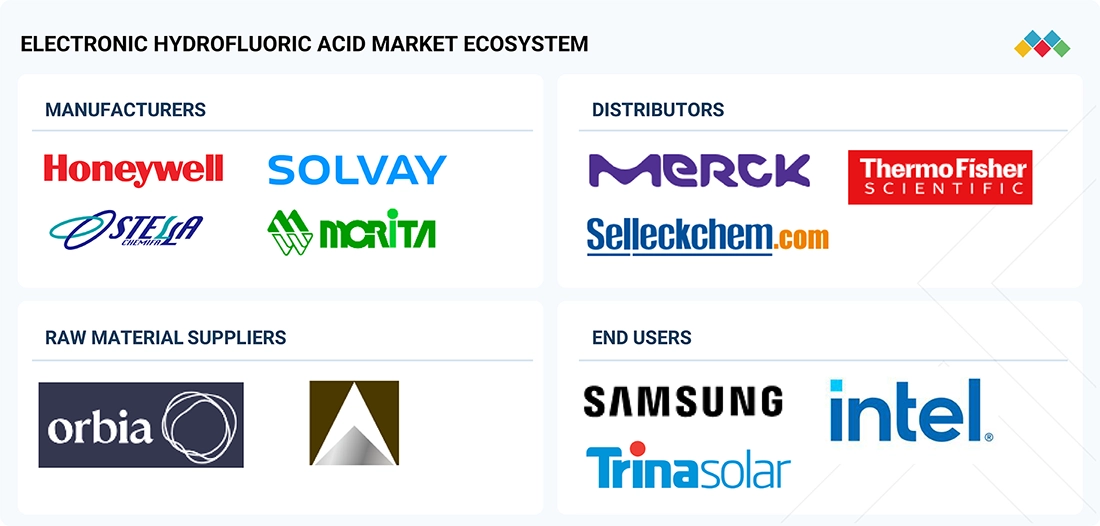
ELECTRONIC HYDROFLUORIC ACID MARKET: COMMERCIAL USE CASES ACROSS INDUSTRIES
| COMPANY | USE CASE DESCRIPTION | BENEFITS |
|---|---|---|
 |
Development of electronic hydrofluoric acid solutions for advanced semiconductor wafer cleaning and etching in AI and 5G chip fabrication, including Puranal grades with zero-liquid-discharge systems for sustainable production. | Enhanced yield in sub-3nm nodes by minimizing ppt-level impurities, reduced environmental impact through recycling innovations, and strengthened supply chain resilience amid 2025 CHIPS Act expansions, supporting over 90 new US fabs. |
 |
Incorporation of 10 ppb-grade electronic hydrofluoric acid as a buffered isotropic etching agent combined with ammonium fluoride for precise oxide removal in photovoltaic and microelectronics wafer processing. | Improved light absorption in high-efficiency solar cells (>25% conversion), eco-friendly waste reduction via hydrofluoric acid recycling, and reliable supply for Asia Pacific's $5B+ PV investments in 2025, enabling cleaner label solutions for renewable energy manufacturers. |
 |
Production of 12N-purity electronic hydrofluoric acid for critical cleaning and etching in leading-edge semiconductor devices, including GAAFETs and high-layer 3D NAND, with proprietary refining for lithium-ion battery applications. | Superior defect prevention at parts-per-quadrillion levels for next-gen chips, disaster-resilient global supply chains post-2025 expansions, and enhanced durability in high-temperature environments align with Japan’s semiconductor ecosystem goals. |
 |
Supply of straight and buffered electronic hydrofluoric acid variants for high-selectivity oxide layer etching in LCD/OLED panels and advanced memory chips, integrated with microelectronic cleaning solutions. | Precise control for 90nm-5nm processes, reducing surface roughness, low metallic impurities, boosting efficiency in 5G/AI devices, and sustainable R&D investments capturing 15-19% of the Asia Pacific's share through capacity expansions in 2025. |
Logos and trademarks shown above are the property of their respective owners. Their use here is for informational and illustrative purposes only.
Related Ecosystem
Speciality Chemicals
- Corrosion Inhibitors
- Polyetheretherketone (PEEK)
- Acrylonitrile Butadiene Styrene (ABS)
- Epoxy Resin
- Polycarbonate
- Basf se
- DOW CHEMICAL COMPANY
- Evonik industries ag
- Clariant ag.
- Solvay sa
Key Takeaways
- Rest Of Asia Pacific's electronic hydrofluoric acid market is valued at USD 12.7 million in 2025 with projected growth to USD 16.4 million by 2030.
- Rest Of Asia Pacific is experiencing a 5.3% CAGR, driven by semiconductor and electronics manufacturing expansion.
- Rest Of Asia Pacific's market growth is supported by increasing demand for high-purity chemical inputs in microelectronics fabrication.
- Rest Of Asia Pacific represents an emerging opportunity for electronic-grade hydrofluoric acid suppliers targeting the region's growing industrial base.
Electronic Hydrofluoric Acid Market Report Scope
| Report Metric | Details |
|---|---|
| Base Year | 2025 |
| Fastest Growing Segment | SEMICONDUCTOR WAFERS (Application) |
| Forecast Period | 2025–2030 |
| Growth Rate | CAGR of 6% from 2025 to 2030 |
| Largest Segment | FLUORITE-BASED (Type) |
| Market Size Base Year (Billions) | ~USD 1.4 (2025) |
| Revenue Forecast (Billions) | ~USD 1.87 (2030) |
| Segments Covered | Grade, Type, Application |
Rest Of Asia Pacific Electronic Hydrofluoric Acid Market Report Segmentation
3 segment dimensions are covered across the global market.
By Grade
- El Grade
- Up Grade
- Up-S
- Up-Ss
- Up-Sss
By Type
- Fluorite-Based
- Fluorite-Basedfluorite-Based
- Fluorosilicic Acid-Based
By Application
- Electronic Components
- Flat Panel Displays
- Leds & Compound Semiconductors
- MEMS
- Optical Fibers
- Semiconductor Wafers
- Solar Cells
Target Audience
- Chemical Manufacturers & Suppliers : Need regional market data to assess expansion opportunities, production capacity planning, and distribution strategy development in Rest Of Asia Pacific's emerging semiconductor chemical sector.
- Semiconductor Equipment Providers : Require market intelligence on electronic hydrofluoric acid consumption trends to align equipment sales strategies and support customer base growth across Rest Of Asia Pacific manufacturing facilities.
- Investment & Private Equity Firms : Seek regional market analysis to evaluate investment opportunities in chemical manufacturing, semiconductor supply chains, and emerging industrial ventures within Rest Of Asia Pacific.
- Electronics & Semiconductor Manufacturers : Need supply chain insights and market forecasts to secure reliable electronic-grade hydrofluoric acid sourcing and optimize procurement strategies in Rest Of Asia Pacific operations.
- Market Research & Consulting Professionals : Require detailed regional cutout data to support client advisory services, competitive benchmarking, and strategic recommendations specific to Rest Of Asia Pacific chemical and semiconductor markets.
Key Companies in the Rest Of Asia Pacific Electronic Hydrofluoric Acid Market
| Company | HQ | Ownership | Strongest segments |
|---|---|---|---|
| STELLA CHEMIFA CORPORATION | Japan | Public Company | Semiconductor and LCD etching chemicals (HF, buffered HF, etching solutions),Fluorides for optical materials and specialty applications,Battery materials (lithium hexafluorophosphate, fluoride nanoparticles), |
| LANXESS | Germany | Public Company | Specialty Additives,Advanced Intermediates,Consumer Protection, |
| SOLVAY | Belgium | Public Company | Soda ash and sodium bicarbonate,Hydrogen peroxide and derivatives,Silica (precipitated and highly dispersible), |
| DONGYUE GROUP | China | Public Company | Polymers (PTFE and fluoropolymers),Refrigerants,Organic Silicone, |
| HONEYWELL INTERNATIONAL INC. | United States | Public Company | Industrial Automation,Building Automation,Energy and Sustainability Solutions (UOP and related), |
| NAVIN FLUORINE INTERNATIONAL LIMITED | India | Public Company | Mafron refrigerants (AC, refrigeration, mobile AC),Inorganic fluorides (salts, complexes for O&G, steel, abrasives, solar),Specialty fluoro intermediates (including boron trifluoride and adducts), |
| BASF | Germany | Public Company | Chemicals (Petrochemicals & Intermediates),Materials (Isocyanates, Polyamides, Inorganic Basics),Industrial Solutions (Dispersions, Resins, Additives, Catalysts), |
| ZHEJIANG YONGHE REFRIGERANT CO., LTD. | China | Public Company | Fluorocarbon chemicals and mixed refrigerants,Fluorinated polymer materials and monomers,Fluorinated fine chemicals, |
| SINOCHEM LANTIAN CO., LTD. | China | Private Company | ODS substitutes and refrigerants (JINCOOL and related),Fluoropolymers,Fluorinated specialty chemicals and intermediates, |
STELLA CHEMIFA CORPORATION
Stella Chemifa Corporation is a Japanese public company founded in 1916 with 683 employees. The company operates in the chemical industry.
LANXESS
Lanxess is a German public company founded in 1863 with 11,630 employees. The company is a major player in the chemical sector.
SOLVAY
Solvay is a Belgian public company founded in 1863 with 8,400 employees. The company operates as a global chemical and advanced materials manufacturer.
DONGYUE GROUP
Dongyue Group is a Chinese public company founded in 1987 with 6,377 employees. The company operates in the chemical industry.
HONEYWELL INTERNATIONAL INC.
Honeywell International Inc. is a United States public company founded in 1885 with 101,000 employees. The company is a diversified technology and manufacturing conglomerate.
NAVIN FLUORINE INTERNATIONAL LIMITED
Navin Fluorine International Limited is an Indian public company founded in 1967 with 1,569 employees. The company specializes in fluorine-based chemicals.
BASF
BASF is a German public company founded in 1865 with 106,428 employees. The company is one of the world's largest chemical manufacturers.
ZHEJIANG YONGHE REFRIGERANT CO., LTD.
Zhejiang Yonghe Refrigerant Co., Ltd. is a Chinese public company founded in 1998 with 2,938 employees. The company specializes in refrigerant chemicals.
SINOCHEM LANTIAN CO., LTD.
Sinochem Lantian Co., Ltd. is a Chinese private company founded in 2003. The company operates in the chemical sector.
Reasons to Buy this Report
- Regional Market Sizing : Obtain precise market valuation for Rest Of Asia Pacific (USD 12.7M in 2025) with accurate forecasts through 2030, enabling targeted investment and expansion decisions in emerging semiconductor regions.
- Growth Trajectory Analysis : Understand the 5.3% CAGR specific to Rest Of Asia Pacific versus global 6% benchmark, identifying regional growth drivers and competitive positioning within the broader Asian chemical market.
- Semiconductor Supply Chain Insights : Gain intelligence on electronic hydrofluoric acid demand patterns driven by semiconductor manufacturing expansion, helping suppliers optimize production capacity and distribution networks across emerging industrial centers.
- Competitive Landscape Assessment : Evaluate market dynamics specific to Rest Of Asia Pacific, including emerging competitors, regulatory environments, and customer concentration to inform market entry and partnership strategies.
- Strategic Planning & Forecasting : Leverage region-specific projections through 2030 to develop long-term business strategies, capital allocation plans, and market penetration approaches tailored to Rest Of Asia Pacific's unique growth profile.
Frequently asked questions
What is the market size of electronic hydrofluoric acid in Rest Of Asia Pacific?
Rest Of Asia Pacific's electronic hydrofluoric acid market is estimated at USD 12.7 million in 2025 and is forecast to reach USD 16.4 million by 2030.
What is the growth rate for electronic hydrofluoric acid in Rest Of Asia Pacific?
Rest Of Asia Pacific's electronic hydrofluoric acid market is projected to grow at a CAGR of 5.3% from 2025 to 2030.
What drives demand for electronic hydrofluoric acid in Rest Of Asia Pacific?
Rest Of Asia Pacific's demand is primarily driven by expanding semiconductor manufacturing, microelectronics fabrication, and specialty chemical applications requiring high-purity hydrofluoric acid.
Which industries consume electronic hydrofluoric acid in Rest Of Asia Pacific?
Rest Of Asia Pacific's primary consumers include semiconductor manufacturers, microelectronics fabrication facilities, and specialty chemical producers requiring electronic-grade hydrofluoric acid.
What is the forecast for Rest Of Asia Pacific's electronic hydrofluoric acid market by 2030?
Rest Of Asia Pacific's electronic hydrofluoric acid market is forecast to reach USD 16.4 million by 2030, representing steady growth from the 2025 baseline of USD 12.7 million.
RESEARCH METHODOLOGY
The study involved four key activities to determine the current size of the global hydrofluoric acid market. Comprehensive secondary research was conducted to gather information on the market, related product markets, and the broader product group. The next step was to validate these findings, assumptions, and estimates with industry experts across the hydrofluoric acid value chain through primary research. Both top-down and bottom-up approaches were used to estimate the overall market size. Following this, market segmentation and data triangulation processes were applied to define the size of various segments and sub-segments.
Secondary Research
The market for companies offering hydrofluoric acid is determined through secondary data from paid and free sources, analyzing the product portfolios of leading firms in the industry, and rating these companies by their performance and quality. Secondary sources such as Business Standard, Bloomberg, World Bank, and Factiva were used to gather information for this study on the hydrofluoric acid market. Multiple sources were consulted during the secondary research process to collect relevant data. These sources included annual reports, press releases, investor presentations of luxury vinyl tile vendors, forums, certified publications, and white papers. This secondary research provided essential insights into the industry’s value chain, the pool of key players, market classification, and segmentation from both market and technology perspectives.
Primary Research
In the primary research process, various primary sources from both the supply and demand sides were interviewed to gather qualitative and quantitative information for this report. The supply-side sources included industry experts such as Chief Executive Officers (CEOs), Vice Presidents (VPs), marketing directors, technology and innovation directors, and other key executives from several leading companies and organizations operating in the Hydrofluoric acid market. After completing the market engineering process—which involved calculations for market statistics, market breakdowns, market size estimations, market forecasting, and data triangulation—extensive primary research was conducted to collect information and verify the critical figures obtained. Primary research also identified the segmentation types, industry trends, competitive landscape of Hydrofluoric acid offered by various market players, and key market dynamics, including drivers, restraints, opportunities, challenges, industry trends, and strategies of major players. Throughout the complete market engineering process, the top-down and bottom-up approaches and several data triangulation methods were extensively used to estimate and forecast market segments and subsegments listed in this report. In-depth qualitative and quantitative analysis was performed on the entire market engineering process to highlight key insights and information throughout the report.
Market Size Estimation
The top-down and bottom-up methods were used to estimate and verify the size of the global hydrofluoric acid market. These methods were also widely employed to determine the size of various related market segments. The research approach for estimating the market size included the following:
Data Triangulation
After determining the overall market size through estimation methods, the market was divided into various segments and subsegments. Data triangulation and market breakdown procedures were used, where applicable, to complete the overall market analysis and determine precise statistics for each segment and subsegment. The data was triangulated by examining different factors and trends from both the demand and supply sides.
Market Definition
The reaction between a hydrogen atom and a fluorine atom produces hydrogen fluoride, a colorless, corrosive liquid or vapor with a strong, unpleasant, pungent odor. Hydrofluoric acid forms when hydrogen fluoride dissolves in water. The report divides the hydrofluoric acid market based on its grades, applications, and regions. It is available in different grades depending on the acid's concentration levels. In terms of its uses, hydrofluoric acid is employed in several industries, such as chemical manufacturing and glass etching.
Stakeholders
- Hydrofluoric Acid Manufacturers
- Raw Material Suppliers
- Traders and Distributors
- Industry Associations
- Research Organizations, Trade Associations, and Government Agencies
- Commercial R&D Institutes
- End-use Industries
Report Objectives
- To define, describe, and forecast the size of the global hydrofluoric acid market based on grade, application, and region in terms of value and volume
- To provide detailed information on the significant drivers, restraints, opportunities, and challenges influencing the market
- To strategically analyze micromarkets concerning individual growth trends, prospects, and their contribution to the market
- To assess the growth opportunities in the market for stakeholders and provide details on the competitive landscape for market leaders
- To forecast the market size of segments and subsegments for North America, Europe, the Asia Pacific, South America, and the Middle East & Africa
- To strategically profile key players and comprehensively analyze their market shares and core competencies
- To analyze competitive developments such as product launches, acquisitions, expansions, partnerships, and agreements in the hydrofluoric acid market
- To provide the impact of AI/Gen AI on the market
Get the Full Electronic Hydrofluoric Acid Market Report
Full forecast, segment splits, and company analysis for all Electronic Hydrofluoric Acid Market.
- UK Electronic Hydrofluoric Acid Market
- South Africa Electronic Hydrofluoric Acid Market
- Brazil Electronic Hydrofluoric Acid Market
- Argentina Electronic Hydrofluoric Acid Market
- Rest Of Europe Electronic Hydrofluoric Acid Market
- GCC Countries Electronic Hydrofluoric Acid Market
- –Rest Of GCC Electronic Hydrofluoric Acid Market
- China Electronic Hydrofluoric Acid Market
- Japan Electronic Hydrofluoric Acid Market
- India Electronic Hydrofluoric Acid Market
- South Korea Electronic Hydrofluoric Acid Market
- Canada Electronic Hydrofluoric Acid Market
- Mexico Electronic Hydrofluoric Acid Market
- US Electronic Hydrofluoric Acid Market
- Germany Electronic Hydrofluoric Acid Market
- Italy Electronic Hydrofluoric Acid Market
- France Electronic Hydrofluoric Acid Market
- Spain Electronic Hydrofluoric Acid Market
Need a Tailored Report?
Customize this report to your needs
Get 10% FREE Customization
Customize This Report
