
Japan Electronic Potting Compound Market (2025-2030)

The Japan Electronic Potting Compound Market was valued at $57 Million in 2025 and projected to reach to $62 Million by 2030, representing a compound annual growth rate of CAGR 1.3%. Japan's electronic potting compound market faces a period of steady but constrained growth, with the 1.3% CAGR reflecting the maturity of both the market and the automotive sector.


| Market Size in | USD 26.32 MN |
| Market Forecast in | |
| CAGR | |
| Forecast Period | |
| Units Considered | Value (USD MN) |
Japan Electronic Potting Compound Market Trends and Insights
- Japan's automotive and transportation sector relies on electronic potting compounds for component protection and thermal management, though growth remains constrained by market maturity and established manufacturing practices.
- The forecast period reflects Japan's steady demand for reliable potting solutions in electric vehicle electronics and advanced driver-assistance systems. Japan's market dynamics are shaped by the country's leadership in automotive innovation and stringent quality standards.
- Japan continues to invest in next-generation vehicle technologies, which sustains baseline demand for potting compounds despite the low growth rate.
- The incremental expansion from 2025 to 2030 underscores Japan's preference for proven, high-performance materials over rapid market disruption, aligning with the nation's engineering-focused automotive culture..
Key Market Statistics
- CAGR (2025-2030) CAGR 1.3%
- Market Size, 2025 ~USD 57 Million
- Forecast, 2030 ~USD 62 Million
- Country Japan
Japan Electronic Potting Compound Market Overview
Modest Growth Trajectory :
Japan's electronic potting compound market is valued at $57.0 million in 2025 and is projected to reach $62.0 million by 2030, representing a conservative CAGR of 1.3%, significantly below the global average of 14.9%.
Automotive Sector Dependency :
Japan's mature automotive and transportation industry drives demand for electronic potting compounds, primarily for component protection, thermal management, and reliability in vehicle electronics and powertrain systems.
Market Maturity Constraints :
Established manufacturing processes and saturated domestic competition limit aggressive market expansion, with Japanese manufacturers focusing on incremental improvements rather than disruptive growth strategies.
EV Transition Opportunities :
Japan's shift toward electric vehicles presents emerging demand for advanced potting compounds in battery management systems, high-voltage connectors, and thermal interface materials in next-generation automotive platforms.
Japan Electronic Potting Compound Market Dynamics
- The country's established manufacturing base and technological expertise provide stability, but limited expansion opportunities in traditional applications restrict upside potential.
- However, Japan's leadership in electric vehicle development and advanced automotive technologies presents emerging opportunities for specialized potting compounds in EV battery systems and high-performance thermal management applications.
- Strategic investments in next-generation formulations and partnerships with EV manufacturers could unlock incremental growth beyond current projections..
Market Ecosystem
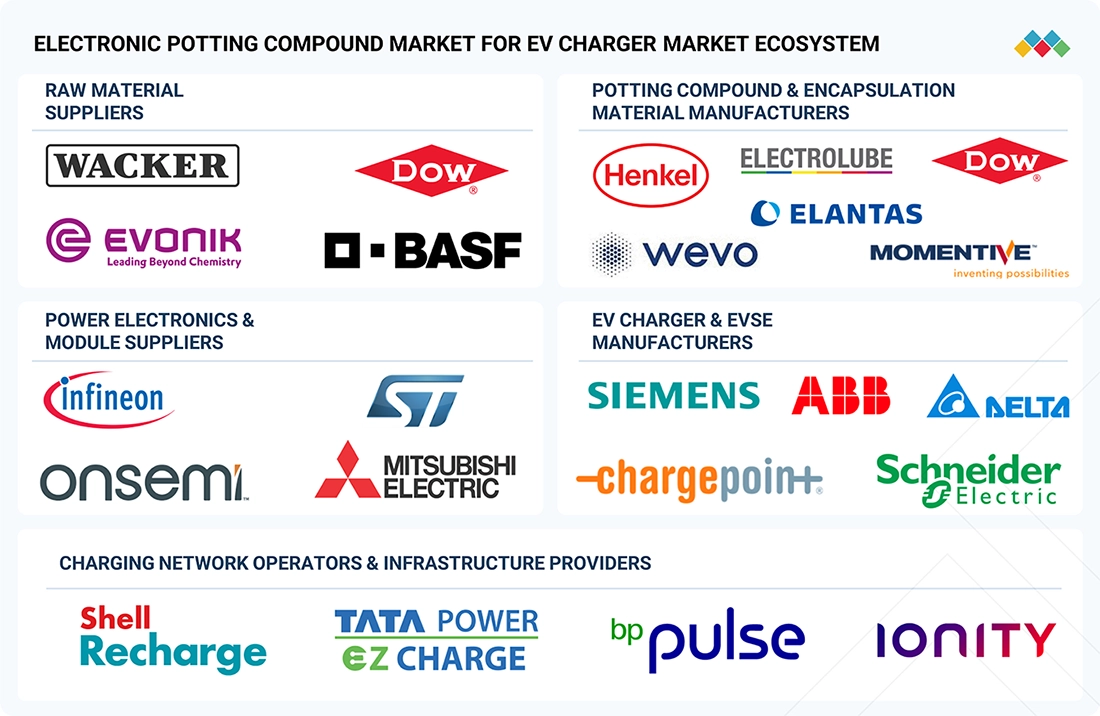
ELECTRONIC POTTING COMPOUND MARKET: COMMERCIAL USE CASES ACROSS INDUSTRIES
| COMPANY | USE CASE DESCRIPTION | BENEFITS |
|---|---|---|
 |
Supplies silicone-based potting compounds for AC and DC fast chargers to protect power modules, PCBs, and connectors from moisture, vibration, and thermal stress | Enhances electrical insulation, improves thermal stability, and extends charger service life in outdoor environments |
 |
Provides silicone encapsulants for high-voltage power electronics in fast-charging stations | Ensures long-term reliability, high dielectric strength, and resistance to extreme temperatures |
 |
Uses epoxy and polyurethane potting compounds to encapsulate onboard charger modules and wallbox EV chargers | Improves mechanical protection, reduces failure rates, and supports compact charger designs |
 |
Delivers silicone potting solutions for DC fast chargers requiring efficient heat dissipation and weather resistance | Improves thermal management, protects sensitive electronics, and enables high power-density charger designs. |
 |
Supplies polyurethane potting compounds for commercial and residential EV charging stations | Balances cost and performance, improves ingress protection, and supports scalable charger manufacturing. |
Logos and trademarks shown above are the property of their respective owners. Their use here is for informational and illustrative purposes only.
Related Ecosystem
Automotive Materials
- Light Commercial Vehicles (LCVs)
- Battery Electric Vehicle (BEV)
- Hybrid Electric Vehicle (HEV)
- Fuel Cell Electric Vehicle (FCEV)
- Agricultural Tractors
- GORKOVSKY AVTOMOBILNY ZAVOD
- AISIN CORPORATION
- Continental ag
- Basf se
- BOSCH LIMITED
Key Takeaways
- Japan's electronic potting compound market is valued at $57.0 million in 2025 with a forecast of $62.0 million by 2030.
- Japan exhibits a conservative growth trajectory with a CAGR of 1.3%, reflecting market maturity and established supplier relationships.
- Japan's automotive sector drives demand through electric vehicle electronics and advanced safety system applications.
- Japan's stringent quality and reliability standards support sustained demand for premium potting compound solutions.
Electronic Potting Compound Market Report Scope
| Report Metric | Details |
|---|---|
| Base Year | 2025 |
| Fastest Growing Segment | DC CHARGER (Charger Type) |
| Forecast Period | 2025–2030 |
| Growth Rate | CAGR of 14.9% from 2025 to 2030 |
| Largest Segment | STATIONARY (Setup Type) |
| Market Size Base Year (Billions) | ~USD 0.36 (2025) |
| Revenue Forecast (Billions) | ~USD 0.73 (2030) |
| Segments Covered | Charger Type, Setup Type, Material Type, Curing Technology, Ev Component |
Japan Electronic Potting Compound Market Report Segmentation
5 segment dimensions are covered across the global market.
By Charger Type
- Ac Charger
- Dc Charger
By Setup Type
- Stationary
- Wall Mount
By Material Type
- Epoxy
- Polyurethane
- Silicone
By Curing Technology
- Room Temperature Cured
- Thermal Cured
- Uv Cured
By Ev Component
- Electric Motor Stator
- EV Battery Cell
- EV Battery Cooling System
- In-Vehicle Charging Connector
- In-Vehicle Power Converter
- On-Board Charger
Target Audience
- Japanese Automotive OEMs : Major Japanese automakers require detailed market insights to optimize supplier selection, forecast potting compound demand for new vehicle platforms, and evaluate emerging EV-specific material requirements.
- Chemical & Materials Manufacturers : Domestic and international potting compound suppliers need Japan-specific market data to assess market entry feasibility, competitive positioning, and growth potential in this mature but stable automotive-dependent segment.
- Tier-1 & Tier-2 Automotive Suppliers : Japanese automotive component manufacturers require market forecasts to plan production capacity, material sourcing strategies, and technology investments aligned with OEM demand and EV transition timelines.
- Investment & Private Equity Firms : Investors evaluating opportunities in Japan's automotive materials sector need accurate market sizing, growth projections, and competitive analysis to assess acquisition targets and portfolio company valuations.
- Market Research & Strategy Consultants : Consulting firms advising clients on Japan market entry, product positioning, and competitive strategy require granular market data, regional insights, and forecast accuracy specific to Japan's potting compound sector.
Key Companies in the Japan Electronic Potting Compound Market
| Company | HQ | Ownership | Strongest segments |
|---|---|---|---|
| HENKEL CORPORATION | Germany | Public Company | Adhesives, Sealants & Functional Coatings,Laundry & Home Care,Hair Care, Styling & Colorants, |
| PARKER HANNIFIN CORP | United States | Public Company | Diversified Industrial – Motion & Control Systems,Diversified Industrial – Filtration, Sealing, Thermal & Adhesives,Aerospace Systems – Airframe & Engine Subsystems, |
| DOW | United States | Public Company | Packaging & Specialty Plastics,Industrial Intermediates & Infrastructure,Performance Materials & Coatings, |
| MOMENTIVE | United States | Private Company | SurveyMonkey core survey platform,GetFeedback CX suite (Essentials, Pro, Ultimate, Direct, Digital),Audience and purpose-built insights solutions, |
| RAMPF | Germany | Private Company | Reactive resin systems and polymers (PU, epoxy, silicone),Mixing, metering, and dispensing systems,Tooling materials and boards, |
HENKEL CORPORATION
Henkel Corporation is a German public company founded in 1876 that employs 42,200 people globally. The company operates as a diversified manufacturer across multiple industrial sectors.
PARKER HANNIFIN CORP
Parker Hannifin Corp is a United States-based public company established in 1917 with 57,950 employees. The company is a major industrial manufacturer serving diverse markets worldwide.
DOW
Dow is a United States-based public company founded in 1897 with 34,600 employees. The company is a major player in the chemical and materials science industry.
MOMENTIVE
Momentive is a United States-based private company founded in 1999 with 1,400 employees. The company operates as a specialty materials manufacturer.
RAMPF
RAMPF is a German private company founded in 1980. The company operates as a private manufacturer.
Reasons to Buy this Report
- Japan-Specific Market Sizing : Obtain precise valuation data for Japan's electronic potting compound market with accurate 2025 baseline ($57M) and 2030 forecast ($62M), enabling accurate budgeting and resource allocation for Japan-focused operations.
- Competitive Landscape Intelligence : Understand Japan's established manufacturer ecosystem, competitive dynamics, and market consolidation trends specific to the domestic market, identifying partnership and acquisition opportunities.
- EV Transition Strategy Development : Leverage insights on Japan's electric vehicle adoption and emerging potting compound requirements for battery systems, enabling product development strategies aligned with Japan's automotive electrification roadmap.
- Regulatory & Standards Compliance : Access Japan-specific regulatory requirements, automotive standards (JIS, JASO), and quality certifications essential for market entry and product commercialization in the Japanese automotive supply chain.
- Growth Opportunity Identification : Identify niche segments and emerging applications within Japan's mature market where specialized potting compounds can capture incremental growth, particularly in thermal management and EV component protection.
Frequently asked questions
What is the current size of Japan's electronic potting compound market?
Japan's electronic potting compound market is estimated at $57.0 million in 2025.
What is the projected market size for Japan by 2030?
Japan's electronic potting compound market is forecast to reach $62.0 million by 2030.
What is the CAGR for Japan's electronic potting compound market?
Japan's market is expected to grow at a compound annual growth rate of 1.3% from 2025 to 2030.
Which industries drive demand for electronic potting compounds in Japan?
Japan's automotive and transportation sector is the primary driver, particularly in electric vehicle electronics and advanced driver-assistance systems.
Why is Japan's growth rate lower than the global average?
Japan's mature automotive market, established supplier networks, and preference for proven materials result in slower growth compared to emerging markets.
RESEARCH METHODOLOGY
The research study draws extensively on secondary sources, including company annual reports, product brochures, industry association publications, EV charging standards documentation, technical white papers, trade journals, and paid databases to compile critical information on the electronic potting compound market. In-depth primary interviews were conducted with material suppliers, EV charger OEMs, power electronics engineers, distributors, and industry experts to validate key insights, refine market estimates, and assess growth potential. This integrated research approach ensures a robust understanding of market dynamics, technological advancements, regulatory influences, and future opportunities within the electronic potting compound landscape for EV chargers.
Secondary Research
Secondary sources included corporate filings, such as annual reports, investor presentations, and financial statements; trade, business, and professional associations; whitepapers and trade-related journals; certified publications; articles by recognized authors; directories; and databases. Secondary data were collected and analyzed to determine the overall market size, which was further validated through primary research.
Primary Research
Extensive primary research was conducted following a comprehensive assessment of the electronic potting compound market. Multiple interviews were carried out with stakeholders across both demand and supply sides. Demand-side participants included EV charger OEMs, power electronics engineers, charging infrastructure developers, and system integrators. Supply-side respondents comprised potting compound manufacturers, raw material suppliers, distributors, dispensing equipment providers, and certification/testing agencies.
The study covered respondents across North America, Europe, the Asia Pacific, the Rest of the World, and key manufacturing hubs such as China, Germany, Japan, South Korea, and the US. Approximately one-third of the interviews represented charger manufacturers and system designers, while the remaining participants were material suppliers and technical experts. Primary insights were gathered through structured questionnaires, virtual interviews, and email interactions focusing on material performance requirements, thermal management needs, regulatory compliance, formulation trends, and future investment priorities shaping the market.
The following is a breakdown of the primary respondents
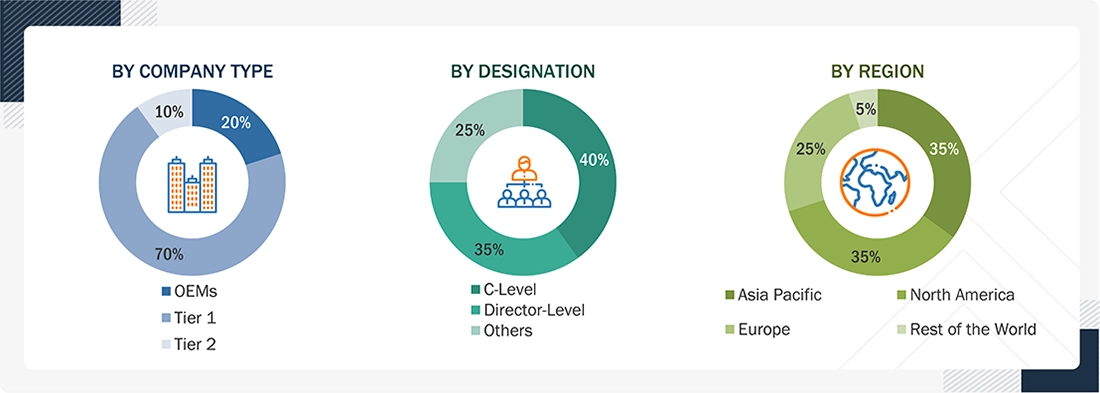
Notes:
Others include sales, managers, and product managers.
Company tiers are based on the value chain; the company's revenue is not considered.
To know about the assumptions considered for the study, download the pdf brochure
Market Size Estimation
Bottom-up and top-down approaches were used to estimate and validate the total size of the electronic potting compound market. This method was also used extensively to estimate the size of various subsegments in the market.
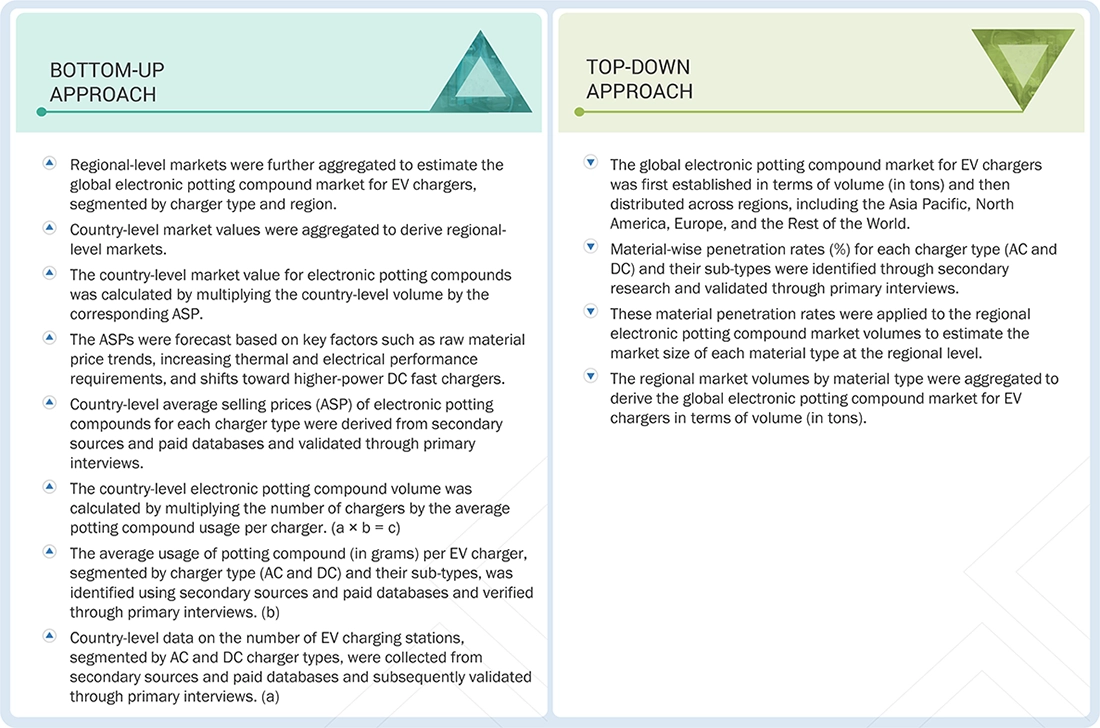
Data Triangulation
After arriving at the overall market size using the market size estimation processes as explained above, the market was split into several segments and subsegments. To complete the overall market engineering process and arrive at the exact statistics of each market segment and subsegment, data triangulation and market breakdown procedures were employed, wherever applicable. The data was triangulated by studying various factors and trends from both the demand and supply sides.
Market Definition
The electronic potting compound for EV charger encompasses advanced insulating and encapsulating materials used to protect power electronics and control components within AC and DC charging systems. These compounds, typically silicone, epoxy, or polyurethane-based, provide electrical insulation, thermal management, mechanical stability, and environmental protection.
Key Stakeholders
- Charging network operators (CPOs)
- Contract manufacturers and EMS providers for charger assemblies
- Dispensing and automation equipment providers
- Distributors and specialty chemical suppliers
- Electric utilities and grid operators
- Electronic potting compound manufacturers
- EV charger OEMs
- EV charging infrastructure developers and integrators
- Government agencies and regulatory authorities
- Power electronics module manufacturers
- Raw material suppliers
- Testing, certification, and standards bodies
- Thermal management solution providers
Report Objectives
- To segment and forecast the electronic potting compound market for EV charger in terms of value (USD million), and volume (tons) based on the following:
- By Charger Type (AC Charger, DC Charger)
- By Region ( Asia Pacific, Europe, North America, Rest of the World)
- To segment and forecast the market in terms of volume (tons), based on the following:
- By EV Component (Electric Motor Stator, EV Battery Cell, EV Battery Cooling System, On-board Charger, In-vehicle Charging Connector, In-vehicle Power Converter, Others)
- By Curing Technology (Room Temperature Cured, Thermal Cured, UV Cured)
- By Material Type (Polyurethane, Epoxy, Silicone)
- By Setup Type (Wall Mount, Stationary)
- To analyze the electronic potting compound market for EV components (electric motor stator, EV battery cells, EV battery cooling system, on-board charger, in-vehicle charging connector, in-vehicle power converter, others) qualitatively
- To analyze technological developments impacting the market
- To provide detailed information about the major factors (drivers, challenges, restraints, and opportunities) influencing market growth
- To strategically analyze the market, considering individual growth trends, prospects, and contributions to the total market
- To study the following concerning the market
- Supply Chain Analysis
- Ecosystem Analysis
- Technology Analysis
- Trade Analysis
- Case Study Analysis
- Patent Analysis
- Regulatory Landscape
- Average Selling Price Analysis
- Impact of AI/GenAI
- Trend and Disruption Impact
- Key Stakeholders and Buying Criteria
- Key Conferences and Events
- Sustainability Initiatives
- To strategically profile key players and comprehensively analyze their market ranking and core competencies
- To track and analyze competitive developments, such as product launches, expansions, and deals, carried out by key industry participants
Available customizations:
With the given market data, MarketsandMarkets offers customizations in accordance with the company’s specific needs.
Get the Full Electronic Potting Compound Market Report
Full forecast, segment splits, and company analysis for all Electronic Potting Compound Market.
- China Electronic Potting Compound Market
- India Electronic Potting Compound Market
- South Korea Electronic Potting Compound Market
- Thailand Electronic Potting Compound Market
- Indonesia Electronic Potting Compound Market
- Singapore Electronic Potting Compound Market
- Austria Electronic Potting Compound Market
- Denmark Electronic Potting Compound Market
- France Electronic Potting Compound Market
- Germany Electronic Potting Compound Market
- Netherlands Electronic Potting Compound Market
- Norway Electronic Potting Compound Market
- Spain Electronic Potting Compound Market
- Sweden Electronic Potting Compound Market
- Switzerland Electronic Potting Compound Market
- UK Electronic Potting Compound Market
- Canada Electronic Potting Compound Market
- Mexico Electronic Potting Compound Market
- US Electronic Potting Compound Market
- Brazil Electronic Potting Compound Market
- UAE Electronic Potting Compound Market
Need a Tailored Report?
Customize this report to your needs
Get 10% FREE Customization
Customize This Report
