
Rest Of Asia Pacific Elemental Analysis Market (2025-2030)

The Rest Of Asia Pacific Elemental Analysis Market was valued at $77.4 Million in 2025 and projected to reach to $96.7 Million by 2030, representing a compound annual growth rate of 4.5%. The Rest Of Asia Pacific elemental analysis market demonstrates steady growth potential, driven by increasing healthcare expenditure and modernization of diagnostic infrastructure across emerging economies.


| Market Size in | USD 26.32 MN |
| Market Forecast in | |
| CAGR | |
| Forecast Period | |
| Units Considered | Value (USD MN) |
Rest Of Asia Pacific Elemental Analysis Market Trends and Insights
- Rest Of Asia Pacific represents a significant emerging segment within the broader Asia Pacific healthcare analytics landscape, driven by increasing adoption of advanced diagnostic technologies and regulatory compliance requirements across pharmaceutical, environmental, and clinical laboratories.
- The region's growth trajectory reflects rising healthcare investments and the expansion of quality control infrastructure in developing economies. Rest Of Asia Pacific's elemental analysis market is characterized by steady demand from pharmaceutical manufacturers, food safety authorities, and environmental monitoring agencies seeking precise elemental composition data.
- Between 2025 and 2030, Rest Of Asia Pacific is expected to experience moderate but consistent market expansion as healthcare modernization initiatives and stricter product safety standards drive laboratory equipment investments.
- The region's growth rate of 4.5% CAGR positions Rest Of Asia Pacific as a stable, developing market with untapped potential in emerging economies..
Key Market Statistics
- CAGR (2025-2030) 4.5% CAGR
- Market Size, 2025 ~USD 77.4 Million
- Forecast, 2030 ~USD 96.7 Million
- Country Rest Of Asia Pacific
Rest Of Asia Pacific Elemental Analysis Market Overview
Market Valuation :
Rest Of Asia Pacific elemental analysis market is valued at USD 77.4 million in 2025, with steady growth trajectory driven by healthcare modernization across emerging economies in the region.
Growth Projection :
The market is forecasted to reach USD 96.7 million by 2030, representing a CAGR of 4.5%, indicating consistent expansion despite being slower than the global average of 7.4%.
Diagnostic Technology Adoption :
Increasing adoption of advanced elemental analysis diagnostic technologies in Rest Of Asia Pacific healthcare facilities is driving market growth, supported by rising healthcare investments and infrastructure development.
Emerging Market Potential :
Rest Of Asia Pacific represents a significant emerging segment within the broader Asia Pacific region, with untapped opportunities in developing healthcare systems and growing demand for precision diagnostics.
Rest Of Asia Pacific Elemental Analysis Market Dynamics
- Rising awareness of advanced analytical techniques in clinical laboratories and pharmaceutical research is propelling market expansion.
- Government initiatives to strengthen healthcare systems and growing private sector investments are creating favorable conditions for market penetration. However, growth remains moderate compared to global benchmarks, reflecting infrastructure challenges and cost constraints in certain markets.
- The region's diverse economic landscape presents both opportunities and barriers to adoption.
- Strategic partnerships, localized solutions, and capacity building initiatives will be critical for stakeholders to capitalize on the emerging demand for elemental analysis technologies in Rest Of Asia Pacific healthcare settings..
Market Ecosystem
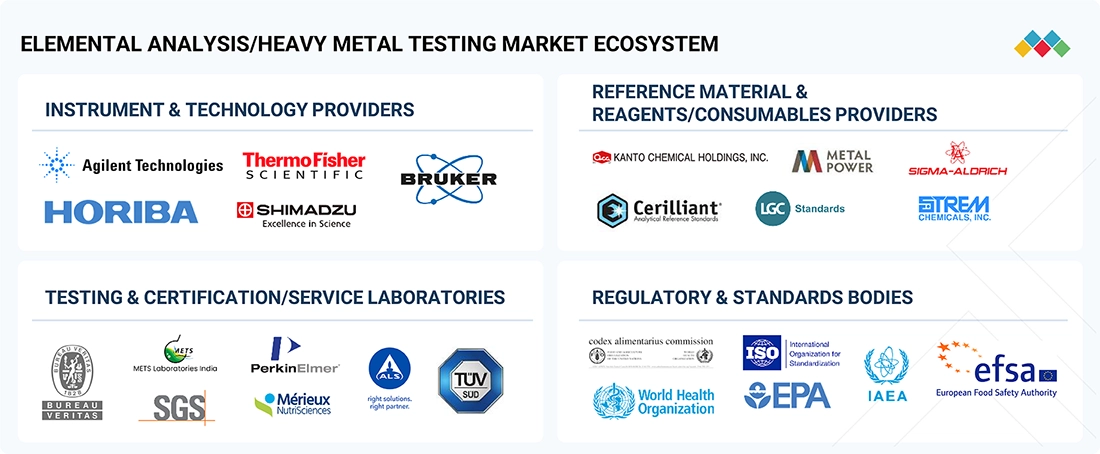
ELEMENTAL ANALYSIS MARKET: COMMERCIAL USE CASES ACROSS INDUSTRIES
| COMPANY | USE CASE DESCRIPTION | BENEFITS |
|---|---|---|
 |
Nationwide laboratory network providing ICP-MS/ICP-OES analysis of drinking water, soil, and industrial effluents for metals such as lead, arsenic, cadmium, and mercury | Regulatory compliance with U.S. EPA/ISO standards | Consistent data quality across multiple states/countries | Rapid turnaround for municipal and industrial clients |
 |
Turnkey heavy metal testing for food, beverages, and consumer products—covering RoHS, REACH, and FDA limits | Ensures export compliance for global supply chains | Reduces product-recall risk | Supports brand reputation and consumer safety |
 |
Industrial onsite sampling & remote monitoring programs for mining, metallurgy, and wastewater plants using automated elemental analyzers | Continuous discharge monitoring to prevent fines | Real-time alerts for process optimization | Lower operational costs through predictive maintenance |
 |
Deployment of portable XRF and ICP instruments for field-based heavy metal screening in soils and construction sites | Faster site remediation decisions | Reduced need for repeated lab shipments | Higher data density for environmental assessments |
Logos and trademarks shown above are the property of their respective owners. Their use here is for informational and illustrative purposes only.
Related Ecosystem
Analytical And Scientific Instrumentation
- Environmental Testing
- Gas Chromatography
- Polymerase Chain Reaction (PCR)
- Automated Liquid Handling Systems
- Flow Cytometry
- Thermo Fisher Scientific Inc.
- Danaher Corporation
- Agilent Technologies, Inc.
- Merck KGaA
- Shimadzu Corporation
Key Takeaways
- Rest Of Asia Pacific's elemental analysis market is valued at USD 77.4 million in 2025 with a projected value of USD 96.7 million by 2030.
- Rest Of Asia Pacific is experiencing a 4.5% CAGR, reflecting steady growth driven by pharmaceutical quality control and regulatory compliance demands.
- Rest Of Asia Pacific's market expansion is supported by increasing healthcare infrastructure investments and modernization of laboratory facilities.
- Rest Of Asia Pacific represents an emerging opportunity with moderate growth potential compared to more mature Asia Pacific markets.
Elemental Analysis Market Report Scope
| Report Metric | Details |
|---|---|
| Base Year | 2025 |
| Fastest Growing Segment | INDUCTIVELY COUPLED PLASMA OPTICAL EMISSION SPECTROSCOPY (ICP-OES) (Technology) |
| Forecast Period | 2025–2030 |
| Growth Rate | CAGR of 7.4% from 2025 to 2030 |
| Largest Segment | HEAVY METAL ANALYZERS (Type) |
| Market Size Base Year (Billions) | ~USD 4.54 (2025) |
| Revenue Forecast (Billions) | ~USD 6.49 (2030) |
| Segments Covered | Technology, Type, End User |
Rest Of Asia Pacific Elemental Analysis Market Report Segmentation
3 segment dimensions are covered across the global market.
By Technology
- Atomic Absorption Spectroscopy (Aas)
- Inductively Coupled Plasma Mass Spectrometry (Icp-Ms)
- Inductively Coupled Plasma Optical Emission Spectroscopy (Icp-Oes)
- Other Techniques
- Other Technologies
- X-Ray Fluorescence Spectroscopy (Xrf)
By Type
- Heavy Metal Analyzers
- Organic Elemental Analyzers
By End User
- Chemical & Petrochemical Industries
- Environmental Testing Labs
- Food & Beverage Industries
- Food & Beverage Industry
- Forensic Testing Labs
- Hospitals & Clinical Labs
- Other End Users
- Pharmaceutical & Biopharmaceutical Companies
- Research & Academia
Target Audience
- Healthcare Diagnostics Manufacturers : Need Rest Of Asia Pacific-specific market data to identify growth opportunities, assess market entry feasibility, and develop region-appropriate product strategies for elemental analysis equipment.
- Clinical Laboratory Operators : Require regional market insights to understand technology adoption trends, competitive dynamics, and investment opportunities in elemental analysis capabilities within Rest Of Asia Pacific healthcare facilities.
- Healthcare Investment Firms : Seek detailed Rest Of Asia Pacific market analysis to evaluate investment potential, identify high-growth segments, and assess risk-return profiles for healthcare diagnostics ventures in emerging markets.
- Pharmaceutical & Research Organizations : Need region-specific market intelligence to understand elemental analysis adoption in Rest Of Asia Pacific research facilities and plan R&D infrastructure investments accordingly.
- Healthcare Policy & Government Bodies : Require Rest Of Asia Pacific market data to inform healthcare modernization initiatives, diagnostic infrastructure development, and regulatory frameworks for advanced analytical technologies.
Key Companies in the Rest Of Asia Pacific Elemental Analysis Market
| Company | HQ | Ownership | Strongest segments |
|---|---|---|---|
| METTLER-TOLEDO | Switzerland | Public Company | Heavy Metal (Lead, Arsenic, Mercury, Cadmium) Analysis,Elemental (C, H, N, O, S) Analysis,Organic Elemental Analysis, |
| AGILENT TECHNOLOGIES, INC. | United States | Public Company | ICP-MS,ICP-OES,AAS, |
| THERMO FISHER SCIENTIFIC INC. | United States | Public Company | ICP-MS,ICP-OES,AAS, |
| BRUKER | United States | Public Company | XRF (benchtop and handheld),ICP-OES / ICP-MS,AAS, |
| PERKINELMER | United States | Public Company | ICP-OES,ICP-MS,AAS, |
| SHIMADZU CORPORATION | Japan | Public Company | Heavy Metal (Lead, Arsenic, Mercury, Cadmium),Elemental (C, H, N, O, S),Organic Elemental Analysis, |
| HORIBA | Japan | Public Company | Heavy Metal Analysis (Pb, As, Hg, Cd),Elemental (C, H, N, O, S),Organic Elemental Analysis, |
| RIGAKU HOLDINGS CORPORATION | Japan | Public Company | XRF-based elemental analysis systems,Other X-ray analytical systems (XRD, imaging) used for elemental workflows,Services (warranty, repairs, maintenance, relocation) tied to elemental analysis, |
| LECO CORPORATION | United States | Public Company | Heavy Metal (Lead, Arsenic, Mercury, Cadmium) – compliance-driven welding and brazing applications,Elemental (C, H, N, O, S) – weld metallurgy and materials integrity,Organic – coatings, fluxes, and process-related organics, |
METTLER-TOLEDO
METTLER-TOLEDO is a Swiss public company founded in 1991 that employs 16,600 people. The company operates in the precision instruments and analytical equipment sector.
AGILENT TECHNOLOGIES, INC.
Agilent Technologies, Inc. is a United States-based public company founded in 1999 with 18,000 employees. The company provides analytical and diagnostic instruments and solutions.
THERMO FISHER SCIENTIFIC INC.
Thermo Fisher Scientific Inc. is a United States public company founded in 1956 with 125,000 employees. The company is a global leader in serving science with laboratory equipment, reagents, and analytical instruments.
BRUKER
Bruker is a United States public company founded in 1960 with 11,085 employees. The company manufactures scientific instruments for molecular and materials research.
PERKINELMER
PerkinElmer is a United States public company founded in 1937 with 11,000 employees. The company provides analytical instruments, software, and services for research and diagnostics.
SHIMADZU CORPORATION
Shimadzu Corporation is a Japanese public company founded in 1875 with 14,649 employees. The company manufactures analytical and measuring instruments, medical devices, and industrial equipment.
HORIBA
HORIBA is a Japanese public company founded in 1945 with 9,101 employees. The company manufactures automotive testing equipment, environmental monitoring systems, and analytical instruments.
RIGAKU HOLDINGS CORPORATION
Rigaku Holdings Corporation is a Japanese public company founded in 1951 with 1,971 employees. The company manufactures X-ray diffraction and analytical instruments.
LECO CORPORATION
LECO Corporation is a United States-based company founded in 1895 with 12,000 employees. The company manufactures laboratory instruments for elemental analysis and materials testing.
Reasons to Buy this Report
- Regional Market Insights : Gain comprehensive understanding of Rest Of Asia Pacific's unique market dynamics, growth drivers, and regional variations that differ from broader Asia Pacific trends and global patterns.
- Accurate Forecasting Data : Access precise market valuations (USD 77.4M in 2025, USD 96.7M in 2030) and CAGR projections (4.5%) specific to Rest Of Asia Pacific for strategic planning and investment decisions.
- Competitive Positioning : Identify market opportunities and competitive landscape within Rest Of Asia Pacific's emerging healthcare segment to develop targeted strategies and optimize market entry approaches.
- Investment Decision Support : Make informed investment and expansion decisions with region-specific data on healthcare modernization trends, diagnostic technology adoption rates, and emerging market potential in Rest Of Asia Pacific.
- Stakeholder Strategy Development : Develop tailored go-to-market strategies, partnership models, and product positioning specifically designed for Rest Of Asia Pacific's healthcare infrastructure and market maturity levels.
Frequently asked questions
What is the current market size of elemental analysis in Rest Of Asia Pacific?
Rest Of Asia Pacific's elemental analysis market is valued at USD 77.4 million in 2025.
What is the projected market size for Rest Of Asia Pacific by 2030?
Rest Of Asia Pacific's elemental analysis market is projected to reach USD 96.7 million by 2030.
What is the CAGR for Rest Of Asia Pacific's elemental analysis market?
Rest Of Asia Pacific's elemental analysis market is growing at a CAGR of 4.5% from 2025 to 2030.
What are the primary drivers of growth in Rest Of Asia Pacific?
Rest Of Asia Pacific's growth is driven by pharmaceutical quality control requirements, regulatory compliance mandates, healthcare infrastructure modernization, and increased laboratory equipment investments.
How does Rest Of Asia Pacific compare to the global elemental analysis market?
Rest Of Asia Pacific's 4.5% CAGR is lower than the global CAGR of 7.4%, indicating a more moderate growth trajectory in this emerging regional segment.
RESEARCH METHODOLOGY
The size of the global elemental analysis market was estimated using four primary research studies to ensure accuracy and reliability. Initial market data and related industry information were collected from 3 to 5 secondary sources. This information was then validated through primary research to confirm key assumptions and overall market sizing. Both top-down and bottom-up approaches were employed to determine the total market size, which was subsequently refined into segment and subsegment estimates. Finally, data triangulation was conducted to verify the accuracy and consistency of the findings.
Secondary Research
Secondary research sources included directories, Factiva, white papers, Bloomberg Business, annual reports, SEC filings, company filings, and investor presentations. These sources provided critical insights into market leaders, end-user segments, regional dynamics, and technological differences across various elemental analysis market segments.
Primary Research
Primary research consisted of both quantitative and qualitative insights obtained through interviews with key stakeholders. On the demand side, participants included regulatory authorities, environmental and industrial monitoring officers, laboratory managers, researchers, hospitals, and research institutions. On the supply side, interviews were conducted with CEOs, product managers, sales heads, and other top executives from relevant companies. These direct interactions helped validate secondary research findings, refine assumptions, and provide deeper insights into market trends, technology adoption, and end-user requirements.
A detailed breakdown of the primary respondents is provided below.
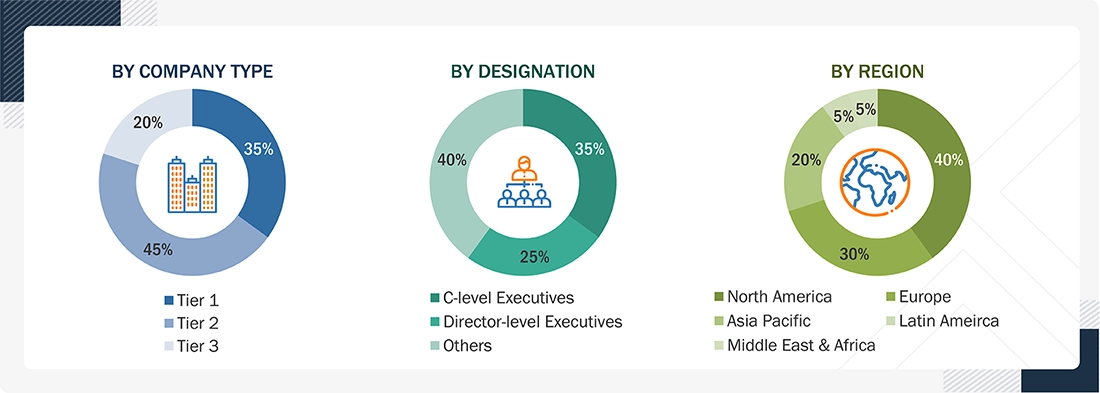
Note q: Others include sales managers, marketing managers, business development managers, product managers, distributors, and suppliers.
Note 2: Companies are classified into tiers based on their total revenue. As of 2024, Tier 1 = >USD 1 billion, Tier 2 = < USD 500 million, and Tier 3 = < USD 100 million.
To know about the assumptions considered for the study, download the pdf brochure
Market Size Estimation
This report utilized revenue share analysis of major companies to evaluate the size of the global elemental analysis market. The analysis involved identifying key market participants and estimating their revenue from elemental analysis market instruments using data collected during both primary and secondary research phases. Secondary research included reviewing annual and financial reports of leading market players, investor presentations, press releases, and business filings. Primary research consisted of detailed interviews with influential stakeholders, including directors, CEOs, product managers, and key marketing executives.
- To determine the overall market value, segmental revenue was calculated by mapping the revenue of leading instrument providers. The process involved the following steps:
- Compiling a list of leading global companies in the elemental analysis market instruments industry.
- Charting annual revenues generated by these companies from elemental analysis market (or the closest relevant business unit/product category).
- Mapping 2024 revenues of leading companies to cover a significant portion of the global market.
- Calculating the total global value of the elemental analysis market instruments market.
Global Elemental analysis Market: Bottom-Up and Top-Down Approach
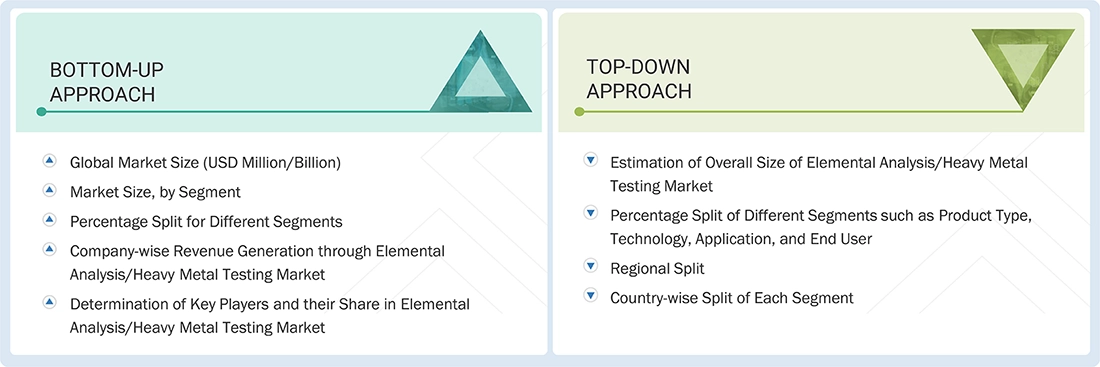
Both bottom-up and top-down approaches were employed to ensure accurate market sizing. In the bottom-up approach, revenues of individual companies and product segments were aggregated to estimate the overall market size. In the top-down approach, global industry revenue estimates were broken down into segments and subsegments based on technology, analyzer type, and end-user adoption. Finally, data triangulation was performed to reconcile both approaches and validate the final market estimates.
Global Elemental analysis Market: Bottom-up and Top-down Approach
Data Triangulation
The elemental analysis market refers to the global industry involved in the detection, quantification, and monitoring of heavy metals in various matrices, including water, soil, air, food, pharmaceuticals, chemicals, and industrial products. Heavy metals such as lead (Pb), mercury (Hg), cadmium (Cd), arsenic (As), chromium (Cr), and nickel (Ni) are monitored due to their toxicological impact on human health, the environment, and industrial processes.
The market encompasses analytical instruments and analyzers used for elemental analysis market, including technologies such as Inductively Coupled Plasma Optical Emission Spectroscopy (ICP-OES), Inductively Coupled Plasma Mass Spectrometry (ICP-MS), Atomic Absorption Spectroscopy (AAS), X-ray Fluorescence (XRF) analyzers, and portable/handheld devices, as well as supporting sample preparation and data analysis systems. The market excludes service-based testing and focuses solely on the sale and adoption of instruments and analytical technologies.
Elemental analysis market is critical across industries for regulatory compliance, environmental protection, public health, quality assurance, and research purposes. The market is driven by increasing industrialization, stricter regulations, rising awareness of contamination risks, and the adoption of advanced analytical technologies that provide accurate, reproducible, and rapid detection of heavy metals in diverse sample matrices.
Market Definition
To ensure accurate data, elemental analysis was divided into various segments and subsegments. A data triangulation process that used both top-down and bottom-up approaches was applied. This involved analyzing factors and trends from both, the demand and supply sides to validate the findings for each segment. The combination of this segmentation with the triangulation process helps ensure that the market data is both accurate and reliable.
Stakeholders
- Instrument manufacturers
- Reagent and consumables suppliers
- Pharmaceutical and biopharmaceutical laboratories
- Chemical and petrochemical industries
- Environmental monitoring agencies
- Food and beverage laboratories
- Forensic testing laboratories
- Hospitals and clinics
- Academic and research institutions
- Distributors and channel partners
- Regulatory and standards organizations
Report Objectives
- To define, describe, and forecast the global elemental analysis market based on technology, product type, application, end user, and region
- To provide detailed information regarding the major factors influencing the growth of the market (drivers, restraints, opportunities, and industry-specific challenges)
- To strategically analyze micromarkets with respect to individual growth trends, prospects, and contributions to the total market
- To analyze opportunities in the market for stakeholders and provide details of the competitive landscape for market leaders
- To forecast the revenue of the market segments with respect to five regions: North America, Europe, the Asia Pacific, Latin America, and the Middle East & Africa
- To profile the key players and comprehensively analyze their market ranking and core competencies
- To benchmark players within the market using a proprietary Company Evaluation Matrix framework, which analyzes market players on various parameters within the broad categories of business strategy excellence and strength of product portfolio
- To analyze competitive developments such as product launches, agreements, expansions, collaborations, and acquisitions in the global elemental analysis market
Get the Full Elemental Analysis Market Report
Full forecast, segment splits, and company analysis for all Elemental Analysis Market.
- Canada Elemental Analysis Market
- US Elemental Analysis Market
- Germany Elemental Analysis Market
- UK Elemental Analysis Market
- Italy Elemental Analysis Market
- France Elemental Analysis Market
- Spain Elemental Analysis Market
- Japan Elemental Analysis Market
- China Elemental Analysis Market
- Australia Elemental Analysis Market
- India Elemental Analysis Market
- South Korea Elemental Analysis Market
- Brazil Elemental Analysis Market
- Mexico Elemental Analysis Market
- Rest Of Europe Elemental Analysis Market
- Rest Of Latin America Elemental Analysis Market
Need a Tailored Report?
Customize this report to your needs
Get 10% FREE Customization
Customize This Report
