
GCC Countries Elevators and Escalators Market (2026-2031)

The GCC Countries Elevators and Escalators Market was valued at $2843.6 Million in 2026 and projected to reach to $3386.2 Million by 2031, representing a compound annual growth rate of 3.55%. The GCC Countries elevators and escalators market is positioned for steady expansion, supported by robust construction activity, government-backed infrastructure initiatives, and increasing urbanization across the region.


| Market Size in | USD 26.32 MN |
| Market Forecast in | |
| CAGR | |
| Forecast Period | |
| Units Considered | Value (USD MN) |
GCC Countries Elevators and Escalators Market Trends and Insights
- This represents a compound annual growth rate (CAGR) of 3.55%, reflecting moderate but consistent demand across the region's emerging urban centers and infrastructure development initiatives.
- Rest Of South America's market growth is driven by increasing urbanization, rising commercial real estate investments, and modernization of existing vertical transportation systems in secondary cities. The forecast period from 2026 to 2031 demonstrates Rest Of South America's growing importance within the broader South American market landscape.
- Rest Of South America is experiencing heightened activity in shopping mall construction, office building development, and residential high-rise projects that necessitate modern elevator and escalator installations.
- Market participants in Rest Of South America are capitalizing on infrastructure upgrades and the replacement of aging systems, positioning the region as a key growth opportunity for manufacturers and service providers..
Key Market Statistics
- CAGR (2026-2031) 3.55% CAGR
- Market Size, 2026 ~USD 2843.6 Million
- Forecast, 2031 ~USD 3386.2 Million
- Country GCC Countries
GCC Countries Elevators and Escalators Market Overview
Steady Regional Growth :
GCC Countries' elevators and escalators market is projected to grow from $2,843.6 million in 2026 to $3,386.2 million by 2031, demonstrating consistent expansion driven by ongoing urbanization and infrastructure modernization across the region.
Above-Global Growth Rate :
With a CAGR of 3.55%, the GCC market outpaces the global average of 2.9%, reflecting stronger regional demand fueled by mega-projects, commercial development, and rising construction activity in key emirates and cities.
Infrastructure Investment Momentum :
GCC countries continue investing heavily in smart cities, commercial complexes, and residential towers, creating sustained demand for advanced elevator and escalator systems with enhanced safety and energy-efficiency features.
Modernization and Retrofit Opportunities :
Aging infrastructure in established urban centers presents significant retrofit and upgrade opportunities, while new construction projects demand cutting-edge vertical transportation solutions tailored to GCC specifications and climate conditions.
GCC Countries Elevators and Escalators Market Dynamics
- Major developments in Dubai, Riyadh, and other key cities continue to drive demand for both new installations and modernization of existing systems.
- The market's 3.55% CAGR reflects moderate but consistent growth as commercial, residential, and hospitality sectors expand. Looking ahead to 2031, the GCC market will benefit from Vision 2030 initiatives, smart city projects, and rising foreign direct investment in real estate and commercial infrastructure.
- Technological advancements in IoT-enabled elevators, energy-efficient systems, and predictive maintenance solutions will further accelerate market growth.
- Regional players and international manufacturers are increasingly tailoring offerings to meet GCC-specific requirements, including extreme heat resilience and advanced safety standards..
Market Ecosystem
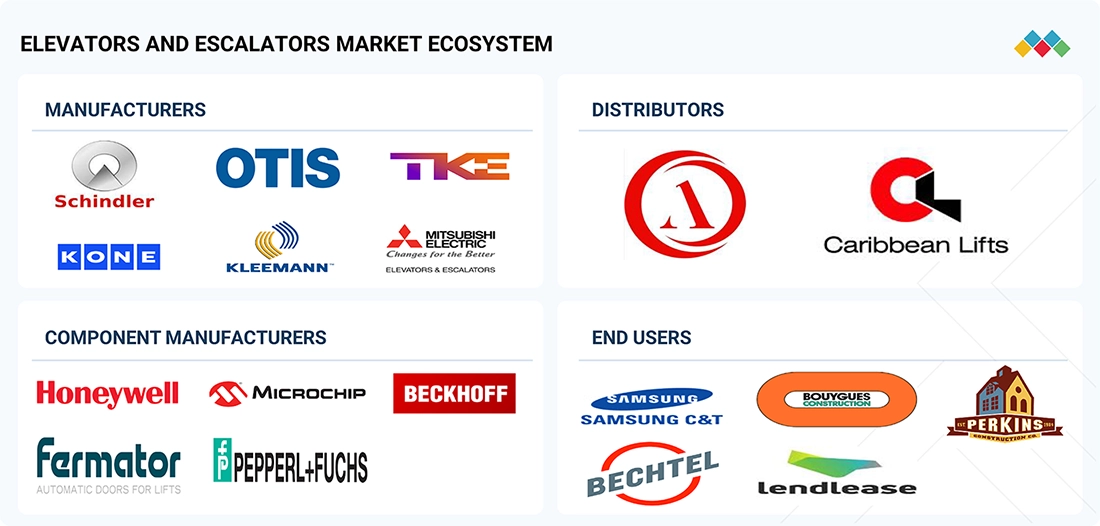
ELEVATORS & ESCALATORS MARKET: COMMERCIAL USE CASES ACROSS INDUSTRIES
| COMPANY | USE CASE DESCRIPTION | BENEFITS |
|---|---|---|
 |
Mitsubishi Electric installed 18 elevators in Ruby, Mumbai's tallest office building (40 stories), engineered to meet LEED green building standards. The system controls elevator speeds, loads, and waiting times, and ensures comfort for high-rise office users. | The destination allocation system improved morning rush-hour transport performance by about 15%, while efficient operations reduced waiting times, lowered energy consumption, and enhanced security. |
 |
Japanese Daisho Group chose exclusive custom elevator solutions in 180 Brisbane buildings: 15 KONE MiniSpace, 4 KONE MonoSpace elevators, linked to a KONE Destination Control System, LED identifiers, E-Link monitoring, and Care Maintenance for premium office functionality. | Achievement of 6 Star Greenstar Office rating, making 180 Brisbane the first building in the city with this top-tier environmental accreditation. |
Logos and trademarks shown above are the property of their respective owners. Their use here is for informational and illustrative purposes only.
Related Ecosystem
Equipment Machine And Tooling
- Wastewater Treatment
- Air Cooled Heat Exchangers
- Diaphragm Pumps
- HVAC System
- Membrane Separation
- Alfa Laval Corporate AB
- Veolia
- Daikin Industries,Ltd.
- Johnson Controls International plc
- Carrier Global Corporation
Infrastructure Material
- Alumina Ceramics
- Ceramic Coatings
- Monolithic Ceramics
- Polyphenylene Sulfide (PPS)
- Titanate Ceramics
- Saint-gobain
- Simpson Manufacturing Co., Inc.
- Basf se
- Sika ag
- DOW CHEMICAL COMPANY
Building And Construction
- HVAC System
- Acoustic Insulation
- Alkyd Resins
- Fiberglass
- Thermal Insulation
- Snc-lavalin group inc.
- Saint-gobain
- LHOIST S.A
- USG CORPORATION
- Basf se
Key Takeaways
- Rest Of South America's market is valued at $2,843.6 million in 2026 and projected to reach $3,386.2 million by 2031, growing at a 3.55% CAGR.
- Rest Of South America is experiencing accelerated urbanization and commercial real estate development, driving demand for new elevator and escalator installations.
- Rest Of South America's modernization initiatives and replacement of aging vertical transportation systems present significant growth opportunities through 2031.
- Rest Of South America's steady 3.55% growth rate positions it as a stable, mid-tier market within the broader South American region.
Elevators and Escalators Market Report Scope
| Report Metric | Details |
|---|---|
| Base Year | 2026 |
| Fastest Growing Segment | MODERNIZATION (Service) |
| Forecast Period | 2026–2031 |
| Growth Rate | CAGR of 2.9% from 2026 to 2031 |
| Largest Segment | ELEVATORS (Type) |
| Market Size Base Year (Billions) | ~USD 99.58 (2026) |
| Revenue Forecast (Billions) | ~USD 114.88 (2031) |
| Segments Covered | Type, Service, Elevator Technology, End-Use Industry |
GCC Countries Elevators and Escalators Market Report Segmentation
4 segment dimensions are covered across the global market.
By Type
- Elevators
- Escalators
- Moving Walkways
By Service
- Maintenance & Repair
- Modernization
- New Installation
By Elevator Technology
- Hydraulic Elevators
- Machine-Room-Less Traction Elevators
- Traction Elevators
By End-Use Industry
- Commercial
- Infrastructure
- Institutional
- Other End-Use Industries
- Residential
Target Audience
- Elevator & Escalator Manufacturers : Manufacturers need GCC-specific market data to assess regional demand, identify growth segments, and develop products tailored to local climate, safety standards, and architectural preferences.
- Construction & Real Estate Developers : Developers require market insights to forecast vertical transportation costs, understand technology trends, and make informed procurement decisions for residential, commercial, and mixed-use projects.
- Maintenance & Service Providers : Service companies need regional market intelligence to identify retrofit opportunities, understand installed base growth, and plan service expansion across GCC countries.
- Investment & Private Equity Firms : Investors seeking GCC exposure need detailed market analysis to evaluate acquisition targets, assess growth potential, and identify consolidation opportunities in the vertical transportation sector.
- Government & Infrastructure Planners : Public sector agencies require market data to inform infrastructure planning, procurement strategies, and policy development for smart cities and modernization initiatives across the GCC region.
Key Companies in the GCC Countries Elevators and Escalators Market
| Company | HQ | Ownership | Strongest segments |
|---|---|---|---|
| SNC-LAVALIN GROUP INC. | Canada | Public Company | Consultancy, Strategy, Advisory, Engineering & Design,Project & Program Management, Project Delivery,Nuclear Lifecycle Services, |
| OTIS WORLDWIDE CORPORATION | United States | Public Company | New Equipment,Service – Maintenance & Repair,Service – Modernization, |
| SCHINDLER | Switzerland | Public Company | Elevators (new equipment),Escalators and moving walks (new equipment),Service and modernization, |
| KONE CORPORATION | Finland | Public Company | New elevators and escalators,Maintenance and service,Modernization and upgrades, |
| HITACHI, LTD. | Japan | Public Company | Green Energy & Mobility (power grids, energy, rail systems),Digital Systems & Services (IT, cloud, integration, public IT),Connective Industries (industrial automation, e-mobility, water, industrial equipment), |
| HYUNDAI ELEVATOR CO., LTD. | South Korea | Public Company | High-speed & ultra-high-speed elevators (THE EL, i-XEL),Low & mid-speed elevators (LUXEN, YZER, N:EX, freight, automobile, marine),Escalators & moving walks, |
| FUJITEC CO., LTD. | Japan | Public Company | Elevators (new equipment),Escalators and moving walks (new equipment),Maintenance and modernization services, |
| MITSUBISHI ELECTRIC CORPORATION | Japan | Public Company | Factory Automation and Industrial Systems,Energy, Public Utility, and Defense/Space Systems,Automotive Equipment, |
| SJEC CORPORATION | China | Public Company | Residential elevators,Commercial elevators,Escalators & passenger conveyors, |
| SHENYANG YUANDA INTELLECTUAL INDUSTRY GROUP CO., LTD. | China | Public Company | Standard passenger elevators (machine room and roomless),High-speed and panoramic elevators,Freight, bed, and accessional elevators, |
SNC-LAVALIN GROUP INC.
SNC-LAVALIN GROUP INC. is a Canadian public company founded in 1911 with 40,246 employees. It operates as a large multinational enterprise with significant workforce presence.
OTIS WORLDWIDE CORPORATION
OTIS WORLDWIDE CORPORATION is a public company founded in the United States in 1853 with 72,000 employees. It is a major global enterprise with extensive operational scale and long-established market presence.
SCHINDLER
SCHINDLER is a Swiss public company founded in 1874 with 67,315 employees. The company operates as a large multinational enterprise with significant global workforce.
KONE CORPORATION
KONE CORPORATION is a Finnish public company founded in 1908 with 64,884 employees. It operates as a major global enterprise with substantial international presence.
HITACHI, LTD.
HITACHI, LTD. is a Japanese public company founded in 1910 with 287,901 employees. It is one of the world's largest multinational conglomerates with extensive global operations.
HYUNDAI ELEVATOR CO., LTD.
HYUNDAI ELEVATOR CO., LTD. is a South Korean public company founded in 1984 with 2,712 employees. The company operates as an established elevator manufacturer and service provider.
FUJITEC CO., LTD.
FUJITEC CO., LTD. is a Japanese public company founded in 1948 with 11,777 employees. The company operates as a significant elevator and building systems manufacturer.
MITSUBISHI ELECTRIC CORPORATION
MITSUBISHI ELECTRIC CORPORATION is a Japanese public company founded in 1921 with 150,386 employees. It operates as a major multinational corporation with extensive global operations and diverse business segments.
SJEC CORPORATION
SJEC CORPORATION is a Chinese public company founded in 1992. The company operates as an established enterprise with public market presence.
SHENYANG YUANDA INTELLECTUAL INDUSTRY GROUP CO., LTD.
SHENYANG YUANDA INTELLECTUAL INDUSTRY GROUP CO., LTD. is a Chinese public company founded in 2001 with 1,744 employees. The company operates as a publicly traded enterprise with established market presence.
Reasons to Buy this Report
- Regional Market Sizing & Forecasts : Obtain precise market valuations and growth projections specific to GCC Countries, enabling accurate budget allocation and investment decisions for the 2026-2031 period.
- Competitive Landscape Intelligence : Understand key players, market share distribution, and competitive strategies within the GCC region to identify partnership and expansion opportunities.
- Growth Driver Analysis : Identify specific infrastructure projects, regulatory changes, and urbanization trends driving the 3.55% CAGR in GCC Countries to capitalize on emerging opportunities.
- Segment & Application Insights : Access detailed breakdowns of residential, commercial, hospitality, and industrial elevator/escalator demand across GCC markets to refine product positioning.
- Strategic Market Entry Planning : Leverage GCC-specific data on customer preferences, technical requirements, and market dynamics to develop targeted go-to-market strategies and localization approaches.
Frequently asked questions
What is the market size of elevators and escalators in Rest Of South America?
Rest Of South America's elevators and escalators market is estimated at $2,843.6 million in 2026 and is forecast to grow to $3,386.2 million by 2031.
What is the CAGR for Rest Of South America's elevators and escalators market?
Rest Of South America's market is projected to grow at a compound annual growth rate (CAGR) of 3.55% from 2026 to 2031.
What factors are driving growth in Rest Of South America's elevators and escalators market?
Rest Of South America's market growth is driven by urbanization, commercial real estate expansion, shopping mall and office building construction, and modernization of aging vertical transportation infrastructure.
How does Rest Of South America's market compare to the broader South America region?
Rest Of South America represents a significant portion of the South American market, with its 3.55% CAGR reflecting steady growth in secondary cities and emerging urban centers across the region.
What opportunities exist for market participants in Rest Of South America?
Rest Of South America offers opportunities in new installations for commercial and residential projects, system modernization, maintenance services, and replacement of outdated equipment in developing urban areas.
RESEARCH METHODOLOGY
The study involved four major activities to estimate the current size of the global elevators and escalators market. Exhaustive secondary research was conducted to gather information on the market, the peer product market, and the parent product group market. The next step was to validate these findings, assumptions, and sizes with industry experts across the elevator and escalator value chain through primary research. The top-down and bottom-up approaches were employed to estimate the overall size of the elevators and escalators market. After that, market breakdown and data triangulation procedures were used to determine the size of different segments of the market.
Secondary Research
The market for companies offering elevators and escalators is derived from secondary data available through paid and unpaid sources, by analyzing the product portfolios of the major companies in the ecosystem, and by rating the companies based on their performance and quality. For this study, various secondary sources, such as Business Standard, Bloomberg, the World Bank, and Factiva, were referred to identify and collect information on the elevators and escalators market. In the secondary research process, various secondary sources were referred to identify and collect information related to the study. Secondary sources included annual reports, press releases, and investor presentations from elevator and escalator vendors, forums, certified publications, and whitepapers. Secondary research was used to obtain critical information on the industry’s value chain, the pool of key players, market classification, and segmentation from market- and technology-oriented perspectives.
Primary Research
In the primary research process, various primary sources from the supply and demand sides were interviewed to obtain qualitative and quantitative information for this report. The primary sources from the supply side included industry experts, such as chief executive officers (CEOs), vice presidents (VPs), marketing directors, technology and innovation directors, and related key executives from several key companies and organizations operating in the elevators and escalators market. After the complete market engineering (calculations for market statistics, market breakdown, market size estimations, market forecasting, and data triangulation), extensive primary research was conducted to gather information and verify and validate the critical numbers arrived at.
Primary research was also conducted to identify segmentation types, industry trends, the competitive landscape of elevators and escalators offered by various market players, and key market dynamics, including drivers, restraints, opportunities, challenges, trends, and key player strategies. In the complete market engineering process, top-down and bottom-up approaches, along with several data triangulation methods, were extensively used to perform market estimation and forecasting across the overall market segments and subsegments listed in this report. Extensive qualitative and quantitative analysis was performed on the complete market engineering process to list the key information/insights throughout the report.
The following is the breakdown of primary respondents:
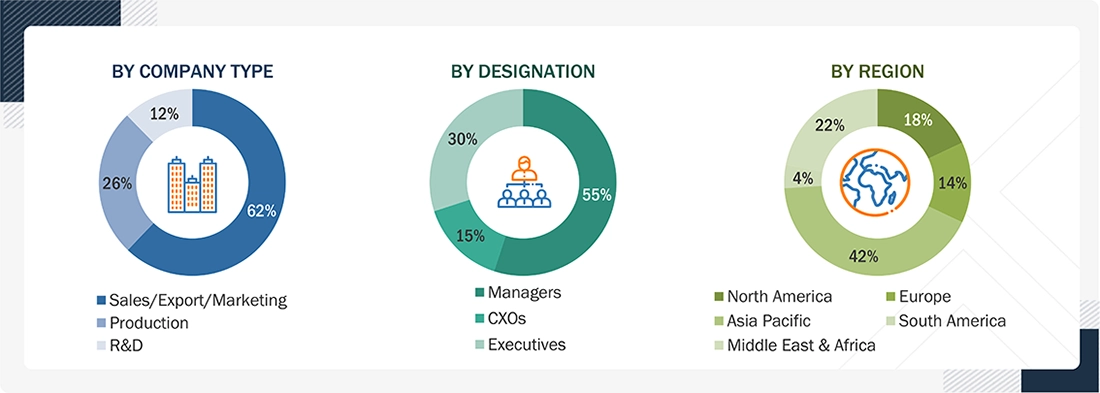
To know about the assumptions considered for the study, download the pdf brochure
Market Size Estimation
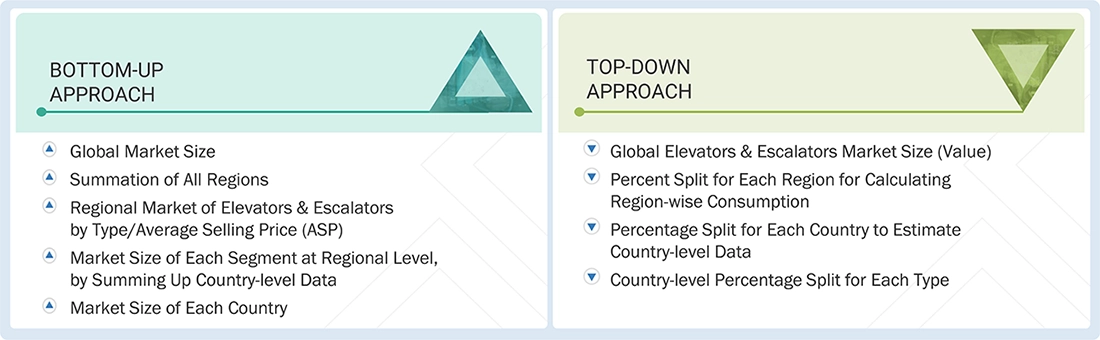
The top-down and bottom-up approaches were used to estimate and validate the size of the global elevators and escalators market. These approaches were also used extensively to estimate the size of various dependent market segments. The research methodology used to estimate the market size included the following:
Elevators & Escalators Market : Top-Down and Bottom-Up Approach
Data Triangulation
After arriving at the overall market size using the market size estimation processes, the market was split into several segments and subsegments. The data triangulation and market breakup procedures were employed, where applicable, to complete the overall market engineering process and derive the exact statistics for each market segment and subsegment. The data was triangulated by studying various factors and trends from the demand and supply sides.
Market Definition
An elevator, also known as a lift, is a technological solution for vertical transportation, facilitating the movement of individuals or goods between different levels of a building, a vessel, or other structures. Typically powered by electric motors, elevators employ either traction cables or counterweight systems, such as hoists or hydraulic pumps with cylindrical pistons (e.g., jacks). In contrast, an escalator is a vertical transportation system that uses a continuously moving staircase. Operating on the principle of a conveyor transport device, an escalator comprises a motor-driven chain of interconnected steps that ascend or descend on tracks, ensuring that the step treads remain in a horizontal position.
Key Stakeholders
- Raw Material Suppliers and Producers
- Component Manufacturers
- Elevator and Escalator OEMs
- Elevator and Escalator Manufacturers
- Traders and Distributors of Elevators and Escalators
- Installation & Engineering Contractors
- Maintenance & Service Providers
- End Users
- NGOs, Governments, Research Organizations, Investment Banks, Venture Capitalists, and Private Equity Firms
- Technology & Software Providers
Report Objectives
- To define, describe, and forecast the size of the global elevators and escalators market, by type, elevator technology, service, and end-use industry, in terms of value and volume
- To forecast the market size of segments for North America, Europe, Asia Pacific, South America, and the Middle East & Africa, along with their respective countries, in terms of value and volume
- To provide detailed information on the significant drivers, restraints, opportunities, and challenges influencing the market
- To strategically analyze micromarkets concerning individual growth trends, prospects, and their contribution to the market
- To assess the growth opportunities in the market for stakeholders and provide details on the competitive landscape for market leaders
- To strategically profile key players and comprehensively analyze their market shares and core competencies
- To analyze competitive developments, such as product launches, agreements, collaborations, partnerships, acquisitions, contracts, and expansions in the elevators and escalators market
- To provide the impact of AI/Gen AI on the market
- To provide the macroeconomic outlook for each region covered under the study, and the impact of the 2025 US tariff on the market
Available customizations:
With the given market data, MarketsandMarkets offers customizations according to client-specific needs.
The following customization options are available for the elevators and escalators report:
Product Analysis
-
A product matrix that gives a detailed comparison of the product portfolio of each company
Regional Analysis
-
A further breakdown of the elevators and escalators market for additional countries
Company Information
-
Detailed analysis and profiling of additional market players (up to five)
Get the Full Elevators and Escalators Market Report
Full forecast, segment splits, and company analysis for all Elevators and Escalators Market.
- China Elevators and Escalators Market
- Japan Elevators and Escalators Market
- India Elevators and Escalators Market
- South Korea Elevators and Escalators Market
- Canada Elevators and Escalators Market
- Mexico Elevators and Escalators Market
- US Elevators and Escalators Market
- Germany Elevators and Escalators Market
- France Elevators and Escalators Market
- UK Elevators and Escalators Market
- Italy Elevators and Escalators Market
- Spain Elevators and Escalators Market
- Saudi Arabia Elevators and Escalators Market
- UAE Elevators and Escalators Market
- Brazil Elevators and Escalators Market
- Argentina Elevators and Escalators Market
- South America Elevators and Escalators Market
- Rest Of Europe Elevators and Escalators Market
- Rest Of Asia Pacific Elevators and Escalators Market
Need a Tailored Report?
Customize this report to your needs
Get 10% FREE Customization
Customize This Report
