
US Employee Experience Management Market (2023-2028)

The US Employee Experience Management Market was valued at $2003.4 Million in 2023 and projected to reach to $3198.2 Million by 2028, representing a compound annual growth rate of 9.8%. The US Employee Experience Management Market is poised for sustained growth through 2028, reaching $3,198.2 million as enterprises recognize the direct correlation between employee experience and business outcomes.


| Market Size in | USD 26.32 MN |
| Market Forecast in | |
| CAGR | |
| Forecast Period | |
| Units Considered | Value (USD MN) |
US Employee Experience Management Market Trends and Insights
- The US market reflects strong organizational investment in digital workplace solutions, employee engagement platforms, and workforce analytics tools as companies prioritize talent retention and productivity.
- In 2023, the US accounted for a significant portion of North American spending, driven by large enterprises modernizing their HR technology infrastructure and mid-market adoption of integrated employee experience platforms. By 2028, the US Employee Experience Management Market is expected to expand substantially as organizations increasingly recognize the strategic value of holistic employee experience strategies.
- The US market growth is fueled by rising competition for talent, remote and hybrid work adoption, and the need for data-driven insights into employee satisfaction and performance.
- US companies are investing in comprehensive solutions that span recruitment, onboarding, engagement, learning, and retention to create seamless employee journeys and improve organizational outcomes..
Key Market Statistics
- CAGR (2023-2028) 9.8% CAGR
- Market Size, 2023 ~USD 2003.4 Million
- Forecast, 2028 ~USD 3198.2 Million
- Country US
US Employee Experience Management Market Overview
Market Valuation :
The US Employee Experience Management Market reached $2,003.4 million in 2023, demonstrating significant organizational investment in workplace technology and employee-centric solutions across enterprises.
Strong Growth Trajectory :
With a CAGR of 9.8% through 2028, the US market is expanding faster than many adjacent sectors, driven by competitive talent markets and the need for digital transformation in workforce management.
Digital Workplace Adoption :
US companies are increasingly deploying integrated digital workplace solutions, employee engagement platforms, and workforce analytics tools to enhance productivity and streamline remote and hybrid work environments.
Talent Retention Focus :
Organizations across the US are prioritizing employee experience investments as a strategic lever for talent retention, reducing turnover costs, and building competitive advantage in tight labor markets.
US Employee Experience Management Market Dynamics
- Accelerating digital transformation, hybrid work normalization, and increasing focus on employee wellness and engagement are key growth drivers.
- US companies are investing heavily in integrated platforms that combine HR analytics, engagement tools, and workplace collaboration features to create seamless employee journeys.
- The market will continue to benefit from rising labor costs, competitive talent acquisition challenges, and regulatory pressures around workplace culture and diversity initiatives..
Market Ecosystem
Related Ecosystem
Software And Services
- Natural Language Processing (NLP)
- Machine Learning
- Supply Chain Management
- Predictive Analytics
- Image Sensors
- International Business Machines Corporation
- MICROSOFT CORPORATION
- Oracle Corporation
- SAP SE
- Amazon.com, Inc.
Key Takeaways
- The US Employee Experience Management Market is valued at $2,003.4 million in 2023 and will reach $3,198.2 million by 2028 with a 9.8% CAGR.
- US organizations are prioritizing integrated employee experience platforms to address talent retention, remote work management, and workforce productivity challenges.
- The US market is driven by enterprise digital transformation initiatives, mid-market adoption of HR technology, and competitive talent acquisition pressures.
- By 2028, the US market will see increased investment in AI-powered analytics, personalized employee journeys, and data-driven HR decision-making capabilities.
Employee Experience Management Market Report Scope
| Report Metric | Details |
|---|---|
| Base Year | 2023 |
| Fastest Growing Segment | WORKFORCE MANAGEMENT (Application Area) |
| Forecast Period | 2023-2028 |
| Growth Rate | CAGR of 10.2% from 2023 to 2028 |
| Largest Segment | LARGE ENTERPRISES (Organization Size) |
| Market Size Base Year (Billions) | ~USD 6.83 (2023) |
| Revenue Forecast (Billions) | ~USD 11.1 (2028) |
| Segments Covered | Offering, Software, Standalone Software, Industry, Component, Solution, Service, Deployment Type, Organization Size, Vertical, Type, Application Area |
US Employee Experience Management Market Report Segmentation
12 segment dimensions are covered across the global market.
By Offering
- Services
- Software
By Software
- Integrated Software
- Standalone Software
By Standalone Software
- Employee Engagement
- Employee Performance Management
- Employee Recognition & Rewards
- Employee Survey & Feedback
- Other Software
By Industry
- Bfsi
- Government
- Healthcare
- It & Ites
- Manufacturing
- Other Industries
- Telecom
By Component
- Services
- Solutions
By Solution
- Leave And Absence Management
- Others*
- Time And Attendance Management
- Workforce Analytics
- Workforce Scheduling
By Service
- Consulting
- Implementation
- Training, Support, And Maintenance
By Deployment Type
- Cloud
- On-Premises
By Organization Size
- Large Enterprises
- Smes
By Vertical
- Bfsi
- Consumer Goods And Retail
- Education
- Energy And Utilities
- Government
- Healthcare
- Healthcare And Life Sciences
- It And Telecom
- Ites
- Manufacturing
- Others*
- Telecom
- Transportation And Logistics
By Type
- Advisory Services
- Implementation And Integration Services
- Support And Maintenance Services
By Application Area
- Employee Development
- Employee Engagement
- Payroll
- Recruitment
- Retention
- Workforce Management
US: EMPLOYEE EXPERIENCE MANAGEMENT MARKET, BY INDUSTRY, 2023–2028
| Segment | 2023 | 2024 | 2025 | 2026 | 2027 | 2028 | CAGR (%) |
|---|---|---|---|---|---|---|---|
| GOVERNMENT | 141.6 | 156.1 | 172.8 | 192 | 212.2 | 232.5 | 10.4 |
| IT & ITES | 470 | 514.5 | 566.2 | 624.8 | 686.3 | 747.1 | 9.7 |
| MANUFACTURING | 78.7 | 84.9 | 92.1 | 100.1 | 108.3 | 116.1 | 8.1 |
| OTHER INDUSTRIES | 366.6 | 403 | 445.3 | 493.5 | 544.3 | 594.9 | 10.2 |
| TELECOM | 246 | 267.4 | 292 | 319.9 | 348.7 | 376.8 | 8.9 |
| BFSI | 344.4 | 380.6 | 422.8 | 471 | 522.2 | 573.8 | 10.7 |
| HEALTHCARE | 356 | 388.5 | 426.2 | 468.9 | 513.4 | 557.1 | 9.4 |
| TOTAL | 2003.4 | 2195.1 | 2417.4 | 2670.2 | 2935.6 | 3198.2 | 9.8 |
Target Audience
- Enterprise HR Leaders : Chief Human Resources Officers and VP of Talent need US market insights to justify employee experience investments, benchmark spending against peers, and align technology roadmaps with organizational talent strategies.
- Technology Vendors & Solution Providers : HR software companies, workplace collaboration platforms, and analytics providers require detailed US market data to assess competitive positioning, identify growth opportunities, and refine product-market fit strategies.
- Private Equity & Investment Firms : PE investors and corporate development teams evaluating acquisitions in the HR tech space need comprehensive US market analysis to assess portfolio company growth potential and valuation benchmarks.
- Management Consultants : Strategy and digital transformation consultants advising US enterprises on workplace modernization require market data to support recommendations, validate business cases, and guide client investments.
- Corporate Strategy Teams : Chief Strategy Officers and business development executives need US-specific market intelligence to identify emerging vendors, evaluate build-vs-buy decisions, and anticipate competitive threats in employee experience.
Reasons to Buy this Report
- Market Size & Growth Data : Access precise US market valuation ($2,003.4M in 2023) and forecast projections ($3,198.2M by 2028) with 9.8% CAGR to inform strategic planning and investment decisions specific to the American market.
- Competitive Landscape Intelligence : Understand the US-specific vendor ecosystem, solution categories, and competitive positioning within digital workplace, engagement platforms, and workforce analytics segments driving market expansion.
- Segment & Trend Analysis : Identify high-growth segments within the US market including remote work enablement, employee wellness platforms, and analytics-driven HR solutions with detailed adoption rates and spending patterns.
- Strategic Investment Guidance : Make informed M&A, partnership, and product development decisions based on US market dynamics, emerging technologies, and organizational priorities shaping employee experience investments.
- Regional Opportunity Assessment : Evaluate US market opportunities by industry vertical, company size, and geography to prioritize go-to-market strategies and resource allocation for maximum ROI in the American market.
Frequently asked questions
What is the current size of the US Employee Experience Management Market?
The US Employee Experience Management Market was valued at $2,003.4 million in 2023 and is expected to grow to $3,198.2 million by 2028.
What is the projected growth rate for the US market through 2028?
The US Employee Experience Management Market is projected to grow at a compound annual growth rate (CAGR) of 9.8% from 2023 to 2028.
What are the primary drivers of growth in the US Employee Experience Management Market?
Key growth drivers in the US market include talent competition, remote and hybrid work adoption, digital workplace modernization, and the need for employee engagement and retention solutions.
Which US organizations are leading adoption of Employee Experience Management solutions?
Large US enterprises are leading adoption through comprehensive digital transformation initiatives, while mid-market companies are increasingly implementing integrated platforms to improve employee engagement and productivity.
How is the US market expected to evolve by 2028?
By 2028, the US market will see greater emphasis on AI-powered analytics, personalized employee experiences, real-time feedback mechanisms, and integrated solutions spanning the entire employee lifecycle.
RESEARCH METHODOLOGY
The research study involved four major activities in estimating the employee experience management market size. Exhaustive secondary research has been done to collect important information about the market and peer markets. The next step has been to validate these findings, assumptions, and sizing with the help of primary research with industry experts across the value chain. Both top-down and bottom-up approaches have been used to estimate the market size. Post which the market breakdown and data triangulation have been adopted to estimate the market sizes of segments and sub-segments.
Secondary Research
The market size of the companies offering employee experience management to various end users was arrived at based on the secondary data available through paid and unpaid sources and by analyzing the product portfolios of major companies in the ecosystem and rating the companies based on their performance and quality. In the secondary research process, various sources were referred to identify and collect information for the study. The secondary sources included annual reports of Microsoft, press releases of multiple companies, such as Oracle, SAP, and Qualtrics, and white papers, journals, and certified publications and articles from recognized authors, directories, and databases, such as the IMF and the US Bureau of Labor Statistics.
Secondary research was used to obtain critical information about the industry’s supply chain, the total pool of key players, market classification and segmentation according to the industry trends to the bottom-most level, regional markets, and key developments from market- and technology-oriented perspectives, all of which were further validated by primary sources.
Primary Research
In the primary research process, various primary sources from the supply and demand sides were interviewed to obtain qualitative and quantitative information for the report. The primary sources from the supply side included Chief Executive Officers (CEOs), Chief Technology Officers (CTOs), Chief Operating Officers (COOs), Vice Presidents (VPs), Managing Directors (MDs), technology and innovation directors, and related key executives from various key companies and organizations operating in the employee experience management market.
Primary interviews were conducted to gather insights, such as market statistics, data on revenue collected from software and services, market breakups, market size estimations, market forecasts, and data triangulation. Stakeholders from the demand side, such as Chief Information Officers (CIOs), Chief Finance Officers (CFOs), Chief Strategy Officers (CSOs), and the installation team of end users who use employee experience management, were interviewed to understand buyers’ perspectives on suppliers, products, service providers, and their current usage of employee experience management, which is expected to affect the overall employee experience management market growth.
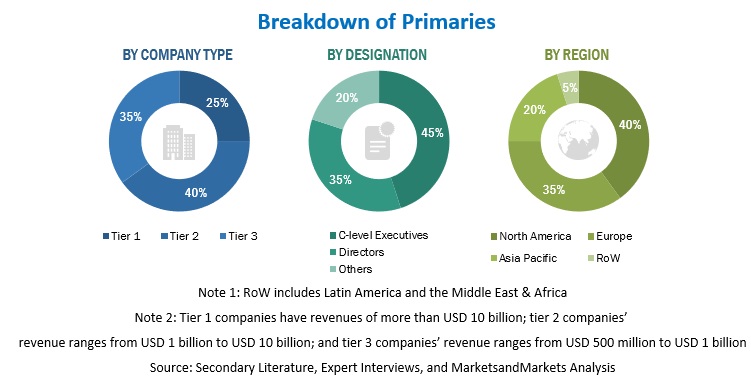
To know about the assumptions considered for the study, download the pdf brochure
Market Size Estimation
In the market engineering process, the top-down and bottom-up approaches were used along with multiple data triangulation methods to estimate and validate the size of the employee experience management market and other dependent submarkets. The research methodology used to estimate the market sizes includes the following:
- Initially, MarketsandMarkets focuses on top-line investments and spending in the ecosystems. Further, significant developments in the critical market area have been considered.
- Tracking the recent and upcoming developments in the employee experience management market that include investments, R&D activities, product launches, collaborations, mergers and acquisitions, and partnerships, as well as forecasting the market size based on these developments and other critical parameters.
- Conduct multiple discussions with key opinion leaders to know about diverse types of authentications and brand protection offerings used and the applications for which they are used to analyze the breakup of the scope of work carried out by major companies.
- Segmenting the market based on technology types concerning applications wherein the types are to be used and deriving the size of the global application market.
- Segmenting the overall market into various market segments
- Validating the estimates at every level through discussions with key opinion leaders, such as chief executives (CXOs), directors, and operation managers, and finally with the domain experts at MarketsandMarkets
Market Size Estimation Methodology-Bottom-up approach
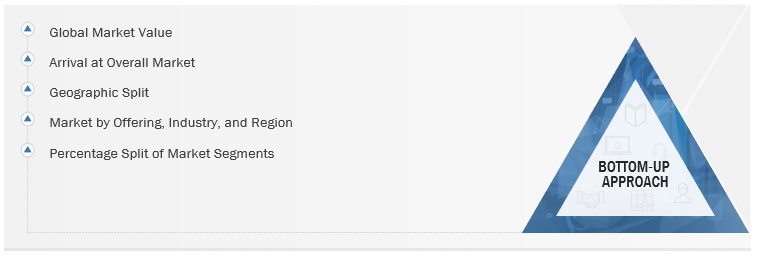
To know about the assumptions considered for the study, Request for Free Sample Report
Market Size Estimation Methodology-top-down approach
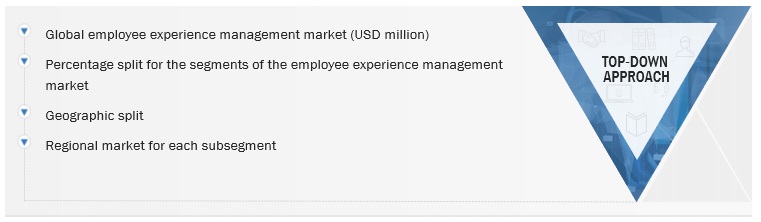
Data Triangulation
After arriving at the overall market size from the estimation process explained above, the employee experience management market has been split into several segments and sub-segments. To complete the overall market engineering process and arrive at the exact statistics for all segments and sub-segments, data triangulation and market breakdown procedures have been used, wherever applicable. The data has been triangulated by studying various factors and trends from both the demand and supply sides.
The employee experience management market size has been validated using top-down and bottom-up approaches.
Market Definition
Employee experience management (EXM) is a comprehensive solution that combines technology, tools, and services to enhance employee engagement, productivity, and retention, which can significantly impact an organization's profitability and efficiency. EXM involves shaping every employee interaction with a company, from the hiring process to onboarding and exit strategies. Both IT and HR departments play a critical role in implementing strategies that support optimal employee performance. Technology is a crucial enabler of a positive EXM strategy, and by selecting the right tools and integrating them seamlessly, organizations can create a data-driven, personalized, and continually evolving employee experience that fosters productivity, loyalty, and a thriving company culture.
Stakeholders
- Employee experience management software and service providers
- Value-added resellers (VARs)
- Research organizations
- Consulting firms
- Application service providers
- Cloud platform providers
- Investors and venture capitalists
- System integrators (SIs)
- Technology providers
- Suppliers, distributors, and contractors
- End users/Enterprise users
Report Objectives
- To determine and forecast the global employee experience management market by offering (software and services), industry, and region from 2023 to 2028, and analyze the various macroeconomic and microeconomic factors that affect the market growth.
- To forecast the size of the market segments concerning five central regions: North America, Europe, Asia Pacific (APAC), Latin America, and the Middle East & Africa (MEA).
- To provide detailed information about the major factors (drivers, restraints, opportunities, and challenges) influencing the growth of the market.
- To analyze each submarket with respect to individual growth trends, prospects, and contributions to the overall market.
- To analyze the opportunities in the market for stakeholders by identifying the high-growth segments of the market.
- To profile the key market players; provide a comparative analysis based on business overviews, regional presence, product offerings, business strategies, and key financials; and illustrate the market’s competitive landscape.
- Track and analyze competitive developments in the market, such as mergers and acquisitions, product developments, partnerships and collaborations, and Research and Development (R&D) activities.
Available Customizations
With the given market data, MarketsandMarkets offers customizations per the company’s specific needs. The following customization options are available for the report:
Geographic Analysis
- Further break-up of the Asia Pacific market into countries contributing 75% to the regional market size
- Further break-up of the North American market into countries contributing 75% to the regional market size
- Further break-up of the Latin American market into countries contributing 75% to the regional market size
- Further break-up of the Middle East African market into countries contributing 75% to the regional market size
- Further break-up of the European market into countries contributing 75% to the regional market size
Company Information
- Detailed analysis and profiling of additional market players (up to 5)
Get the Full Employee Experience Management Market Report
Full forecast, segment splits, and company analysis for all Employee Experience Management Market.
- Canada Employee Experience Management Market
- UK Employee Experience Management Market
- Italy Employee Experience Management Market
- China Employee Experience Management Market
- India Employee Experience Management Market
- Brazil Employee Experience Management Market
- France Employee Experience Management Market
- Germany Employee Experience Management Market
- Rest Of Europe Employee Experience Management Market
- Spain Employee Experience Management Market
- Anz Employee Experience Management Market
- Japan Employee Experience Management Market
- Rest Of Asia Pacific Employee Experience Management Market
- Mexico Employee Experience Management Market
- Rest Of Latin America Employee Experience Management Market
- GCC Countries Employee Experience Management Market
- South Africa Employee Experience Management Market
- Rest Of GCC Countries Employee Experience Management Market
- Saudi Arabia Employee Experience Management Market
- UAE Employee Experience Management Market
Need a Tailored Report?
Customize this report to your needs
Get 10% FREE Customization
Customize This Report
