
Australia Endoscopic Submucosal Dissection/ESD Market (2025-2030)

The Australia Endoscopic Submucosal Dissection/ESD Market was valued at $4 Million in 2025 and projected to reach to $6.1 Million by 2030, representing a compound annual growth rate of 8.7%. Australia's Endoscopic Submucosal Dissection market is experiencing steady expansion driven by technological advancements and increasing clinical adoption across major metropolitan healthcare centers.


| Market Size in | USD 26.32 MN |
| Market Forecast in | |
| CAGR | |
| Forecast Period | |
| Units Considered | Value (USD MN) |
Australia Endoscopic Submucosal Dissection/ESD Market Trends and Insights
- This 8.7% compound annual growth rate reflects Australia's advancing healthcare infrastructure and increasing adoption of minimally invasive endoscopic procedures.
- Australia's healthcare system continues to invest in cutting-edge gastrointestinal diagnostic and therapeutic technologies, driving demand for ESD devices and training across major metropolitan and regional centers. The growth trajectory in Australia is underpinned by rising prevalence of early-stage gastrointestinal cancers, improved screening awareness, and reimbursement support from Australia's Medicare system.
- Australia's endoscopy specialists are increasingly adopting ESD techniques as a preferred alternative to surgical resection, particularly for Barrett's esophagus and early gastric lesions.
- Market expansion in Australia is also supported by growing partnerships between local hospitals and international ESD device manufacturers, enhancing product availability and clinical expertise throughout the country..
Key Market Statistics
- CAGR (2025-2030) 8.7% CAGR
- Market Size, 2025 ~USD 4 Million
- Forecast, 2030 ~USD 6.1 Million
- Country Australia
Australia Endoscopic Submucosal Dissection/ESD Market Overview
Market Valuation Growth :
Australia's ESD market is valued at USD 4.0 million in 2025, with projections reaching USD 6.1 million by 2030, representing a robust 8.7% CAGR that outpaces the global average of 8.4%.
Healthcare Infrastructure Investment :
Australia's advanced healthcare system is increasingly investing in minimally invasive endoscopic technologies, with major hospitals and private clinics adopting ESD procedures for gastrointestinal lesion management.
Procedural Adoption Trends :
Growing clinical acceptance of ESD over traditional surgical interventions in Australian medical centers is driving demand, particularly for early-stage gastric and colorectal cancer treatment.
Regulatory Support & Reimbursement :
Australia's Medicare system and private health insurers are expanding coverage for ESD procedures, improving patient access and encouraging healthcare providers to integrate these advanced techniques into their endoscopy departments.
Australia Endoscopic Submucosal Dissection/ESD Market Dynamics
- The 8.7% CAGR reflects strong demand from gastroenterologists and surgeons seeking tissue-preserving alternatives to conventional resection methods.
- Growing awareness among Australian patients and healthcare professionals about ESD's benefits in treating early gastrointestinal cancers is accelerating market penetration. Looking ahead to 2030, Australia's ESD market will benefit from continued healthcare infrastructure modernization, rising prevalence of gastrointestinal disorders, and improved reimbursement pathways through Medicare and private insurers.
- Training programs and specialist certifications in ESD techniques are expanding across Australian medical institutions, further supporting market growth and establishing ESD as a standard-of-care procedure in the country's endoscopy landscape..
Market Ecosystem
Related Ecosystem
Medical Devices
- Polymerase Chain Reaction (PCR)
- Magnetic Resonance Imaging (MRI)
- Disposable Autoinjectors
- Pulse Oximeters
- Blood Pressure Monitors
- Medtronic plc
- Abbott Laboratories
- Stryker Corporation
- Becton, Dickinson and Company
- JOHNSON & JOHNSON
Key Takeaways
- Australia's ESD market is valued at USD 4.0 million in 2025 and is projected to reach USD 6.1 million by 2030, representing an 8.7% CAGR.
- Australia's Medicare reimbursement policies and healthcare investment in minimally invasive procedures are primary growth catalysts for the ESD market.
- Australia's endoscopy centers are increasingly adopting ESD as a preferred treatment for early-stage gastrointestinal cancers and Barrett's esophagus.
- Strategic partnerships between Australian hospitals and international ESD manufacturers are expanding product access and clinical training capabilities across Australia.
Endoscopic Submucosal Dissection/ESD Market Report Scope
| Report Metric | Details |
|---|---|
| Base Year | 2025 |
| Fastest Growing Segment | KNIVES (Product) |
| Forecast Period | 2025–2030 |
| Growth Rate | CAGR of 8.4% from 2025 to 2030 |
| Largest Segment | GASTROSCOPES & COLONOSCOPES (Product) |
| Market Size Base Year (Billions) | ~USD 0.5 (2025) |
| Revenue Forecast (Billions) | ~USD 0.75 (2030) |
| Segments Covered | Product, Indication, End User |
Australia Endoscopic Submucosal Dissection/ESD Market Report Segmentation
3 segment dimensions are covered across the global market.
By Product
- Gastroscopes & Colonoscopes
- Grasp/Clips
- Graspers/Clips
- Injection Agents
- Knives
- Other Products
- Tissue Retractors
By Indication
- Colon Cancer
- Esophageal Cancer
- Stomach Cancer
By End User
- Ambulatory Surgical Centers
- Hospitals
- Other End Users
- Specialty Clinics
AUSTRALIA: ENDOSCOPIC SUBMUCOSAL DISSECTION MARKET, BY END USER, 2023–2030
| Segment | 2023 | 2024 | 2025 | 2026 | 2027 | 2028 | 2029 | 2030 | CAGR (%) |
|---|---|---|---|---|---|---|---|---|---|
| AMBULATORY SURGICAL CENTERS | 1.32 | 1.41 | 1.55 | 1.67 | 1.82 | 1.97 | 2.14 | 2.32 | 8.4 |
| HOSPITALS | 4.29 | 4.59 | 5.06 | 5.47 | 5.98 | 6.53 | 7.1 | 7.75 | 8.9 |
| OTHER END USERS | 0.21 | 0.22 | 0.24 | 0.25 | 0.27 | 0.29 | 0.31 | 0.34 | 7.1 |
| SPECIALTY CLINICS | 1.56 | 1.66 | 1.81 | 1.95 | 2.11 | 2.29 | 2.47 | 2.68 | 8.1 |
| TOTAL | 7.38 | 7.88 | 8.66 | 9.34 | 10.18 | 11.08 | 12.03 | 13.08 | 8.6 |
Target Audience
- Medical Device Manufacturers : ESD equipment and instrument manufacturers need Australia-specific market data to develop localized product strategies, establish distribution partnerships, and optimize market entry timing in this growing healthcare segment.
- Healthcare Investors & Private Equity : Investment firms evaluating opportunities in Australian healthcare technology require detailed market sizing, growth projections, and competitive dynamics to assess ROI potential and identify acquisition targets.
- Hospital & Clinic Administrators : Healthcare facility leaders need market intelligence on ESD adoption trends, reimbursement models, and procedural demand forecasts to justify capital investments in endoscopy department upgrades and staff training.
- Gastroenterology & Surgery Specialists : Clinical practitioners require market insights on ESD procedure adoption rates, training availability, and peer adoption patterns across Australian institutions to inform practice development and skill acquisition decisions.
- Healthcare Consultants & Analysts : Consulting firms and research organizations need comprehensive Australia-focused ESD market data to support client advisory work, competitive benchmarking, and strategic planning in the Australian healthcare sector.
Key Companies in the Australia Endoscopic Submucosal Dissection/ESD Market
| Company | HQ | Ownership | Strongest segments |
|---|---|---|---|
| OLYMPUS CORPORATION | Japan | Public Company | Gastrointestinal Solutions,Urology,Respiratory, |
| MEDTRONIC | Ireland | Public Company | Cardiovascular Portfolio,Neuroscience Portfolio,Medical Surgical Portfolio (incl. Diabetes), |
| FUJIFILM HOLDINGS CORPORATION | Japan | Public Company | Healthcare (medical systems, CDMO, pharma, regenerative medicine, cosmetics/supplements),Electronics (display/touch, semiconductor and image sensor materials, storage/archiving, industrial equipment, fine chemicals),Business Innovation (office equipment, document solutions, graphic communications, inkjet heads), |
| BOSTON SCIENTIFIC CORPORATION | United States | Public Company | Cardiovascular (structural heart, CRM, peripheral interventions, oncology),MedSurg – Endoscopy (GI, pancreaticobiliary, infection prevention, single-use scopes),MedSurg – Urology and Pelvic Health, |
| SUMITOMO BAKELITE CO., LTD. | Japan | Public Company | Semiconductor encapsulation and substrate materials,Phenolic molding compounds and industrial resins,Copper-clad laminates (phenolic and epoxy), |
| CREO MEDICAL GROUP PLC | United Kingdom | Public Company | CROMA platform and capital equipment,Speedboat Inject and multimodal endoscopic instruments,MicroBlate Fine and MicroBlate Flex ablation devices, |
| HOYA CORPORATION | Japan | Public Company | Eyeglasses and ophthalmic lenses,Contact lenses and Eyecity retail,Intraocular lenses and surgical ophthalmology, |
| CONMED CORPORATION | United States | Public Company | Orthopedic & Sports Medicine (BioBrace, Y-Knot, TruShot, Hall power tools),General Surgery (AirSeal insufflation, Buffalo Filter smoke, endomechanical),Endoscopic Technologies (GI therapeutic and diagnostic), |
| STERIS | Ireland | Public Company | Healthcare sterilization and washer-disinfectors,Endoscope reprocessing systems and consumables,Operating room equipment and integration, |
OLYMPUS CORPORATION
Olympus Corporation is a Japanese public company founded in 1919 with 28,138 employees. The company operates as a diversified manufacturer with significant operations in medical devices and imaging technology.
MEDTRONIC
Medtronic is a public company headquartered in Ireland, founded in 1949, with approximately 95,000 employees. It is a global leader in medical technology, services, and solutions.
FUJIFILM HOLDINGS CORPORATION
Fujifilm Holdings Corporation is a Japanese public company established in 1934 with 73,526 employees. The company operates across imaging, information, and document solutions, as well as healthcare and materials sectors.
BOSTON SCIENTIFIC CORPORATION
Boston Scientific Corporation is a United States-based public company founded in 1979 with 59,000 employees. It specializes in the development and manufacture of medical devices and technologies.
SUMITOMO BAKELITE CO., LTD.
Sumitomo Bakelite Co., Ltd. is a Japanese public company founded in 1932 with 7,524 employees. The company manufactures advanced materials and components for various industrial applications.
CREO MEDICAL GROUP PLC
Creo Medical Group PLC is a United Kingdom-based public company founded in 2003 with 104 employees. The company develops and commercializes medical devices and technologies.
HOYA CORPORATION
Hoya Corporation is a Japanese public company established in 1941 with 37,752 employees. The company manufactures optical products, medical devices, and precision equipment.
CONMED CORPORATION
CONMED Corporation is a United States-based public company founded in 1970 with 3,900 employees. The company designs, manufactures, and sells medical devices and equipment for surgical and patient monitoring applications.
STERIS
STERIS is a public company headquartered in Ireland, founded in 1985. The company provides sterilization and contamination control products and services for healthcare and industrial markets.
Reasons to Buy this Report
- Market-Specific Sizing & Forecasts : Access precise valuation data for Australia's ESD market with detailed 2025-2030 projections, enabling accurate financial planning and investment decisions tailored to the Australian healthcare landscape.
- Competitive Landscape Intelligence : Understand key players, market share distribution, and competitive strategies specific to Australia's ESD sector, helping identify partnership and expansion opportunities in this growing market.
- Regulatory & Reimbursement Insights : Gain comprehensive analysis of Medicare coverage policies, private insurer reimbursement trends, and regulatory pathways unique to Australia, critical for market entry and pricing strategies.
- Clinical Adoption & End-User Trends : Discover adoption rates among Australian gastroenterologists, surgeons, and hospitals, including barriers to adoption and key drivers influencing procedure uptake across different healthcare settings.
- Growth Opportunity Identification : Identify high-potential segments, emerging applications, and geographic hotspots within Australia where ESD demand is accelerating, supporting targeted business development and resource allocation.
Frequently asked questions
What is the current market size of ESD in Australia?
Australia's ESD market was valued at USD 4.0 million in 2025 and is expected to grow to USD 6.1 million by 2030.
What is the projected growth rate for Australia's ESD market?
Australia's ESD market is projected to grow at a compound annual growth rate (CAGR) of 8.7% from 2025 to 2030.
What factors are driving ESD adoption in Australia?
Key drivers include rising early-stage gastrointestinal cancer prevalence, improved screening awareness, Medicare reimbursement support, and increasing specialist adoption of minimally invasive techniques in Australia.
Which conditions are most commonly treated with ESD in Australia?
In Australia, ESD is primarily used to treat early-stage gastric cancers, Barrett's esophagus, and other early gastrointestinal lesions as an alternative to surgical resection.
How is Australia's healthcare system supporting ESD market growth?
Australia's healthcare system supports ESD growth through Medicare reimbursement policies, investment in advanced endoscopy infrastructure, and partnerships between hospitals and international device manufacturers.
RESEARCH METHODOLOGY
The study focused on estimating the current size of the endoscopic submucosal dissection (ESD) market. We conducted thorough secondary research to gather information about the market. The next step involved validating our findings, assumptions, and estimates through primary research by consulting industry experts throughout the value chain. We used various approaches, including top-down and bottom-up methods, to calculate the total market size. Subsequently, we applied market breakdown and data triangulation techniques to estimate the sizes of different segments and subsegments within the ESD market.
Secondary Research
This research study heavily utilized secondary sources, including directories and databases such as Dun & Bradstreet, Bloomberg Businessweek, Factiva, whitepapers, and company documents. The purpose of the secondary research was to identify and gather information for a comprehensive, technical, market-oriented, and commercial analysis of the endoscopic submucosal dissection (ESD) market. It also aimed to collect vital information about leading industry players, market classification, and segmentation according to industry trends, down to the most granular levels, as well as geographic markets and key developments related to the market. Additionally, a database of key industry leaders was created based on the findings from the secondary research.
Primary Research
During the primary research process, a variety of supply-side and demand-side sources were interviewed to gather both qualitative and quantitative information for this report. On the supply side, primary sources included industry experts such as CEOs, vice presidents, marketing and sales directors, technology and innovation directors, engineers, and other key executives from various companies and organizations operating in the ESD market. On the demand side, primary sources encompassed hospitals, clinics, researchers, lab technicians, purchasing managers, and stakeholders from corporate and government bodies.
Breakdown of Primary Interviews
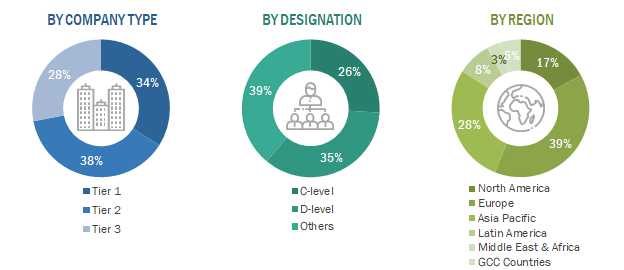
Note 1: C-level executives include CEOs, COOs, and CTOs.
Note 2: Others include sales, marketing, and product managers.
Note 3: Companies are classified into tiers based on their total revenue. As of 2024: Tier 1 = >USD 1 billion, Tier 2 = USD 500 million to USD 1 billion, and Tier 3 = < USD 500 million.
To know about the assumptions considered for the study, download the pdf brochure
Market Size Estimation
Both top-down and bottom-up approaches were used to estimate and validate the total size of the ESD market. These methods were also used extensively to estimate the size of various subsegments in the market. The research methodology used to estimate the market size includes the following:
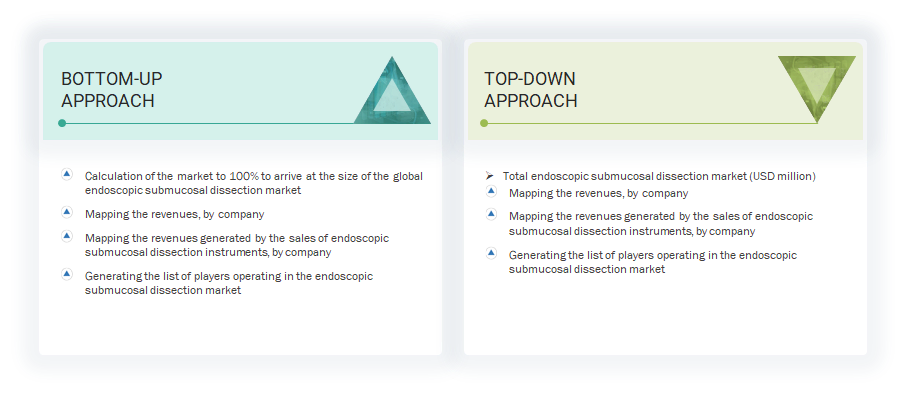
Data Triangulation
The entire market was split into three segments when the market size was determined. Data triangulation and market breakdown processes were used where necessary to complete the entire market engineering process and arrive at precise statistics for all segments.
Approach to derive the market size and estimate market growth.
Using secondary data from paid and unpaid sources, the market rankings for the major players were determined following a thorough analysis of their sales of ESD. Due to data restrictions, the revenue share in certain cases was determined after a thorough analysis of the product portfolio of big corporations and their individual sales performance. This information was verified at each stage by in-depth interviews with professionals in the field.
Market Definition
Endoscopic submucosal dissection (ESD) is an advanced therapeutic endoscopy technique for superficial gastrointestinal neoplasms. In endoscopic submucosal dissection, the equipment includes different types of knives, forceps, snares, and a few other products that support the procedure, as well as accessories used to ease the handling of instruments during surgeries.
Stakeholders
- Manufacturers of endoscopes and related devices
- Suppliers and distributors of endoscopy devices
- Hospitals, diagnostic centers, and medical colleges
- Independent surgeons and private offices of physicians
- Ambulatory surgery centers (ASCs)
- Teaching hospitals and academic medical centers
- Government bodies/municipal corporations
- Business research and consulting service providers
- Venture capitalists
- US Food and Drug Administration (US FDA)
- European Union (EU)
Report Objectives
- To define, describe, and forecast the endoscopic submucosal dissection market by product, indication, end user, and region
- To provide detailed information regarding the major factors influencing the market growth (drivers, restraints, opportunities, and challenges)
- To analyze the micromarkets with respect to individual growth trends, prospects, and contributions to the overall endoscopic submucosal dissection market
- To analyze market opportunities for stakeholders and provide details of the competitive landscape for key players
- To forecast the size of the endoscopic submucosal dissection market in six regions: North America (US and Canada), Europe (Germany, the UK, France, Spain, Italy, and the Rest of Europe), the Asia Pacific (Japan, China, India, Australia, South Korea, and the Rest of Asia Pacific), Latin America (Brazil, Mexico, and the Rest of Latin America), the Middle East & Africa, and the GCC Countries
- To strategically profile the key players in the global market and comprehensively analyze their core competencies
- To track and analyze competitive developments, such as product launches, expansions, agreements, and acquisitions, of the leading players in the market
Get the Full Endoscopic Submucosal Dissection/ESD Market Report
Full forecast, segment splits, and company analysis for all Endoscopic Submucosal Dissection/ESD Market.
- Japan Endoscopic Submucosal Dissection/ESD Market
- China Endoscopic Submucosal Dissection/ESD Market
- India Endoscopic Submucosal Dissection/ESD Market
- South Korea Endoscopic Submucosal Dissection/ESD Market
- Canada Endoscopic Submucosal Dissection/ESD Market
- Germany Endoscopic Submucosal Dissection/ESD Market
- France Endoscopic Submucosal Dissection/ESD Market
- UK Endoscopic Submucosal Dissection/ESD Market
- Italy Endoscopic Submucosal Dissection/ESD Market
- Spain Endoscopic Submucosal Dissection/ESD Market
- Brazil Endoscopic Submucosal Dissection/ESD Market
- Mexico Endoscopic Submucosal Dissection/ESD Market
- US Endoscopic Submucosal Dissection/ESD Market
- GCC Countries Endoscopic Submucosal Dissection/ESD Market
- Rest Of Europe Endoscopic Submucosal Dissection/ESD Market
- Rest Of Asia Pacific Endoscopic Submucosal Dissection/ESD Market
- Rest Of Latin America Endoscopic Submucosal Dissection/ESD Market
Need a Tailored Report?
Customize this report to your needs
Get 10% FREE Customization
Customize This Report
