
Asia Pacific Energy Management Systems Market (2024-2029)

The Asia Pacific Energy Management Systems Market was valued at $10360 Million in 2024 and projected to reach to $20740 Million by 2029, representing a compound annual growth rate of 14.9%. The Asia Pacific Energy Management Systems market is poised for exceptional growth through 2029, driven by accelerating industrialization, rapid urbanization, and escalating energy costs across the region.


| Market Size in | USD 26.32 MN |
| Market Forecast in | |
| CAGR | |
| Forecast Period | |
| Units Considered | Value (USD MN) |
Asia Pacific Energy Management Systems Market Trends and Insights
- Asia Pacific's rapid industrialization, urbanization, and increasing energy consumption are driving demand for advanced energy management solutions across the region.
- The market in Asia Pacific is expanding faster than the global average, reflecting strong regulatory support for energy efficiency and sustainability initiatives in countries like China, India, Japan, and South Korea. Asia Pacific's energy management systems adoption is accelerated by rising electricity costs, grid modernization efforts, and corporate sustainability commitments.
- In 2024, Asia Pacific accounts for a significant share of global energy management investments, with enterprises and utilities increasingly deploying IoT-enabled monitoring and control systems.
- By 2029, Asia Pacific is expected to solidify its position as a critical growth engine, driven by smart grid deployments, renewable energy integration, and government mandates for carbon reduction across the region..
Key Market Statistics
- CAGR (2024-2029) 14.9% CAGR
- Market Size, 2024 ~USD 10360 Million
- Forecast, 2029 ~USD 20740 Million
- Geography Asia Pacific
Asia Pacific Energy Management Systems Market Overview
Fastest Growing Regional Market :
Asia Pacific's Energy Management Systems market is expanding at 14.9% CAGR, outpacing the global average of 13.8%, driven by rapid industrialization and urbanization across the region.
Significant Market Expansion :
The market is projected to nearly double from $10,360 million in 2024 to $20,740 million by 2029, reflecting strong adoption of advanced energy management solutions across Asia Pacific economies.
China and Japan Lead the Region :
China ($6,580M) and Japan ($5,530M) are the dominant markets in Asia Pacific, collectively representing over half the regional market value and driving innovation in energy efficiency technologies.
Rising Energy Consumption Demand :
Increasing energy consumption from manufacturing, commercial, and residential sectors across Asia Pacific is creating substantial demand for intelligent energy management systems and optimization solutions.
Asia Pacific Energy Management Systems Market Dynamics
- Countries like China, Japan, and India are investing heavily in smart grid infrastructure and digital energy solutions to optimize consumption and reduce operational expenses.
- Government initiatives promoting energy efficiency and sustainability are further catalyzing market expansion. The region's growing manufacturing base, expanding commercial real estate, and increasing adoption of IoT and AI-powered energy management platforms are creating substantial opportunities.
- Rising electricity prices and environmental regulations are compelling enterprises to implement advanced energy management systems.
- Asia Pacific's market trajectory suggests it will remain the fastest-growing region globally, with emerging economies contributing significantly to the projected doubling of market value by 2029..
Market Ecosystem
Related Ecosystem
Decarbonization
- Battery Electric Vehicle (BEV)
- Energy Management Systems
- Fuel Cell
- Fuel Cell Electric Vehicle (FCEV)
- Geographical Information System (GIS)
- TotalEnergies SE
- Siemens ag
- Mitsui & Co., Ltd.
- General Electric Company
- Thyssenkrupp ag
Power Infrastructure
- Geographical Information System (GIS)
- Cogeneration
- Battery Electric Vehicle (BEV)
- Cellular Network
- Fuel Cell
- ABB India Limited
- Siemens ag
- SCHNEIDER ELECTRIC SE
- General Electric Company
- Eaton Corporation plc
Smart Energy And Digital Solutions
- Cellular Network
- Analytics Software
- Geographical Information System (GIS)
- Meter Data Management (MDM)
- Smart Meters
- Siemens ag
- SCHNEIDER ELECTRIC SE
- ABB India Limited
- General Electric Company
- Eaton Corporation plc
Key Takeaways
- Asia Pacific's Energy Management Systems Market is projected to double from $10.36B in 2024 to $20.74B by 2029, representing a 14.9% CAGR.
- Asia Pacific is outpacing global growth rates, driven by rapid industrialization, urbanization, and strong regulatory frameworks for energy efficiency.
- Smart grid modernization and renewable energy integration are key growth catalysts in Asia Pacific's energy management systems adoption.
- Asia Pacific enterprises are increasingly investing in IoT-enabled monitoring and control systems to reduce operational costs and meet sustainability targets.
Energy Management Systems Market Report Scope
| Report Metric | Details |
|---|---|
| Base Year | 2024 |
| Fastest Growing Segment | CLOUD (Deployment) |
| Forecast Period | 2024-2029 |
| Growth Rate | CAGR of 13.8% from 2024 to 2029 |
| Largest Segment | INDUSTRIAL ENERGY MANAGEMENT SYSTEMS (Type) |
| Market Size Base Year (Billions) | ~USD 44.19 (2024) |
| Revenue Forecast (Billions) | ~USD 84.34 (2029) |
| Segments Covered | Component, Deployment, End-Use Industry, Type |
Asia Pacific Energy Management Systems Market Report Segmentation
4 segment dimensions are covered across the global market.
By Component
- Hardware
- Services
- Software
By Deployment
- Cloud
- On-Premises
By End-Use Industry
- Food & Beverage
- Manufacturing
- Other End-Use Industries
- Power & Energy
- Residential & Commercial
- Telecom & It
By Type
- Building Energy Management Systems
- Home Energy Management Systems
- Industrial Energy Management Systems
Target Audience
- Energy Management Solution Providers : Vendors and technology companies need Asia Pacific market data to identify expansion opportunities, understand regional demand patterns, and develop localized energy management solutions for diverse markets.
- Industrial and Manufacturing Enterprises : Large manufacturers across Asia Pacific require market insights to benchmark energy efficiency investments, identify best-in-class solutions, and optimize operational costs through advanced energy management systems.
- Utility Companies and Grid Operators : Regional utilities need comprehensive market analysis to understand smart grid adoption trends, emerging technologies, and customer demand for energy management services across Asia Pacific.
- Investment and Private Equity Firms : Investors targeting Asia Pacific's energy sector require detailed market forecasts, growth drivers, and competitive landscape data to identify acquisition targets and investment opportunities in energy management.
- Government and Policy Makers : Regional governments and regulatory bodies need market intelligence to develop energy efficiency policies, incentive programs, and infrastructure investments aligned with Asia Pacific's energy management growth trajectory.
Countries within Asia Pacific - compare and drill down
| Country | 2025 size (native) |
|---|---|
| China | USD 6580 Million |
| India | USD 1800 Million |
| Japan | USD 5530 Million |
| Rest Of Asia Pacific | USD 6840 Million |
Country market size visualization
Reasons to Buy this Report
- Regional Market Dominance Insights : Gain detailed understanding of Asia Pacific's 14.9% CAGR growth trajectory and how it outperforms global markets, enabling strategic positioning in the fastest-growing energy management region.
- Country-Level Market Intelligence : Access granular data on China, Japan, and India's energy management markets, identifying high-potential segments and investment opportunities within Asia Pacific's diverse economies.
- Competitive Landscape Analysis : Understand regional competitive dynamics, key players, and market consolidation trends specific to Asia Pacific's energy management sector for informed business strategy development.
- Growth Driver Identification : Discover region-specific growth catalysts including industrialization patterns, urbanization trends, and regulatory frameworks driving energy management adoption across Asia Pacific markets.
- Forecast-Driven Decision Making : Leverage 2024-2029 projections showing market expansion from $10.36B to $20.74B to make data-backed investment and expansion decisions in Asia Pacific's energy management sector.
Frequently asked questions
What is the current market size of Energy Management Systems in Asia Pacific?
The Asia Pacific Energy Management Systems Market was valued at $10,360 million in 2024 and is expected to grow to $20,740 million by 2029.
What is the CAGR for Asia Pacific's Energy Management Systems Market?
Asia Pacific's Energy Management Systems Market is growing at a CAGR of 14.9% from 2024 to 2029, outpacing the global average.
Which countries are driving growth in Asia Pacific's energy management systems market?
China, India, Japan, and South Korea are leading growth drivers in Asia Pacific, supported by industrialization, smart grid initiatives, and renewable energy investments.
What are the main drivers of energy management systems adoption in Asia Pacific?
Key drivers include rising electricity costs, grid modernization efforts, corporate sustainability commitments, IoT technology adoption, and government carbon reduction mandates across Asia Pacific.
How is Asia Pacific's market growth compared to global trends?
Asia Pacific's 14.9% CAGR exceeds the global CAGR of 13.8%, positioning the region as a critical growth engine for the global Energy Management Systems Market.
RESEARCH METHODOLOGY
This study encompassed significant efforts in determining the present size of the energy management systems market. It commenced with a thorough secondary research process to gather data related to the market, similar markets, and the overarching industry. Subsequently, these findings, assumptions, and market size calculations were rigorously validated by consulting industry experts across the entire supply chain through primary research. The total market size was assessed by conducting an analysis specific to each country. Following that, the market was further dissected, and the data was cross-referenced to estimate the size of various segments and sub-segments within the market.
Secondary Research
In this research study, a wide range of secondary sources were utilized, including directories, databases, and reputable references such as Hoover's, Bloomberg BusinessWeek, Factiva, World Bank, International Monetary Fund (IMF), the US Department of Energy (DOE), and the International Energy Agency (IEA). These sources played a crucial role in gathering valuable data for a comprehensive analysis of the global energy management system market, covering technical, market-oriented, and commercial aspects. Additional secondary sources included annual reports, press releases, investor presentations, whitepapers, authoritative publications, articles authored by well-respected experts, information from industry associations, trade directories, and various database resources.
Primary Research
The EMS market involves a range of stakeholders, including IT service providers, support infrastructure equipment providers, component providers, software providers, system integrators, network service providers, financial organizations, and energy efficiency consultants within the supply chain. To gather qualitative and quantitative insights, various primary sources from both the supply and demand sides of the market were interviewed. The following breakdown presents the primary respondents involved in the research study.
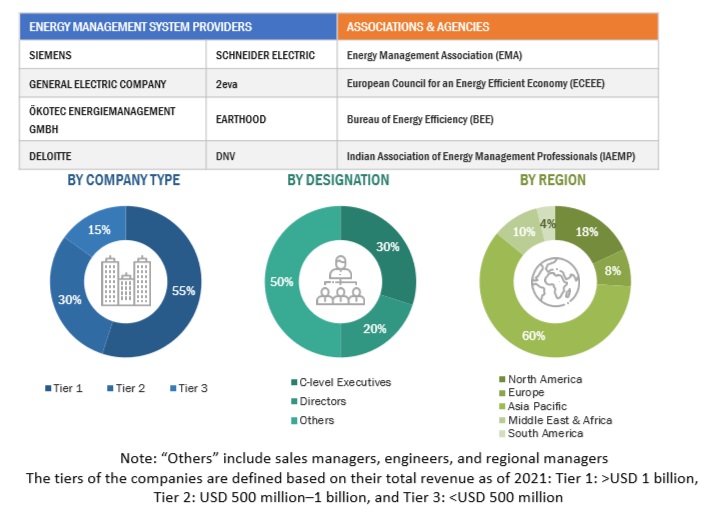
To know about the assumptions considered for the study, download the pdf brochure
Market Size Estimation
The estimation and validation of the global energy management systems market size have been conducted using a bottom-up approach. This approach was rigorously employed to ascertain the dimensions of multiple subsegments within the market. The research process comprises the following key stages.
- In this method, the statistics for each offering of energy management systems have been examined at both the country and regional levels.
- Thorough secondary and primary research has been conducted to gain a comprehensive understanding of the global market landscape for various segments of market.
- When calculating and forecasting the market size, qualitative factors such as market drivers, limitations, opportunities, and challenges have been taken into account.
Global Energy Management Systems Market Size: Bottom-Up Approach
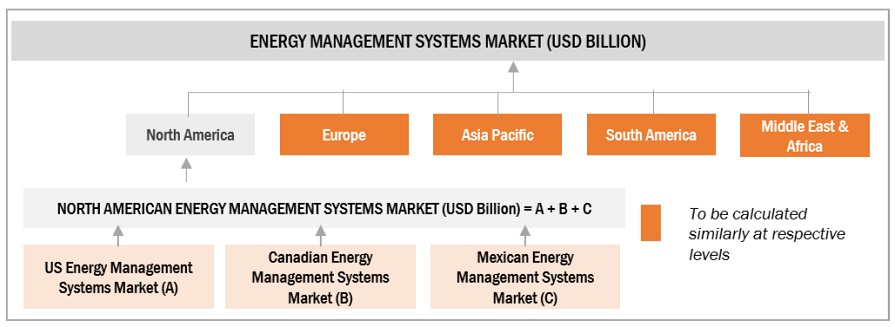
To know about the assumptions considered for the study, Request for Free Sample Report
Data Triangulation
The process of determining the overall market size involved the methodologies described earlier, followed by segmenting the market into multiple segments and subsegments. To finalize the comprehensive market analysis and obtain precise statistics for each market segment and subsegment, data triangulation and market segmentation techniques were applied, as appropriate. Data triangulation was accomplished by examining various factors and trends from both the demand and supply perspectives within the ecosystem of the EMS market.
Market Definition
Energy Management Systems (EMS) refer to a set of integrated technologies and solutions designed to monitor, control, and optimize the production, consumption, and distribution of energy in various environments, including residential, commercial, industrial, and utility sectors. EMS encompasses a combination of hardware, software, and services that enable organizations and individuals to manage energy use efficiently, reduce energy costs, improve energy performance, and contribute to environmental sustainability.
Key Stakeholders
- EMS vendors
- Energy service providers (private/government)
- Utility platform and analytics vendors
- System design and development vendors
- System integrators/migration service providers
- Consultants/consultancies/advisory firms
- Environmental research institutes
- Private or investor-owned utilities
- Government & research organizations
- State and national regulatory authorities
- Investors/Shareholders
- Investment banks
Objectives of the Study
- To define, describe, segment, and forecast the energy management systems market, by value, based on component, type, deployment, and end-use industry.
- To forecast the market size, by value, for five key regions: North America, South America, Europe, Asia Pacific, and the Middle East & Africa, along with their key countries
- To provide detailed information about the key factors, such as drivers, restraints, opportunities, and challenges influencing the growth of the market
- To strategically analyze the subsegments concerning individual growth trends, prospects, and contributions of each segment to the overall market size
- To analyze market opportunities for stakeholders and details of the competitive landscape for market leaders
- To strategically profile the key players and comprehensively analyze their market shares and core competencies.
- To track and analyze competitive developments, such as product launches, mergers, acquisitions, expansions, and supply contracts in the market.
Available Customization
With the given market data, MarketsandMarkets offers customizations based on the company’s specific needs. The following customization options are available for the report:
PRODUCT ANALYSIS
- Product Matrix, which provides a detailed comparison of the product portfolio of each company
COMPANY INFORMATION
- Detailed analyses and profiling of additional market players (up to 5)
Get the Full Energy Management Systems Market Report
Full forecast, segment splits, and company analysis for all Energy Management Systems Market.
- US Energy Management Systems Market
- Canada Energy Management Systems Market
- Mexico Energy Management Systems Market
- Germany Energy Management Systems Market
- UK Energy Management Systems Market
- France Energy Management Systems Market
- Italy Energy Management Systems Market
- China Energy Management Systems Market
- India Energy Management Systems Market
- Japan Energy Management Systems Market
- Brazil Energy Management Systems Market
- Argentina Energy Management Systems Market
- Saudi Arabia Energy Management Systems Market
- UAE Energy Management Systems Market
- South Africa Energy Management Systems Market
- Rest Of Europe Energy Management Systems Market
- Rest Of Asia Pacific Energy Management Systems Market
- GCC Countries Energy Management Systems Market
- Rest Of South America Energy Management Systems Market
- Rest Of GCC Energy Management Systems Market
Need a Tailored Report?
Customize this report to your needs
Get 10% FREE Customization
Customize This Report
