
China Energy Management Systems Market (2024-2029)

The China Energy Management Systems Market was valued at $3520 Million in 2024 and projected to reach to $6580 Million by 2029, representing a compound annual growth rate of 13.3%. China's Energy Management Systems market is poised for accelerated growth through 2029, driven by government mandates for carbon reduction and industrial energy efficiency improvements.


| Market Size in | USD 26.32 MN |
| Market Forecast in | |
| CAGR | |
| Forecast Period | |
| Units Considered | Value (USD MN) |
China Energy Management Systems Market Trends and Insights
- This expansion reflects China's commitment to industrial efficiency, renewable energy integration, and digital transformation across its manufacturing and utility sectors.
- China's aggressive push toward carbon neutrality and smart grid modernization is driving widespread adoption of advanced energy management solutions among enterprises and grid operators. The market in China is characterized by rapid technological advancement and substantial government support through policy initiatives and infrastructure investments.
- China's focus on IoT-enabled systems, artificial intelligence, and real-time energy monitoring is reshaping how organizations optimize consumption and reduce operational costs.
- Between 2024 and 2029, China is expected to capture significant market share within the Asia Pacific region, driven by its large industrial base, urbanization trends, and regulatory mandates for energy efficiency compliance. China's competitive landscape features both established multinational players and emerging domestic technology providers competing to deliver integrated solutions.
- The country's emphasis on digital infrastructure and smart manufacturing positions China as a critical growth engine for the global Energy Management Systems market..
Key Market Statistics
- CAGR (2024-2029) 13.3% CAGR
- Market Size, 2024 ~USD 3520 Million
- Forecast, 2029 ~USD 6580 Million
- Country China
China Energy Management Systems Market Overview
Carbon Neutrality Mandate :
China's dual carbon goals (peak emissions by 2030, neutrality by 2060) are driving massive investments in energy management systems across industrial and utility sectors to optimize consumption and reduce carbon footprint.
Smart Grid Modernization :
China is rapidly deploying advanced metering infrastructure and IoT-enabled grid systems, with state-owned utilities investing heavily in digital transformation to enhance grid efficiency and renewable energy integration.
Manufacturing Sector Adoption :
Chinese manufacturers are increasingly adopting EMS solutions to comply with energy efficiency standards and reduce operational costs, particularly in heavy industries like steel, cement, and chemicals.
Renewable Energy Integration :
With China leading global renewable capacity installations, EMS solutions are critical for managing variable solar and wind generation, balancing grid stability, and optimizing distributed energy resources.
China Energy Management Systems Market Dynamics
- The market's 13.3% CAGR reflects strong demand from utilities modernizing grid infrastructure and manufacturers seeking compliance with stringent energy regulations.
- State support through subsidies and favorable policies for smart grid projects will continue to fuel adoption.
- Additionally, the integration of AI and big data analytics into EMS platforms is enabling predictive energy optimization, attracting both domestic and international vendors to expand operations in China's competitive landscape..
Market Ecosystem
Related Ecosystem
Decarbonization
- Battery Electric Vehicle (BEV)
- Energy Management Systems
- Fuel Cell
- Fuel Cell Electric Vehicle (FCEV)
- Geographical Information System (GIS)
- TotalEnergies SE
- Siemens ag
- Mitsui & Co., Ltd.
- General Electric Company
- Thyssenkrupp ag
Power Infrastructure
- Geographical Information System (GIS)
- Cogeneration
- Battery Electric Vehicle (BEV)
- Cellular Network
- Fuel Cell
- ABB India Limited
- Siemens ag
- SCHNEIDER ELECTRIC SE
- General Electric Company
- Eaton Corporation plc
Smart Energy And Digital Solutions
- Cellular Network
- Analytics Software
- Geographical Information System (GIS)
- Meter Data Management (MDM)
- Smart Meters
- Siemens ag
- SCHNEIDER ELECTRIC SE
- ABB India Limited
- General Electric Company
- Eaton Corporation plc
Key Takeaways
- China's Energy Management Systems market will grow from $3,520M (2024) to $6,580M (2029), representing a 13.3% CAGR.
- China's carbon neutrality targets and smart grid modernization initiatives are primary catalysts for market expansion.
- China's industrial sector and utility operators are increasingly adopting AI-powered and IoT-enabled energy management solutions.
- China's domestic technology providers are competing alongside multinational firms, creating a dynamic and innovation-driven market.
Energy Management Systems Market Report Scope
| Report Metric | Details |
|---|---|
| Base Year | 2024 |
| Fastest Growing Segment | CLOUD (Deployment) |
| Forecast Period | 2024-2029 |
| Growth Rate | CAGR of 13.8% from 2024 to 2029 |
| Largest Segment | INDUSTRIAL ENERGY MANAGEMENT SYSTEMS (Type) |
| Market Size Base Year (Billions) | ~USD 44.19 (2024) |
| Revenue Forecast (Billions) | ~USD 84.34 (2029) |
| Segments Covered | Component, Deployment, End-Use Industry, Type |
China Energy Management Systems Market Report Segmentation
4 segment dimensions are covered across the global market.
By Component
- Hardware
- Services
- Software
By Deployment
- Cloud
- On-Premises
By End-Use Industry
- Food & Beverage
- Manufacturing
- Other End-Use Industries
- Power & Energy
- Residential & Commercial
- Telecom & It
By Type
- Building Energy Management Systems
- Home Energy Management Systems
- Industrial Energy Management Systems
Target Audience
- EMS Solution Vendors : Software and hardware providers need detailed market intelligence on China's regulatory environment, customer preferences, and competitive dynamics to develop localized offerings and capture market share.
- Utility Companies & Grid Operators : State Grid Corporation and regional utilities require insights on emerging EMS technologies and best practices to modernize infrastructure, integrate renewables, and achieve efficiency targets.
- Industrial Manufacturers : Heavy industry operators in steel, chemicals, and cement sectors need market data to evaluate EMS investments for compliance, cost reduction, and competitive advantage in energy-intensive operations.
- Investment & Private Equity Firms : Investors evaluating opportunities in China's energy tech sector need comprehensive market analysis, growth forecasts, and risk assessments to guide capital allocation decisions.
- Government & Policy Makers : Energy regulators and policy officials require market insights to design effective incentive programs, set realistic efficiency targets, and monitor progress toward carbon neutrality objectives.
Reasons to Buy this Report
- Regulatory Compliance Insights : Understand China's evolving energy efficiency standards and carbon reduction policies to ensure your EMS solutions meet local regulatory requirements and qualify for government incentives.
- Competitive Landscape Analysis : Identify key domestic and international players in China's EMS market, their market share, technology differentiation, and strategic partnerships to inform competitive positioning.
- Sector-Specific Opportunities : Gain detailed insights into adoption rates across manufacturing, utilities, commercial buildings, and data centers to prioritize market entry and tailor solutions for high-growth segments.
- Technology Trend Forecasting : Access analysis of emerging technologies like AI-driven optimization, edge computing, and blockchain integration in China's EMS ecosystem to guide R&D and product development strategies.
- Investment Decision Support : Leverage market sizing, growth projections, and profitability analysis to make informed decisions on market entry, expansion, partnerships, or M&A activities in China's energy management sector.
Frequently asked questions
What is the current size of China's Energy Management Systems market?
China's Energy Management Systems market was valued at $3,520 million in 2024 and is projected to reach $6,580 million by 2029.
What is the expected growth rate for China's Energy Management Systems market?
China's Energy Management Systems market is expected to grow at a compound annual growth rate (CAGR) of 13.3% from 2024 to 2029.
What are the main drivers of growth in China's Energy Management Systems market?
Key drivers include China's carbon neutrality commitments, smart grid modernization, industrial efficiency mandates, renewable energy integration, and digital transformation initiatives across manufacturing and utility sectors.
Which sectors are driving demand for Energy Management Systems in China?
China's industrial manufacturing, utility companies, commercial enterprises, and government-backed infrastructure projects are the primary demand drivers for energy management solutions.
Who are the major competitors in China's Energy Management Systems market?
China's market includes both multinational technology providers and domestic Chinese companies offering integrated energy management, IoT, and AI-powered solutions tailored to local regulatory and operational requirements.
RESEARCH METHODOLOGY
This study encompassed significant efforts in determining the present size of the energy management systems market. It commenced with a thorough secondary research process to gather data related to the market, similar markets, and the overarching industry. Subsequently, these findings, assumptions, and market size calculations were rigorously validated by consulting industry experts across the entire supply chain through primary research. The total market size was assessed by conducting an analysis specific to each country. Following that, the market was further dissected, and the data was cross-referenced to estimate the size of various segments and sub-segments within the market.
Secondary Research
In this research study, a wide range of secondary sources were utilized, including directories, databases, and reputable references such as Hoover's, Bloomberg BusinessWeek, Factiva, World Bank, International Monetary Fund (IMF), the US Department of Energy (DOE), and the International Energy Agency (IEA). These sources played a crucial role in gathering valuable data for a comprehensive analysis of the global energy management system market, covering technical, market-oriented, and commercial aspects. Additional secondary sources included annual reports, press releases, investor presentations, whitepapers, authoritative publications, articles authored by well-respected experts, information from industry associations, trade directories, and various database resources.
Primary Research
The EMS market involves a range of stakeholders, including IT service providers, support infrastructure equipment providers, component providers, software providers, system integrators, network service providers, financial organizations, and energy efficiency consultants within the supply chain. To gather qualitative and quantitative insights, various primary sources from both the supply and demand sides of the market were interviewed. The following breakdown presents the primary respondents involved in the research study.
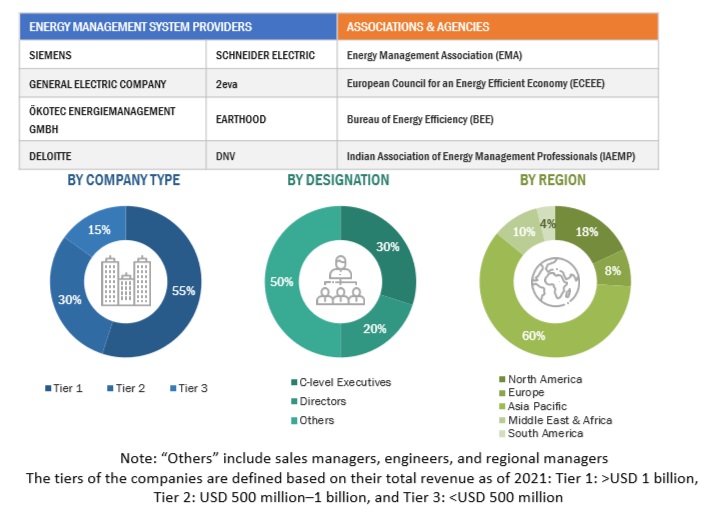
To know about the assumptions considered for the study, download the pdf brochure
Market Size Estimation
The estimation and validation of the global energy management systems market size have been conducted using a bottom-up approach. This approach was rigorously employed to ascertain the dimensions of multiple subsegments within the market. The research process comprises the following key stages.
- In this method, the statistics for each offering of energy management systems have been examined at both the country and regional levels.
- Thorough secondary and primary research has been conducted to gain a comprehensive understanding of the global market landscape for various segments of market.
- When calculating and forecasting the market size, qualitative factors such as market drivers, limitations, opportunities, and challenges have been taken into account.
Global Energy Management Systems Market Size: Bottom-Up Approach
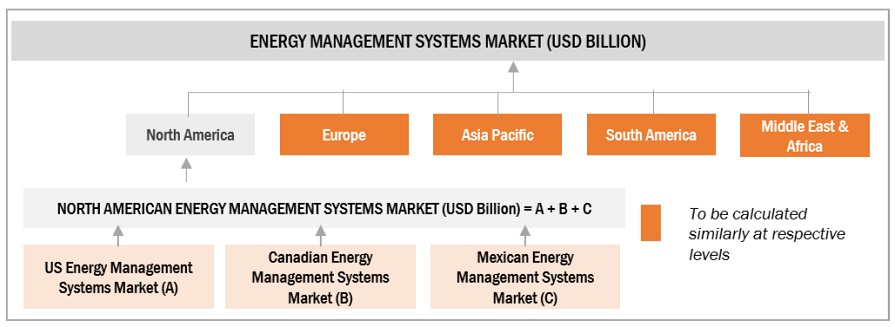
To know about the assumptions considered for the study, Request for Free Sample Report
Data Triangulation
The process of determining the overall market size involved the methodologies described earlier, followed by segmenting the market into multiple segments and subsegments. To finalize the comprehensive market analysis and obtain precise statistics for each market segment and subsegment, data triangulation and market segmentation techniques were applied, as appropriate. Data triangulation was accomplished by examining various factors and trends from both the demand and supply perspectives within the ecosystem of the EMS market.
Market Definition
Energy Management Systems (EMS) refer to a set of integrated technologies and solutions designed to monitor, control, and optimize the production, consumption, and distribution of energy in various environments, including residential, commercial, industrial, and utility sectors. EMS encompasses a combination of hardware, software, and services that enable organizations and individuals to manage energy use efficiently, reduce energy costs, improve energy performance, and contribute to environmental sustainability.
Key Stakeholders
- EMS vendors
- Energy service providers (private/government)
- Utility platform and analytics vendors
- System design and development vendors
- System integrators/migration service providers
- Consultants/consultancies/advisory firms
- Environmental research institutes
- Private or investor-owned utilities
- Government & research organizations
- State and national regulatory authorities
- Investors/Shareholders
- Investment banks
Objectives of the Study
- To define, describe, segment, and forecast the energy management systems market, by value, based on component, type, deployment, and end-use industry.
- To forecast the market size, by value, for five key regions: North America, South America, Europe, Asia Pacific, and the Middle East & Africa, along with their key countries
- To provide detailed information about the key factors, such as drivers, restraints, opportunities, and challenges influencing the growth of the market
- To strategically analyze the subsegments concerning individual growth trends, prospects, and contributions of each segment to the overall market size
- To analyze market opportunities for stakeholders and details of the competitive landscape for market leaders
- To strategically profile the key players and comprehensively analyze their market shares and core competencies.
- To track and analyze competitive developments, such as product launches, mergers, acquisitions, expansions, and supply contracts in the market.
Available Customization
With the given market data, MarketsandMarkets offers customizations based on the company’s specific needs. The following customization options are available for the report:
PRODUCT ANALYSIS
- Product Matrix, which provides a detailed comparison of the product portfolio of each company
COMPANY INFORMATION
- Detailed analyses and profiling of additional market players (up to 5)
Get the Full Energy Management Systems Market Report
Full forecast, segment splits, and company analysis for all Energy Management Systems Market.
- US Energy Management Systems Market
- Canada Energy Management Systems Market
- Mexico Energy Management Systems Market
- Germany Energy Management Systems Market
- UK Energy Management Systems Market
- France Energy Management Systems Market
- Italy Energy Management Systems Market
- India Energy Management Systems Market
- Japan Energy Management Systems Market
- Brazil Energy Management Systems Market
- Argentina Energy Management Systems Market
- Saudi Arabia Energy Management Systems Market
- UAE Energy Management Systems Market
- South Africa Energy Management Systems Market
- Rest Of Europe Energy Management Systems Market
- Rest Of Asia Pacific Energy Management Systems Market
- GCC Countries Energy Management Systems Market
- Rest Of South America Energy Management Systems Market
- Rest Of GCC Energy Management Systems Market
Need a Tailored Report?
Customize this report to your needs
Get 10% FREE Customization
Customize This Report
