
Latin America Enterprise Networking Market (2025-2030)

The Latin America Enterprise Networking Market was valued at $5793.6 Million in 2025 and projected to reach to $8525.9 Million by 2030, representing a compound annual growth rate of 8.0%. Latin America's enterprise networking market is positioned for sustained growth as organizations across financial services, manufacturing, and telecommunications sectors prioritize digital transformation initiatives.


| Market Size in | USD 26.32 MN |
| Market Forecast in | |
| CAGR | |
| Forecast Period | |
| Units Considered | Value (USD MN) |
Latin America Enterprise Networking Market Trends and Insights
- This 8.0% compound annual growth rate reflects Latin America's increasing digital transformation initiatives across financial services, manufacturing, and telecommunications sectors.
- Latin America is witnessing accelerated adoption of cloud-based networking solutions and SD-WAN technologies as organizations modernize their IT infrastructure. The enterprise networking landscape in Latin America is being shaped by rising cybersecurity concerns and the need for scalable, flexible network architectures.
- Latin America's businesses are investing in advanced networking capabilities to support remote work, multi-cloud environments, and edge computing deployments.
- Between 2025 and 2030, Latin America is expected to see significant growth driven by regulatory compliance requirements, increased bandwidth demands, and the proliferation of IoT and AI-enabled applications across enterprises..
Key Market Statistics
- CAGR (2025-2030) 8.0% CAGR
- Market Size, 2025 ~USD 5793.6 Million
- Forecast, 2030 ~USD 8525.9 Million
- Geography Latin America
Latin America Enterprise Networking Market Overview
Strong Regional Growth Trajectory :
Latin America's enterprise networking market is expanding at 8.0% CAGR, reaching $5,793.6 million in 2025 and projected to hit $8,525.9 million by 2030, driven by digital transformation across key sectors.
Financial Services Leadership :
The financial services sector in Latin America is spearheading enterprise networking adoption, with banks and fintech companies investing heavily in secure, scalable network infrastructure to support digital banking and payment solutions.
Manufacturing & Telecom Expansion :
Manufacturing and telecommunications sectors are accelerating their networking investments, leveraging enterprise solutions to optimize operations, enhance connectivity, and support Industry 4.0 initiatives across the region.
Digital Transformation Momentum :
Latin America is witnessing accelerated adoption of cloud-based networking solutions and SD-WAN technologies as enterprises modernize legacy infrastructure and improve operational efficiency across distributed locations.
Latin America Enterprise Networking Market Dynamics
- The region's 8.0% CAGR reflects increasing investments in network modernization, cloud connectivity, and cybersecurity infrastructure to support business continuity and competitive advantage. Key growth drivers include rising demand for SD-WAN solutions, increased adoption of hybrid cloud architectures, and regulatory compliance requirements in financial services.
- As enterprises expand their digital footprint and embrace remote work models, the need for robust, scalable networking solutions continues to intensify, creating significant opportunities for vendors and service providers throughout Latin America..
Market Ecosystem
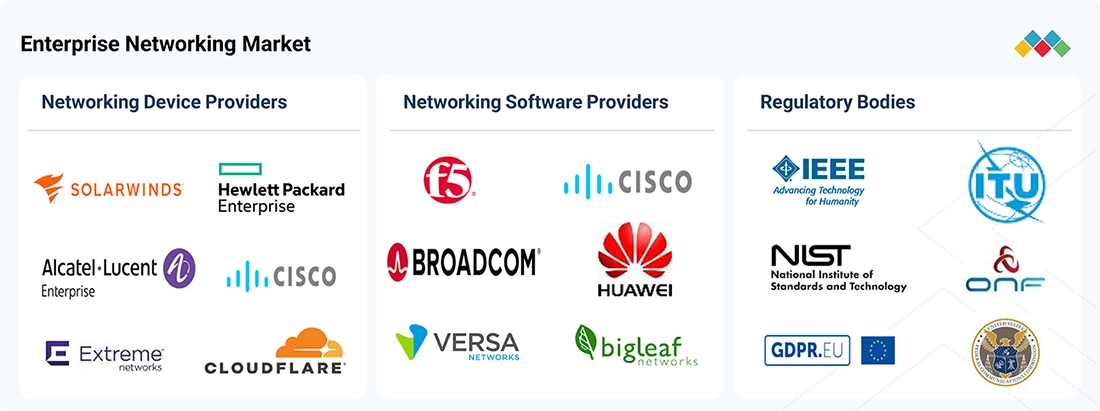
ENTERPRISE NETWORKING MARKET: COMMERCIAL USE CASES ACROSS INDUSTRIES
| COMPANY | USE CASE DESCRIPTION | BENEFITS |
|---|---|---|
 |
Cisco provides enterprise networking solutions through its Catalyst switching, wireless networking, Catalyst Center, SD-Access, SD-WAN, and Meraki cloud-managed networking portfolios. Organizations use these solutions to connect employees, branch offices, campuses, cloud applications, and IoT devices. Network automation, analytics, and integrated security help IT teams manage connectivity, monitor performance, and enforce consistent access policies across distributed enterprise environments. | Improved campus and branch connectivity | Centralized network management and automation | Enhanced network visibility and performance monitoring | Secure access for employees and IoT devices | Reliable connectivity across cloud and distributed locations |
 |
HPE delivers enterprise networking through HPE Aruba Networking, including access points, switches, gateways, Aruba Networking Central, and ClearPass. Organizations use these solutions to manage wired and wireless campus networks, branch connectivity, and SD-WAN environments. AI-powered network management, dynamic segmentation, and identity-based access controls help enterprises automate network operations, support IoT and BYOD devices, and apply consistent security policies across users and locations. | AI-driven network monitoring and troubleshooting | Simplified wired and wireless network operations | Improved network security through identity-based access controls | Better connectivity for IoT and BYOD devices | Scalable campus and branch infrastructure |
 |
Fortinet provides secure enterprise networking through FortiGate next-generation firewalls, FortiSwitch, FortiAP, FortiManager, and Secure SD-WAN. Enterprises use these solutions to connect branch offices, campuses, remote users, and multi-cloud environments while integrating network connectivity with security enforcement. Centralized management, application-aware traffic routing, AI-powered security services, and network segmentation help organizations protect network traffic, optimize application performance, and simplify distributed network operations. | Integrated networking and security management | Improved threat detection and protection | Optimized application performance and WAN connectivity | Consistent security policies across branches and cloud environments | Reduced network complexity and operating costs |
Logos and trademarks shown above are the property of their respective owners. Their use here is for informational and illustrative purposes only.
Related Ecosystem
Data Centre And Networking
- Software-Defined Networking (SDN)
- Mid-Sized Data Centers
- Small Data Centers
- Remote Monitoring
- Smart Healthcare
- Cisco Systems, Inc.
- HUAWEI TECHNOLOGIES CO LTD
- Hewlett Packard Enterprise Company
- MITSUBISHI ELECTRIC INFORMATION NETWORK CORPORATION
- MITSUBISHI ELECTRIC INFORMATION SYSTEMS CORPORATION
Key Takeaways
- Latin America's enterprise networking market will grow from $5,793.6M (2025) to $8,525.9M (2030) at an 8.0% CAGR.
- Latin America is rapidly adopting SD-WAN and cloud-native networking solutions to modernize enterprise infrastructure.
- Cybersecurity and regulatory compliance are primary drivers of networking investment across Latin America.
- Latin America's financial services and manufacturing sectors are leading enterprise networking adoption and spending.
Enterprise Networking Market Report Scope
| Report Metric | Details |
|---|---|
| Base Year | 2025 |
| Fastest Growing Segment | SMES (Organization Size) |
| Forecast Period | 2025-2030 |
| Growth Rate | CAGR of 8.6% from 2025 to 2030 |
| Largest Segment | SERVICE PROVIDERS (End User) |
| Market Size Base Year (Billions) | ~USD 125.95 (2025) |
| Revenue Forecast (Billions) | ~USD 190.27 (2030) |
| Segments Covered | Offering, Type, Speed, Network, Deployment Mode, Connection Type, End User, Service Provider, Enterprise, Networking Device, Switch Type, Fixed Switch Type, Switch Speed, Networking Software, Service, Professional Service, Organization Size, Vertical, Sdn Type, Application |
Latin America Enterprise Networking Market Report Segmentation
20 segment dimensions are covered across the global market.
By Offering
- Networking Devices
- Networking Software
- Sdn Infrastructure
- Services
- Software
- Solutions
By Type
- Access Points
- Appliances
- Consulting
- Deployment & Integration
- Firewalls
- Fixed Switches
- Gateways
- Implementation
- Managed Services
- Managed Switches
- Modular Switches
- Network Automation
- Network Management & Monitoring
- Network Security
- Network Virtualization
- Other Networking Devices
- Other Networking Software
- Power Over Ethernet (Poe) Switches
- Professional Services
- Routers
- Software
- Support & Maintenance
- Switches
- Training And Support
- Unmanaged Switches
By Speed
- 400 Gbps And Above
- > 40 Gbps To <=100 Gbps
- >1 Gbps To <=10 Gbps
- >10 Gbps To <=40 Gbps
- >100 Gbps To <=400 Gbps
By Network
- Branch Network
- Campus Network
- Campus Networks
- Data Center Network
- Remote Network
By Deployment Mode
- Cloud
- Do-It-Yourself (Diy)
- Managed Sd-Wan (Telco Or Msp)
- On-Premises
- Sd-Wan As A Service (Cloud-Based)
By Connection Type
- Wired
- Wireless
By End User
- Cloud Service Providers
- Enterprises
- Service Providers
- Telecommunication Service Providers
- Vertical
By Service Provider
- Cloud Service Providers
- Telecom Service Providers
By Enterprise
- Bfsi
- Education
- Government
- Healthcare & Life Sciences
- It & Ites
- Manufacturing
- Media & Entertainment
- Other Enterprises
- Retail & E-Commerce
- Transportation & Logistics
By Networking Device
- Access Points
- Firewalls
- Gateways
- Other Networking Devices
- Routers
- Switches
By Switch Type
- Fixed Switches
- Modular Switches
By Fixed Switch Type
- Managed Switches
- Power Over Ethernet (Poe) Switches
- Unmanaged Switches
By Switch Speed
- 400 Gbps And Above
- > 40 Gbps To <=100 Gbps
- >1 Gbps To <=10 Gbps
- >10 Gbps To <=40 Gbps
- >100 Gbps To <=400 Gbps
By Networking Software
- Network Automation
- Network Management And Monitoring
- Network Security
- Network Virtualization
- Other Networking Software
By Service
- Managed Services
- Professional Services
By Professional Service
- Consulting
- Deployment & Integration
- Support & Maintenance
By Organization Size
- Large Enterprises
- Smes
By Vertical
- Bfsi
- Education
- Energy And Utilities
- Government
- Government & Defense
- Healthcare
- Ites
- Manufacturing
- Other Verticals
- Retail
- Retail & E-Commerce
- Telecom
- Transportation And Logistics
By Sdn Type
- Hybrid Sdn
- Open Sdn
- Sdn Via Api
- Sdn Via Overlay
By Application
- Other Applications
- Sd-Lan
- Sd-Wan
- Security Applications
Target Audience
- Enterprise IT Decision Makers : CIOs and IT directors in Latin American enterprises need this data to evaluate networking infrastructure investments, benchmark against regional peers, and justify budget requests for digital transformation initiatives.
- Networking Solution Vendors : Equipment manufacturers and software providers require Latin America-specific market intelligence to identify growth opportunities, prioritize regional expansion, and develop localized go-to-market strategies.
- System Integrators & Resellers : Service providers and channel partners need detailed market insights to identify high-potential customer segments, forecast demand, and align service offerings with Latin American enterprise networking requirements.
- Investment & Strategy Consultants : Management consultants and investment firms use this market data to advise clients on M&A opportunities, market entry strategies, and competitive positioning within Latin America's networking sector.
- Telecommunications Operators : Telecom service providers in Latin America need market forecasts to plan network infrastructure investments, develop enterprise service portfolios, and capitalize on growing demand for managed networking solutions.
Countries within Latin America - compare and drill down
| Country | 2025 size (native) |
|---|---|
| Brazil | USD 3734.3 Million |
| Mexico | USD 2873.2 Million |
| Rest Of Latin America | USD 1918.3 Million |
Country market size visualization
Reasons to Buy this Report
- Regional Market Sizing & Forecasts : Obtain precise market valuations for Latin America's enterprise networking sector with country-level breakdowns for Brazil and Mexico, enabling accurate budget allocation and investment planning.
- Sector-Specific Growth Insights : Understand which Latin American industries—financial services, manufacturing, and telecommunications—are driving networking investments and identify emerging opportunities within each vertical.
- Competitive Landscape Analysis : Gain intelligence on vendor positioning, market share dynamics, and competitive strategies specific to Latin America to inform go-to-market and partnership decisions.
- Technology Adoption Trends : Track adoption rates of SD-WAN, cloud networking, and hybrid infrastructure solutions across Latin America to align product development and sales strategies with regional demand patterns.
- Strategic Growth Planning : Leverage 5-year forecasts and CAGR analysis to develop long-term expansion strategies, identify high-growth markets within Latin America, and optimize resource allocation for maximum ROI.
Frequently asked questions
What is the projected market size for enterprise networking in Latin America by 2030?
Latin America's enterprise networking market is projected to reach $8,525.9 million by 2030, growing from $5,793.6 million in 2025.
What is the CAGR for enterprise networking in Latin America?
Latin America's enterprise networking market is expected to grow at a compound annual growth rate of 8.0% between 2025 and 2030.
Which industries are driving enterprise networking growth in Latin America?
Latin America's financial services, telecommunications, manufacturing, and retail sectors are primary drivers of enterprise networking investment and adoption.
What networking technologies are gaining traction in Latin America?
Latin America is experiencing increased adoption of SD-WAN, cloud-based networking, edge computing, and AI-enabled network management solutions.
What are the main challenges for enterprise networking in Latin America?
Latin America faces challenges including cybersecurity threats, regulatory compliance complexity, infrastructure limitations in remote areas, and budget constraints among mid-market enterprises.
RESEARCH METHODOLOGY
The research study involved four major activities in estimating the enterprise networking market size. Exhaustive secondary research has been done to collect important information about the market and peer markets. The next step was to validate these findings and assumptions and size them with the help of primary research with industry experts across the value chain. Both top-down and bottom-up approaches have been used to estimate the market size. After which, data triangulation was adopted to estimate the market sizes of segments and sub-segments.
Secondary Research
The market size of companies offering enterprise networking devices, software, and services for various subscribers is arrived at based on the secondary data available through paid and unpaid sources and by analyzing the different offerings (devices, software, and services) of major companies in the ecosystem and rating them based on their performance and quality. In the secondary research process, various sources were referred to for identifying and collecting information for this study. The secondary sources included annual reports, press releases and investor presentations of companies, white papers, journals, and certified publications and articles from recognized authors, directories, and databases.
Secondary research was mainly used to obtain key information about the industry’s supply chain, the total pool of key players, market classification, and segmentation according to the industry trends to the bottommost level, regional markets, and key developments from both market- and technology-oriented perspectives, all of which were further validated by primary sources.
Primary Research
In the primary research process, various primary sources from both the supply and demand sides were interviewed to obtain qualitative and quantitative information for the report. The primary sources from the supply side include industry experts, such as chief executive officers (CEOs), vice presidents (VPs), marketing directors, technology and innovation directors, and related key executives from various key companies and organizations providing enterprise networking solutions. The primary sources from the demand side include end users, such as chief information officers (CIOs), consultants, service professionals, technicians and technologists, and managers at public and investor-owned utilities.
In the market engineering process, top-down and bottom-up approaches have been extensively used, along with several data triangulation methods, to perform market estimation and market forecasting for the overall market segments and subsegments listed in the report. Extensive qualitative and quantitative analyses have been performed on the complete market engineering process to list key information/insights throughout the report.
After the complete market engineering (including calculations for market statistics, market breakup, market size estimations, market forecasting, and data triangulation), extensive primary research has been conducted to gather information. Primary research has been conducted to identify the segmentation, industry trends, key players, competitive landscape, and key market dynamics, such as drivers, restraints, opportunities, challenges, industry trends, and key strategies.
Breakdown of Primaries
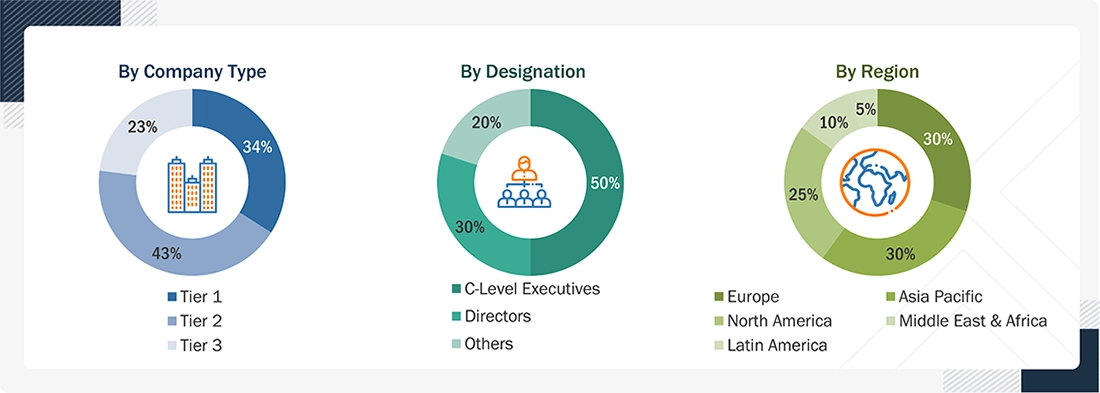
Note 1: Tier 1 companies have revenues of more than USD 10 billion; tier 2 companies’ revenue ranges from USD 1 billion to USD 10 billion; and tier 3 companies’ revenue ranges from USD 500 million to USD 1 billion.
Source: Secondary Literature, Expert Interviews, and MarketsandMarkets Analysis.
To know about the assumptions considered for the study, download the pdf brochure
Market Size Estimation
The total size of the enterprise imaging IT market was determined after data triangulation using the two approaches outlined below. After each approach was completed, the results were combined into a weighted average based on the level of assumptions used in each approach.
Enterprise Networking Market: Top-Down and Bottom-Up Approach
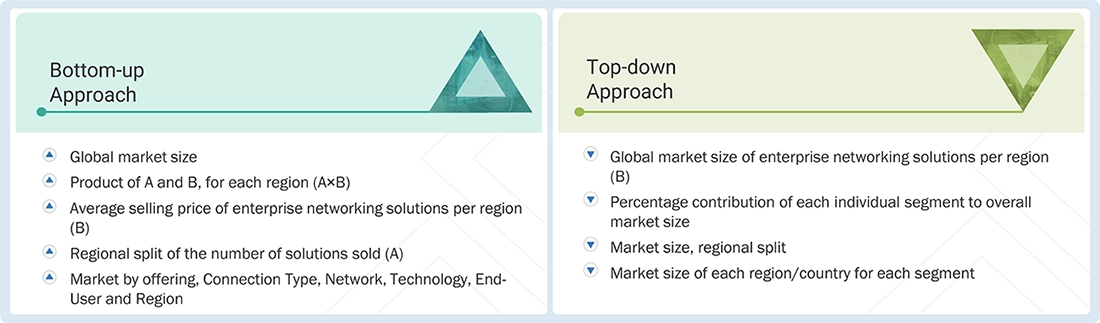
Data Triangulation
The size of the enterprise imaging IT market was estimated through segmental extrapolation using the bottom-up approach. The methodology is outlined below.
- Revenue of individual companies was gathered from public sources and databases.
- Shares of leading players in the enterprise imaging IT market were obtained from secondary sources to the extent available. In certain cases, shares of enterprise imaging IT businesses have been ascertained after a detailed analysis of various parameters, including product portfolios, market positioning, selling price, and geographic reach and strength.
- Individual share or revenue estimates were validated through interviews with experts.
- The total revenue in the enterprise imaging IT market was determined by extrapolating the market share data of major companies.
Market Definition
The enterprise imaging IT market comprises software and IT infrastructure solutions that enable seamless management, integration, and sharing of medical images across departments and care settings. It supports unified imaging workflows, enhances clinical collaboration, and improves diagnostic efficiency. This market serves hospitals, diagnostic centers, and integrated delivery networks, with the goal of optimizing image-driven decision-making.
Key Stakeholders
- Vendor neutral archive (VNA) & PACS vendors
- Government bodies
- Healthcare service providers
- Clinical/Physician centers
- Healthcare professionals
- Health IT service providers
- Healthcare associations/institutes
- Ambulatory care centers
- Venture capitalists
- Distributors and resellers
- Maintenance and support service providers
- Integration service providers
- Advocacy groups
- Data security and privacy experts
- Investors and financial institutions
- Industry associations and trade groups
Report Objectives
- To define, describe, and forecast the enterprise imaging IT market by function, modality, application, offering, deployment mode, therapeutic area, end user, and region.
- To provide detailed information regarding the major drivers, restraints, opportunities, and challenges influencing market growth
- To strategically analyze micromarkets1 with respect to individual growth trends, prospects, and contributions to the overall enterprise imaging IT solutions market
- To analyze market opportunities for stakeholders and provide details of the competitive landscape for key players.
- To forecast the size of the enterprise imaging IT solutions market in five main regions (and their respective countries): North America, Europe, Asia Pacific, the Middle East & Africa, and Latin America
- To provide key industry insights, such as supply chain, regulatory, patent, and the Impact of the 2025 US tariff.
- To profile the key players in the market and comprehensively analyze their core competencies2
- To analyze competitive developments, such as solution launches, enhancements, & upgrades, collaborations, partnerships, acquisitions, agreements, and expansions of the leading players in the market
- To benchmark players within the market using the company evaluation matrix, which analyzes market players on various parameters within the broad categories of business strategy, market share, and product offerings.
Available customizations:
With the given market data, MarketsandMarkets offers customizations as per your company’s specific needs. The following customization options are available for the report:
- Company information
- Detailed analysis and profiling of additional market players (up to 5)
Geographic Analysis
- Further breakdown of the Rest of Asia Pacific enterprise imaging IT market into Taiwan, New Zealand, Thailand, Singapore, Malaysia, and other countries
- Further breakdown of the Rest of Europe enterprise imaging IT market into Russia, Austria, Finland, Sweden, Turkey, Norway, Poland, Portugal, Romania, Denmark, and other countries
Get the Full Enterprise Networking Market Report
Full forecast, segment splits, and company analysis for all Enterprise Networking Market.
- US Enterprise Networking Market
- UK Enterprise Networking Market
- China Enterprise Networking Market
- Brazil Enterprise Networking Market
- France Enterprise Networking Market
- Germany Enterprise Networking Market
- Italy Enterprise Networking Market
- Nordics Enterprise Networking Market
- Rest Of Europe Enterprise Networking Market
- Spain Enterprise Networking Market
- India Enterprise Networking Market
- Japan Enterprise Networking Market
- Rest Of Asia Pacific Enterprise Networking Market
- South East Asia Enterprise Networking Market
- South Korea Enterprise Networking Market
- Mexico Enterprise Networking Market
- Rest Of Latin America Enterprise Networking Market
- Bahrain Enterprise Networking Market
- Ksa Enterprise Networking Market
- Kuwait Enterprise Networking Market
- Rest Of Middle East Enterprise Networking Market
- UAE Enterprise Networking Market
- Canada Enterprise Networking Market
Need a Tailored Report?
Customize this report to your needs
Get 10% FREE Customization
Customize This Report